Iran hardliner decries firefighter offer for 'weak, good-for-nothing' Los Angeles
A firefighter works to extinguish the Highland Fire, a wind driven wildfire near Aguanga, California.
A hardline Iranian lawmaker torched an Iranian government offer to help put out fires in Los Angeles, home to a sizeable Iranian diaspora population, as a waste of money.
“I am not okay with a single cent of my taxes being spent on the weak Los Angeles good-for-nothing people before it goes to Gaza,” Tehran representative Mehdi Koochakzadeh said.
His remarks were a rebuke to government spokesperson Fatemeh Mohajerani, who over the weekend offered to send firefighters to help combat blazes which have destroyed hundreds of homes and killed at least two dozen people.
“Humanity cannot remain indifferent to the destruction of homes and natural resources, whether caused by war or the wrath of nature,” she said, drawing a parallel with Gaza which lies decimates as Israel fights Iran-backed armed groups.
Koochakzadeh also took aim at two bills seeking to reduce Iran's bank blacklisting, saying they served Washington's goals.
He slammed slammed the efforts to accede to anti-money laundering conventions under the Financial Action Task Force (FATF) as tantamount to “approving servitude to America.”
The bills aim to ease banking restrictions imposed on Iran due to its placement on the FATF blacklist, which hinders the country's international banking operations.
Earlier this month, Iran's Minister of Economy announced that the Supreme Leader had authorized a review of the two key international conventions.
Abdolnaser Hemmati shared on X that relative moderate president Masoud Pezeshkian informed him of the Ali Khamenei's approval for revisiting the Palermo and Countering the Financing Of Terrorism (CFT) bills.
Koochakzadeh's comments sparked a stir within the parliamentary session, leading Speaker Mohammad Bagher Ghalibaf to intervene after Koochakzadeh’s microphone was cut off.
Ghalibaf reminded the assembly that parliament had already fulfilled its role by referring the bills to the Expediency Discernment Council, a body whose members are appointed by Khamenei to rule on disputes between the parliament and government.
“The council had a one-year period to address this issue, which has now lapsed. The government is pursuing permission for a renewed review,” Ghalibaf said.
The Expediency Discernment Council, became involved after another senior body the Guardian Council rejected the two FATF-related bills in 2017.
The FATF, a global financial watchdog created by the G7, plays a crucial role in shaping international banking policies.
Iran’s continued placement on the FATF blacklist has done serious harm to the country’s banking system, leaving it categorized as high-risk due to deficiencies in addressing money laundering, terrorism and proliferation financing.
For Iran to re-enter the international financial system, it must finalize its legislation on the Palermo and CFT conventions.
Despite efforts to join the FATF, experts such as Mohammad Khazaei, Secretary-General of the Iranian Committee of the International Chamber of Commerce, have said additional reforms will be necessary to attract foreign investment.
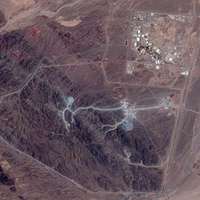
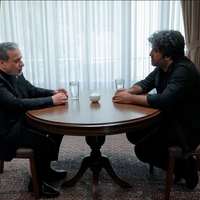
Negotiators from Iran and the European E3 countries of France, Britain and Germany convened a third round of talks on the Islamic Republic's nuclear program in Geneva on Monday, an Iranian deputy foreign minister said.
"We discussed ideas involving certain details in the sanctions-lifting and nuclear fields that are needed for a deal," Kazem Gharibabadi said in a post on X.
He described the talks as "serious, frank, and constructive", adding that the two sides agreed to continue their dialogue.
"Sides concurred that negotiations should be resumed and to reach a deal, all parties should create and maintain the appropriate atmosphere," he said.
Echoing Gharibabadi's characterization, Christian Turner, Political Director at the Foreign, Commonwealth & Development Office (FCDO), described the session in similar terms, without explicitly mentioning Tehran's nuclear program or sanctions relief.
"UK French & German Political Directors met again with our Iranian counterparts in Geneva today. Talks were serious, frank & constructive. Against a challenging context, we discussed concerns & reiterated our commitment to a diplomatic solution. We agreed to continue our dialogue," Turner's post on X read.
The German Foreign Office and France’s Director General of Political and Security Affairs at the Ministry for Europe and Foreign Affairs, Frédéric Mondoloni, also shared the same statement on their X accounts.
The talks follow meetings in November as tensions mounted following the UN nuclear watchdog's Board of Governors' resolution censuring of Iran and demanding Tehran resolve outstanding issues with the IAEA over its advancing nuclear program.
Iranian Foreign Minister Abbas Araghchi last month expressed Tehran's readiness for renewed talks with world powers aimed at breaking the long-standing deadlock over its disputed nuclear program.
The remarks were the among the clearest yet signaling that Iran, faced with a bevy of economic and military setbacks, sought to ease isolation due to intensify under a second presidency of Donald Trump through talks.
“The formula we have is the same as the previous JCPOA formula, which is building trust about Iran's nuclear program in exchange for the removal of sanctions. We are ready to negotiate on this basis," he said.
The Joint Comprehensive Plan of Action (JCPOA) is the agreement signed in July 2015 between Iran, the European Union and the five permanent members of the UN Security Council plus Germany, commonly known as the P5+1.
Trump withdrew the US from the deal in 2018 during his first term in office and reinstated sanctions on Tehran.
Iran, in turn, has accelerated uranium enrichment to levels exceeding those required for peaceful purposes, approaching the purity needed to develop a nuclear weapon.
President Masoud Pezeshkian welcoming former President Mohammad Khatami at the presidential office
In a cabinet meeting this week, President Masoud Pezeshkian voiced his opposition to restrictions placed on the public appearances of former President Mohammad Khatami, the unofficial leader of the Reform Front.
“The situation in the country was supposed to improve, we were not meant to witness such unjustified restrictions anymore,” Pezeshkian said during the Sunday evening meeting.
The comments follow a recent incident where Khatami was barredfrom attending a public event, as well as the indictment of prominent Reformist economist Mohsen Renani.
According to the moderate news outlet Asr-e Iran, Pezeshkian also directed Intelligence Minister Esmail Khatib and Justice Minister Amin-Hossein Rahimi to urgently address the issue and provide a report on measures to avoid similar incidents in the future.
Restrictions imposed on Khatami and Renani
During the inauguration of a charity cancer center in Tehran last Thursday, Fatemeh Hashemi, daughter of former President Akbar Hashemi Rafsanjani, revealed that Khatami had not been “granted permission” to attend the ceremony.
It remains unclear which security agency or authority ordered Khatami’s exclusion, but it is widely believed to have come from intelligence agencies.
Reformists and the media argued in the past few days that Pezeshkian should have challenged the higher powers responsible for the ban.
In the case of economist Renani, the state’s Revolutionary Court recently ordered the blocking of his personal website and Telegram channel due to articles he published several years ago and indicted him for some of his writings considered “propaganda against the system.”
President facing backlash over restrictions
Pezeshkian has faced significant criticism from Iranian media, politicians, and the public for the incident involving Khatami and Renani’s indictment.
Critics, many of whom believe Pezeshkian was not directly responsible for the restrictions, have pointed out the inconsistency between his calls for “unity” among political forces and the actions taken against prominent figures by other centers of power under his watch.
In an open letter released Sunday, prominent university professors called on Pezeshkian to uphold freedom of expression and basic rights, urging him to address the restrictions and accusations against Renani for his scholarly work.
Reform Front’s response
Javad Emam, spokesperson for the Reform Front, criticized the exclusion of reformist figures and their supporters from the government, despite calls for unity and national reconciliation.
The Reform Front officially backed Pezeshkian’s bid for the presidency, with Khatami separately endorsing Pezeshkian in a video message to Iranians.
“To achieve unity, one cannot ignore supporters and exclude them from events, political participation, and decision-making,” Emam told a local news website on Friday.
The spokesperson said that Pezeshkian chose 16 of the 19 ministers in his cabinet from among hardliners and ultra-hardliners, despite his promise to engage all political factions.
Pointing out that half of Iranians chose not to vote in the presidential elections, he added that the public's exclusion from the decision-making process is also a serious issue and the wishes of those who did not vote should not be ignored.
“People must decide for themselves and shape their destiny. No one must decide for the nation and then burden them with the consequences,” he said, adding, “Has any representative of that fifty percent [who abstained] been given the opportunity to voice their concerns? What steps have been taken so far to make them feel included and satisfied?”
Criticism from prominent reformist commentator
Outspoken Reformist commentator Sadegh Zibakalam also criticized Pezeshkian’s failure to deliver on his promises of unity in light of his concessions to hardliners and the recent events.
When asked by a reporter last week how much Pezeshkian had achieved in creating unity, Zibakalam sarcastically replied, “100 percent!”
When asked for examples, he listed what he thought Pezeshkian had not done: he had not visited the grave of Mahsa Jina Amini, whose death in the custody of the so-called morality police sparked the 2022-2023 “Woman, Life, Freedom” protests. He also said Pezeshkian failed to meet with prominent dissidents and political prisoners.
At last week's National Unity Conference in Tehran, where Pezeshkian also spoke, Zibakalam argued that the President could not reconcile the deep political and ideological differences with ultra-hardliners.
He pointed to the significant influence of former nuclear negotiator and hardliner Saeed Jalili, lawmaker Hamid Rasaei, and their supporters in Pezeshkian's administration, reinforcing his view that Pezeshkian is advocating a "sham" unity.
A pharmacist organizes medications on shelves in an Iranian pharmacy.
Iran’s pharmaceutical industry is grappling with sharp price increases born out of the weakness of Iran's currency, causing some drug costs to more than quadriple.
The increases are likely to gain pace as the government reduces foreign currency allocations for essential goods.
Newly released data from Zahravi Pharmaceutical Company illustrates the extent of the price surge.
The price of 20 milligrams of basic antibiotic Gentamicin rose from 460,000 rials to 2,366,700 rials—a 415% increase. Vitamin B12 prices climbiedby 156% from 526,000 rials to 1,355,980 rials.
Health Minister Mohammadreza Zafarghandi recently linked rising medication prices to currency fluctuations.
“Medication prices are influenced by exchange rate fluctuations and will undergo changes,” Zafarghandi said, while emphasizing the government’s commitment to supporting consumers.
“The government intends to pay the difference caused by exchange rate changes to insurance companies. This amount will be provided to them so that the price changes for medications are not paid out of people's pockets,” he added.
Despite these assurances, the impact on the healthcare system remains a growing concern. The rial has nearly a third of its value since September, making it increasingly expensive for pharmaceutical companies to import raw materials.
The 2025 budget outlined by President Masoud Pezeshkian’s administration includes a 20% reduction in foreign currency allocations for essential goods and a 35% increase in the subsidized exchange rate, further straining the sector.
Economic observers caution that government policies may place additional burdens on patients. The head of the Tehran Chamber of Commerce previously warned that securing foreign currency and local rials for production remains a challenge, particularly in sectors reliant on imports like pharmaceuticals.
Zahravi Pharmaceutical Company’s price hikes may be the first in a wave of similar adjustments across the industry, as other manufacturers are expected to follow suit. While government intervention aims to cushion the blow, the overall trajectory suggests an increasingly precarious healthcare system.
With further cuts in subsidies and rising exchange rates on the horizon, patients and providers alike face a difficult year ahead.
Iran summoned the French ambassador to Tehran on Monday, cautioning him over recent meetings with an exiled opposition organization which the government has proscribed a 'terrorist' group, the Iranian Foreign Ministry spokesman said.
"The ambassador was given a caution regarding hosting terrorism and supporting terrorist groups," spokesman Esmail Baghaei said during a regular briefing, referring to an event held by the Mujahedeen-e-Khalq (MEK).
The event, held in Paris on Saturday, was attended by Keith Kellogg, who is set to serve as President-elect Donald Trump’s special envoy for Ukraine.
It follows a meeting in Paris last Thursday when the group, known as the National Council of Resistance of Iran, the political arm of the Mojahedin-e Khalq group, hosted former US Secretary of State Mike Pompeo.
Pompeo had been part of the Trump administration which had levied crippling sanctions on Tehran for its nuclear program.
The MEK has long been a source of contention between Tehran and Western governments.
Iran views the group as a terrorist organization responsible for attacks within the country in the 1980s, while the MEK describes itself as an opposition movement seeking regime change in Iran. The group was a leftist-Islamist underground network during the monarchy, opposed to Western influence in Iran. After the revolution, which it supported, a rift developed between the newly established clerics and the MEK.
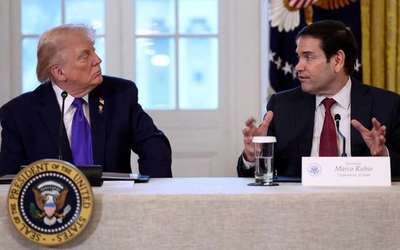
Iran will not beg the United States for nuclear negotiations, the country’s foreign ministry spokesman said on Monday as the incoming Trump administration promises a maximum pressure stance on Tehran.
"Regarding the United States, we will make decisions at the appropriate time based on actions and approaches," Esmail Baghaei said at a press conference in Tehran. "Naturally, negotiation is not something we would beg for."
The remarks come amid continued tensions between Tehran and Washington over issues including Iran’s nuclear program and ongoing military action across the region.
Last week, Iran's Supreme Leader Ali Khamenei rebuked proponents of renewed nuclear talks with the United States under President Donald Trump, warning of intractable American hostility.
Trump has said Iran cannot be allowed to develop a nuclear weapon. The country is already under significant sanctions imposed during his first administration.