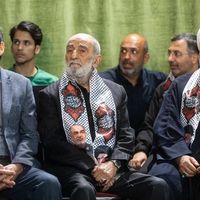
Former President Mohammad Khatami visited Masoud Pezeshkian at his home after his election win
Iran's Reformists are calling on President Masoud Pezeshkian to take action against other power centers that prevented Mohammad Khatami, their de facto leader, from attending a public event on Thursday.
On the eighth anniversary of former President Akbar Hashemi Rafsanjani's death, his family inaugurated a charity cancer center in Tehran. The facility, built in Hashemi Rafsanjani's memory, was launched during a high-profile ceremony attended by numerous political and public figures, including former President Hassan Rouhani. However, Mohammad Khatami's absence was conspicuous.
In her speech at the event, Hashemi-Rafsanjani's daughter, Fatemeh Hashemi, revealed that Khatami “was not given permission” to attend the ceremony. It remains unclear which security agency or authority made this decision. Reformists argue that while Pezeshkian may not bear direct responsibility, he should challenge the higher powers responsible for the ban.
Reformist politician Zahra Bahramnejad told the media that despite Pezeshkian’s efforts to involve a broader range of political forces loyal to the Islamic Republic in governance, certain power structures and influential elites continue to resist political unity.
In Iranian political discourse, terms like “highest officials of the system” often refer to Supreme Leader Ali Khamenei, who exerts significant influence over critical decisions in the country.
Many believe Khamenei approved Pezeshkian’s candidacy in the July elections to boost voter turnout amid expectations of low engagement. Pezeshkian has acknowledged that without Khamenei’s support, the Guardian Council would not have cleared him to run.
Reformists push for a greater role in governance
Reformists have called on Pezeshkian to address the obstruction of his efforts to foster national unity, a promise he has frequently emphasized as the only path to “saving Iran”.
Although Pezeshkian identifies himself as a Reformist, his so-called "Government of Unity" includes several figures from the rival hardline camp and only a handful of Reformists.
Banning Khatami from attending the ceremony coincided with a conference on “national unity” elsewhere in Tehran that Pezeshkian addressed on the same day.
This contradiction, Reformist politician Mohammad-Ali Abtahi argued in a social media post, highlights the challenges of achieving unity among the country’s top political factions.
Abtahi, who served as vice president under Khatami, emphasized the symbolic importance of Khatami’s continued exclusion from Iran's political sphere by hardliners.
“What can one say about unity when conditions are so restricted and doors so closed that the presence of the country’s most influential and popular political figure … at such a ceremony is not permitted?” Ebrahim Ansari-Lari, a former governor general during Khatami’s presidency asked in a note he sent to the media following the incident.
In his note, Ansari-Lari also criticized Pezeshkian for “saying the same things as usual” in his address to the conference and "leaving without ever mentioning the incident or showing a sign of discontent.”
Pezeshkian and Khatami’s relationship
Pezeshkian served as health minister during Khatami’s presidency (1997-2005) and has consistently expressed respect for the former president. Khatami played a significant role in supporting Pezeshkian during the election, with the Reformist Front rallying behind his candidacy.
After the elections, Khatami visited Pezeshkian at his home. In an extremely rare move, the state-run television which for nearly two decades had never shown Khatami’s image, unless in a negative light.
The state television’s brief report sparked hope among reformists that the severe restrictions imposed on Khatami might be removed, or at least somehow relaxed, under Pezeshkian's administration.
In a highly symbolic gesture, Pezeshkian reciprocated the visit, inviting Khatami to the presidential office for the first time in 19 years for a meeting. Iranian media reported that Pezeshkian and Khatami discussed the newly elected president’s cabinet makeup during the meeting that lasted over an hour and a half.
Restrictions on Khatami
Unlike presidential candidate Mir-Hossein Mousavi, his wife Zahra Rahnavard, who were placed under house arrest following the disputed 2009 elections which reinstated Mahmoud Ahmadinejad as president, Khatami faced severe restrictions without formal confinement, after the 2009 popular protests against the election results.
A vocal supporter of Mousavi’s candidacy, Khatami has been barred from attending public events and traveling since then, not only internationally, but also domestically.
In 2010, Iranian media reported that Khatami was prevented from leaving the country to attend a nuclear disarmament conference in Hiroshima, Japan. Former President Mahmoud Ahmadinejad denied involvement in the travel ban.
Domestic travel restrictions appeared to have been somehow relaxed in late October when after fifteen years, Khatami was allowed to travel to Yazd, the capital of his home province, and to speak to the members of the public in a few places he visited.
Firefighters hose down a hotspot at a commercial building that burned down during the Eaton Fire, in Altadena, California, US, January 10, 2025.
Iran's hardline media described the Los Angeles fire as an act of divine anger and a punishment for the United States' support of Israel in the Gaza conflict.
The Kayhan newspaper, funded by Supreme Leader Ali Khamenei, wrote on its front-page headline Saturday that by supporting Israel in Gaza, the US had "created apocalyptic scenes," and now "the cries of the oppressed children of Gaza and the Palestinian mothers have caught up with America, imposing a similar situation on the state of California and the city of Los Angeles."
The Jam-e Jam newspaper also ran a similar story on its front page with the headline "Fire-Angeles."
The newspaper referred to Donald Trump's comment that the Middle East would turn into hell if Israeli hostages were not freed before his inauguration and described the Los Angeles fire as "America's hell."
A representative of Iran's Supreme Leader Ali Khamenei also called the California fires "God's revenge against the leaders of America" over what he called their complicity in Israel's war in Gaza.
"A city the size of Gaza has burned, while all its inhabitants were American capitalists. This fire was God’s revenge against the American leaders," said Rasoul Falahati, a representative of Khamenei in Gilan province in northern Iran.
On Tuesday, US President-elect Donald Trump warned during a press conference at his Mar-a-Lago estate in Florida that "all hell will break out in the Middle East" if Hamas does not release the hostages by Inauguration Day, repeating the statement several times.
The Arabic-language Al-Alam Network, owned by the state media corporation Islamic Republic of Iran Broadcasting (IRIB), shared images showing the destruction caused by the Los Angeles fires and compared them to the devastation in Gaza.
Other Iranian media also used terms like "Los Angeles in hell" and "the infernal city," criticizing what they described as "very weak" crisis management in the US.
The Fars News Agency reported that "the infernal fire of Los Angeles is days away from being contained."
"Grim footage out of California is reminiscent of ravaged homes, schools, and hospitals in Gaza," Zarif wrote. "It's only human to sympathize with Californians who've lost everything to the wrath of nature—particularly as many there have stood with Gazans who lost everything to the savagery of Israel."
Meanwhile, government offices and schools across Iran were shut down on Saturday due to a natural gas shortage, extending the ongoing energy crisis that began at the start of winter with widespread gas and electricity shortages.
Since Tuesday, six simultaneous blazes have swept through Los Angeles County neighborhoods, claiming at least 11 lives and damaging or destroying 10,000 structures. The toll is expected to rise as firefighters conduct house-to-house searches.
The largest wildfire ravaging parts of Los Angeles this week changed direction on Saturday, prompting additional evacuation orders and presenting a fresh challenge to exhausted firefighters.
A female rally participant carrying the re-production of a rocket in Tehran.
An IRGC General has acknowledged that a highly publicized large-scale drill conducted by the paramilitary Basij forces on Friday in Tehran failed to attract significant participation, despite the provision of free food and gifts.
Hassan Hassanzadeh, the commander of Tehran’s Mohammad Rasoulollah IRGC base, told local media that the trend of declining participation has intensified since the fall of Iran’s ally, Bashar al-Assad, in Syria. In a rare admission, he acknowledged that many IRGC and Basij members did not respond to calls to join what was intended to be a 110,000-strong drill.
However, the actual participation figure remains uncertain, as Hassanzadeh also said that “According to preliminary figures I have received, at least 27,000 Afghan brothers and sisters residing in Iran have filled out the participation form for the drills.”
Hassanzadeh, referring to what he described as a trend of non-cooperation by IRGC and Basij members with IRGC programs, stated: "Unfortunately, many of our colleagues who have had the honor of serving in the Basij and the IRGC have either declined to participate for various reasons or have not yet given a definitive response. This is a trend that we have seen increase since the events in Syria."
The event appeared more like a parade through the streets of the capital than a military drill intended to prepare for the defense of Tehran. Many Iranians on social media suggested that the exercise was aimed more at intimidating residents and deterring anti-government protests than preparing for a potential foreign attack.
Cardboard cutouts showing Islamic Republic "martyrs" during a show of force by the IRGC in Tehran. January 10, 2025
The participants included anti-riot forces riding in groups of motorcyclists, a formation commonly used during protests. Typically, two men share each motorbike, with the passenger armed with clubs or chains to strike protesters.
The event also featured men carrying cardboard cutouts of “martyrs,” such as former Hezbollah leader Hassan Nasrallah, killed by Israel, and Ismail Haniyeh of Hamas, assassinated in Tehran last year. Heavily armed IRGC forces were present, carrying assault rifles and riding in pick-up trucks mounted with heavy machine guns. Some participants, dressed as early Islamic warriors, brandished oversized swords—all these displays seemingly intended to intimidate the public.
Afghans seen during the Tehran drills-parade on January 10, 2025
An official IRGC announcement highlighted the distribution of free food to all participants, along with a few hundred “wedding gift packages” for supporters preparing to get married. In Iran, free food handed out at such events is commonly referred to as “sandis,” a term often used humorously. Those who attend government-organized gatherings solely for the freebies are mockingly called “Sandiskhor,” or freeloaders.
Iran International analyst, Morad Veisi pointed out before the event that “The timing of the drill coincides with political shifts in the US, including the return of Donald Trump to the White House, and a weakening of Tehran’s regional position, which have raised concerns within the Islamic Republic’s ruling circles.”
Iranian President Masoud Pezeshkian will visit Moscow on January 17 to meet Russian President Vladimir Putin and sign a strategic cooperation agreement, the Iranian Embassy announced.
The statement followed a meeting on Friday between Kazem Jalali, Iran's Ambassador to Moscow, and Andrey Rudenko, Russia's Deputy Foreign Minister. Russia, confirming the meeting, said: "Current issues on the bilateral agenda were discussed, including upcoming high-level contacts," as quoted by Tass.
The initiative comes after both Iran and Russia lost their key Middle Eastern ally, Bashar al-Assad of Syria, last month, when Islamic insurgents swept down from the north and seized Damascus within days.
Discussing the specifics of the deal, Jalali told Iran's state-run Young Journalists Club (YJC), "The independence and security of our country, as well as self-reliance, are crucial elements, and we are not particularly inclined to align ourselves with any specific bloc."
"National independence is of great importance to the Islamic Republic of Iran. After all, we have been paying the price for it for 45 years," he added in an article published Saturday.
Last week, government spokesperson Fatemeh Mohajerani also told Sputnik that Iran expects to sign a comprehensive cooperation agreement with Russia on January 17, during President Masoud Pezeshkian's visit to Moscow.
Mohajerani told the media that the president's upcoming visit to Moscow is expected to advance two major initiatives: "The North-South Corridor, which is already underway, and the plan to transfer Russian gas to Iran—both of which have been key points of agreement between the two sides."
Tehran and Moscow first signed a long-term agreement in March 2001, officially titled the Treaty of the Foundation of Mutual Relations and the Principles of Cooperation between the Islamic Republic of Iran and the Russian Federation Act. Initially set for ten years, it was extended twice for five-year terms.
Despite similar announcements about a new agreement since 2020, a renewed treaty has yet to be finalized.
According to Iran’s ambassador to Russia, the two countries agreed in 2021 to extend the treaty for another five years, with its expiration now set for 2026.
In 2023, reports suggested potential challenges in developing a new agreement with Russia, although few details about its content have been made public.
Some commentators in Iran have criticized Russia for the fall of Iran's ally, Bashar al-Assad, noting that Moscow failed to provide sufficient support when insurgents advanced toward Damascus. Ataollah Mohajerani, a government-aligned analyst, wrote in Etemad daily on Saturday that Russia could similarly abandon the Islamic Republic if its interests demanded it.
The Islamic Republic also has a long-term agreement with China, though its details remain undisclosed. Throughout its 45-year standoff with the United States and the accompanying international isolation, Tehran has consistently sought to deepen its cooperation with Moscow and Beijing.
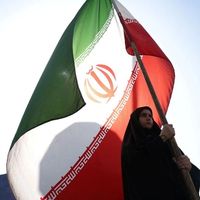
Members of Iranian militia forces (Basij) attend an anti-Israeli march in Tehran, Iran, January 10, 2025.
Individuals linked to a spy network associated with the intelligence service of a Persian Gulf country have been arrested, the Revolutionary Guards announced, without naming the country or providing details about the suspects.
"Through the continuous efforts of the anonymous soldiers of Imam Mahdi, members of a spy network tied to the intelligence service of a Persian Gulf country were apprehended on Friday," said a statement from the Public Relations Office of the Vali-e-Asr Corps in Khuzestan Province on Saturday.
The statement added that the arrested individuals had been gathering sensitive information from critical facilities in the province. They have been handed over to judicial authorities for further action.
The IRGC and Iran's Ministry of Intelligence have frequently announced the discovery and dismantling of alleged spy or terrorist cells. However, such claims are rarely accompanied by publicly available evidence, follow-up reports, or public trials, making independent verification impossible.
Brigadier General Yitzhak Segev, the last Israeli military attaché in Iran from 1977-1979 pictured with the Iranian Air Force Commander visiting Israel.
As US President Jimmy Carter was laid to rest this week, the specter of 1979 arose anew. For Yitzhak Segev, Israel's last military attaché in Iran before the Islamic Revolution, Carter shares blame for the ayatollahs' rise.
“He [Carter] did all he could to push the Shah out without thinking who would replace him,” General Brigadier Yitzhak Segev told Iran International. “Carter spoke against the Shah and criticized him.”
"I'm not saying the regime of the Shah was good or not corrupt. I am not saying Savak was good also, but every time you must think about how to continue or who will be the replacement," Segev added, referring to the late monarch Mohammed Reza Pahlavi's feared spy agency.
Segev served as military attaché in Iran from 1977 to 1979, escaping after Ayatollah Ruhollah Khomeini returned to Iran in February 1979 in a triumphant defeat of the Shah, who had announced he was going on "vacation".
Segev provided his eye-witness accounts, conversations and observations from the years leading to the revolution and its aftermath.
Brigadier General Yitzhak Segev official Iranian imperial document.
As an elite officer in the Israeli military, Segev had direct conversations with Carter and American, Iranian and Israeli government and military officials in the run-up to the Islamic revolution that transformed the monarchy into an Islamic theocracy.
While Segev said he respects Carter, praising him as a human rights trailblazer and statesman for his role in the Camp David Accords that brought peace between Egypt and Israel, he said the Democratic president let Iran down.
“His treatment of Iran was catastrophic.”
Carter’s role in Iran is a lightning rod of controversy. Many in the Iranian diaspora flocked to social media when learning of Carter’s death on Dec. 29 to again blame him for the rise of Khomeini.
Segev, who continued to have friendly relations with Carter after the 1979 revolution, said the late president believed the end of the Shah’s 37-year reign and 2500 years of monarchy in Iran would lead to democracy.
Carter’s championing of democracy and human rights drove that belief, in Segev’s view. The Americans, he said, naively thought Khomeini, an anti-communist, would protect American interests and felt the Shah had already lost control of the country and was doomed.
Brigadier General Yitzhak Segev touring Iran with officials.
General Robert Husyer was dispatched to Tehran as a US envoy in 1979 on a secret mission to meet with the Iranian army, according to Segev, in an account corroborated by declassified US documents and a Husyer's memoir.
“Instead of coming to the army and building confidence with the army or promoting a replacement from the army or civilian (leadership) that would keep relations with America and the West, he really pushed for democracy,” Segev told Eye for Iran.
It would later be revealed that many of these Iranian generals were planning their defection and some even joined the anti-Shah movement.
Husyer in his memoir said Carter’s administration had not ruled out US support for a coup. According to Husyer’s memoir and Segev’s recollections, Zbigniew Brzezinski, the national security advisor, advocated for immediate action but Cyrus Vance, the secretary of state, opposed a coup.
“Brzezinski wanted [his order] to convey to the Iranian military a green light to stage a military coup. President Carter intended it to convey such a meaning only as a last resort,” Huyser wrote in this memoir.
Within the US government, officials were divided about what to do about its flailing Mideast ally amid backdrop of the Cold War.
Carter’s quest for democracy may have blinkered him on Khomeini’s true intentions, Segev said, and the prevailing threat to the Americans at the time was communism.
Ayatollah Khomeini arriving to Iran after 15 years in exile.
“The unusual story is that before Khomeini landed President Carter called the president of France and the president of Germany and told them: ‘don't worry, I checked about Khomeini and he is not communist’,” Segev said.
The BBC published a report in 2016 based on declassified US diplomatic cables saying Carter had contacts with Khomeini and his representatives in Tehran prior to his takeover.
Khomeini, who was in exile in Paris at the time, reportedly assured the Americans he would restore stability and that American interests would be protected in a series of letters he sent to Carter.
Islamic Republic officials have repeatedly denied any secret correspondence with a nation Khomeini referred to as the “great Satan.”
Officials who worked closely with Carter like Stuart Eizenstat, the president's chief domestic policy adviser, blame the Shah for the Islamic Republic's rise.
"Jimmy Carter did not lose Iran, the Shah did," Eizenstat said in a eulogy at the late president’s funeral on Thursday.
In attendance were President Joe Biden, President-elect Donald Trump and all other living former US presidents, making for a rare re-litigation of the hotly disputed events of 1979 before the country's most senior leaders.
Regrets?
A few years after the 1979 revolution, Segev met with President Carter and Cyrus Vance at a peace conference in Atlanta.
Curious about the Carter administration's conclusions after Khomeini had solidified power, he spoke to the former President and Vance, directly asking the latter if he had any regrets about US actions during the 1979 revolution.
“I told him: 'I must ask you. Now after the revolution, how do feel?' He told me that he felt big regret and it was a big mistake,” said Segev, who said he asked the same of Carter later that night.
“President Carter did not show any regret,” he said.
Jimmy Carter and the Shah of Iran, November 15, 1977
Israeli offer of help
In 1978, as anti-Shah sentiment was growing and spreading outside Iran's capital, the Israelis offered Tehran help.
Israeli military leader and politician Moshe Dayan and Segev met with Nematollah Nassiri, the head of Iran’s former intelligence agency Savak.
The meeting did not go as the Israeli officials had anticipated, Segev said.
“I remember the meeting now after 45 years like it happened yesterday,” he said.
“Nassiri’s son was on his leg and Dayan told him ‘General Nasiri, Segev told me that there are big demonstrations. I came here to offer you any help from Israel.’"
"Nasiri told him, ‘don't worry, everything is under control. We control the situation. We don't need anything. We have everything. But if you are here, let's talk about the war between Ethiopia and Somalia’,” said Segev.
Segev recalls leaving the meeting disappointed and said Dayan told him, "‘I'm ashamed to tell you this. Nassiri is senile. Let's leave him.’"
To learn more about Segev’s escape from Iran and his meeting with Ayatollah Mohammad Hossein Beheshti, one of the leaders of the Islamic Revolution, watch or listen to Eye for Iran Episode 33. You can watch on YouTube or Listen on Spotify,Apple, Amazon, Castbox or any major podcast platform.