Iran Says Possible To ‘Bring The Loose Ends Together’ In Nuclear Talks

Talks over Iran’s nuclear program resumed in Vienna Thursday with Enrique Mora, the senior European official, set mediating between Iran and the United States.
Talks over Iran’s nuclear program resumed in Vienna Thursday with Enrique Mora, the senior European official, set mediating between Iran and the United States.
The European Union has played an active role in continuing efforts to revive the 2015 Iran nuclear deal, the JCPOA (Joint Comprehensive Plan of Action) since year-long Vienna talks between Iran and six world powers paused in March. The new Vienna round appears to focus on a text produced in late July by EU foreign policy chief Joseph Borrell.
Mora Thursday met twice with Ali Bagheri Kani, the lead Iranian negotiator, according to a journalist at the Palais Coburg hotel and the official Iranian news agency IRNA, which also reported Mora met Rob Malley, the lead US negotiator.
IRNA quoted Bagheri Kani that Iran had presented “to the other sides our ideas, in terms of format and proposals, to make it possible to conclude the Vienna negotiations” and that he believed it possible “to bring the loose ends together in a short time if the other side is ready for a similar step.”
Thorny differences remain between Washington and Tehran. Speaking to al-Jazeera television Thursday, Mohammad Marandi, advisor-cum-spokesman for the Iranian negotiators, referring to the US leaving the JCPOA in 2018, said Washington had to give “the necessary assurances, so the Iranians are not fooled again.”
Marandi denied Iran had ever asked for guarantees over a future US presidency or that it had set as a precondition for JCPOA restoration the removal of Washington’s 2019 designation of Iran’s Revolutionary Guards (IRGC) as a ‘foreign terrorist organization.’
Marandi said Iran needed “assurances that the United States does not [again] violate the deal without paying a heavy price…” Asked if Americans would agree to this, the advisor replied: “That’s what they are going to be negotiating about.”
Reuters quoted an anonymous Iranian official that among Iran “own suggestions” raised in Vienna, apparently in addition to Borrell’s proposals, was “lifting sanctions on the Guards gradually.”
Step by step?
There has been speculation as to whether Borrell’s proposals might include a step-by-step approach to reviving the JCPOA, with sanctions lifted in stages as Iran stepped down its nuclear program, which has expanded since 2019 including enriching uranium to 60 percent and using advanced centrifuges barred under the deal.
Iran’s atomic chief Mohammad Eslami Thursday reiterated Tehran’s demand that the International Atomic Energy (IAEA) should accept Iran’s explanations over nuclear work before 2003, a demand that many reports have suggested Tehran sees as a precondition for restoring the JCPOA.
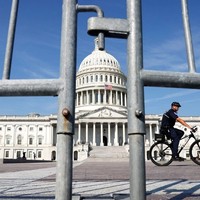
Emphasizing domestic pressure on President Joe Biden over his approach to Iran, Senator Bob Menendez, Democrat Chairman of the Senate Foreign Relations Committee, repeated his view that the JCPOA was dead.
Return to JCPOA ‘a fantasy’
“A return to the 2015 deal is not only unrealistic and unproductive, it is a fantasy,” Menendez said. “Iran is drawing out negotiations with delaying tactics and brinkmanship…It is time for us to send a message that we will do whatever is necessary to defend the national interest of the United States and to ensure than Iran never achieves a nuclear weapon.”
Menendez was addressing, virtually, the ‘International Convention for a Free Iran,’ which is sponsored by the Mujahideen-e Khalq, the Iranian opposition group once allied to Saddam Hussein and which Tehran regards as a ‘terrorist’ organization. Menendez praised Maryam Rajavi, the MEK co-leader, and condemned Iran’s “push towards a nuclear weapon.”
A poll by Data For Progress published Wednesday found 42 percent of Americans likely to vote in November’s mid-term elections were “very concerned” or “somewhat concerned” over Iran “developing the ability to produce a nuclear weapon.” Seventy-eight percent favored using “all our best diplomatic tools to put an end to Iran’s nuclear weapons program,” with 12 percent favoring “war with Iran…to slow down its nuclear weapons development.”