• العربية
  • فارسی
Brand
  • Iran Insight
  • Politics
  • Economy
  • Analysis
  • Special Report
  • Opinion
  • Podcast
  • Iran Insight
  • Politics
  • Economy
  • Analysis
  • Special Report
  • Opinion
  • Podcast
  • Theme
  • Language
    • العربية
    • فارسی
  • Iran Insight
  • Politics
  • Economy
  • Analysis
  • Special Report
  • Opinion
  • Podcast
All rights reserved for Volant Media UK Limited
volant media logo

Criticism of Iran's Government Continues Despite Khamenei’s Ban
Jun 24, 2022, 15:39 GMT+1Updated: 16:40 GMT+1
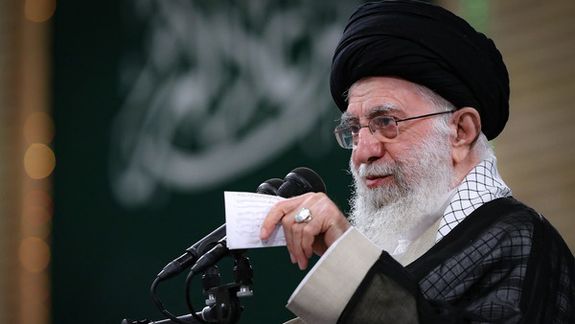
Ali Khamenei speaking on June 12, 2022

Top clerics, politicians and the media in Iran have ignored a warning from the Supreme Leader this week not to criticize the government and state officials.

As has been the case in recent weeks, the economic performance of the government was the main target of attacks, but critics also slammed Raisi’s personal blunders.

However, none of the critics mentioned that all the government policies as well as the government itself were endorsed by Khamenei and perhaps he is to be blamed for the mistakes of the government he brought to power by “engineering” the 2021 presidential election.

Raisi was under fire by several Iranian newspapers, despite restrictions on media, for saying that clerics rather than doctors and nurses have helped Iranians out of the coronavirus pandemic.

Meanwhile, Ayatollah Nasser Makarem Shirazi, a hardline cleric, holding one of the highest ranks in Iran’s Shiite clerical system, said during a meeting with Planning and Budget Organization Chief Vice President Massoud Mirkazemi that “People are suffering because of rising prices and the government should be accountable for that,” ٍEftekhari news website in Tehran reported.

The senior ayatollah who has overall supported Khamenei throughout the years, obviously ignored his plea on Tuesday not to criticize state officials.

Makarem Shirazi called on the government to “at least convince the people” and explain why prices have dramatically risen, despite the government’s claims of exporting more oil.

“This is a mystery for the people, and they ask why the prices are rising while the government says it is selling more oil,” he said. He also questioned why the government cannot prevent the smuggling of essential commodities out of the country.

The ayatollah also called on the government to think of a solution for the unusual rise in the cost of housing in Iran. Elsewhere in his remarks Makarem Shirazi said the government should also explain why low-quality Iranian cars are more expensive than foreign vehicles and why the government prevents car imports.

He warned that the government’s behavior and its failure in controlling prices can lead to people’s distrust in the government.

Another cleric, Abolghasem Alizadeh, the former religious propaganda official, told Fars News on Wednesday that Friday Prayer imams cannot do their job if the government does not give them money.

Yet another cleric, Seyyed Ali Ghazi Askar, the superintendent of the shrine of Hazrat Abd ul-Azim near Tehran also called on the government to control the rising cost of housing in Iran, Fars reported. Ghazi Askar said the government is indebted to the mosques and should pay what it owes to them through allocating annual budgets.

Conservative commentator Mohammad Mohajeri said in an interview, “President Raisi still sees himself in the atmosphere of election campaigns. He still thinks he can evade responding to criticisms by attacking others including the previous government.

Meanwhile he criticized Raisi’s cabinet by saying that “there is a terribly high degree of illiteracy in the government.” He added that Raisi does not pay any attention to areas where his government is utterly inefficient.

Mohajeri reiterated that the country needs to national solidarity, but this cannot be achieved with weak media and individuals whose priority is their factional affiliation.


Most Viewed

Iran diplomacy wobbles as factions compete to avoid looking soft on US
1
INSIGHT

Iran diplomacy wobbles as factions compete to avoid looking soft on US

2
VOICES FROM IRAN

Bread shortages, soaring prices strain households in Iran, residents say

3
ANALYSIS

The politics of pink: how Iran uses cuteness to rebrand violence

4

Scam messages seek crypto for ships’ safe passage through Hormuz, firm warns

5
EXCLUSIVE

Family told missing teen was alive, then received his body 60 days later

Banner
Banner

Spotlight

  • Diplomacy tolls at Hormuz as conflict returns to its doorstep
    OPINION

    Diplomacy tolls at Hormuz as conflict returns to its doorstep

  • Opposition to US talks grows in Tehran as ceasefire deadline nears
    INSIGHT

    Opposition to US talks grows in Tehran as ceasefire deadline nears

  • Tehran moderates see ‘no deal–no war’ limbo as worst outcome
    INSIGHT

    Tehran moderates see ‘no deal–no war’ limbo as worst outcome

  • The future has been switched off here
    TEHRAN INSIDER

    The future has been switched off here

  • Lights out, then gunfire: Witnesses recount Mashhad protest crackdown
    VOICES FROM IRAN

    Lights out, then gunfire: Witnesses recount Mashhad protest crackdown

  • Is Iran entering its Gorbachev moment?
    INSIGHT

    Is Iran entering its Gorbachev moment?

•
•
•

More Stories

Several People Arrested Over Gathering Of 'Indecent' Teenagers In Iran

Jun 24, 2022, 11:24 GMT+1

The governor of the southwestern city of Shiraz says several people have been arrested following the release of a video showing a gathering of teenagers who were not observing compulsory hijab.

The video that went viral on Thursday showed dozens of teenage boys and girls gathered in one of Shiraz's main streets. Many of the teenage girls were not wearing headscarves as is mandatory for girls over the age of nine.

The city’s governor Lotfollah Sheibani called it a "norm-breaking rally," adding that as soon as they were informed about the gathering, the police, in coordination with the judiciary, took action to identify and detain the organizers. "So far, 10 people who organized the rally have been arrested."

However, a few hours later, Fars News Agency, affiliated with the Revolutionary Guard, quoted the Chief Justice of Fars province as saying that only "five of the main organizers of the ceremony were arrested, and none of the participating teenagers are detained."

Recently, Iran’s morality police arrested 120 people in a nature tour in the forests of the Caspian Sea area for flouting their hijab, dancing together, and drinking alcohol.

Since hijab became compulsory in Iran, within a couple of years from the establishment Islamic Republic in 1979, many women have been resisting the prescribed standards of hijab promoted by the state and refuse to accept it even at the cost of being arrested, fined or even lashed.

Speculations Abound Over IRGC Intelligence Chief’s ‘Dismissal’

Jun 23, 2022, 20:38 GMT+1
•
Maryam Sinaiee

The replacement of the Revolutionary Guard (IRGC) Intelligence Organization Chief Hossein Taeb has fueled many speculations about the reasons for his dismissal.

Taeb’s removal, his appointment as advisor to the commander in chief of the IRGC, and appointment of Mohammad Kazemi were all announced Thursday after days of rumors on social media.

Taeb’s name has become the top hashtag in Persian social media over the past 24 hours. There is an abundance of posts that include more rumors and speculations about what most refer to as his “dismissal” and his current whereabouts.

Taeb has not been seen in the past few days.

Wednesday afternoon, social media users claimed that Taeb, one of the most feared men in Iran had survived an assassination attempt, allegedly by Israel, but was in critical condition at the I RGC's Baghyatollah hospital in Tehran.

Some social media users allege that what they say was a hasty announcement of Taeb’s replacement was a cover up of his purported assassination by Israel.

There are also claims that Taeb was shot in the leg when agents stormed his office to arrest him and clashed with his bodyguards. There are also claims that over thirty other individuals belonging to SAS (Persian acronym for IRGC Intelligence) were arrested in raids in different areas of Tehran overnight.

On June 19, following Taeb’s recent threats against Israelis, the Israeli Prime Minister Naphtali Bennet said that Israel would continue to strike those who send terrorists to attack Israelis in various overseas locations. “Our new rule is: Whoever sends – pays,” he said. This has been interpreted as a direct threat against the head of the IRGC’s SAS.

Taeb’s dismissal has also been linked to Turkey's announcement Thursday that the National Intelligence Organization (MIT) thwarted a planned attack against Israeli diplomats and tourists in Istanbul. MIT said that it detained eight suspects allegedly working for an Iranian intelligence cell.

Undated phot of Ta'eb with Qasem Soleimani seen on the foreground
100%
Undated phot of Ta'eb with Qasem Soleimani seen on the foreground

Some believe that his failure to succeed in the operations he had promised to carry out has displeased Supreme Leader Ali Khamenei. Others say he has been found to be an agent of Israel.

Well-known journalist Hengameh Shahidi tweeted on Thursday that she had confirmation from reliable sources that Taeb was sacked by the direct order of none other than the Supreme Leader himself.

Abdollah Ganji, the former editor of the IRGC-linked Javan newspaper, in a tweet Thursday dismissed all these speculations and claimed that Taeb’s removal from his position was “only a very ordinary transfer to a bigger stronghold.”

But some other hardliners appear to be pleased with Taeb’s removal. “After the removal of Hossein-Ali Montazeri as successor to the founder of the Islamic revolution,Taeb’ removal from the helm of SAS is the most consequential dismissal in the history of the revolution. This surgery, undoubtedly, will lead to higher security in the country,” former hardline lawmaker Hamid Rasaei tweeted Thursday.

Supporters of the former president Mahmoud Ahmadinejad have been sharing his comments in an interview four years ago when he said he had always opposed Taeb’s appointment as the chief of SAS. “He has no balance. He will cause chaos in everything. He only knows how to create bogus cases,” Ahmadinejad said in the interview in reference to the many cases of high profile arrests of Iranians, foreigners, and dual nationals.

Taeb’s replacement is likely to affect many of his allies including Parliament Speaker Mohammad-Bagher Ghalibaf, a former Revolutionary Guard top brass general. Ghalibaf’s political life has hugely depended on his alliance with Taeb, hardliner journalist Vahid Ashtari, who first revealed the ‘Layette-Gate” scandal involving Ghalibaf’s family in April, told Didehban-e Iran news website on Thursday.

Iran International journalist Morteza Kazemian believes that removing Taeb from office is the biggest shift in security matters in the history of the Islamic Republic. “This is A massive earthquake in the structure of power in Iran the aftershocks of which will not remain limited to the IRGC, security bodies, and in matters related to Israel,” he tweeted, adding: “This will even affect Khamenei’s succession.”

Taeb is known for having very close relations with Khamenei’s secretive son, Mojtaba, a former co-fighter in the Iran-Iraq War (1980-1988), who many believe is being groomed to succeed his father.

Tehran Among Least Liveable Cities In The World, Study Reveals

Jun 23, 2022, 20:09 GMT+1

According to an annual report from the Economist, Tehran is among the bottom ten cities in the ranking of 173 cities in terms of the Global Liveability Index. 

In the report published by the Economist intelligence unit -- the research and analysis division of The Economist -- on Thursday, Tehran is at the 163rd place of the list that quantifies the challenges to an individual's lifestyle in cities worldwide.

The study reviewed and assessed 173 cities across five broad categories of stability, healthcare, culture and environment, education and infrastructure.

In terms of stability and infrastructure, Tehran is worse than Douala in Cameroon, although in overall average Iran is one place higher. Considering culture and environment, Tehran is even worse than Libya’s Tripoli, Nigeria’s Lagos, and Syria’s Damascus, which are at the rock-bottom of the rankings. 

The only category that saved Iran from languishing at the very bottom is healthcare that has 20 percent weight in the total score, but a closer look at the category reveals that the quality and availability of private healthcare is the decisive factor in the index. Tehran does have private health care but it is not affordable for ordinary Iranians, who are struggling to make ends meet due to above-50-percent inflation.

The Austrian capital, Vienna, has made a comeback as the world’s most liveable city as a rollback of covid-19 restrictions has translated into rankings resembling those seen before the pandemic. It is followed by Copenhagen in Denmark and Switzerland’s Zurich. 

Iran's IRGC Intelligence Chief Removed In Major Move

Jun 23, 2022, 13:14 GMT+1
•
Iran International Newsroom

IRGC-linked news agencies have reported that the Guards' counter-intelligence chief Mohammad Kazemi has replaced Hossein Taeb as the IRGC's intelligence chief.

Tasnim quoted IRGC's Public Relations spokesman Ramazan Sharif as saying that IRGC Commander Hossein Salami has appointed Kazemi as the IRGC's new intelligence chief on Thursday, June 23.

IRGC social media outlets Wednesday night ended nearly two days of rumors about the "dismissal" of Taeb, announcing that he has been removed from his post, but he will be appointed to a higher position.

Sharif told Tasnim that Hossein Taeb has been appointed as an "adviser" to the IRGC commander, a clear sign that the former intelligence chief has been demoted. Meanwhile, the fact that Taeb's removal and Kazemi's appointment is announced by a low-key IRGC officer rather than Supreme Leader Ali Khamenei who directly oversees the IRGC Intelligence is another indication that Taeb has been dismissed from his job.

Tasnim placed the news about Taeb under its top story which is about Lavrov's visit in an elaborate attempt to downplay the development. The report's headline is also about Kazemi's appointment rather than Taeb's removal.

In recent weeks there were multiple mysterious incidents in which IRGC officers and operatives were killed or died in unexplained circumstances. Iran blamed Israel for some of the incidents.

According to Sharif, Kazermi has been the IRGC Intelligence Organization's counter-intelligence chief for many years and is highly experienced in intelligence and security matters. Kazemi is a brigadier general while Taeb was a cleric with some military experience that dated back to the 1980s war with Iraq.

According to political analyst Morteza Kazemian, Taeb, one of the most feared men in Iran's security system, was the second strongest man in the country's intelligence system only after Khamenei. Kazemian added that Taeb maintained good relations with Khamenei's son Mojtaba, a former comrade during the war.

Meanwhile, Kazemian suggested that Russian Foreign Minister Sergey Lavrov visiting Tehran on Thursday, possibly carried a message that revealed flaws in Taeb's performance. In a press conference in Tehran Lavrov Thuesday did refer to an "intelligence protection agreement|" with Tehran, wihtout elaboration.

Taeb was recently harshly criticized by social media activists and some politicians for failing to detect and prevent Israel's destructive operations in Iran.

Social media activists also said that the change on top of the IRGC Intelligence Organization revealed a divide in the organization that was already noticed after several leaks. On the other hand, the fact that an Israeli news outlet, Kaan News reported Taeb's removal from his post several days before its confirmation by Iranian officials, was another indication that Israel had access to insider information from the IRGC Intelligence Organization.

Furthermore, the choice of the new chief from the counter-intelligence unit, points out the fact that the reason for the change was something happening within the organization where Kazemi was in a better position to detect the leaks.

Social media activist and war veteran Hadi Mehrani said in a tweet that the change will have major repercussions and significant events are likely to take place in Iran.

The spokesman for Iran's Reform Front, Ali Shakouri Rad also said in a tweet on the same date that: Taeb's removal is a very important development which requires to be elaborated as the organization has a major role in elections and the running of the affairs of the state in Iran."

Food Price Inflation In Iran Reaches 80 Percent

Jun 22, 2022, 18:10 GMT+1
•
Mardo Soghom

Inflation soared in Iran in May-June as the government lifted import subsidies for essential goods, with food prices jumping by more than 82 percent.

The inflation rate reported by the Statistical Center of Iran (SCI) pertained to point-to-point calculation of rising prices, comparing the last Iranian calendar month of Khordad that ended June 20 with the same month in 2021.

Based on figures announced by SCI on June 22, overall point-to-point inflation rose by 52.5 percent, while non-food goods and services rose by 36.8 percent compared to the same month in 2021.

In early May, the government decided to end food import subsidies in place since 2018, that was allegedly abused by corrupt officials and businessmen to divert cheap dollars provided by the government, for non-essential imports.

The program of import subsidies cost the government $9-15 billion a year, depending on widely diverging figures quoted by different officials.

When the Iranian rial began to nosedive in early 2018, the government decided to offer cheap dollars for importing essential goods and commodities, such as wheat, animal feed, medicines, and a range of other items.

But rial’s decline continued without reprieve with the currency losing value ninefold by April 2022, as United States’ sanctions on Iranian oil exports and international banking imposed in 2018 continued.

Protests around Tehran Bazaar after another fall of the national currency. June 11, 2022
100%
Protests around Tehran Bazaar after another fall of the national currency. June 11, 2022

Compared with the previous month this year (April21-May 20), the inflation index rose by 13.2 percent. But the shocking price jump was for the food sector with a 36.8 percent jump in one month.

However, the most politically significant and sensitive price increases were for cooking oil, bread and cereals.

Cooking oil jumped by 200 percent in one month and 250 percent compared with the same month in 2021. Bread and cereals jumped by 93.8 percent in one year and almost 20 percent compared to the previous 30-day period.

Dairy prices jumped by 47 percent in one month and 111 percent in one year.

However, the numbers published by the SCI still might not convey the real picture of rising prices. For example, in case of rents, the report showed an annual increase of 31.7 percent, while other reports speak of up to 100 percent rise in rental fees in the past few months, driving some lower middle class families into homelessness.

Protests began immediately in May after the government announced the elimination of food subsidies and have continued almost daily since then. Even government-controlled media are slamming the presidential administration for what they say is mismanagement of the economy.

Around 80 percent of the economy is directly or indirectly controlled by the state, which leads to planning nightmares, nepotism, political favoritism and corruption.

What helped the Islamic Republic to muddle through in past decades was oil export income, which has been significantly reduced by US sanctions imposed when the Trump administration withdrew from the 2015 nuclear agreement known as the JCPOA.

Year-long negotiations to revive the agreement have not succeeded, reportedly by Iran’s insistence for removal of sanctions imposed on its Revolutionary Guard, which is accused among other things of supporting terrorism.

With sanctions in place and an economy burdened by inefficiency, Iran’s financial situation will likely remain dismal, making the political atmosphere unstable in the country.