Germany arrests two members of pro-Iranian group over synagogue plot
Police secures an area after a suspected politically motivated arson attack in Munich, Germany, September 3, 2026.
German federal police arrested two Iraqi nationals on Thursday on suspicion of belonging to a pro-Iranian terrorist group that prosecutors say plotted attacks on synagogues in Cologne and another European city.
Unidentified people acting on the group’s behalf went to the synagogues on two consecutive nights in late March, “presumably carrying explosive devices,” federal prosecutors said.
Neither attack took place, and investigators said they still did not know why.
Police arrested the two men, identified as Mostafa Al-R. and Ameer J., in Heidelberg and Cologne.
Prosecutors said both were “strongly suspected of membership in a domestic terrorist organization.”
According to the arrest warrants, Mostafa Al-R. and Mohammad al-Saadi, who faces charges in the United States, founded the group with others in late 2025 to prepare and carry out attacks in Germany and elsewhere in Europe.
Ameer J. also belonged to the group, which prosecutors said raised money and recruited people from outside its ranks to carry out bombings.
Prosecutors also identified al-Saadi as a key figure in a separate group, Harakat Ashab al-Yamin al-Islamiyyah, or HAYI.
It emerged publicly under that name after the Iran war broke out in early 2026. Prosecutors suspect HAYI was behind a series of attacks on US, Israeli and Jewish institutions in Europe beginning in March.
The investigation grew out of information from Germany’s domestic intelligence service.
More than 250 officers took part in Thursday’s operation, which included court-ordered searches at 17 properties across three states. A search in Hürth concerned a third suspect, prosecutors said.
A Federal Court of Justice judge issued the arrest warrants on November 18. The two men were due before a judge on Thursday for a decision on whether to hold them in pretrial detention.
Satellite imagery shows construction at Iran’s Behjatabad underground facility on November 24, 2026. (Vantor Technologies/Institute for Science and International Security)
Iran is rapidly constructing a fortified underground complex between two of its main nuclear sites that could house weapons systems or infrastructure linked to its nuclear program, a Washington-based research institute said on Wednesday.
“The function of the facility is not clear at this time. More information is needed to make an accurate assessment,” the Institute for Science and International Security said in a post on X.
The Behjatabad facility stands out among similar underground complexes built across Iran for its unusually rapid pace of construction, according to the institute, which published satellite imagery provided by Vantor Technologies.
The complex lies midway between the Isfahan nuclear site and Pickaxe Mountain near Natanz, approximately 62 kilometers from each. Its outer security perimeter is expected to encompass roughly 12,000 acres (5,000 hectares).
The site's security measures, the nature and pace of construction and Iran’s previous construction practices suggest the complex could serve several military purposes, including housing missile systems or other major weapons systems, the institute said.
“A nuclear purpose cannot be ruled out,” it added.
The facility was first identified by satellite imagery analyst Ben Tzion Macales, who said in a November 17 post on X that construction activity had accelerated following Operation Epic Fury, the US military campaign against Iran earlier this year.
The scale of construction activity was such that progress could be tracked even using relatively low-resolution Sentinel-2 satellite imagery, Macales added.
Satellite imagery reviewed by Vantor showed that initial construction activity began in December 2025 and expanded considerably throughout 2026.
The institute said it would publish additional satellite imagery and a more detailed assessment of the facility in a forthcoming report.
Rebuilding nuclear infrastructure
Construction of the Behjatabad complex comes as the Islamic Republic has sought to rebuild and reinforce some of its underground facilities following attacks on its nuclear and military infrastructure during the 12-day and 40-day wars.
An assessment published by the institute on November 21, 2025, five months after the 12-day war, found that the June attacks on Fordow, Natanz and Isfahan had inflicted extensive and, in some cases, catastrophic damage on Iran’s nuclear infrastructure.
Iran was unable at the time to enrich uranium on a significant scale or manufacture large numbers of centrifuges and had made little progress in restoring its damaged capabilities, according to the assessment.
Researchers warned, however, that the destruction of Iran’s main enrichment facilities did not mean all of its sensitive nuclear capabilities had been eliminated.
Satellite imagery at the time showed activity consistent with debris removal, equipment recovery and efforts to reinforce some facilities.
Remaining nuclear facilities
Among the facilities examined by the institute was Pickaxe Mountain, an underground complex near Natanz that was not targeted during the 12-day war in June 2025.
Iran announced in 2020 that it intended to establish a facility capable of assembling thousands of centrifuges annually at the complex.
Construction of the new facility was approaching completion by November 2025, according to the institute’s assessment.
Researchers identified Pickaxe Mountain as one of the potential sites where Iran could restore parts of its centrifuge manufacturing and assembly capabilities or potentially resume uranium enrichment.
The institute also examined reconstruction at Taleghan 2, a facility within the Parchin military complex that was targeted by Israel in October 2024.
Satellite imagery from 2025 showed extensive reconstruction at the site, including the installation of a cylindrical structure that researchers assessed could have applications in nuclear weapons-related research. Its intended function had not been independently confirmed.
Satellite imagery shows the tunnel complex under construction at Iran’s Behjatabad underground facility on November 24, 2026. (Vantor Technologies/Institute for Science and International Security)
At least three sites associated with possible weapons-related activities had undergone clearance work following attacks, the institute said in its November 2025 assessment.
Uncertainty over enriched uranium stocks
The whereabouts and condition of Iran’s stockpile of some 440 kilograms of uranium enriched to 60% remain among the major unresolved questions surrounding its nuclear program.
Restrictions on access to Iranian nuclear facilities had prevented the International Atomic Energy Agency from fully accounting for the stockpile, the institute said in its November 2025 assessment.
The agency assessed at the time that the material had probably not been removed from the main nuclear sites at Isfahan, Fordow and Natanz, although it could have been relocated within those complexes.
Satellite imagery alone cannot establish what activities are taking place inside Iran’s underground facilities, where its enriched uranium is stored or the condition of its nuclear equipment, according to the institute.
The rapid construction at Behjatabad adds to the growing importance of underground facilities in assessing the future of Iran’s nuclear and military programs.
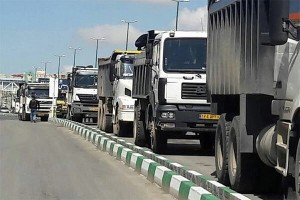
Trucks line in Isfahan, central Iran, during a strike on November 25, 2026.
Iranian truck drivers entered a fifth day of strikes on Thursday, with their union saying drivers in 18 cities were refusing to haul freight at rates that have stayed flat as the cost of keeping a truck on the road has climbed.
The Union of Truck Drivers and Trucking Associations Across Iran named Isfahan, Kermanshah in the west and Kazerun in the southern province of Fars among the cities in a message to drivers on Telegram. Truckers in Shiraz stopped work on Sunday, the day the strike began.
The union urged drivers to hold out for higher rates, saying that when one driver agreed to carry a load for next to nothing, others lost out too.
"Tires are priced in dollars, oil is priced in dollars, diesel is priced in dollars," the union said. "So freight rates have to reflect reality too." The rial fell past 2.8 million to the dollar on the open market this week, a record low.
Drivers also face higher insurance premiums, tolls and repair bills, according to the union. "Until we get what we're owed, we won't haul freight," it said.
Diesel shortages, limited supplies of engine oil and tires, and the rising cost of maintaining an aging fleet threatened freight transport across Iran, the union said in a separate statement.
Factories rely on the same trucks to move their goods as farmers do to get crops to market, it said. If those problems persist, production, distribution and prices would all be affected. Farmers had voiced support for the drivers on Wednesday, the union said.
Most of Iran's goods move by road, so truckers' strikes can quickly be felt in shops and markets. In 2018, a truckers' strike over pay and costs spread to hundreds of cities, and the judiciary threatened strikers with harsh punishment.
B‑1B Lancer bomber at the RAF Fairford airbase, after police declared a major incident at the base after several men were arrested on suspicion of offences under the Explosives Act, in Fairford, Gloucestershire, Britain, September 28, 2026. REUTERS/Toby Shepheard
Britain’s Royal Air Force (RAF) is moving military aircraft into hangars and hardened shelters at night to protect them from potential drone attacks amid growing security threats, including suspected Iranian plots targeting British airbases, Sky News reported on Wednesday.
The RAF is also reportedly considering installing anti-drone netting to protect aircraft that remain exposed at military bases.
Iran is suspected of plotting to target RAF Fairford in Gloucestershire, an airbase used by US bombers during the war with Iran. The threat prompted the Pentagon to evacuate bomber aircraft from the facility.
The United States has also relocated military aircraft from a second British airbase following reports of another suspected Iranian threat.
British and US authorities have brought charges against five men in connection with the suspected IRGC-linked plot targeting RAF Fairford in September.
On November 10, US prosecutors announced charges against three men, including a suspect accused of coordinating activities through coded telephone calls while detained in a New York jail. Two other men have been charged in Britain in connection with the suspected plot.
British authorities assessed the suspected Fairford plot as highly likely to have been coordinated in Iran and almost certainly directed by the IRGC, Parliament was told on October 12.
Iranian Foreign Minister Abbas Araghchi rejected Britain’s accusations in a September 30 post on X, pointing to the release on bail of suspects arrested in connection with the Fairford incident.
“I can confirm Iran's belief that releasing supposed terrorists working for foreign states really says it all,” Araghchi wrote, adding: “You're barking up the wrong tree.”
RAF chief Air Chief Marshal Harv Smyth said on Tuesday that the air force was preparing for a scenario where “there is no sanctuary at home, you are fighting from the UK but you need to get on the move.”
Smyth stressed the importance of dispersing military aircraft across multiple locations and maintaining operational readiness in the event of a conflict.
The measures also come amid concerns over Russian sabotage. Britain’s domestic intelligence agency MI5 and the Ministry of Defence warned British companies supplying military equipment to Ukraine on Tuesday that they faced an increased risk of Russian sabotage.
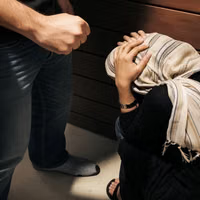
A woman shields her head from a man's raised fist in an image depicting domestic violence in Iran.
From childhood sexual abuse to violence at the hands of husbands and fathers, Iranian women have shared experiences they say they kept secret for years, revealing how fear, stigma and discrimination have silenced victims.
The accounts emerged after Iran International asked women on Instagram to describe violence they had experienced but never spoken about, ahead of the International Day for the Elimination of Violence Against Women on November 25.
Many women said fear of social judgment, pressure to protect their families' reputation and a lack of legal protection had prevented them from speaking out.
“I had so many painful experiences within my family and society that I did not want to have a daughter, fearing she might experience what I did, even at the hands of those closest to her,” one woman wrote.
When home is not safe
Many respondents described violence inflicted by their closest relatives, including fathers, brothers and husbands.
One woman said her father repeatedly struck her on the head with a clothes iron when she was 18 following an argument over her wearing makeup, leaving her hospitalized. Despite his subsequent apologies, she said she had never forgiven him.
Another described severe beatings by her husband during pregnancy, including an assault that damaged her amniotic sac when she was six months pregnant.
A third said abuse by her mother and older brother had driven her to attempt suicide at 15. She married at 17 to escape her family, only to find herself trapped in another cycle of violence that eventually ended in divorce.
The accounts emerged against a backdrop of killings of women and girls by relatives and other people known to them.
A woman sits inside a shelter for survivors of domestic violence in Iran. (NCRI Women’s Committee)
At least 84 women and girls killed in seven months
According to figures compiled from media reports, at least 84 women and girls were killed in Iran between March 21 and October 13 this year. In 75 cases, the perpetrator was someone known to the victim. Twelve victims were under 18, eight of whom were killed by fathers, brothers or other blood relatives.
The figures cover only cases made public through media reports.
One respondent said that had she not married, her abusive brothers might have subjected her to the same fate as Sogand Sayyadi, a 16-year-old girl who died earlier this month after falling from a fifth-floor window in Kermanshah.
Sayyadi's father is under investigation on suspicion of assault and murder, allegations he denies.
An illustrative image depicting sexual harassment against women in Iran.
Abuse beyond the home
Childhood sexual abuse, rape by relatives and harassment in public spaces also featured prominently in the responses.
One woman described being sexually abused by her grandfather and later harassed by men on the streets while looking for work.
A 24-year-old said she had experienced sexual harassment since the age of eight, on her way to school, in taxis, on the metro, at work and even among relatives.
For some, financial dependence made confronting abuse particularly difficult.
“Given the situation in the country, I could not change jobs,” one woman wrote. “The person harassing me knew I was silent out of fear and financial necessity, and continued his behavior.”
Hijab enforcers confront a woman without a headscarf near Tehran’s Grand Bazaar.
Discrimination begins at school
Several women traced their earliest experiences of violence and discrimination to school and the enforcement of compulsory hijab.
One recalled how her middle school principal took her to the school office and cut her hair with scissors because her thick, curly hair protruded beneath her head covering.
Another woman recalled being required to wear a headscarf from the age of six. “There, they taught us that because we were girls, we had no right to speak loudly, laugh or protest,” she wrote of her school.
Others described restrictions on education, employment and personal freedom imposed by their families.
“My family forced me into marriage without caring that I wanted to go to school and continue my education,” a woman who experienced child marriage wrote.
Several respondents also pointed to discriminatory laws under the Islamic Republic, which they said left women with little protection against abuse.
Women at a safe house for survivors of domestic violence in Iran. (NCRI Women’s Committee)
The price of speaking out
Fear of the consequences of reporting violence was a recurring theme, with women describing victim-blaming, family pressure, possible prosecution and the risk of further abuse.
One woman who had been physically assaulted at a social gathering said she abandoned plans to file a complaint after being told that a court might question her for attending an event with men unrelated to her.
Some respondents pointed to insulting comments and attempts to justify violence beneath Iran International's Instagram post itself as examples of why women often remain silent.
Others expressed solidarity with survivors and encouraged them to share their experiences.
But for many, escaping an abusive relationship or bringing physical violence to an end had not meant an end to their suffering. The psychological consequences, they said, continued years later.
With marriages in Iran at half their 2010 peak and young people priced out of setting up a home, a lawmaker has proposed letting couples marry on paper and wait up to five years to live together, reviving debate over religious answers to an economic problem.
Amirhossein Bankipour, a member of parliament's Cultural Committee, said young Iranians faced a growing gap between sexual maturity and the means to start a household. Only 1 percent of young men and 20 percent of young women under 20 marry, he said.
"Our first solution is marriage, and if that is not possible, the second is chastity and modesty. But if these solutions alone are insufficient, we should not ignore the problem and must consider other options," he said.
His third option is a long engagement in law. In Iran, couples often sign a marriage contract, known as aqd, months before they hold a wedding and move in together. Bankipour proposed stretching that period to four or five years, until the couple has a job, a home or enough money to live on.
Half as many marriages
Official figures show how far marriage has slipped out of reach. Iran registered 431,415 marriages in the year to March 2026, down 8.8 percent from the year before and about half the 891,627 recorded in 2010, according to the national population headquarters, which cited civil registration data.
The average age at first marriage has risen to 28.2 for men and 24.1 for women.
Officials blame rising housing costs, dowry expenses, inflation and job insecurity. With inflation near 89 percent and rents a third higher than a year ago, some couples who divorce now cannot afford to move out of the home they shared.
A couple stands facing a religious shrine in an advertisement for a marriage registration office in Iran that also issues temporary marriage (sigheh) certificates.
Between desire and doctrine
Under Iranian law, sex outside marriage is a crime, which leaves young Iranians few legal options for intimacy.
One of them is temporary marriage, known in Persian as sigheh, a practice recognized in Shiite jurisprudence. Unlike permanent marriage, a sigheh has an agreed duration and a set dowry. It can last from a few hours to several years and ends without divorce.
Religious authorities present it as a way to meet sexual needs without breaking Islamic law. Bankipour did not explicitly propose it, but his remarks revive a long debate over how far marriage contracts can be stretched to fit lives that marriage no longer fits.
Sigheh's legal standing has not brought social acceptance. Even in religious families, it carries a stigma, especially for women, Iran International has reported.
Temporary marriage has also given commercial sex a legal cover.
A May 2025 Iran International investigation found online platforms offering paid encounters marketed as Islamic marriage. Intermediaries advertised women by age, appearance, education and location, offering arrangements from a few hours to monthly contracts. Contacts with several operators showed that some arranged real meetings rather than simply defrauding customers.
Iran's cyber police later acknowledged the spread of such platforms but described many as scams. Prostitution is banned in Iran.
Temporary marriage gives men and women very different rights. A man may have any number of temporary wives at once, and needs no permission from a permanent wife. A woman may have only one husband at a time, and must wait at least 45 days after a sigheh ends before entering another.
A woman in a temporary marriage has no right to maintenance after it ends and no right to inherit from her husband. Registration is required only if a child is conceived, which can make it hard for women to prove the marriage or the father's identity in court.
Those gaps fall hardest on women who enter a sigheh out of economic need. The same arrangement that gives men a religiously permitted route to sex can leave women with lasting social judgment.
Earlier this year, state-backed gatherings set up matchmaking stalls, urging young Iranians to marry earlier and expect less materially from married life. State-backed "spouse-finding" apps promote early marriage under a 2021 population law.
Bankipour's proposal also concedes that jobs and housing now stand between young Iranians and marriage. But instead of addressing those obstacles, it separates the marriage contract from the cost of setting up a home.
Young Iranians who choose relationships outside marriage, meanwhile, face legal risks, family expectations and social restrictions, often while still living with their parents