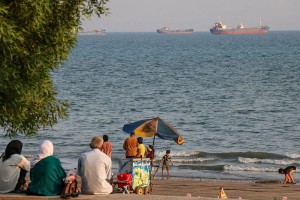
People on the waterfront in Bandar Abbas, Iran’s main port on the Strait of Hormuz, November 20, 2026.
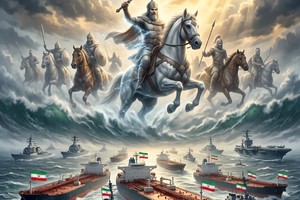
Iranian state media and officials have denied that Iran was about to send tankers through the US naval blockade, after four days in which Guards-linked outlets, lawmakers and Friday prayer leaders spread the claim and AI-generated images showed ships breaking through.
The denials began on Sunday, the same day President Donald Trump said that if Iranian ships tested the blockade, “they’ll all be at the bottom of the sea like the rest of the navy.”
How the story grew
The reports began on Thursday, when the oil tracker TankerTrackers said Iran appeared to be preparing to ship out oil again. The Revolutionary Guards-affiliated Fars news agency had already published a commentary proposing a tanker convoy to break the blockade, and many readers took it as an operational plan.
The claims did not come only from commentators and social media. Friday prayer leaders in several cities called for the blockade to be broken, and some said tankers would soon sail from Kharg Island for China. Lawmakers repeated the claim over the weekend, and Foreign Minister Abbas Araghchi said on Friday that “the blockade must be broken.”
Hardliners welcomed the prospect of a confrontation. Propaganda images and videos, some built from real footage and others generated with artificial intelligence, claimed that an Iranian tanker named Khat Shekan, or “Line Breaker,” had crossed the blockade on Saturday. On Sunday, claims that 14 tankers had crossed spread widely online.
TankerTrackers said no tanker called Line Breaker existed. It also said an Iran-linked liquefied natural gas tanker named Tania Star that appeared in ship-tracking data on Sunday was a spoof, and that the vessel did not exist.
‘No basis in reality’
The Guards-affiliated Tasnim news agency said on Sunday that no operation had been planned for the weekend. The claims, it said, grew out of “a series of proposals by some individuals in the media or on social media,” and people had stitched together reports, some unrelated, to suggest an operation on Saturday or Sunday.
But Tasnim said Iran would not put up with the blockade forever. “Whether Iran will tolerate the naval blockade in the long term is not an issue of uncertainty; it will certainly break it, and this has been repeatedly stated by official military and civilian officials,” it said.
Iran was planning measures against the blockade and had prepared equipment and logistics, Tasnim said, but claims of an operation in the past day or two had “no basis in reality.” It accused people it called “capitulationists” of hoping to present a failed operation as proof that Iran had run out of options and should give in, and said the “enemy front” wanted to paint it as the failure of an Iranian military strategy.
Foreign Ministry spokesman Esmail Baghaei called the reports “media speculation” on Monday, blaming news sites, Telegram channels and other social media.
The state news agency IRNA, citing an account called the “War Message Center,” said no tanker convoy was moving toward the blockade as described or at the time claimed. The reports came from misreadings of ship-tracking data and speculation that hardened into claims of a confirmed operation through reposting, it said.
Iran’s response to the blockade was not limited to “a media scenario,” it said, and there were ways to get around or break the blockade whose details were not necessarily made public.
It is not clear who runs the War Message Center. It has not said it belongs to any state body, though accounts under that name have published war news and military statements since March.
‘Zero hour’
Nour News, which is close to the Supreme National Security Council, said on Sunday that the episode should not be judged only by whether an operation was confirmed or denied. The time for Iran to decide on breaking the blockade was “approaching rapidly,” it said, and everyone from Washington to regional governments and mediators should prepare for the coming “zero hour.”
Ending the blockade was becoming a public demand, it said, and the diplomatic window was not unlimited.
Mehdi Kharratian, a hardline commentator, told state TV’s Jahan Ara program on Sunday that he had not confirmed the tanker reports but that such news could influence decision-makers.
He urged officials to act, whether by halting all oil traffic through the Strait of Hormuz, confronting the UAE over what he called smuggling through the strait’s southern channel, or targeting ships heading for Arab ports.
“Ultimately, there are several solutions, and one of them has to be implemented,” he said.
Another hardline commentator, Ruhollah Jomei, wrote on X that the “project” had achieved its goals by stepping up regional diplomacy to lift the blockade. Regional capitals had been made to understand that “the Strait of Hormuz is either for everyone or for no one,” he wrote.
Fereydoun Majlesi, a former diplomat, told the Fararu news site that holding back a tanker operation, or denying it, showed “timely rationality.” The publicity and the threat of a US military response could have turned a maritime operation into a trap and a wider war, he said. “I believe we should not put the country in a position from which it would be difficult to exit, and which could cause damage that cannot be repaired.”
‘Lose-lose’
Some pro-government social media users asked why the reports had been allowed to run for days before being denied.
One, Abuzar Mashayekhi, suggested the reports had been a security operation to test reactions abroad, including in Arab countries, and public opinion at home, and that the late denial may have been deliberate.
Others said the confusion had damaged public trust. A user named Ario wrote on X that if the reports had only been meant to test the US response and measure support at home, the outcome was “lose-lose.” “Both the pragmatic credibility [of the approach] and social capital would be damaged,” the user wrote.
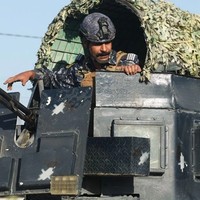
A member of the Iraqi police takes part in a security deployment on the outskirts of Jurf al-Sakhar, Babil province, Iraq, November 20, 2026. REUTERS/Alaa Al-Marjani
Iraq’s deployment of government forces to Jurf al-Sakhar, a longtime stronghold of Iran-backed Kataib Hezbollah, has raised questions about whether Baghdad can restore state authority or has merely reached a new compromise with powerful armed groups.
Experts told Iran International that the deployment marked a significant step in the government’s efforts to rein in militias, but cautioned that a withdrawal of Kataib Hezbollah fighters would not necessarily end Tehran’s influence.
Mukhlad Hazem, a former security adviser to the Iraqi parliament’s leadership, described the deployment as a step no previous Iraqi prime minister had dared to take, but said it was too early to assess its success.
Ahmed al-Sharif, an Iraqi strategic affairs expert, said even if Kataib Hezbollah withdrew from Jurf al-Sakhar, it could relocate its fighters to another strategically important area.
Iraqi Prime Minister Ali al-Zaidi announced on Friday the start of a drive to extend state authority across the country as army and federal police forces entered Jurf al-Sakhar, an area south of Baghdad that had been under the group’s control for 12 years.
“We have not entered a war. Everyone there is your brother,” Zaidi said in a video message to troops deployed in the area, officially known as Jurf al-Nasr.
Zaidi said his government sought to extend its authority throughout Iraq, combat corruption and end the presence of weapons outside state control.
Government forces entered without major clashes despite earlier threats by Kataib Hezbollah and mounting tensions with Baghdad.
However, subsequent reports indicated that Kataib Hezbollah fighters remained in the area even after government forces entered.
A deal to avert confrontation
The standoff escalated earlier this month after details of a confidential 19-page report on suspected oil smuggling in Jurf al-Sakhar appeared in Iraqi media on November 9.
Based on satellite imagery and an examination of oil transportation routes and tanker movements, the report identified suspicious activity near oil pipelines dating back to 2021.
Kataib Hezbollah denied allegations of involvement in illegal oil-related activities.
Zaidi ordered an investigation, but the dispute quickly widened into a confrontation over security control of the area.
Kataib Hezbollah defended its presence, saying it was necessary to prevent the resurgence of Islamic State and protect routes leading to the Shiite holy city of Karbala.
As tensions mounted, Esmail Qaani, commander of the Quds Force of the Islamic Revolutionary Guard Corps (IRGC), traveled to Baghdad for talks with Iraqi political leaders and armed groups.
Kataib Hezbollah confirmed on November 19 that its secretary-general, Abu Hussein al-Hamidawi, had met Qaani alongside Badr Organization leader Hadi al-Amiri and Popular Mobilization Forces (PMF) chairman Falih al-Fayyadh.
Iraqi media reported that Zaidi and Qaani had reached an understanding on the peaceful withdrawal of Kataib Hezbollah and its replacement by a joint security force.
Reuters also reported that Shiite political leaders had mediated a deal to avert an armed confrontation.
Under the arrangement, security responsibilities in Jurf al-Sakhar were divided among the army, federal police, energy police and units of the PMF.
Withdrawal or redeployment?
Sharif described Jurf al-Sakhar as one of Tehran’s key strongholds in its confrontation with the United States.
He said a gradual withdrawal could give Kataib Hezbollah time to await developments in negotiations between Tehran and Washington amid the risk of renewed escalation.
Sharif said Tehran opposed efforts to bring all weapons under Iraqi state control because doing so would deprive Iran of an important source of leverage in its dealings with Washington.
In his assessment, Tehran’s intervention was intended to prevent an armed confrontation between Iraqi government forces and Kataib Hezbollah while securing more time for the group to redeploy its fighters.
The US State Department said on November 18 that Washington expected the Iraqi government to hold Iran-aligned armed groups accountable for their violent and destabilizing activities.
Twelve years of displacement
Located in northern Babil province near the Euphrates River, Jurf al-Sakhar lies close to key routes connecting Baghdad with Anbar and Karbala provinces.
The predominantly Sunni Arab area was recaptured from Islamic State in October 2014 by Iraqi government forces and Shiite armed groups, including Kataib Hezbollah.
The group subsequently took control of security in the area, restricting access for displaced residents, journalists and many government officials.
More than 6,000 families have been displaced from Jurf al-Sakhar since 2014, according to Iraq’s Ministry of Migration and Displacement, with many still living elsewhere.
Hazem said Sunni political factions wanted the issue resolved and displaced families allowed to return.
He said the deployment of government forces and the establishment of an operations center had diminished Jurf al-Sakhar’s status as an area beyond the reach of state authorities.
Completing that process, however, would depend on bringing weapons exclusively under state control and addressing outstanding security and economic issues.
Hazem cautioned that Jurf al-Sakhar’s infrastructure had been severely damaged and that displaced residents would be unable to return without reconstruction.
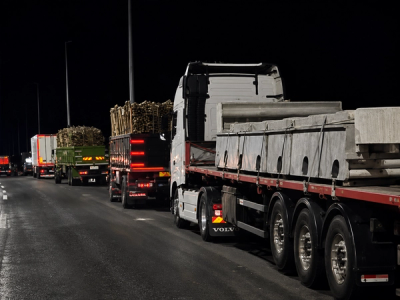
Trucks at the Dogharoun border crossing between Iran and Afghanistan (ISNA).
Iran says a US land blockade would be nearly impossible to enforce, citing extensive economic ties with neighboring countries and alternative supply routes as Washington seeks to widen the reach of its naval blockade.
Foreign Minister Abbas Araghchi dismissed the prospect of Washington sealing Iran's land borders in an interview with state news agency IRNA on Monday, pointing to the country's geographical size and the economic capabilities of its provinces.
“A land blockade of Iran is almost impossible,” Araghchi said.
Speaking after a meeting with heads of the Foreign Ministry's provincial offices, Araghchi highlighted frequent cross-border movement and longstanding historical and cultural ties with neighboring countries.
He said Iran's border provinces could “open the routes that the enemy seeks to close to us.”
His remarks come more than two weeks after US Central Command (CENTCOM) announced the establishment of Task Force Iron Gate to disrupt Iranian supply networks across the country's land borders and the Caspian Sea, targeting shipments of advanced weapons, dual-use technology and sanctioned materials, as well as illicit financial flows.
CENTCOM commander Admiral Brad Cooper said on November 7 that closer coordination with other US government agencies would “further constrain Iran's ability to finance terrorism, rebuild weapons factories, and replenish their military.”
Hamid Ghanbari, deputy foreign minister for economic diplomacy, said Monday that Iran had been preparing for such restrictions for years, developing alternative trade corridors and pursuing preferential trade agreements with neighboring countries and the Eurasian Economic Union to reduce its reliance on southern ports.
“Despite all these pressures, no shortage of goods is being felt in the country today,” Ghanbari said, while acknowledging that US restrictions had inflicted economic damage and caused hardship for Iranians.
He acknowledged, however, that redirecting freight from southern ports to land crossings had exposed shortcomings in Iran's transport infrastructure, which had not been equipped to handle such volumes.
Ghanbari said capacity was gradually being expanded and that temporary disruptions at several eastern and western border crossings had been resolved.
The limitations of overland trade had already raised concerns among Iranian business representatives.
Davoud Rangi, vice chair of Iran's Chamber of Commerce Import Management Committee, warned in August that replacing a single ship carrying essential goods would require around 2,500 trucks.
He said land corridors lacked the capacity to replace maritime imports and that relying on them would sharply increase transportation costs.
Araghchi stressed that efforts to withstand economic pressure did not mean abandoning diplomacy.
“We must make those imposing sanctions despair of achieving their objectives,” he said, adding that diplomatic efforts to negotiate the removal of sanctions were continuing.
Pressure on neighboring countries
Araghchi said the Foreign Ministry had tasked its provincial offices and embassies in neighboring countries with expanding cross-border trade, working with local authorities and businesses to identify new economic opportunities.
Ghanbari said Iran's neighbors had largely maintained commercial ties with the country despite US pressure, with nearly all of its border crossings now operating normally.
Iraqi Foreign Minister Fuad Hussein said on November 8 that the US Treasury had asked Baghdad to close all but two of its border crossings with Iran.
Hussein told Al Jazeera that closing the crossings would be difficult and would damage Iraq's economy, adding that discussions with Washington were continuing.
US officials had spent weeks unsuccessfully pressing Iran's neighbors to close their border crossings, the New York Times reported on November 11, citing three Iraqi officials and a US official familiar with the discussions.
Turkey had largely resisted changing its border policies, while Iraq had rejected Washington's request despite temporarily closing some crossings. Pakistan had intermittently shut crossings, citing security concerns and new import procedures.
The newspaper reported that neighboring countries feared tighter trade restrictions on Iran could damage their own economies and trigger unrest in border communities dependent on cross-border commerce.
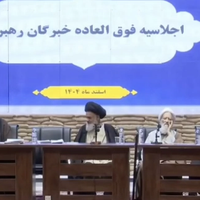
اسکرینشاتی از ویدیوی جلسه مجلس خبرگان در اسفند ۱۴۰۴ که در آن مجتبی خامنهای به رهبری جمهوری اسلامی انتخاب شد.
Iranian state media left the location unnamed when they released footage of a March meeting where clerics chose Mojtaba Khamenei to succeed his father. However, a detail at the front of the room helped identify it.
The Assembly of Experts, the clerical body tasked under Article 107 of Iran’s constitution with choosing the supreme leader, met after Ali Khamenei was killed in US-Israeli strikes on February 28.
Two members date the meeting to March 8. The Assembly publicly named his son as his successor shortly after midnight the following day, Tehran time.
Iranian state media released the 53-second video on November 22, more than eight months after the succession. An unidentified man announces that Mojtaba Khamenei received more than two-thirds of the vote. Assembly members respond with chants of “Allah Akbar” (God is greatest).
Khamenei himself does not appear. No independently verified photograph, video or audio recording of Khamenei from his time in office has surfaced. His directives have reached the public through undated statements and officials who relay his words. His absence has raised questions about whether he is alive and how much authority he exercises relative to the Islamic Revolutionary Guard Corps (IRGC).
The footage offers a rare look at how the clerics received the announcement. In interviews intercut with the meeting, members describe their fear of assassination and the security arrangements for getting them to the hall.
Mohsen Qomi, a member of the Assembly’s presiding board, credited the Revolutionary Guards with making the meeting possible.
The video was circulated on Instagram with a caption describing it as the first footage of the announcement. A banner on screen makes the same claim. Neither identifies the venue or gives the day of the meeting.
Iran International had reported on March 5 that a session planned for that day would be held largely online and that at least eight members would stay away. The footage shows clerics gathered in person for the announcement.
How the hall was identified
At the front of the hall, a wall of decorative sandbags runs beneath a large screen. A wooden desk with three horizontal slots stands in front of it.
The same wall and desk appear in photographs of a provincial council meeting held in Qom six months later.
Figure 1. The dais. The sandbag wall in front of the LED screen (Red 1) and the wooden desk with three horizontal slits (Yellow 1) appear in both.
Defa Press published the photographs on September 22. Taken by Zeinab Zamani, they show Qom’s governor chairing the fifth session of the provincial administrative council the previous evening. The caption names the Isar Conference Hall at Qom’s Cultural Center and Museum of the Islamic Revolution and Holy Defense.
Figure 2. The seating. The five chairs on the right aisle (Green), the center block with distinct front-row seats (Yellow 2) and the portable table before the front row (Red 2) appear in both.
The seating provides a second match. Both sets of images show five chairs of the same type along the right aisle, a distinctive front row in the center block and a small table in front of it.
The annotations below mark the corresponding features.
How members dated the meeting
The screen behind the speakers reads “Special Meeting of the Assembly of Experts, Esfand 1404.” That month of the Iranian calendar ran from February 20 to March 20. The meeting took place after Ali Khamenei’s death on February 28 and before the Assembly announced his successor. Mehr News Agency carried the announcement at 3:17 a.m. on March 9 in Tehran, still March 8 GMT.
On March 9, Mehr quoted Assembly member Ahmad Khatami as saying the clerics had met in person in Qom the previous evening, the first of the Nights of Qadr, the holiest nights of Ramadan.
Qomi also dated the session to Sunday, March 8, in a statement carried by the state news agency IRNA. He said 59 of the Assembly’s 84 members attended and that the result was announced immediately. He estimated that Khamenei received about three-quarters of the vote.
A third member, Mostafa Hasanati, the Friday prayer leader of Najafabad, described an earlier attempt to vote individually. In a video published by Entekhab on November 23, he said members initially cast ballots one by one using sealed envelopes. Fearing the procedure would cast doubt on the result, they wrote that they wanted to meet in person “even if we are torn to pieces.”
Hasanati said it took three or four days to bring the clerics together on a Night of Qadr. Of the three possible evenings, only March 8 preceded the public announcement. The other two fell on March 10 and 12.
Like Qomi, Hasanati put attendance at 59. He said 49 voted for Khamenei, or 83% of those present. His tally and Qomi’s estimate both fit the description heard in the video, “more than two thirds.” The footage does not establish the exact count.
Hasanati said members had first tried to gather at the Fatima Masumeh Shrine in Qom, but called off the meeting when fighter jets flew overhead. Iran International reported on March 5 that the session planned for that day was to be run from a building next to the shrine.
Tasnim news agency reported that the Assembly’s seat in Tehran was struck on the night of March 2 and its secretariat in Qom the following day. Tasnim said the Qom building was empty at the time.
Qom’s deputy governor for political and security affairs later put the toll in the city’s Resalat Square at six killed and 30 wounded. The Assembly’s secretariat said three of its employees had been killed.
Neither account specified whether anyone was inside the secretariat when it was hit. Qomi referred to strikes on two Assembly buildings in Qom. The visual evidence places the succession meeting at the museum.
[@portabletext/react] Unknown block type "table", specify a component for it in the `components.types` prop
What the clerics recalled
The interviews give a sense of the precautions surrounding the vote and how little time the members spent together.
Reza Ramezani Gilani recalled being driven around for up to two hours. Mohammad Baqer Mohammadi Laeini said only Assembly members were present when they reached the venue.
Ali Abbasi put the time between arrival and departure at no more than 40 to 45 minutes. He did not say how much of that time the members spent deliberating.
Mohsen Mohammadi Araki said all members were targets for assassination. Hashem Hosseini Bushehri described the difficulty of making a decision during wartime.
The video also includes Rahim Tavakol saying, “We stand by our word.” The excerpt gives little context for the remark.
[@portabletext/react] Unknown block type "table", specify a component for it in the `components.types` prop
At the front of the hall, an unidentified man reads out the result.
“His Holiness Ayatollah Sayyed Mojtaba Khamenei with a majority of more than two thirds of the vote was introduced as the next Supreme Leader.”
The members respond with chants of “Allah Akbar.”
Figure 3. Google Maps satellite view of the Museum of Holy Defense on Avini North Boulevard, Qom (Plus Code: JV22+3XR), where the meeting was held.
A photo released by Fars News Agency in November 2025 shows hardline Iranian lawmaker Hamid Rasaei browsing his Telegram account on his tablet during a parliamentary session.
A dispute over a convicted lawmaker’s voting tablet has divided Iran’s parliament, with a news agency accusing ultraconservatives on Monday of forcing the cancellation of Sunday’s session and allowing a factional feud to halt the work of the legislature.
The dispute centered on Hamid Rasaei, a hardline Tehran MP and outspoken critic of Parliament Speaker Mohammad Bagher Ghalibaf. Rasaei had been granted temporary leave from Evin Prison, where he began serving a 10-month sentence in September over an article accusing Ghalibaf of tampering with parliamentary documents.
Rasaei arrived at parliament on Sunday to find his access to the tablet system lawmakers use to participate and vote remotely still blocked.
Several allies, including Tehran MPs Mehdi Kouchakzadeh and Ali Khezrian, demanded that his access be restored and threatened to disrupt proceedings once the session opened, ILNA reported.
Enough lawmakers were present in person or online for a quorum. After about 90 minutes of efforts to resolve the dispute, the parliamentary leadership, chaired that day by Deputy Speaker Ali Nikzad, canceled the sitting.
Rasaei gave a different account, accusing Ghalibaf of refusing to restore his access and saying the leadership called off the session because it feared what he might say on the floor.
Parliament’s media office said Rasaei was still serving his sentence and his leave had expired. Lawmakers had raised the issue the previous Wednesday, when Deputy Speaker Hamidreza Haji-Babaei said parliament had asked the judiciary whether Rasaei could exercise his parliamentary duties while on leave. By Sunday, it had received no reply.
In its Monday analysis, ILNA said Rasaei and his allies had grounds to seek a ruling on his voting rights. But by threatening to disrupt the sitting, lawmakers close to the ultraconservative Paydari Front had turned a legal question into a show of factional strength. The agency also faulted the leadership for giving a handful of MPs an effective veto over whether the rest could meet.
“Parliament must not be held hostage to factional sensitivities,” ILNA wrote. “Not today, not tomorrow, not over a tablet or anything else.”
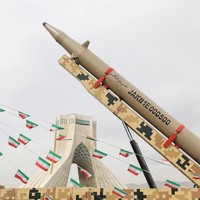
The front page of Tehran’s municipal newspaper Hamshahri on Monday featured an image under the headline “All of Europe within Iran’s range.”
Iranian officials have renewed threats against military bases in Europe, with a lawmaker saying the country's missiles can now reach 4,500 kilometers, more than twice their previously declared range.
Ahmad Bakhshayesh Ardestani, a member of parliament's National Security and Foreign Policy Committee, said Monday that Iran's missile range had increased from 2,000 to 4,500 kilometers, placing European military bases within reach.
“Our young leader has announced that missiles must be made accurate and capable of precision strikes. This means we have Europe within our grasp,” Bakhshayesh Ardestani said.
The lawmaker offered no independent technical evidence for the 4,500-kilometer figure. Iran's previously declared missile range of approximately 2,000 kilometers already placed parts of southern and southeastern Europe within reach.
Daily threatens European bases
Hamshahri, a newspaper owned by Tehran Municipality, published an image on Monday under the headline “All of Europe within Iran's range.”
The newspaper suggested that an order to respond to attacks without geographical restrictions could signal a shift in Iran's military strategy.
“Increasing the range of ballistic missiles to approximately 5,000 kilometers has raised concerns among Western countries,” Hamshahri wrote.
On November 3, Hamshahri published a map identifying US military bases and infrastructure across Europe as potential targets. Another article published by Hamshahri Online, citing the newspaper Javan, identified facilities in Cyprus and Greece.
Ebrahim Azizi, chairman of parliament's National Security and Foreign Policy Committee, said Monday that Iran's armed forces had developed the capability to make “enemies” regret attacking the country and were at their highest level of readiness, according to Tasnim, a news agency affiliated with the Revolutionary Guards.
Khamenei orders longer-range missiles
Qassem Qoreishi, deputy head of the Basij organization, said on November 18 that Mojtaba Khamenei had ordered the armed forces to increase missile range in response to the possibility of US operations shifting to more distant bases.
The following day, Qoreishi said Khamenei had also called for greater missile accuracy.
Mohammad Mokhber, an adviser to Khamenei, previously interpreted the leader's call for responses without geographical restrictions as removing limits on missile range.
The Revolutionary Guards subsequently announced that Iran's self-imposed 2,000-kilometer limit had been lifted, without specifying whether longer-range missiles had been developed or deployed.
Tasnim has suggested that modifications to the Khorramshahr-4 missile, including reducing warhead weight, could extend its range to between 3,000 and 4,000 kilometers.
Missile capabilities face questions
An earlier Revolutionary Guards attack on the joint US-British base at Diego Garcia in the Indian Ocean involved two missiles, neither of which reached its target. One was intercepted and the other failed during flight.
Israeli officials estimated their range at approximately 4,000 kilometers, while the Associated Press raised the possibility that satellite-launch technology contributed to the extended range.
The unsuccessful strike did not establish that Iran possesses missiles capable of consistently delivering accurate strikes at such distances.
Damage to missile facilities and difficulties obtaining foreign components have further constrained production, leaving questions about whether Iran's declared longer-range capabilities can be deployed reliably.