Sex work blessed by religion: Inside Iran’s temporary marriage network
A woman in Tehran enters a dwelling next to an entrance sealed and marked as closed by court order
Online platforms for temporary marriage, or sigheh, in Iran give men access to an underground sex economy that - far from totally contradicting the ruling theocracy - flourishes with a certain religious blessing.
On messaging apps like Telegram, channels advertise “Islamic marriage services.”
The language is coded—halal sigheh, “marriage under sharia supervision,” or “regulated Islamic companionship” — but the business model is simple: pick, pay and meet.
Under Iran's Shi'ite Muslim legal code, men are legally permitted to enter into temporary marriages for a fixed period—ranging from minutes to years—without court approval or official registration.
These marriages automatically dissolve when the agreed-upon time expires.
Iran International encountered a functioning industry of religiously sanctioned pimping, one that exploits the legal ambiguity of sigheh to facilitate sex work. Many users are conned. But some are not.
While screenshots were translated from Farsi, no photos—even blurred ones—have been included in this report, as we could not verify whether the women pictured were genuinely behind the profiles used in these exchanges.
All screenshots referenced in this investigation were translated from the original Farsi to English for clarity. Personal communication details, including phone numbers, account handles, and payment information, have been removed to protect the security and privacy of those involved.
Iran International contacted several channels and in half the cases, different women responded from different numbers. One sent audio replies. Another agreed to meet in person—for a cash exchange, if a deposit was paid.
In another case, a woman offered options for a short-term arrangement and said she was working “with the support of a governmental office,” insisting that payment be made to their account first.
To obtain a woman’s contact information alone, clients are typically asked to pay between 3 million to 5 million rials (roughly $3.50 to $6 at current exchange rates). Full service arrangements labeled as “monthly sigheh contracts” range from 70 to 400 million rials ($83 to $476), with rates varying based on location, age or even height.
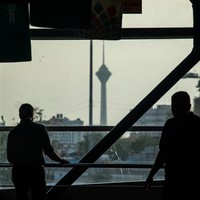
In one case in Iran International's investigation, a woman arranged to meet at a metro station in west Tehran after initial negotiations, with two rounds of fees—labeled as 'identification' and 'dowry'—required as conditions to be paid after the meeting.
“Bring the balance in cash,” she instructed. “After we talk, if you’re satisfied, we go somewhere.” Her tone was direct and businesslike. The transaction mirrored sex work in every way—except it was presented as a religious contract.
'Virginity guaranteed'
The channels involved do not describe sigheh as a sexual service. Instead, they variously frame it as a “pious alternative to sinful behavior”—“a way to support chaste women,” one wrote.
Listings often include physical traits, education level and place of residence. Some promise “virginity guaranteed.” Longer-term packages come with varying price tags—often higher for women labeled as educated or Tehran-based.
“We only use women who are under the protection of the Islamic Republic. No funny business. Everything is legal under sharia,” wrote another channel.
Behind that language lies a structured operation. Clients are matched. Money is transferred through intermediary accounts—typically under male names.
Some users told Iran International that they had even received handwritten contracts and met women after paying.
Yet scams still exist. Some men are strung along with fake profiles and asked for repeated payments—dowries, insurance fees, “pregnancy contingencies”—only to have contact cut off once the money is sent.
One man in Karaj who spoke on condition of anonymity told Iran International: “I sent money three times. Each time there was a new excuse. The last time, they asked for an abortion deposit. Then she vanished.”
The online platforms are not licensed or regulated by the state but are not shut down either. Their visibility on domestic platforms points to at least a passive tolerance from authorities.
Even Fars News, which is close to Iran's Islamic Revolutionary Guard Corps, wrote on the phenomenon on Wednesday but mostly sought to discredit the platforms as a scam aiming to defraud credulous men.
But it also implicitly acknowledged the existence of real actors within the system.
“Our field investigation shows that many of these pages lack any official or legal license and are mostly created for purposes such as fraud, extortion, and even the dissemination of users' personal information,” the outlet wrote.
The use of “many” rather than “all” leaves room for exceptions—an implicit admission that not every channel is fake and that some do involve actual individuals, transactions, and encounters.
An apparent official tolerance of sigheh as a moral buffer against paid sex appears to have opened the door to commodifying women under theological cover. Prostitution is criminalized and punished, yet sigheh remains legal and broadly interpreted—creating a religiously sanctioned loophole.
“Pimping is illegal,” said a Tehran-based legal expert who requested anonymity for security reasons. “But sigheh offers a loophole. If the woman agrees, there’s a contract, and it’s framed as religious—who’s going to prosecute it?”
The line between religiously permitted marriage and outright sexual commerce is not just blurred—it has become a business model. For the Islamic Republic, it is one that hides in plain sight, cloaked in doctrine and fueled by tanking standards of living and deepening poverty.
Far from being limited to scams, the sigheh economy has become a channel for monetizing sexual access under the guise of religious propriety.
France will file a legal complaint against Iran at the International Court of Justice (ICJ) on Friday over the prolonged detention of two French nationals, the foreign ministry said on Thursday.
Cécile Kohler and her partner Jacques Paris have been held in Iran since May 2022 on espionage charges that Paris has strongly denied.
French authorities accuse Tehran of subjecting the couple to conditions akin to torture in Tehran’s Evin prison and failing to provide consular access.
“I can confirm that France will bring a case before the International Court of Justice tomorrow,” said foreign ministry spokesperson Christophe Lemoine.
Iranian state television previously broadcast videos of the two appearing to confess, but France has denounced the footage as the result of forced confessions.
Earlier in the month, French President Emmanuel Macron has referred to the couple as “hostages” and vowed to secure their release, as France and other EU states accuse Iran of engaging in “hostage diplomacy” by detaining foreign nationals to extract political concessions.
An unknown number of international citizens are being held by Tehran, including Europeans.
In January, the European Parliament adopted a motion for a resolution condemning Iran’s detention of European Union citizens, labelling the practice as “hostage diplomacy.”
Iran has denied mistreatment or political motives in the detentions, although reports by rights groups such as Human Rights Watch and Amnesty International have documented the practice extensively, including the use of forced confessions.
Oil prices fell sharply on Thursday as signs of progress in US-Iran nuclear negotiations and an unexpected rise in US crude inventories raised concerns about a potential supply glut.
Brent crude futures dropped as much as 3.7% to $63.68 a barrel in early trade before paring losses to $63.98. US West Texas Intermediate (WTI) crude fell 3.3% to $61.05.
The sell-off followed remarks by US President Donald Trump, who said Washington was in "very serious negotiations with Iran for long-term peace" during his tour of the Persian Gulf, adding that Tehran had "sort of" agreed to US terms for a possible deal.
Traders view a possible agreement as a step toward easing sanctions on Iran, which could pave the way for the return of Iranian oil exports to global markets.
Adding to the downward pressure, data released late Wednesday showed an unexpected build in US crude inventories last week, fueling concerns about oversupply.
"The market is reacting to both the political developments and the inventory surprise," said a trader at a London-based commodities firm. "Any indication that Iranian barrels could re-enter the market weighs on prices."
Earlier this week, markets rallied on a US-China trade truce and a flurry of investment deals unveiled during Trump's visit to the Middle East.
Still, oil markets remain volatile as investors weigh the potential timing and terms of any US-Iran agreement, along with broader macroeconomic risks.
When US President Donald Trump torched Iran’s leadership in a long speech in front of Saudi Arabia’s crown prince in Riyadh on Tuesday, he likely didn’t anticipate how warmly his words would resonate with many Iranians—or perhaps he did.
Across Persian-language social media, many users were almost in awe, surprised with both the content and tone of Trump’s speech. Even journalists inside Iran couldn’t help risking reprimand by praising a US president.
“It was so intelligent of Trump to highlight issues such as the destruction of monuments and the water mafia,” renowned journalist Sadra Mohaqeq wrote on X. "And what a coincidence that he said all this on the same day he lifted US sanctions on Syria."
In his speech in Riyadh, Trump described the Islamic Republic as a “destructive” force, accusing the rulers in Tehran of “stealing their people’s wealth to fund terror and bloodshed abroad,” just as neighboring Arab leaders were building their countries.
"No one could have described the situation of a plundered country in a few sentences better than Trump," Middle Eastern Studies student Masoud Paydari posted on X.
"He uttered the harshest and most bitter words with complete politeness," a classmate commented under his post.
Trump had no good words for Iran’s supreme leader Ali Khamenei but all the world’s praise for Mohammad Bin Salman. Still, he left the door open for a “better and hopeful future” if Tehran chose to change course.
"He spoke as if he were a fellow Iranian chatting with a friend. His words were so clear. Iran’s officials should die of shame," user Maryamgh wrote on X. Many agreed, suggesting that an Iranian writer may have helped draft the US President’s speech.
Trump’s comments on Iran’s nuclear program were largely overlooked by Iranians on social media. It was his lengthy and detailed remarks about mismanagement, economic waste and cultural neglect that clearly struck a nerve.
"In a country on the southern part of the Persian Gulf, major international investors line up to offer cooperation, while another country on the northern part of the same gulf is left with no trade partners,” a user posting as Cryptosamz wrote on X, “because all its officials, from top to bottom, are thieves."
While social media users reacted with rare openness, Tehran’s major dailies remained conspicuously silent. Under apparent pressure not to credit Trump in Iran's tightly-controlled media landscape, they avoided the speech altogether.
Hardliners largely ignored it as well.
Kayhan, whose chief is appointed by Khamenei, was the only paper to address the speech directly, dismissing it as "reckless" with little elaboration. The IRGC-linked Javan stuck to its combative line. "We won’t negotiate if they insist on zero enrichment," read the headline.
State media covered Trump’s visit without pointing out its economic significance.
The wealth being amassed on the other side of the Persian Gulf was derided as mere "petrodollars," with no words of self-reflection on why they freely sell oil, reinvest profits, and fund global ventures as Iran—sitting on comparable if not superior natural resources—struggles to meet basic needs like water and electricity.
Iran's Supreme Leader Ali Khamenei issued one of his strongest denunciations of the West and Israel in recent months, vowing that the Islamic Republic would continue to confront what he described as Western-backed “savagery and bloodshed.”
"Standing up against the crimes and barbarism of the Zionist regime in Gaza and the West's support for this bloodshed is a collective duty," Khamenei told a group of Red Crescent Society rescue workers on Monday.
"Today, the world is being run by these human-like beasts, and the Islamic Republic considers it its duty to stand against their savagery and bloodshed," he added, according to a readout of his remarks published by his website on Wednesday.
The remarks were among the sharpest since talks between the United States and Iran began last month, and were published after US President Donald Trump lambasted Tehran's foreign and domestic policy in a Riyadh speech on Tuesday.
"It is precisely this sense of duty that drives enemies—like these well-dressed, cologne-wearing, Western savages in suits—to stand against and show hostility toward the Islamic Republic. If we stop opposing their barbarity, they would have no enmity with us," Khamenei said.
"The main issue of the Western bullies as the Islamic Republic's rejection of their false civilization and said: Falsehood is doomed to decline and destruction," he added.
Iran’s Expediency Council has conditionally approved the country’s accession to the Palermo Convention, one of the two key legislative items tied to the Financial Action Task Force (FATF) standards aimed at addressing money laundering and terrorism financing.
The move could ease Iran’s exit from the international money laundering blacklist and restore access to global banking should Western sanctions against it be lifted.
In a brief statement, the council's spokesman Mohsen Dehnavi announced it had agreed to join the UN convention against transnational organized crime, “within the framework of the Constitution and domestic laws.”
The decision marks a cautious step toward meeting FATF requirements but falls short of full endorsement.
The council also confirmed that discussions on the related Countering the Financing of Terrorism (CFT) bill will continue in upcoming sessions.
In a letter to Expediency Council chairman Sadeq Amoli Larijani, they argued that any approval—conditional or not—should wait until the risk of the UN “snapback” sanctions mechanism is entirely eliminated.
The snapback mechanism, which allows for the automatic reimposition of UN sanctions under the 2015 nuclear deal, is set to expire in October 2025 unless triggered by a signatory.
While Larijani recently hinted that conditional approval might be viable, conservative MPs have warned that even limited compliance could make Iran vulnerable to external pressure and economic penalties.
The FATF has kept Iran on its blacklist due to its failure to adopt international standards on money laundering and terror financing.