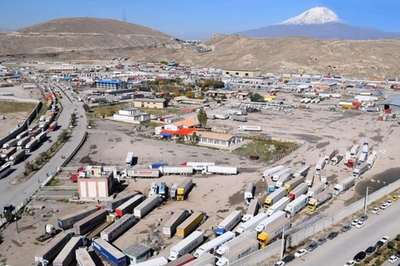
A special event honoring the Iranian community in the United Arab Emirates, held at the Dubai Exhibition Centre in Expo City Dubai on September 13, 2025. / Photo by WAM
The United Arab Emirates’ decision to halt all trade and financial transactions with Iran threatens one of Tehran’s most important routes for imports, petroleum-product sales and access to international commercial and financial networks.
The UAE Foreign Ministry said this week that all trade, commercial exchanges and financial transactions with Iran had been halted until further notice.
Afra Al Hameli, director of the Strategic Communications Department at the UAE Ministry of Foreign Affairs, said the decision came “in light of regional escalations that undermine regional and international peace and security.”
The UAE halted trade with Tehran a day after Donald Trump spoke by phone with UAE President Sheikh Mohamed bin Zayed, though it is unclear whether the decision was connected to Trump’s “Economic D-Day” campaign against Iran, announced later on Wednesday.
Trade between the two countries had already been severely disrupted after the war began in late February, when Iran launched attacks on the UAE and shipping through the Strait of Hormuz was curtailed.
In late June, however, Mohammad-Sadegh Ghannadzadeh, a deputy at Iran’s Trade Promotion Organization, said commercial exchanges with the UAE were gradually resuming through Jebel Ali Port. He said goods and containers stranded during the war were again being cleared and moved toward Iran.
The latest UAE announcement now casts doubt on the continuation of that channel.
Al Hameli also stressed that the UAE remains committed to protecting the integrity of the international financial system, complying with international law and applying the highest global standards.
That position is significant because even if political tensions eventually ease, Iranian businesses would still face serious restrictions stemming from US sanctions and Iran’s continued status as a high-risk jurisdiction subject to a Financial Action Task Force call for countermeasures.
One of Iran’s most important trading partners
The importance of the UAE to Iran can be seen in the latest official partner-by-partner trade figures available from Iranian customs.
During the first 10 months of the Iranian fiscal year that began in March 2025, Iran exported around $6.5 billion worth of non-oil goods to the UAE, equivalent to 14.3% of its non-oil exports.
Iran imported approximately $14.8 billion worth of goods from the UAE during the same period, accounting for 30.2% of its total imports.
Before the war, the UAE was therefore Iran’s largest supplier of goods and its third-largest destination for non-oil exports, behind China and Iraq.
Its importance extended well beyond ordinary merchandise trade. The UAE was also the largest destination for Iranian fuel oil, or mazut, and a market for other petroleum products.
A blow to mazut exports and fuel supply
Data from commodity intelligence firm Kpler, reviewed by Iran International, show that Iran exported an average of around 256,000 barrels per day of fuel oil in 2025.
Nearly 70% went to the UAE, making it by far Iran’s largest market for the product.
A prolonged halt in trade therefore threatens not only Iran’s non-oil exports but one of its most important outlets for petroleum products.
The UAE had also been among the destinations for Iranian liquefied petroleum gas, or LPG, although China accounts for the large majority of Iranian LPG exports. Iran’s total LPG exports generate more than $10 billion in annual revenue.
The UAE relationship is also important from the opposite direction.
An internal Iranian Oil Ministry report previously reviewed by Iran International showed that Tehran had increasingly relied on barter arrangements to meet domestic fuel shortages, exchanging part of its mazut exports for gasoline and diesel, particularly through traders operating in the UAE.
Iran is already struggling with a gasoline supply deficit, while officials have discussed measures ranging from tighter rationing to higher fuel prices.
Restricting access to the UAE could therefore affect not only export revenue but Iran’s ability to obtain products and refined fuels needed by the domestic market.
The end of Dubai’s role as Iran’s gateway to global trade?
The UAE’s importance to Iran has never been limited to direct bilateral trade.
For decades, Dubai has served as one of the principal re-export hubs for goods entering Iran, allowing Iranian companies to obtain products manufactured in countries with which direct trade is difficult, costly or restricted.
US sanctions and Iran’s exclusion from much of the international banking system have made this intermediary role particularly important.
Goods manufactured in Europe and Asia have routinely entered Iran through UAE-based traders and logistics networks, while Iranian companies have also used Dubai as a route to reach other markets.
The financial dimension is equally important. Dubai has long been a center for Iranian exchange houses, trading companies and intermediaries that help move money across borders despite Iran’s restricted access to the global financial system.
US sanctions packages targeting Iranian oil, petrochemical and procurement networks have repeatedly designated companies and individuals based in the UAE for alleged roles in facilitating transactions on Tehran’s behalf.
A broad and sustained UAE crackdown would therefore affect more than the physical movement of goods. It could also constrain financial, logistical and commercial networks that Iran has spent years using to mitigate its international isolation.
A major new gap for Iran’s economy
The latest available Iranian customs breakdown shows that merchandise trade between Iran and the UAE totaled about $21.3 billion in just the first 10 months of the previous Iranian fiscal year.
But even that figure understates the UAE’s economic importance because it does not capture Dubai’s wider role as a re-export, logistics and financial center for Iranian businesses.
Iran is now confronting the UAE halt while already under pressure from sanctions, foreign-currency constraints, weaker foreign trade and disruptions to energy exports.
Alternative routes through Oman, Iraq, Turkey and other neighboring countries can keep some trade moving, but they lack the combination of proximity, port infrastructure, financial connectivity and established commercial networks that Dubai offered.
The UAE has given no timetable for lifting its suspension.
For Iran, the risk is therefore not simply the loss of billions of dollars in bilateral trade. A prolonged halt could close one of its most important gateways to the global economy.
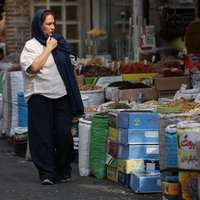
An Iranian woman buys eggs in Tehran / Photo by Reuters
Donald Trump has promised an “Economic D-Day” against Iran, a threat Tehran dismissed as another failed US policy. But with inflation, shipping costs and supply strains already biting, how much more pressure can Iran’s fragile economy absorb?
President Donald Trump on Wednesday announced what he called the “most crushing economic operation ever taken against any country,” threatening unprecedented economic isolation and consequences for countries whose financial institutions, businesses or government entities continue providing Tehran with an economic lifeline.
“Oil smuggling, swap lines, cash transfers, exchange houses, ship registries, front companies — it all needs to stop NOW,” Trump wrote on Truth Social, calling on US allies to join the campaign.
Iranian Foreign Minister Abbas Araghchi dismissed the announcement on Thursday as “doubling down on failed policies,” while Iran’s Foreign Ministry called the campaign “economic terrorism” and a “crime against humanity,” saying Tehran would continue resisting US military, economic and political pressure.
The Trump administration, however, is signaling that the campaign could go considerably further than existing sanctions.
Treasury Secretary Scott Bessent told CNBC on Thursday that Washington would impose the “toughest sanctions in history” on Iran and said the administration would outline its measures on Monday.
“It is going to work in Iran and we are going to collapse this regime,” Bessent said.
He said countries continuing to do business with Tehran would face US enforcement actions. Asked whether that could include China, which buys the overwhelming majority of Iran’s shipped oil, Bessent said some conversations were better held privately.
Bessent also suggested that “maximum economic pressure” could reduce the likelihood of another major military phase, describing the economic campaign and the US naval blockade as a “one-two punch.”
Already under strain
Even before the new US economic campaign was announced, Iranian economic reporting was documenting the price the confrontation was already imposing at home: higher shipping costs, pressure on medicine supplies and further strain on household budgets.
Emergency Central Bank allocations have enabled round-the-clock clearance of wheat and pharmaceutical imports at Shahid Rajaee Port in Bandar Abbas, yet reports by ILNA and Donya-ye Eghtesad said container freight rates remained 35 to 40 percent above baseline because of persistent war-risk surcharges.
The pressure is also reaching medicine supplies. On Monday, a major pharmaceutical company in Tehran said the government could no longer provide the foreign currency it required at subsidized rates, warning that some medicines could disappear from shelves or be sold at two to three times current prices.
Donya-ye Eghtesad has linked elevated shipping costs to domestic production bottlenecks, arguing that more expensive freight raises the cost of imported intermediate goods and adds to broader inflationary pressure.
The paper said temporary customs measures were treating symptoms rather than causes, with high insurance premiums and port congestion continuing to increase raw-material costs.
“So long as transit protocols remain uncodified,” the daily wrote, “industrial input costs will remain elevated, eroding domestic purchasing power daily.”
Those pressures are hitting an economy already struggling with steep inflation. Iran’s 12-month inflation rate reached 66 percent in July, while food prices were 128 percent higher than a year earlier. War, sanctions and disruptions to trade and imports have further squeezed household purchasing power.
Cooking oil, meat and dairy products have moved beyond the reach of many working- and middle-class families. Iranian reports describe households cutting back on staples and non-essential spending, while a kilogram of lamb can consume up to 10 percent of a minimum-wage worker’s monthly income.
Housing costs have also intensified the squeeze. Rents have risen sharply in major cities including Tehran, Mashhad and Isfahan despite nominal government caps, increasing housing insecurity and pushing some families toward cheaper districts or shared accommodation.
Iranian reports increasingly describe teachers, civil servants and office workers struggling to maintain their living standards despite holding multiple jobs. Peripheral provinces including Ilam, Sistan-Baluchestan and Kurdistan face even greater economic pressure.
Less leverage at Hormuz
Compounding that vulnerability, Iran may also be losing some of the strategic leverage it hoped to gain from disrupting traffic through the Strait of Hormuz.
CNN reported Wednesday that more than 80 percent of recent liquid cargo transits through Hormuz had either used the Omani route or traveled with transponders switched off and likely followed it.
Axios separately reported that the US military was operating a shipping corridor along the Omani side of the Strait, helping 15 to 20 tankers enter or leave the Persian Gulf each night.
The reports suggest Iran could be left absorbing many of the economic consequences of disruption at Hormuz while gaining less bargaining power from it.
That also changes the context of Iran’s negotiations with Oman over navigation through the Strait. Foreign Ministry spokesman Esmaeil Baghaei said Iranian and Omani technical teams had agreed on geographic coordinates and navigation lanes for a proposed shipping scheme.
Iranian economic commentary had portrayed formalization of such an arrangement as important to lowering insurance and shipping costs. But if Washington can increasingly move vessels through an Oman-side corridor without an agreement that gives Tehran a central role, Iran may have less ability to use the Strait to extract political or economic concessions.
Iran has endured decades of US sanctions and built extensive networks to circumvent them, giving Tehran reason to doubt whether another pressure campaign can force a change in course.
But the starting point this time is different: an economy already weakened by inflation, disrupted trade and the costs of war, while one of Tehran’s most important sources of leverage appears to be eroding.
Trump has yet to spell out the full measures behind his “Economic D-Day.” Bessent says those details will come Monday. The question is whether Washington can close enough of Iran’s remaining economic lifelines to impose pressure Tehran cannot absorb — or whether the Islamic Republic can once again adapt while passing much of the cost on to ordinary Iranians.
US Secretary of State Marco Rubio meets Greek Foreign Minister Giorgos Gerapetritis in Washington, March 1, 2025. (Marco Rubio/X)
For years, diplomacy between Iran and the United States has largely been conducted through a familiar group of intermediaries.
Oman has traditionally provided the most discreet and trusted channel, while Qatar, Pakistan and Turkey have used their relations with both sides to facilitate contacts or transmit messages.
Yet the continuing deadlock in negotiations has now encouraged Washington to widen the diplomatic circle.
In recent days, Austria and Greece have separately opened contacts with Tehran after consultations with US Secretary of State Marco Rubio, according to media reports.
The unexpected involvement of Austria and Greece suggests that European diplomacy, long marginalized in the Iran-US relationship, may be making a cautious return in the context of a regional military escalation.
The sequence of recent contacts is striking. US Secretary of State Marco Rubio met Austrian Foreign Minister Beate Meinl-Reisinger in Washington on August 11 and spoke by telephone with Greek Foreign Minister George Gerapetritis the following day. On August 13, both European ministers held separate conversations with Iranian Foreign Minister Abbas Araghchi. Although the US State Department denied asking them to transmit messages, the timing was probably not coincidental. The State Department subsequently confirmed that Iran had been discussed, while Austria formally offered Vienna as a venue for potential future talks. Greece emphasized freedom of navigation and maritime security in its exchanges with Tehran.
This is not yet formal mediation. Neither Austria nor Greece has the experience, access or accumulated trust that Oman possesses. Their involvement should instead be understood as an exploratory attempt to identify additional channels at a moment when traditional diplomacy is struggling. The proliferation of intermediaries itself is revealing: it demonstrates not the vitality of the diplomatic process, but its fragmentation.
Austria’s possible role is rooted in diplomatic history. Vienna hosted negotiations that culminated in the July 14, 2015 nuclear agreement, formally known as the Joint Comprehensive Plan of Action (JCPOA). It is also home to the International Atomic Energy Agency, which would likely play a central role in verifying any future settlement concerning Iranian nuclear activities. Austria can therefore offer more than a neutral meeting room. It provides an institutional environment closely associated with nuclear diplomacy, technical verification and the memory of an agreement that once appeared capable of containing the Iranian nuclear crisis.
Vienna nevertheless carries contradictory symbolism. For Iranian officials, it recalls the JCPOA’s acceptance of limited Iranian enrichment for civilian purposes and the partial lifting of sanctions. But it also evokes the subsequent collapse of the agreement after the first Trump administration withdrew from it in 2018. Austria cannot repair that breach of confidence on its own. Its principal advantage is therefore procedural rather than political: it can provide a discreet and credible setting in which the United States, Iran and the IAEA might clarify their positions.
Greece brings a different form of leverage. As one of the world’s leading maritime nations, it has direct interests in the security of the Strait of Hormuz and the Red Sea. The disruption of navigation through Hormuz is not an abstract geopolitical problem for Athens. It affects Greek-owned shipping, insurance costs, energy prices and the stability of international trade. Greece can consequently address Iran not only as a European Union member and US ally, but also as the representative of an industry directly exposed to the consequences of escalation.
This maritime dimension may make Athens useful in discussions focused on practical arrangements rather than an immediate comprehensive agreement. Measures guaranteeing freedom of navigation, reducing threats against commercial vessels or creating communication mechanisms to prevent incidents at sea could be easier to negotiate than the most divisive nuclear and security questions. Greece could contribute technical knowledge and political advocacy to such discussions, although it lacks the capacity to provide Iran with the sanctions relief or security guarantees Tehran ultimately seeks.
The emergence of Austria and Greece also exposes the decline of the traditional European powers in the Iranian diplomatic arena. France, Germany and the United Kingdom were central to the nuclear negotiations that began in the early 2000s. Since then, however, the credibility of the European trio has deteriorated in Tehran and the three countries are facing bilateral diplomatic crises in their relations with Tehran. Iranian leaders accuse them of failing to protect the economic benefits of the nuclear agreement after the American withdrawal and of increasingly aligning themselves with Washington’s coercive approach. The mutual distrust generated by sanctions, mutual accusations of security “infiltration” and spying, regional conflict and disputes over Iran’s nuclear activities has left little space for the earlier model of European mediation.
This marginalization is being reinforced by the widening security confrontation. The Financial Times reported Wednesday that Iran had considered attacking US military targets in Europe, including in Bulgaria and Cyprus, if Washington further escalated the war.
Reuters reported Wednesday that a NATO official said the alliance was prepared to address any threat and take necessary action to defend its members. The official cited four occasions earlier this year when NATO air defenses intercepted Iranian ballistic missiles heading toward Turkey, saying they demonstrated the strength and effectiveness of NATO’s deterrence and defense posture.
Smaller European countries may therefore benefit from carrying less political baggage. Austria is associated more closely with dialogue than with strategic pressure and maintained substantial economic and energy ties with the Islamic Republic throughout the 1990s and 2000s. Greece, for its part, has generally remained outside the most confrontational debates over Iran. Yet their relative neutrality should not be overstated. Both countries are members of the European Union and close partners of the United States. Tehran will ultimately judge their usefulness by their ability to secure concrete concessions from Washington, not by the cordiality of their diplomatic rhetoric.
Their involvement also reflects the widening international cost of the conflict. The restriction of traffic through Hormuz, a corridor through which roughly one-fifth of global oil consumption normally passes, has transformed the crisis from a bilateral confrontation into a global economic emergency. Washington wants the strait reopened, while Tehran sees control over navigation as one of its most powerful remaining sources of leverage. Austria and Greece are entering the process because the consequences of failure now extend far beyond the Middle East.
The immediate objective should therefore be modest. Vienna and Athens are unlikely to replace Muscat, Doha or Islamabad, and multiplying intermediaries can produce contradictory messages and allow both Iran and the United States to avoid making difficult decisions. Their most useful contribution would be to support a coordinated diplomatic framework: Austria concentrating on nuclear verification and the venue for talks, Greece on maritime security, and traditional regional mediators on political communication and guarantees. Ultimately, no mediator can compensate for a lack of political will to pursue a diplomatic solution rather than military escalation. Austria and Greece cannot make that choice on behalf of Washington and Tehran, but they may help create the conditions in which diplomacy becomes possible.
Their return is therefore neither a diplomatic breakthrough nor an irrelevant gesture. It reflects an increasingly marginalized Europe urgently seeking new ways around a dangerous impasse. If carefully coordinated, these unlikely European channels could help prepare the ground for renewed negotiations. Otherwise, they risk becoming yet another improvised attempt to contain a conflict that its principal actors have so far proved unable to resolve. Europe nevertheless has a strong interest in assuming a more active diplomatic role: European states are already bearing many of the conflict’s economic and security consequences, yet they possess neither the political leverage to shape a settlement nor the military capacity – and, in most cases, the willingness – to impose one.
Some luxury apartments in northern Tehran are being advertised above the price of central Munich or Sydney: 25 billion rials, about $13,228, per square meter, according to Farhikhtegan newspaper, which examined the listings.
Eleven of 16 properties examined in the affluent neighborhoods of Aghdasiyeh and Elahiyeh were advertised above 10 billion rials ($5,291) per square meter, the Iranian daily said on Wednesday.
It has to be noted that the Tehran figures are sellers' asking prices for a small selection of high-end properties, not completed transactions, while the international figures represent broader city-center apartment prices.
Average asking prices across Tehran were around 2.3 billion to 2.5 billion rials ($1,217-$1,323) per square meter, with completed sales likely to be lower than advertised prices, Farhikhtegan said.
Monthly salaries for many Iranian workers are commonly put at around 200 million to 250 million rials, equivalent to roughly $105 to $132.
A luxury house in northern Tehran
Multimillion-dollar properties in northern Tehran
A 500-square-meter property in Aghdasiyeh was advertised at 15 billion rials ($7,937) per square meter, giving it a total asking price of around 7.5 trillion rials ($3.97 million), according to the newspaper.
Another property measuring 600 square meters was offered at 18 billion rials ($9,524) per square meter, or approximately 10.8 trillion rials ($5.71 million).
An 850-square-meter residential property marketed for redevelopment carried an asking price of 22 billion rials ($11,640) per square meter, putting the entire property at about 18.7 trillion rials ($9.89 million).
Prices in the sample climbed further in Elahiyeh. A 2,000-square-meter property marketed for redevelopment was advertised at 25 billion rials ($13,228) per square meter, equivalent to about 50 trillion rials ($26.46 million).
A 510-square-meter unit in a residential tower carried the same per-square-meter price, taking its total asking price to roughly 12.75 trillion rials ($6.75 million).
Tehran luxury prices overtake selected global cities
Farhikhtegan separately estimated luxury residential property in northern Tehran at $13,369 per square meter and compared that figure with average apartment prices across 30 cities.
Munich stood at $13,217 per square meter and Sydney at $13,067, according to the comparison. Shenzhen followed at $12,947, Taipei at $12,922 and Luxembourg at $12,793.
The Tehran estimate draws on luxury properties in some of the capital's most expensive neighborhoods, while the international figures cover broader city-center apartment markets.
International data focused specifically on luxury housing paints a different picture.
Knight Frank's Wealth Report 2026 defines prime property as the most desirable and expensive homes in a market, generally representing the top 5% by value.
Its data show that $1 million bought 42.1 square meters of prime residential property in Sydney at the end of 2025, implying a value of about $23,800 per square meter. The equivalent figures were about $30,400 in London, $29,500 in New York and $16,100 in Dubai.
Those figures put northern Tehran's listings in a different context. At an open-market exchange rate of around 1.89 million rials to the dollar, a property advertised at 25 billion rials per square meter was equivalent to about $13,228, below the prime residential values recorded by Knight Frank in Sydney, London, New York and Dubai.
The contrast highlights how Tehran can appear more expensive than Sydney when selected high-end listings in the Iranian capital are compared with average city-center apartments abroad, but cheaper when measured against Sydney's prime residential segment.
Tehran is not included in Knight Frank's international prime residential index, meaning no standardized ranking between the Iranian capital and the cities covered by its data is available.
Previous listings cited by the newspaper included furnished apartments offered for monthly rents of roughly $1,100 to $4,200, with some landlords seeking dollar payments to limit the erosion of rental income as the rial loses value.
A luxury house in northern Tehran
However, most residential sales and rental agreements remain denominated in Iran's currency.
The growing divide between incomes and housing costs has reshaped living arrangements for some Iranians, pushing tenants to cheaper cities or Tehran’s outskirts, back into their parents’ homes, or into shared apartments to split expenses.
US President Donald Trump seated next to Pete Hegseth
With the 60-day period set by the June US-Iran memorandum now over and no final agreement in place, Washington faces a choice between intensifying pressure, renewing major strikes or settling into a prolonged and unstable holding pattern.
President Donald Trump said Tuesday that there were “no talks or conversations going on, or scheduled” with Iran and that the US naval blockade remained in force.
A White House official told Semafor that Trump’s Truth Social post amounted to calling off talks with Iran for the foreseeable future.
The message appeared to contradict Jared Kushner, who just a day earlier described contacts with different parts of the Iranian government as unusually “robust” and spoke of “very positive and active conversations.”
The IRGC, meanwhile, has denied Trump’s claim that US officials were holding back-channel talks with Revolutionary Guard officials.
The conflicting accounts underscore one of the central uncertainties after the 60-day deadline passed: how much of the confrontation visible in public reflects what may be happening behind the scenes.
Interviews with three analysts and former officials suggest the end of the 60-day period does not necessarily leave Washington with a binary choice between launching another major offensive and walking away.
A third possibility is emerging: an extended and highly unstable holding pattern in which Washington intensifies economic pressure, maintains the blockade and avoids a return to the intensive military campaign seen earlier in the conflict, while retaining the option of renewed strikes.
Neither war nor peace
Former US Ambassador John Craig said he believes Trump has been persuaded by his military and foreign-policy advisers that further major military action would not necessarily resolve the conflict, particularly the nuclear issue.
“I think this is going to go on for quite a while, simply because there doesn't seem to be any other alternative,” Craig told Iran International.
Craig described that status quo as one in which the United States continues trying to keep ships, oil and goods moving through the Strait of Hormuz while Iran carries out lower-level attacks and probes against regional targets, all without a meaningful diplomatic process capable of producing an agreement.
“So no peace,” Craig said. “Not very high level of attacks and kinetic actions, but still no agreement and no process — even more important, no process to find an agreement.”
But Craig stressed that what is visible may tell only part of the story.
He said it is impossible to know what preparations could be taking place during the apparent lull, including whether new targeting packages are being assembled, intelligence operations are underway or assistance is being provided to people inside Iran.
“We don't know everything that is going on,” Craig said.
Ilan Berman, senior vice president of the American Foreign Policy Council, similarly said the current situation could persist well beyond the end of the 60-day period.
“I have the growing feeling that this status quo could persist for some time,” Berman told Iran International.
One reason, he said, is domestic US politics. With midterm elections approaching, the opportunity for attempting a quick and decisive conclusion to the conflict may already have passed.
Instead, Washington may increasingly conclude that time is on its side.
Berman said countries around the Persian Gulf, Central Asia and elsewhere are also using this period to build infrastructure and alternative transport corridors aimed at reducing vulnerabilities exposed by the conflict, particularly the dependence of global trade on the Strait of Hormuz.
“This isn't a great situation,” Berman said, “but time ends up working for Washington and not for Tehran.”
Can economic pressure break the stalemate?
Iran's economy is already under extraordinary pressure.
Iran's annual inflation reached 66% in July, while food prices rose 128% year-on-year, according to the Statistical Center of Iran, severely eroding household purchasing power.
Those pressures are being compounded by sanctions, the naval blockade, disruption to Iran's energy trade and the prospect of another round of US economic measures.
For Washington, that raises the possibility that time itself, combined with escalating economic pressure, could accomplish what another major military offensive may not.
Berman described Iran's economic crisis as potentially “the transformative variant,” arguing that the danger for the government grows as the rial loses value, purchasing power collapses and basic foods become increasingly unaffordable.
“This is not a sustainable condition,” he said.
But he cautioned that economic deterioration does not automatically produce political upheaval. Tehran can attempt to soften the impact through currency measures, trade arrangements and other economic interventions.
What has changed, Berman argued, is the nature of the leadership confronting those pressures. He described the current system as increasingly rigid and militarized, leaving it potentially less willing to prioritize domestic economic development.
Casey Babb, a senior fellow and director at the Macdonald-Laurier Institute, described the current moment as a “very uncertain and fragile holding pattern.”
He said Washington could combine substantially greater economic pressure with military capabilities it has so far chosen not to fully deploy.
But Babb cautioned that economic warfare carries consequences far beyond Iran's leadership.
“There is a human cost to that as well,” he said. “Innocent Iranians are going to suffer from that as well and already are.”
Babb said the United States clearly does not want a costly conventional ground war, while Iran's leadership has shown little indication that it is prepared to make the concessions Washington is seeking.
“It will take something probably quite significant for the regime to behave differently,” Babb said.
When does the shooting start again?
None of the analysts interviewed for this story suggested the current lull means the military confrontation is over.
Berman went further, saying he expects US strikes against Iran to happen again.
“The question to me is not whether or not there are going to be strikes again, because I think there will be,” he said.
The more important question, he argued, is whether future attacks remain limited actions designed to restore deterrence — what he described as “knuckle wraps” — or become the beginning of another major phase of the war.
Berman described the confrontation as an increasingly prolonged battle of wills, contrasting it with what he said Washington had initially envisioned as a shorter conflict similar to its campaign in Venezuela.
That creates another danger.
Unlike during the Cold War, he said, Washington and Tehran lack reliable lines of communication specifically designed to keep tactical confrontations from escalating into something much larger.
The result may be neither war nor peace.
Berman compared the current moment to the end of the second act of a three-act play — the point when the action temporarily slows before the pace picks up again.
But the apparent lull may be deceptive.
As Craig emphasized, intelligence operations, military targeting and other preparations could be taking place beyond public view. Diplomatic contacts may also be more complicated than the conflicting public statements from Washington and Tehran suggest.
The visible status quo could persist for some time.
What is happening underneath it — and what eventually breaks it — is much harder to know.”
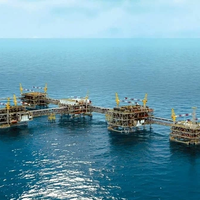
File photo released by ISNA in September 2013 shows a worker during the installation of an oil rig in Changuleh, Mehran county, Ilam province, western Iran.
Donald Trump’s maximum pressure is usually scored by counting tankers and tracking the rial, but Iran’s budget points to a deeper cost: more than $80 billion in NIOC bank debt and sovereign-fund arrears, repeatedly deferred as Iranians shoulder the burden.
On August 5, a state bank froze the accounts of the National Iranian Oil Company, NIOC, over about $1 billion owed to the sovereign wealth fund, two years past due. A separate case was already running: a $1.5 billion tax assessment the company says it simply cannot pay. Enforcement on that one stopped only when the presidency intervened.
The episode matters because the law shielding the company is also where its condition is recorded. NIOC publishes no audited accounts, and Iran's budget shows state companies only in aggregate, leaving its debt to be reconstructed from budget provisions and disclosures by other state institutions.
This year's budget sets the amount of NIOC debt to the central bank and commercial banks being deferred at 55 billion euros, about $63.5 billion, covering principal and interest on financing for upstream oil and gas development. It appears as a single sentence at the bottom of a table in which every other figure is in rials or percentages, renewed every year since 2019.
Iran's sovereign wealth fund, the National Development Fund, has separately said NIOC is its largest debtor, with $17 billion in unpaid loans.
Those two categories alone amount to more than $80 billion. No single official document presents them as one consolidated NIOC debt figure.
Iran's entire general budget this year converts to roughly $37 billion at the open-market rate. For scale, the deferred bank debt alone is about 1.7 times what the government plans to spend in a year.
That burden grows without anyone borrowing another dollar. The debt is in foreign currency, and the rial has fallen from about 900,000 to the dollar in early 2025 to nearly 2 million today, a slide President Trump celebrated in August as his administration "destroying Iran's currency." Each step down makes the same $63 billion heavier against NIOC's rial costs and the state's domestic revenues.
That burden grows in rial terms without anyone borrowing another dollar. The debt is in foreign currency, and the rial has fallen from about 900,000 to the dollar in early 2025 to nearly 2 million today, a slide President Trump celebrated in August as his administration "destroying Iran's currency.” Each step down increases the rial value of the same $63 billion obligation and makes it larger relative to the state's domestic revenues.
Maximum pressure is usually scored from the outside: barrels tracked leaving the Persian Gulf, the rial's slide, the lengthening sanctions lists. By that scorecard the campaign is working.
A clearer measure is the condition of the company at the center of the sanctioned trade, and by that measure the campaign has worked more completely than the scorecard shows. The pressure did not stop Iran's oil. It changed the terms of the business, and the new terms have broken the company that produces it, in every sense but the accounting one.
The business model was set at the top. After the United States withdrew from the nuclear deal in 2018 and reimposed sanctions, Ali Khamenei told officials not to leave the economy waiting on "decisions to be made by others." The objective instead was to plan with the sanctions in place and, in his formulation, to neutralize them.
The oil ministry's version of neutralization was to keep production alive with domestic contractors, the Revolutionary Guard's companies among them. On its own terms, that part worked. Output that had fallen below 2 million barrels a day in 2020, the lowest in almost four decades by American government estimates, was rebuilt to about 3.6 million by mid-2024, a recovery the oil minister boasted of publicly.
Selling those barrels was another matter.
"We have unofficial or unconventional sales, all of which are secret," then-oil minister Bijan Zanganeh said in 2019, "because if they are made known America would immediately stop them." His deputy called it the grey market.
In practice, that meant selling at sanctions-driven discounts that have varied widely over time, reaching $10 to $15 a barrel below Brent through 2024 and 2025, particularly to China's independent refiners; using a shadow fleet, ship-to-ship transfers and obscured vessel identities; relabeling Iranian crude as originating elsewhere; and paying intermediaries to keep the chain moving. China has at times taken roughly 90 percent of Iran's exported crude.
Payment itself became another layer of the sanctions trade. Iranian oil proceeds have been trapped or restricted in foreign banking systems, while other sales have been settled through barter or in currencies that are difficult to repatriate freely.
India created a rupee payment mechanism for Iranian crude in 2019, and the channel stalled the same year when Indian purchases stopped. Roughly $6 billion in Iranian oil proceeds frozen in South Korea were eventually transferred to restricted accounts in Qatar as part of the 2023 prisoner exchange.
Every additional discount, commission and restriction reduces what reaches Iran. NIOC's statutory share of crude and condensate export proceeds is set at 14.5 percent, so lower realized export revenue narrows the company's own take as well.
The difference between what the model earned and what production cost was covered on credit, in foreign currency, from the central bank, state banks and the sovereign wealth fund, with parliament's authorization.
By January 2019 the state knew in writing that the arrangement was not paying for itself. The parliament's research arm reported that NIOC, then about $50 billion in debt on its own count of the previous year, could not repay what it owed. The party line continued anyway: the same parliament approved fresh lending in the same budget, and two months later wrote the first deferral into law.
The dollar figures were tracked for two more years, to about $60 billion in March 2020 and about $70 billion in March 2021. Then that series went quiet.
The liabilities themselves did not vanish from the record. Two years later the Economy Ministry put NIOC's debts for 2021 at 1,683 trillion tomans, the largest of any state company in Iran, ahead of Bank Sepah and Bank Melli. At the exchange rate of the day, that is the same $60 to $65 billion the dollar series had been reporting.
What disappeared was the ability to follow it: a comparable figure, year by year, in the currency the money was owed in. The largest corporate debt in Iran's history was reduced to one renewable sentence that for six years carried no number at all. When a number finally surfaced this February, it settled what the silence had left open. The bank debt did not go away. It was rolled forward.
The meter still runs, though not at one rate. The sovereign fund's published terms for foreign-currency oil and gas facilities are 3.5 percent for the fund plus 2.5 for the agent bank, 6 percent all-in. On the $17 billion it is owed, that alone is close to $1 billion a year, almost exactly the size of the claim that froze the company's accounts in August.
The central bank has never published its contract rate, so the future cost can only be estimated. If even a 4 percent rate were applied to the $63 billion outstanding balance, it would add more than $2.5 billion in interest over a year; at the sovereign fund's 6 percent rate, the figure would approach $3.8 billion.
What the budget does establish is that the deferred bank debt already consists of principal and interest. The cost of carrying the old debt has become part of the debt.
For comparison, $1.5 billion in foreign currency is allocated for medicine this year, in a spring when pharmacy prices jumped several hundred percent, cancer and dialysis drugs ran short, and officials blamed scarce foreign currency. Depending on the rates applied to NIOC’s different debts, the annual interest burden could exceed that amount by several billion dollars.
An Iranian who misses a single loan installment pays the contract rate plus a 6-point penalty. The oil company's interest simply accrues, uncollected, year after year. A deferral, in the end, is a bet that a better year is coming, one with a surplus large enough to settle old bills. The Islamic Republic has been promising that better year that is yet to come for forty-seven years.
Because the loans are neither collected nor written off, the central bank and the state banks carry them as sound assets, the same accounting that keeps Iran's insolvent banks upright. When those banks come up short, they overdraw at the central bank, and that is where base money is created.
The transmission is not mechanical, but it is the route by which a single failed lender, Bank Ayandeh, accounted for about a quarter of the growth in Iran's monetary base in 2022-23. The bill reaches Iranians as inflation: the tax no one votes on, taking its largest share from the poorest.
Fifteen years of records say NIOC could not pay when conditions were merely bad. With its fields bombed and its exports blockaded, repayment is beyond reach in any scenario.
And the pressure is still tightening. On August 13, Treasury Secretary Scott Bessent, who runs the Economic Fury campaign against the Islamic Republic, promised measures "like have never been seen in the history of the economic isolation of a country," on top of a blockade meant to keep anything from moving in or out of Iranian ports. Whatever they turn out to be, they are aimed at the only revenue that could ever service this debt.
Nor does the optimistic case rescue the company. Even a full lifting of sanctions would not change the arithmetic quickly, because a company with damaged fields and war-hit infrastructure would have to borrow more before it could export more.
Maximum pressure set the terms of this downfall, but the decisive choices were Tehran's: to keep pumping at any margin, to stop publishing a comparable foreign-currency debt figure after 2021, and to push the bill forward one year at a time.
The company that once symbolized Iran's oil wealth was not felled by a rival or a market. It was sacrificed, quietly, by its own state, to the nuclear program and the regional ambitions that brought the sanctions, and to the business model built to outlast them, and the receipt is one sentence long, perpetually renewed every year.