• العربية
  • فارسی
Brand
  • Iran Insight
  • Politics
  • Economy
  • Analysis
  • Special Report
  • Opinion
  • Podcast
  • Live TV
  • Iran Insight
  • Politics
  • Economy
  • Analysis
  • Special Report
  • Opinion
  • Podcast
  • Live TV
  • Theme
  • Language
    • العربية
    • فارسی
  • Iran Insight
  • Politics
  • Economy
  • Analysis
  • Special Report
  • Opinion
  • Podcast
  • Live TV
All rights reserved for Volant Media UK Limited
volant media logo
ANALYSIS

Can Iran's fragile economy survive Trump's 'Economic D-Day'?

Behrouz Turani
Behrouz Turani

Iran International

Aug 20, 2026, 18:00 GMT+1
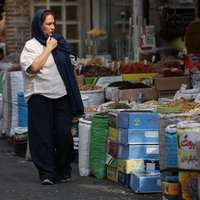
An Iranian woman buys eggs in Tehran / Photo by Reuters

Donald Trump has promised an “Economic D-Day” against Iran, a threat Tehran dismissed as another failed US policy. But with inflation, shipping costs and supply strains already biting, how much more pressure can Iran’s fragile economy absorb?

President Donald Trump on Wednesday announced what he called the “most crushing economic operation ever taken against any country,” threatening unprecedented economic isolation and consequences for countries whose financial institutions, businesses or government entities continue providing Tehran with an economic lifeline.

“Oil smuggling, swap lines, cash transfers, exchange houses, ship registries, front companies — it all needs to stop NOW,” Trump wrote on Truth Social, calling on US allies to join the campaign.

Iranian Foreign Minister Abbas Araghchi dismissed the announcement on Thursday as “doubling down on failed policies,” while Iran’s Foreign Ministry called the campaign “economic terrorism” and a “crime against humanity,” saying Tehran would continue resisting US military, economic and political pressure.

The Trump administration, however, is signaling that the campaign could go considerably further than existing sanctions.

Treasury Secretary Scott Bessent told CNBC on Thursday that Washington would impose the “toughest sanctions in history” on Iran and said the administration would outline its measures on Monday.

“It is going to work in Iran and we are going to collapse this regime,” Bessent said.

He said countries continuing to do business with Tehran would face US enforcement actions. Asked whether that could include China, which buys the overwhelming majority of Iran’s shipped oil, Bessent said some conversations were better held privately.

Bessent also suggested that “maximum economic pressure” could reduce the likelihood of another major military phase, describing the economic campaign and the US naval blockade as a “one-two punch.”

Already under strain

Even before the new US economic campaign was announced, Iranian economic reporting was documenting the price the confrontation was already imposing at home: higher shipping costs, pressure on medicine supplies and further strain on household budgets.

Emergency Central Bank allocations have enabled round-the-clock clearance of wheat and pharmaceutical imports at Shahid Rajaee Port in Bandar Abbas, yet reports by ILNA and Donya-ye Eghtesad said container freight rates remained 35 to 40 percent above baseline because of persistent war-risk surcharges.

The pressure is also reaching medicine supplies. On Monday, a major pharmaceutical company in Tehran said the government could no longer provide the foreign currency it required at subsidized rates, warning that some medicines could disappear from shelves or be sold at two to three times current prices.

Donya-ye Eghtesad has linked elevated shipping costs to domestic production bottlenecks, arguing that more expensive freight raises the cost of imported intermediate goods and adds to broader inflationary pressure.

The paper said temporary customs measures were treating symptoms rather than causes, with high insurance premiums and port congestion continuing to increase raw-material costs.

“So long as transit protocols remain uncodified,” the daily wrote, “industrial input costs will remain elevated, eroding domestic purchasing power daily.”

Those pressures are hitting an economy already struggling with steep inflation. Iran’s 12-month inflation rate reached 66 percent in July, while food prices were 128 percent higher than a year earlier. War, sanctions and disruptions to trade and imports have further squeezed household purchasing power.

Cooking oil, meat and dairy products have moved beyond the reach of many working- and middle-class families. Iranian reports describe households cutting back on staples and non-essential spending, while a kilogram of lamb can consume up to 10 percent of a minimum-wage worker’s monthly income.

Housing costs have also intensified the squeeze. Rents have risen sharply in major cities including Tehran, Mashhad and Isfahan despite nominal government caps, increasing housing insecurity and pushing some families toward cheaper districts or shared accommodation.

Iranian reports increasingly describe teachers, civil servants and office workers struggling to maintain their living standards despite holding multiple jobs. Peripheral provinces including Ilam, Sistan-Baluchestan and Kurdistan face even greater economic pressure.

Less leverage at Hormuz

Compounding that vulnerability, Iran may also be losing some of the strategic leverage it hoped to gain from disrupting traffic through the Strait of Hormuz.

CNN reported Wednesday that more than 80 percent of recent liquid cargo transits through Hormuz had either used the Omani route or traveled with transponders switched off and likely followed it.

Axios separately reported that the US military was operating a shipping corridor along the Omani side of the Strait, helping 15 to 20 tankers enter or leave the Persian Gulf each night.

The reports suggest Iran could be left absorbing many of the economic consequences of disruption at Hormuz while gaining less bargaining power from it.

That also changes the context of Iran’s negotiations with Oman over navigation through the Strait. Foreign Ministry spokesman Esmaeil Baghaei said Iranian and Omani technical teams had agreed on geographic coordinates and navigation lanes for a proposed shipping scheme.

Iranian economic commentary had portrayed formalization of such an arrangement as important to lowering insurance and shipping costs. But if Washington can increasingly move vessels through an Oman-side corridor without an agreement that gives Tehran a central role, Iran may have less ability to use the Strait to extract political or economic concessions.

Iran has endured decades of US sanctions and built extensive networks to circumvent them, giving Tehran reason to doubt whether another pressure campaign can force a change in course.

But the starting point this time is different: an economy already weakened by inflation, disrupted trade and the costs of war, while one of Tehran’s most important sources of leverage appears to be eroding.

Trump has yet to spell out the full measures behind his “Economic D-Day.” Bessent says those details will come Monday. The question is whether Washington can close enough of Iran’s remaining economic lifelines to impose pressure Tehran cannot absorb — or whether the Islamic Republic can once again adapt while passing much of the cost on to ordinary Iranians.

Most Viewed

Iran weighs attacks on military targets in Europe – FT
1

Iran weighs attacks on military targets in Europe – FT

2
ANALYSIS

The 60-day deadline is over. Now what does Trump do with Iran?

3
VOICES FROM IRAN

Tehran gas stations run dry as fuel price hike fears mount

4

Iran campaign urges people to fund sacrifice of 10,000 sheep for Khamenei’s health

5

Luxury Tehran property asking prices surpass Munich and Sydney

Banner
Banner
Banner

Spotlight

  • UAE trade halt threatens one of Iran’s remaining economic lifelines
    ANALYSIS

    UAE trade halt threatens one of Iran’s remaining economic lifelines

  • Can Iran's fragile economy survive Trump's 'Economic D-Day'?
    ANALYSIS

    Can Iran's fragile economy survive Trump's 'Economic D-Day'?

  • The unlikely return of European diplomacy in the Iran-US conflict
    ANALYSIS

    The unlikely return of European diplomacy in the Iran-US conflict

  • For Iranian journalists, exile can last a lifetime
    OPINION

    For Iranian journalists, exile can last a lifetime

  • Seven months on, January protests still shape Iranians’ lives
    VOICES FROM IRAN

    Seven months on, January protests still shape Iranians’ lives

  • Forced to serve in the IRGC, now fighting to stay in Canada
    INSIGHT

    Forced to serve in the IRGC, now fighting to stay in Canada

•
•
•

More Stories

A poem hailed as Khamenei's prophecy is an acrostic: Born of Satan

Aug 20, 2026, 13:11 GMT+1
•
Arash Sohrabi
100%

Days before he was killed, Ali Khamenei gave a poem to a translator, a senior cleric says. Iranian outlets published it as his prophecy of his own martyrdom. Then readers ran down the first letters: I am Ali Khamenei, born of Satan.

The account comes from Mohammad-Ali Mousavi Jazayeri, the former Friday prayer leader of Ahvaz and a former member of the Assembly of Experts, in a video that spread across Persian social media this week.

Jazayeri says he heard the story from Abbas Hazbavi, an Arabic-language poet from Khuzestan. By that account, intermediaries told Hazbavi after meeting Khamenei that the leader had urgent business with him, and a call from the office followed.

Hazbavi says he went on the first day of Ramadan, around ten days before Khamenei was killed on February 28, and that the supreme leader handed him a poem and asked him to render it into Arabic. The Khuzestan news site Sobh-e Khouzestan published the interview along with the full Persian text.

Hazbavi was a plausible choice. An established religious poet, he has translated Khomeini's ghazals into Arabic and has publicly recited his own Arabic rendering of Khamenei's verse. The office would have had his number.

The poem reads, on the surface, exactly as its promoters wanted. "Alas, I came late to my purpose," one line runs, "and heard the meaning of martyrdom from the beloved's lips." Another appears to name the month: "If the tyrant has marked my body as his target, in Esfand my soul will set out after the lovers." Khamenei was killed on the ninth day of Esfand (February 28).

The trouble is in the margin. Taking the first letter of each of the poem's 22 hemistiches in order produces a sentence: man Ali Khamenei zadeh-ye Sheytanam. "I am Ali Khamenei, born of Satan."

The device is a classical one. Persian poets have used the acrostic, known in traditional prosody as movashshah, for centuries to conceal a name or a dedication in the opening letters of successive lines. Twenty-two letters forming a grammatical sentence is not coincidence; someone built it deliberately.

Who that was is the question the story leaves open. Iran International cannot verify Jazayeri's account, Hazbavi's, or the poem's authorship, and there is no evidence that Khamenei wrote the poem.

What the establishment's own account supplies is the route the poem travelled: through the supreme leader's office, into a translator's hands, and out into print under Khamenei's name. Every step of that journey is described by his admirers, not his enemies.

100%
Left: ILNA's report presenting the poem as Ali Khamenei's own, under the headline "The leader who counted the moments to martyrdom." Right: the same address today, after the agency removed it.

It landed among outlets primed to want it. The verses ran on ILNA, Hamshahri and Khabar Online, among others, at a time when Iranian media were combing Khamenei's life for signs he had foreseen his own end.

ILNA's version, headlined "The leader who counted the moments to martyrdom," has since been taken down.

Too late to delete

On Persian social media, where the poem returned to circulation this week with the first letters marked in red, the mood has been close to disbelief.

"Apparently Khamenei ordered a poem he could pass off as his own," one widely shared post said. "The poet delivered, all right. Now the state sites have finally noticed and they're deleting it."

"At first I thought it was a joke," another user wrote. "They've pulled it from a lot of sites, but it's still up on the eulogists' channels."

Others turned to the question of where the poem came from. "So someone inside the leader's own house did this," one post said, speculating about who in Khamenei's circle might have arranged it.

One user drew out the reversal at the heart of the affair: "They wanted to show a miracle, that he foresaw his own martyrdom. The very poem they are using as proof says the opposite: that he was born of Satan."

The appetite the poem fed is well documented. In the weeks after Khamenei's killing, Iranian media ran a steady stream of material presenting him as having anticipated it, including a genuine ghazal of his that Hamshahri Online published under the headline "The ghazal the martyred leader wrote for his own martyrdom."

The flood has been large enough that Khamenei's own Office for the Preservation and Publication of Works has had to issue a denial over a different poem attributed to him after a cleric recited it publicly, saying the attribution and the story around it "are entirely untrue."

Jazayeri's own history gives the episode a final turn. In 1989, when the Assembly of Experts chose Khamenei to succeed Khomeini, it was Jazayeri who proposed that the new leader be addressed as an ayatollah rather than by his actual, lesser clerical rank.

Thirty-seven years later, the same cleric put his name to a poem whose hidden line calls him the son of the devil.

The phrase itself has been used against Khamenei before. In January, the US ambassador to Israel, Mike Huckabee, called him "a true son of Satan" in a post on X.

What is new is where Iranians found it this week: inside a poem his own admirers were circulating as scripture.

The unlikely return of European diplomacy in the Iran-US conflict

Aug 19, 2026, 17:00 GMT+1
•
Clément Therme
100%
US Secretary of State Marco Rubio meets Greek Foreign Minister Giorgos Gerapetritis in Washington, March 1, 2025. (Marco Rubio/X)

For years, diplomacy between Iran and the United States has largely been conducted through a familiar group of intermediaries.

Oman has traditionally provided the most discreet and trusted channel, while Qatar, Pakistan and Turkey have used their relations with both sides to facilitate contacts or transmit messages.

Yet the continuing deadlock in negotiations has now encouraged Washington to widen the diplomatic circle.

In recent days, Austria and Greece have separately opened contacts with Tehran after consultations with US Secretary of State Marco Rubio, according to media reports.

The unexpected involvement of Austria and Greece suggests that European diplomacy, long marginalized in the Iran-US relationship, may be making a cautious return in the context of a regional military escalation.

The sequence of recent contacts is striking. US Secretary of State Marco Rubio met Austrian Foreign Minister Beate Meinl-Reisinger in Washington on August 11 and spoke by telephone with Greek Foreign Minister George Gerapetritis the following day. On August 13, both European ministers held separate conversations with Iranian Foreign Minister Abbas Araghchi. Although the US State Department denied asking them to transmit messages, the timing was probably not coincidental. The State Department subsequently confirmed that Iran had been discussed, while Austria formally offered Vienna as a venue for potential future talks. Greece emphasized freedom of navigation and maritime security in its exchanges with Tehran.

This is not yet formal mediation. Neither Austria nor Greece has the experience, access or accumulated trust that Oman possesses. Their involvement should instead be understood as an exploratory attempt to identify additional channels at a moment when traditional diplomacy is struggling. The proliferation of intermediaries itself is revealing: it demonstrates not the vitality of the diplomatic process, but its fragmentation.

Austria’s possible role is rooted in diplomatic history. Vienna hosted negotiations that culminated in the July 14, 2015 nuclear agreement, formally known as the Joint Comprehensive Plan of Action (JCPOA). It is also home to the International Atomic Energy Agency, which would likely play a central role in verifying any future settlement concerning Iranian nuclear activities. Austria can therefore offer more than a neutral meeting room. It provides an institutional environment closely associated with nuclear diplomacy, technical verification and the memory of an agreement that once appeared capable of containing the Iranian nuclear crisis.

Vienna nevertheless carries contradictory symbolism. For Iranian officials, it recalls the JCPOA’s acceptance of limited Iranian enrichment for civilian purposes and the partial lifting of sanctions. But it also evokes the subsequent collapse of the agreement after the first Trump administration withdrew from it in 2018. Austria cannot repair that breach of confidence on its own. Its principal advantage is therefore procedural rather than political: it can provide a discreet and credible setting in which the United States, Iran and the IAEA might clarify their positions.

Greece brings a different form of leverage. As one of the world’s leading maritime nations, it has direct interests in the security of the Strait of Hormuz and the Red Sea. The disruption of navigation through Hormuz is not an abstract geopolitical problem for Athens. It affects Greek-owned shipping, insurance costs, energy prices and the stability of international trade. Greece can consequently address Iran not only as a European Union member and US ally, but also as the representative of an industry directly exposed to the consequences of escalation.

This maritime dimension may make Athens useful in discussions focused on practical arrangements rather than an immediate comprehensive agreement. Measures guaranteeing freedom of navigation, reducing threats against commercial vessels or creating communication mechanisms to prevent incidents at sea could be easier to negotiate than the most divisive nuclear and security questions. Greece could contribute technical knowledge and political advocacy to such discussions, although it lacks the capacity to provide Iran with the sanctions relief or security guarantees Tehran ultimately seeks.

The emergence of Austria and Greece also exposes the decline of the traditional European powers in the Iranian diplomatic arena. France, Germany and the United Kingdom were central to the nuclear negotiations that began in the early 2000s. Since then, however, the credibility of the European trio has deteriorated in Tehran and the three countries are facing bilateral diplomatic crises in their relations with Tehran. Iranian leaders accuse them of failing to protect the economic benefits of the nuclear agreement after the American withdrawal and of increasingly aligning themselves with Washington’s coercive approach. The mutual distrust generated by sanctions, mutual accusations of security “infiltration” and spying, regional conflict and disputes over Iran’s nuclear activities has left little space for the earlier model of European mediation.

This marginalization is being reinforced by the widening security confrontation. The Financial Times reported Wednesday that Iran had considered attacking US military targets in Europe, including in Bulgaria and Cyprus, if Washington further escalated the war.

Reuters reported Wednesday that a NATO official said the alliance was prepared to address any threat and take necessary action to defend its members. The official cited four occasions earlier this year when NATO air defenses intercepted Iranian ballistic missiles heading toward Turkey, saying they demonstrated the strength and effectiveness of NATO’s deterrence and defense posture.

Smaller European countries may therefore benefit from carrying less political baggage. Austria is associated more closely with dialogue than with strategic pressure and maintained substantial economic and energy ties with the Islamic Republic throughout the 1990s and 2000s. Greece, for its part, has generally remained outside the most confrontational debates over Iran. Yet their relative neutrality should not be overstated. Both countries are members of the European Union and close partners of the United States. Tehran will ultimately judge their usefulness by their ability to secure concrete concessions from Washington, not by the cordiality of their diplomatic rhetoric.

Their involvement also reflects the widening international cost of the conflict. The restriction of traffic through Hormuz, a corridor through which roughly one-fifth of global oil consumption normally passes, has transformed the crisis from a bilateral confrontation into a global economic emergency. Washington wants the strait reopened, while Tehran sees control over navigation as one of its most powerful remaining sources of leverage. Austria and Greece are entering the process because the consequences of failure now extend far beyond the Middle East.

The immediate objective should therefore be modest. Vienna and Athens are unlikely to replace Muscat, Doha or Islamabad, and multiplying intermediaries can produce contradictory messages and allow both Iran and the United States to avoid making difficult decisions. Their most useful contribution would be to support a coordinated diplomatic framework: Austria concentrating on nuclear verification and the venue for talks, Greece on maritime security, and traditional regional mediators on political communication and guarantees. Ultimately, no mediator can compensate for a lack of political will to pursue a diplomatic solution rather than military escalation. Austria and Greece cannot make that choice on behalf of Washington and Tehran, but they may help create the conditions in which diplomacy becomes possible.

Their return is therefore neither a diplomatic breakthrough nor an irrelevant gesture. It reflects an increasingly marginalized Europe urgently seeking new ways around a dangerous impasse. If carefully coordinated, these unlikely European channels could help prepare the ground for renewed negotiations. Otherwise, they risk becoming yet another improvised attempt to contain a conflict that its principal actors have so far proved unable to resolve. Europe nevertheless has a strong interest in assuming a more active diplomatic role: European states are already bearing many of the conflict’s economic and security consequences, yet they possess neither the political leverage to shape a settlement nor the military capacity – and, in most cases, the willingness – to impose one.

Luxury Tehran property asking prices surpass Munich and Sydney

Aug 19, 2026, 11:07 GMT+1
•
Hooman Abedi
100%
A luxury house in northern Tehran

Some luxury apartments in northern Tehran are being advertised above the price of central Munich or Sydney: 25 billion rials, about $13,228, per square meter, according to Farhikhtegan newspaper, which examined the listings.

Eleven of 16 properties examined in the affluent neighborhoods of Aghdasiyeh and Elahiyeh were advertised above 10 billion rials ($5,291) per square meter, the Iranian daily said on Wednesday.

It has to be noted that the Tehran figures are sellers' asking prices for a small selection of high-end properties, not completed transactions, while the international figures represent broader city-center apartment prices.

Average asking prices across Tehran were around 2.3 billion to 2.5 billion rials ($1,217-$1,323) per square meter, with completed sales likely to be lower than advertised prices, Farhikhtegan said.

Monthly salaries for many Iranian workers are commonly put at around 200 million to 250 million rials, equivalent to roughly $105 to $132.

100%
A luxury house in northern Tehran

Multimillion-dollar properties in northern Tehran

A 500-square-meter property in Aghdasiyeh was advertised at 15 billion rials ($7,937) per square meter, giving it a total asking price of around 7.5 trillion rials ($3.97 million), according to the newspaper.

Another property measuring 600 square meters was offered at 18 billion rials ($9,524) per square meter, or approximately 10.8 trillion rials ($5.71 million).

  • Tehran rents hit three times many workers’ monthly pay

    Tehran rents hit three times many workers’ monthly pay

An 850-square-meter residential property marketed for redevelopment carried an asking price of 22 billion rials ($11,640) per square meter, putting the entire property at about 18.7 trillion rials ($9.89 million).

Prices in the sample climbed further in Elahiyeh. A 2,000-square-meter property marketed for redevelopment was advertised at 25 billion rials ($13,228) per square meter, equivalent to about 50 trillion rials ($26.46 million).

A 510-square-meter unit in a residential tower carried the same per-square-meter price, taking its total asking price to roughly 12.75 trillion rials ($6.75 million).

Tehran luxury prices overtake selected global cities

Farhikhtegan separately estimated luxury residential property in northern Tehran at $13,369 per square meter and compared that figure with average apartment prices across 30 cities.

Munich stood at $13,217 per square meter and Sydney at $13,067, according to the comparison. Shenzhen followed at $12,947, Taipei at $12,922 and Luxembourg at $12,793.

The Tehran estimate draws on luxury properties in some of the capital's most expensive neighborhoods, while the international figures cover broader city-center apartment markets.

International data focused specifically on luxury housing paints a different picture.

Knight Frank's Wealth Report 2026 defines prime property as the most desirable and expensive homes in a market, generally representing the top 5% by value.

Its data show that $1 million bought 42.1 square meters of prime residential property in Sydney at the end of 2025, implying a value of about $23,800 per square meter. The equivalent figures were about $30,400 in London, $29,500 in New York and $16,100 in Dubai.

Those figures put northern Tehran's listings in a different context. At an open-market exchange rate of around 1.89 million rials to the dollar, a property advertised at 25 billion rials per square meter was equivalent to about $13,228, below the prime residential values recorded by Knight Frank in Sydney, London, New York and Dubai.

The contrast highlights how Tehran can appear more expensive than Sydney when selected high-end listings in the Iranian capital are compared with average city-center apartments abroad, but cheaper when measured against Sydney's prime residential segment.

Tehran is not included in Knight Frank's international prime residential index, meaning no standardized ranking between the Iranian capital and the cities covered by its data is available.

  • Skyrocketing rents push Iranians back to parents’ homes, shared housing

    Skyrocketing rents push Iranians back to parents’ homes, shared housing

Dollar pricing reaches high-end property market

The rial's depreciation has also led some owners of expensive properties to advertise rents or sale prices directly in dollars, Farhikhtegan said.

  • Dollar-pegged pizza in Tehran points to a different kind of regime change

    Dollar-pegged pizza in Tehran points to a different kind of regime change

Previous listings cited by the newspaper included furnished apartments offered for monthly rents of roughly $1,100 to $4,200, with some landlords seeking dollar payments to limit the erosion of rental income as the rial loses value.

100%
A luxury house in northern Tehran

However, most residential sales and rental agreements remain denominated in Iran's currency.

The growing divide between incomes and housing costs has reshaped living arrangements for some Iranians, pushing tenants to cheaper cities or Tehran’s outskirts, back into their parents’ homes, or into shared apartments to split expenses.

The 60-day deadline is over. Now what does Trump do with Iran?

Aug 19, 2026, 02:56 GMT+1
•
Negar Mojtahedi
100%
US President Donald Trump seated next to Pete Hegseth

With the 60-day period set by the June US-Iran memorandum now over and no final agreement in place, Washington faces a choice between intensifying pressure, renewing major strikes or settling into a prolonged and unstable holding pattern.

President Donald Trump said Tuesday that there were “no talks or conversations going on, or scheduled” with Iran and that the US naval blockade remained in force.

A White House official told Semafor that Trump’s Truth Social post amounted to calling off talks with Iran for the foreseeable future.

The message appeared to contradict Jared Kushner, who just a day earlier described contacts with different parts of the Iranian government as unusually “robust” and spoke of “very positive and active conversations.”

The IRGC, meanwhile, has denied Trump’s claim that US officials were holding back-channel talks with Revolutionary Guard officials.

The conflicting accounts underscore one of the central uncertainties after the 60-day deadline passed: how much of the confrontation visible in public reflects what may be happening behind the scenes.

Interviews with three analysts and former officials suggest the end of the 60-day period does not necessarily leave Washington with a binary choice between launching another major offensive and walking away.

A third possibility is emerging: an extended and highly unstable holding pattern in which Washington intensifies economic pressure, maintains the blockade and avoids a return to the intensive military campaign seen earlier in the conflict, while retaining the option of renewed strikes.

Neither war nor peace

Former US Ambassador John Craig said he believes Trump has been persuaded by his military and foreign-policy advisers that further major military action would not necessarily resolve the conflict, particularly the nuclear issue.

“I think this is going to go on for quite a while, simply because there doesn't seem to be any other alternative,” Craig told Iran International.

Craig described that status quo as one in which the United States continues trying to keep ships, oil and goods moving through the Strait of Hormuz while Iran carries out lower-level attacks and probes against regional targets, all without a meaningful diplomatic process capable of producing an agreement.

“So no peace,” Craig said. “Not very high level of attacks and kinetic actions, but still no agreement and no process — even more important, no process to find an agreement.”

But Craig stressed that what is visible may tell only part of the story.

He said it is impossible to know what preparations could be taking place during the apparent lull, including whether new targeting packages are being assembled, intelligence operations are underway or assistance is being provided to people inside Iran.

“We don't know everything that is going on,” Craig said.

Ilan Berman, senior vice president of the American Foreign Policy Council, similarly said the current situation could persist well beyond the end of the 60-day period.

“I have the growing feeling that this status quo could persist for some time,” Berman told Iran International.

One reason, he said, is domestic US politics. With midterm elections approaching, the opportunity for attempting a quick and decisive conclusion to the conflict may already have passed.

Instead, Washington may increasingly conclude that time is on its side.

Berman said countries around the Persian Gulf, Central Asia and elsewhere are also using this period to build infrastructure and alternative transport corridors aimed at reducing vulnerabilities exposed by the conflict, particularly the dependence of global trade on the Strait of Hormuz.

“This isn't a great situation,” Berman said, “but time ends up working for Washington and not for Tehran.”

Can economic pressure break the stalemate?

Iran's economy is already under extraordinary pressure.

Iran's annual inflation reached 66% in July, while food prices rose 128% year-on-year, according to the Statistical Center of Iran, severely eroding household purchasing power.

Those pressures are being compounded by sanctions, the naval blockade, disruption to Iran's energy trade and the prospect of another round of US economic measures.

For Washington, that raises the possibility that time itself, combined with escalating economic pressure, could accomplish what another major military offensive may not.

Berman described Iran's economic crisis as potentially “the transformative variant,” arguing that the danger for the government grows as the rial loses value, purchasing power collapses and basic foods become increasingly unaffordable.

“This is not a sustainable condition,” he said.

But he cautioned that economic deterioration does not automatically produce political upheaval. Tehran can attempt to soften the impact through currency measures, trade arrangements and other economic interventions.

What has changed, Berman argued, is the nature of the leadership confronting those pressures. He described the current system as increasingly rigid and militarized, leaving it potentially less willing to prioritize domestic economic development.

Casey Babb, a senior fellow and director at the Macdonald-Laurier Institute, described the current moment as a “very uncertain and fragile holding pattern.”

He said Washington could combine substantially greater economic pressure with military capabilities it has so far chosen not to fully deploy.

But Babb cautioned that economic warfare carries consequences far beyond Iran's leadership.

“There is a human cost to that as well,” he said. “Innocent Iranians are going to suffer from that as well and already are.”

Babb said the United States clearly does not want a costly conventional ground war, while Iran's leadership has shown little indication that it is prepared to make the concessions Washington is seeking.

“It will take something probably quite significant for the regime to behave differently,” Babb said.

When does the shooting start again?

None of the analysts interviewed for this story suggested the current lull means the military confrontation is over.

Berman went further, saying he expects US strikes against Iran to happen again.

“The question to me is not whether or not there are going to be strikes again, because I think there will be,” he said.

The more important question, he argued, is whether future attacks remain limited actions designed to restore deterrence — what he described as “knuckle wraps” — or become the beginning of another major phase of the war.

Berman described the confrontation as an increasingly prolonged battle of wills, contrasting it with what he said Washington had initially envisioned as a shorter conflict similar to its campaign in Venezuela.

That creates another danger.

Unlike during the Cold War, he said, Washington and Tehran lack reliable lines of communication specifically designed to keep tactical confrontations from escalating into something much larger.

The result may be neither war nor peace.

Berman compared the current moment to the end of the second act of a three-act play — the point when the action temporarily slows before the pace picks up again.

But the apparent lull may be deceptive.

As Craig emphasized, intelligence operations, military targeting and other preparations could be taking place beyond public view. Diplomatic contacts may also be more complicated than the conflicting public statements from Washington and Tehran suggest.

The visible status quo could persist for some time.

What is happening underneath it — and what eventually breaks it — is much harder to know.”

Iran’s ‘infiltration’ bill sparks backlash over sweeping reach

Aug 18, 2026, 04:44 GMT+1
•
Maryam Sinaiee
100%

A bill before Iran’s parliament that would impose new restrictions on contacts with foreign media, universities and organizations has drawn widespread objections over its potential impact on routine academic, cultural and civil-society activity.

Lawmakers approved the bill’s general principles Sunday by 183 votes to four, with five abstentions among 258 members present. Its individual provisions must still be considered and approved separately.

The latest publicly available draft contains 19 articles, although references during Sunday’s parliamentary debate to Articles 26 and 27 indicate that lawmakers may be considering a revised text.

Bill targets broader forms of foreign influence

Supporters say a new law is needed because existing legislation focuses primarily on espionage, while foreign infiltration can take broader forms.

Hassan Ghashghavi, spokesman for parliament’s National Security and Foreign Policy Committee, said Iran already had laws covering espionage but faced a legal gap on infiltration.

Ghashghavi said work on the proposal began before the 12-day war and that relevant state bodies had participated in reviewing it.

The published draft gives the Intelligence Ministry and the Revolutionary Guards’ Intelligence Organization roles in identifying prohibited foreign links and activities. Cases under the proposed legislation would be heard by Revolutionary Courts.

Proposed penalties include prison terms, deprivation of social rights, dissolution of legal entities and confiscation of assets.

The reformist newspaper Sazandegi wrote that the proposal “not only fails to provide a proper definition of infiltration, but is also a warning sign of intensified censorship, greater restrictions and a widening social divide in the country.”

The newspaper questioned why legislation intended to counter foreign infiltration extended to scientific, media, cultural and civic activity rather than concentrating on breaches within sensitive state institutions.

Sociologist Mohammad Rahbari wrote that if the bill is approved in its reported form, “it would be as if parliament had shot itself in the foot,” arguing that the proposed offenses are defined so broadly that even parliament’s own research center could fall within their scope.

Social media activist Hossein Ghatib wrote that “the path to combating infiltration is not to take revenge on society,” arguing that shortcomings in official security structures should not result in restrictions on “university professors, journalists, artists, researchers, students and ordinary citizens.”

Foreign media and embassy contacts

Article 6 of the published draft would prohibit interviews, participation in discussions or “any communication” with media designated as hostile, including US and Israeli outlets and media funded by either country.

Violations would carry a sixth-degree prison sentence, which under Iran’s penal code ranges from more than six months to two years. Parliament has not approved the provision.

Interviews with other foreign media would have to be notified through a system run by the Intelligence Ministry, with failure to do so subject to the same proposed punishment.

Article 7 would criminalize sending video, photographs, audio or “any data” to non-Iranian media or people engaged in media activity outside the country.

The proposed punishment would increase in circumstances the text describes as crisis, unrest or disorder, or when information was sent under a cooperation agreement or with the intent of acting against national security.

The wording could potentially apply beyond professional journalists to people who send images or video of events inside Iran to media organizations abroad.

Iranian daily Shargh wrote that the proposed restrictions could expose foreign-policy journalists, international-relations specialists, translators, academics and businesspeople to prosecution because their work routinely requires contact with foreign institutions.

The newspaper also questioned whether authorities could realistically process permits for the large number of diplomatic, academic and commercial contacts taking place each day.

Article 8 would require individuals and organizations to notify authorities and obtain written permission from the Foreign Ministry or Iranian diplomatic missions for many contacts with foreign embassies, international organizations and non-Iranian institutions, with limited exceptions for personal and consular matters.

Academic and civil-society activity

Article 3 of the published text would prohibit providing “information, reports or statistics” to non-Iranian institutions or foreign nationals without Intelligence Ministry authorization.

The provision itself does not limit those categories to classified information.

Civil-society organizations would also be directly covered by the bill. Article 4 would prohibit non-governmental organizations, associations, political groups and other legal entities from receiving money, contracts, commissions or other financial benefits from foreign governmental or non-governmental bodies without authorization from a state committee.

Proposed penalties include imprisonment and fines, dissolution of organizations and bans of five to 15 years on cultural or social activity for their managers.

In academia, the draft would require the Intelligence Ministry to publish a list of approved foreign universities and research institutions for scholarships, contracts and scientific events.

Cooperation with institutions outside that list could carry criminal penalties if the provision is approved.

Cultural and educational work could face penalties

Other articles of the published text cover films, television series, documentaries, theater, music and books produced with the direction or support of foreign entities specified in the bill.

Works deemed to present a “dark image of Iran” or challenge religious principles could bring financial penalties or professional restrictions if the provisions are ultimately approved.

The draft would also allow prosecutors, based on material supplied by security agencies, to stop production of some works before completion.

Asr-e Iran questioned how authorities would define a “dark image of Iran,” asking whether portrayals of poverty, addiction, discrimination, corruption or migration could fall within that category.

“A country that is afraid of seeing its own wounds is not a healthier country; it may simply have broken its mirrors,” the outlet wrote.

In-person and online courses and workshops could also fall under the legislation if authorities considered them incompatible with “Iranian culture” and linked them to foreign entities covered by the bill.

Participants could also face punishment under the published text if they knew of the organizers’ stated purpose.

Another provision would criminalize certain forms of cooperation with foreign intelligence services, foreign governments, international organizations or non-Iranian individuals and entities to implement the UN 2030 Agenda or international instruments Iran has not formally undertaken to implement under its constitutional procedures.

Scope of bill draws criticism

Osman Salari, a member of the presidium of parliament’s Judicial and Legal Commission, said much of the proposal concerned criminal and judicial matters and argued that the judiciary and his commission had not been sufficiently consulted in its preparation.

Supporters argue that existing rules are fragmented and that a broader law is needed to establish a single framework for countering what the Islamic Republic describes as foreign infiltration.

Individual provisions remain unsettled

Article 1 of the published draft would also punish certain policy, legislative or executive proposals made under the supervision, direction, training or guidance of specified foreign intelligence services, governments or organizations when they result in harms defined by the text.

Those harms include damage to Iran’s security or independence and, under specified circumstances, undermining public trust in the political system, reducing election participation or directing votes toward a particular group or political current.

Other provisions would increase penalties for some economic crimes committed under foreign direction.

Iran enacted separate legislation in October 2025 increasing punishments for espionage and cooperation with Israel and states it designates as hostile. Supporters of the new proposal argue that “infiltration” requires a broader legal framework than espionage alone.

The new bill has yet to be considered article by article. Parliament must also determine the procedure for its further examination, and any final text it approves would require Guardian Council review before becoming law.

Salari said reports about punishments contained in the circulated draft should not be treated as final because lawmakers have not yet considered the individual provisions.

The provisions may therefore change during parliamentary scrutiny. What parliament has approved so far is the principle of legislating against what it describes as foreign infiltration, not the individual restrictions or penalties contained in the publicly available draft.