• العربية
  • فارسی
Brand
  • Iran Insight
  • Politics
  • Economy
  • Analysis
  • Special Report
  • Opinion
  • Podcast
  • Iran Insight
  • Politics
  • Economy
  • Analysis
  • Special Report
  • Opinion
  • Podcast
  • Theme
  • Language
    • العربية
    • فارسی
  • Iran Insight
  • Politics
  • Economy
  • Analysis
  • Special Report
  • Opinion
  • Podcast
All rights reserved for Volant Media UK Limited
volant media logo

Trump wants deal soon or may bomb Iran - Axios
May 4, 2026, 11:40 GMT+1
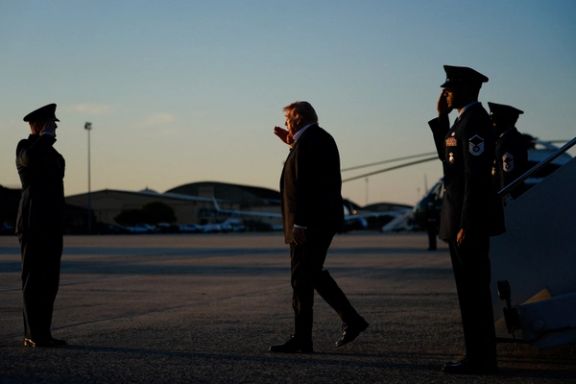
US President Donald Trump arrives at Joint Base Andrews in the US on May 3, 2026.

US President Donald Trump could pursue major military action against Iran if talks do not soon produce the outlines of an achievable deal, Axios reported on Monday, citing a senior US official.

“It’s either we’re looking at the real contours of an achievable deal soon, or he's going to bomb the hell out of them,” the official said.

The report said Trump wants pressure on Iran while keeping diplomatic channels open.

Trump’s envoys Jared Kushner and Steve Witkoff are still exchanging proposals with Iran’s Foreign Minister Abbas Araghchi, it said, citing officials.

A senior US official said the two sides remain far apart.

“There are talks. There are offers. We don't like theirs. They don't like ours,” the official said.

One source described Trump’s Project Freedom to help guide stranded ships out of the Strait of Hormuz as “the beginning of a process that could lead to a confrontation with the Iranians.”

According to the United States Central Command, military support to Project Freedom will include guided-missile destroyers, drones, over 100 land and sea-based aircraft and 15,000 troops.


Most Viewed

Abroad they talk, at home they hang
1
TEHRAN INSIDER

Abroad they talk, at home they hang

2

Islamic Republic puts another political prisoner to death

3
INSIGHT

War shadow lays bare divisions among Iran’s clerics

4

Internet shutdown drives Iranians to leave country for access

5

Trump wants deal soon or may bomb Iran - Axios

Banner
Banner

Spotlight

  • Abroad they talk, at home they hang
    TEHRAN INSIDER

    Abroad they talk, at home they hang

  • War shadow lays bare divisions among Iran’s clerics
    INSIGHT

    War shadow lays bare divisions among Iran’s clerics

  • Who speaks for Iran: What the public rift means, and what it hides
    INSIGHT

    Who speaks for Iran: What the public rift means, and what it hides

  • Tehran hardens stance on Hormuz as ‘non-negotiable’
    INSIGHT

    Tehran hardens stance on Hormuz as ‘non-negotiable’

  • ‘Permit for a terrorist’: Canada opposition asks who cleared ex-IRGC official’s entry
    PODCAST

    ‘Permit for a terrorist’: Canada opposition asks who cleared ex-IRGC official’s entry

  • Iran war cannot end with Revolutionary Guards still in control
    OPINION

    Iran war cannot end with Revolutionary Guards still in control

•
•
•

More Stories

Internet shutdown drives Iranians to leave country for access

May 4, 2026, 08:33 GMT+1

As Iran has experienced a systematic disruption of the international internet for 65 days, access to the free flow of information has turned into a luxury and a symbol of structural inequality, a crisis that has triggered a new wave of migration – migration for internet access.

One consequence of the shutdown has been the emergence of short-term, urgent migration to countries such as Armenia and Turkey. Individuals whose businesses depend on global markets have been forced to temporarily leave the country to preserve their livelihoods.

A technology specialist currently in Yerevan told Iran International: “I spent all my savings from the past year to stay in Armenia for two months. This migration is not voluntary; if I cannot connect, all my foreign contracts will be canceled. Some of my friends even sold their wives’ gold or household items just to reach the internet and not lose their jobs.”

These forced migrations not only drive human capital out of the country but also impose heavy costs on families already under economic strain, especially as such options are only available to a limited number of people.

Three Iranian citizens working in internet-dependent businesses told Iran International they had traveled to Istanbul and rented a small home in a remote area to make use of the 90-day visa-free stay for work.

One of them, a programmer and father of two, said: “The only solution was to leave my wife and children behind so I could finish a project in these three months. That’s just to pay off debts from the past four or five months and cover part of the travel costs. Then we’ll see what happens next.”

  • Iranians denounce tiered internet plan as discriminatory and corrupt

    Iranians denounce tiered internet plan as discriminatory and corrupt

He added that his wife had lost her job due to the internet disruption, saying thre temporary migration and separation from family was the only option available. “Despite all difficulties, my friends and I know that even being able to come to Turkey is not possible for everyone, and that adds to our sense of guilt.”

Security as justification; internet under control

Since February 28, coinciding with the start of military conflict, authorities have used “national security” as justification to restrict access for millions of people, without providing clear answers about the duration of the disruption, instead linking restoration to a return to “normal conditions.”

At the same time, inequality has extended into the digital sphere. While the majority are confined to the domestic network, a black market for “free internet” has emerged, with prices ranging from 5000,000 to 20 million rials per gigabyte ($2.5 to over $10). Average Iranian incomes have contracted to roughly $100–$150 per month due to severe inflation and currency devaluation.

100%

“White SIM cards”: privileged access

Alongside widespread restrictions, authorities have distributed tools known as “white SIM cards,” a term first used during the 2022 protests to describe unfiltered and unmonitored internet access for insiders.

Holders of these SIM cards, often linked to security institutions or state-affiliated media, are able to access global platforms and publish narratives aligned with official messaging.

In addition, services marketed as “Pro internet” have been offered to selected companies and individuals, effectively turning internet access into a state-controlled privilege.

  • Two months offline: Iran blackout drives losses, access splits

    Two months offline: Iran blackout drives losses, access splits

Government spokeswoman Fatemeh Mohajerani confirmed the system on April 28, saying the service had been approved to maintain business connectivity during crisis conditions.

Economic and human toll

The consequences of the shutdown extend beyond statistics. Preliminary estimates from Iran’s Chamber of Commerce put daily losses at around $80 million, both directly and indirectly.

But the deeper impact is human. Disrupted communication, lost educational opportunities, and pressure on healthcare systems reliant on global data have all contributed to rising psychological strain.

Teenagers deprived of digital interaction and elderly individuals cut off from relatives abroad are living in what many describe as enforced isolation.

By formalizing unequal access to the internet, authorities have effectively restricted a basic right. As planes and buses carry workers and professionals across borders in search of connectivity, many inside Iran remain in digital darkness, facing the gradual erosion of their livelihoods and aspirations.

War shadow lays bare divisions among Iran’s clerics

May 3, 2026, 22:22 GMT+1
•
Behrouz Turani

The war with the United States and Israel has exposed unusually open divisions within Iran’s clerical establishment, with hardline calls for escalation clashing with warnings over the cost of continued conflict.

Proposals aimed at de-escalation have been exchanged in recent weeks, according to officials on both sides, but the gap between Washington and Tehran remains wide, with core disagreements unresolved.

Hardline cleric and MP Mahmoud Nabavian said Iran would escalate sharply if attacked again.

“If the United States launches another attack, Iran would strike residential areas housing kings and heads of state in Arab countries” south of the Persian Gulf, he said, while also urging President Donald Trump to “admit defeat.”

In contrast, liberal cleric and human-rights lawyer Mohsen Rohami argued that those opposing negotiations with Washington should be held accountable for the human and material toll of the war.

While ultraconservatives insist Iran must not negotiate, Rohami said “people in the streets of Iran are not opposed to negotiations,” casting diplomacy as both a public demand and a strategic necessity at a time when the costs of war are mounting.

The divide extends beyond the clergy. Hardline MP Ali Khezrian said Iran “will certainly support the war” and has chosen to halt talks with Washington, adding that even indirect messaging through media or intermediaries should stop.

Rohami pushed back, warning lawmakers against presenting personal views as state policy. Decisions on negotiations, he said, rest with Iran’s leadership and are coordinated through the Supreme National Security Council and senior state bodies.

“The decision to negotiate is supported by the nation,” he said in remarks to Khabar Online.

He described Iran’s military actions as defensive but warned that the damage from a prolonged conflict could take years to repair. Steel plants, refineries and major electricity and gas infrastructure have been hit, he said, adding that much of Iran’s industrial base was built over the past century.

“Peace is the norm, and war is the exception,” Rohami said, cautioning that public mobilization in support of the state cannot be sustained indefinitely. “Their presence does not mean they oppose negotiations or agreements.”

A separate commentary on the Asr Iran website identified four “strategic mistakes” by hardliners, including underestimating US and Israeli power and focusing on the enemy’s losses rather than Iran’s own costs.

It also warned against portraying Western adversaries as internally collapsing, arguing that political divisions in democracies tend to narrow in wartime.

If such miscalculations shape decision-making, the commentary said, Iran risks losing both its current position and its chance to bring the conflict to a favorable end..

Islamic Republic puts another political prisoner to death

May 3, 2026, 09:05 GMT+1

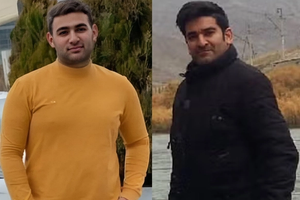
The Islamic Republic executed another political prisoner in Urmia prison on Sunday, the judiciary reported, identifying him as Mehrab Abdollahzadeh.

Born in 1997 in Urmia, he had been arrested on October 22, 2022 during the “Woman, Life, Freedom” protests.

The judiciary said Abdollahzadeh had been sentenced to death on charges of “corruption on earth” in connection with the killing of Abbas Fatemiyeh, described as a “volunteer force” member in Urmia.

Mizan, the judiciary’s media outlet, said the conviction was based on confessions, witness testimony, images and security reports, adding that the Supreme Court upheld the sentence.

He was executed after previously saying in a message from prison, “From the very first day of my arrest, they extracted confessions from me through torture and threats, all of which were false.”

Rights groups cite coercion concerns

Rights organizations also said the case relied on forced confessions obtained under pressure and lacked fair trial guarantees.

The Kurdistan Human Rights Network said Abdollahzadeh was interrogated for 38 days without access to a lawyer or family contact and faced physical and psychological pressure.

The group added he denied the charges and requested mobile location data to challenge his presence at the scene.

Timeline and broader executions

Abdollahzadeh was arrested at his workplace during nationwide protests and later sentenced to death by a revolutionary court in Urmia in September 2024.

Rights groups reported he was moved to solitary confinement days before the execution following a dispute with a prison official.

The execution came after two other men were hanged in the same prison a day earlier on charges of spying for Israel, with rights groups raising concerns over fast-track proceedings and lack of due process.

  • Two more men hanged in Iran as authorities ramp up executions

    Two more men hanged in Iran as authorities ramp up executions

UN human rights chief Volker Turk said this week that at least 21 people have been executed and more than 4,000 arrested on national security charges since the latest conflict in February, warning that rights in Iran continue to face severe restrictions.

"I am appalled that – on top of the already severe impacts of the conflict – the rights of the Iranian people continue to be stripped from them by the authorities, in harsh and brutal ways," Turk said.

Iran's Hormuz toll plan bars Israeli ships, sets terms for US and allies

May 2, 2026, 18:50 GMT+1

Iranian lawmakers say Israeli vessels will be permanently barred from the Strait of Hormuz and ships from the United States and its allies would be allowed through only if they pay war reparations, under a proposed plan to place the waterway under Iranian “management.”

Ali Nikzad, the first deputy speaker of Iran’s parliament, said during a visit by members of parliament’s Construction Commission to Bandar Abbas that the 12-point plan would deny passage to Israeli ships “at any time.”

He said vessels belonging to “hostile countries” would also be barred from crossing the strait unless they first paid compensation for damage caused during the war.

He did not name any country other than Israel, but Iranian officials have used similar language in the past to describe the United States and some of its Arab allies in the Middle East as hostile states.

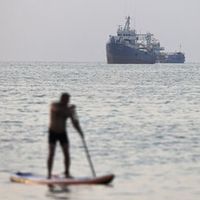
Two months into the US-led war with Iran, the vital waterway remains closed, choking off 20% of the ‌world's oil and gas supplies. The strait was effectively closed after Iran started launching retaliatory strikes against its Arab neighbors in the Persian Gulf.

Since April 13, the United States has also imposed a naval blockade on Iranian ports, further restricting traffic through the strait with the aim of preventing Tehran from turning the waterway into a source of leverage or revenue.

Terms for non-hostile countries

Under the toll plan being reviewed by the parliament, other ships would be required to obtain permission from Iran before passing through Hormuz, Nikzad said.

He added that the measure would be adopted in line with international law and the rights of Iran’s neighbors, while insisting that Tehran would not return the strait to its pre-war status.

“We will not give up our rights in the Strait of Hormuz, and the movement of vessels through the Strait of Hormuz will not be the same as before the third imposed war,” he said.

He described Iran’s proposed new control over Hormuz as comparable in importance to the nationalization of the oil industry in 1951.

Mohammadreza Rezaei, head of parliament’s Construction Commission, said all ships applying for permission to pass through the strait would be required to use the name “Persian Gulf.”

He said 30% of the revenue collected from ships would be allocated to strengthening military infrastructure, while 70% would go to economic development and public welfare.

“Managing the Strait of Hormuz is more important than acquiring nuclear weapons,” Rezaei said.

While Tehran hopes its new toll system will compensate for part of the heavy damage caused by the US-led war, Washington has warned that companies and governments paying Iranian-imposed tolls could face sanctions.

Iran cuts oil output as US blockade strains storage - BBG

May 2, 2026, 14:51 GMT+1

Iran has begun curbing oil production as the US naval blockade tightens around its oil trade, with exports plunging, storage filling and tankers gathering near the country’s main export hub, Bloomberg reported.

The blockade, which took effect on April 13, has left Tehran trying to manage a pressure campaign aimed at its most important source of revenue. Bloomberg said the war has entered a stalemate, with Washington betting that lost oil revenue will force Iran to yield and Tehran betting it can outlast the economic pain and keep global energy prices elevated.

A senior Iranian official told Bloomberg that Tehran is proactively reducing crude output to stay ahead of storage limits rather than waiting for tanks to fill completely. The official said the move could affect as much as 30% of Iran’s oil reservoirs, but argued the risks were manageable because Iranian engineers have years of experience idling and restarting wells under sanctions.

“We have enough expertise and experience,” said Hamid Hosseini, a spokesman for the Iranian Oil, Gas and Petrochemical Products Exporters’ Association. “We’re not worried.”

Bloomberg said Iran’s oil sector had remained resilient before the blockade, producing about 3.2 million barrels a day in March, with exports close to prewar levels. But the current blockade is different from earlier sanctions pressure because the US is physically trying to block waters around the Strait of Hormuz, stranding tens of millions of barrels at sea.

Since the blockade began, Iran has increasingly turned to floating storage. Bloomberg said aging and in some cases derelict tankers have gathered near Kharg Island, Iran’s main export terminal in the Persian Gulf.

US Treasury Secretary Scott Bessent said this week that Kharg Island was “soon nearing capacity,” warning that the pressure could cost Iran about $170 million a day in lost revenue and force Tehran toward negotiations.

“It looks like there’s been a significant slowdown in production,” Antoine Halff, co-founder and chief analyst at Kayrros, said on a conference call. “There is stress in the system.”

If storage fills completely, Iran would have little choice but to cut production by the amount it can no longer export. Based on prewar domestic consumption of about 2 million barrels a day, Bloomberg said that could leave fields operating at roughly half their potential.

Iran could try to move some oil overland to Turkey, Pakistan, Afghanistan and Uzbekistan, Hosseini said, but he put that capacity at only 250,000 to 300,000 barrels a day.

Other options, including rail shipments of some oil products to China, may be difficult and less economical. Bloomberg added that Chinese “teapot” refineries rely on discounted crude and thin margins, while the U. Treasury has also imposed new sanctions on individuals and networks tied to Iran’s “shadow banking” system, including buyers linked to those refineries.

Analysts said Iran still has tools to keep parts of the system running. Vortexa estimates Iran has access to 65 million to 75 million barrels of floating storage capacity, equivalent to roughly 37 very large crude carriers, both inside and outside the blockade.

That capacity may buy Tehran time, but how much depends on how strictly the US enforces the blockade.

Claire Jungman, director of maritime risk and intelligence at Vortexa, told Bloomberg that Iran’s use of floating storage, ship-to-ship transfers and older tankers means its system has not fully broken.

“This allows flows to continue in the near term, even under tighter enforcement,” she said. “We would frame this as a constrained but functioning system, rather than a full disruption.”