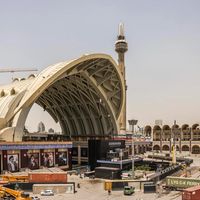
A couple walk in a park overlooking Tehran, with the iconic Milad Tower seen in the background, April 1, 2026
Iran’s economy is entering the new fiscal year under the weight of a profound wartime shock, with inflation reaching levels not seen in decades and essential goods becoming increasingly unaffordable for much of the population.
Official figures released at the end of fiscal year 1404 (March 2026) show annual inflation at 50.6 percent, according to data compiled by government bodies including the parliament’s Research Center. Prices rose 5.6 percent in March alone.
But economists say the headline figure understates the severity of the crisis. The more revealing measure—point-to-point inflation—shows how sharply living costs have risen over the past year.
Government statistics indicate that prices in March 2026 were 71.8 percent higher than a year earlier, a surge that has sharply eroded household purchasing power. In major cities such as Tehran, the increase is believed to be even higher, particularly for food.
The shock has unfolded as weeks of US and Israeli strikes have disrupted economic life across the country. In Tehran, where many residents have temporarily left the city, large parts of the capital’s commercial activity have slowed sharply.
Many businesses remain closed and those who have stayed behind often limit their movements, wary of being caught in unpredictable air strikes.
Attacks on what the attackers describe as “regime infrastructure” have also begun to hit the industrial economy more directly. Recent strikes on major steel production facilities—among the country’s most important industrial employers—have disrupted supply chains and raised fears of wider job losses in manufacturing regions.
For working-class and rural families, the situation is especially acute. Following the removal of preferential exchange rates (arz-e tarjihi), monthly food inflation has climbed above 100 percent, turning basic nutrition into the central economic struggle for many households.
Economists say national averages obscure the depth of the crisis. In some food categories, the real cost of living has effectively doubled, with price increases reaching as high as 150 percent.
Labor activists told the Iranian Labor News Agency (ILNA) that the government’s electronic commodity coupon system—introduced to cushion the impact of rising prices—covers only a small portion of what they describe as the “worker’s basket” of essential goods.
The government-linked Workers’ House has called for a return to direct distribution of staples such as rice, cooking oil and sugar, similar to the rationing system used during the Iran-Iraq war in the 1980s.
Workers in high-risk industries such as construction say the government has suspended its contribution to social-security insurance quotas, leaving many without coverage as workplace accidents increase amid wartime damage to infrastructure.
In mining regions such as Tabas in northeastern Iran, thousands of workers are reportedly unable to retire because employers—under financial strain during the war—cannot pay the required 4 percent premium for jobs classified as “hard and hazardous.”
Economists and labor advocates say the government must urgently introduce targeted relief.
Proposals include special allowances for workers covered by labor law to offset soaring food prices, as well as legal intervention by the judiciary and the Social Security Organization to allow workers in hazardous occupations to retire even if employers cannot currently meet their contribution requirements.
Without such measures, analysts warn, the country risks a deeper erosion of living standards at a moment when the economic effects of war are already reshaping everyday life.
Aheated online dispute over photographs showing civilian victims of strikes in Iranian cities has exposed both the deep mistrust many Iranians feel toward official information and a widening rift among the public itself over how to interpret images emerging from the war.
As photos of wounded civilians circulated widely on social media, some users accused photographers and authorities of staging scenes for propaganda, claiming that individuals depicted in widely shared images were actors and that injuries, dust and distress visible in the photos had been artificially created using makeup and staged scenes.
The accusations spread quickly across Persian-language social media, with skeptics pointing to perceived similarities between people appearing in images linked to separate incidents as supposed evidence.
Even the Persian-language account of Israel’s foreign ministry weighed in on the controversy by reposting one of the disputed images and writing: “If they call the Gaza filmmaking industry ‘Pallywood’, what do they call this?”
A woman gesture to emergency workers from a window of a damaged building in Tehran, hit by US-Israeli strikes, March 28, 2026
A heated online dispute over photographs showing civilian victims of strikes in Iranian cities has exposed both the deep mistrust many Iranians feel toward official information and a widening rift among the public itself over how to interpret images emerging from the war.
As photos of wounded civilians circulated widely on social media, some users accused photographers and authorities of staging scenes for propaganda, claiming that individuals depicted in widely shared images were actors and that injuries, dust and distress visible in the photos had been artificially created using makeup and staged scenes.
The accusations spread quickly across Persian-language social media, with skeptics pointing to perceived similarities between people appearing in images linked to separate incidents as supposed evidence.
Even the Persian-language account of Israel’s foreign ministry weighed in on the controversy by reposting one of the disputed images and writing: “If they call the Gaza filmmaking industry ‘Pallywood’, what do they call this?”
But the claims were soon challenged by fact-checkers and other users, and in some cases the accusations were later withdrawn.
Iran’s independent fact-checking platform Factnameh said a review of several of the controversial images found no evidence supporting claims that they had been staged or taken at different times and locations as alleged.
“Given the presence of debris and victims, the idea that actors were staged in such a scene is highly unlikely,” the platform said, noting that the individuals in the images show clear differences in facial features and body structure despite some similarities.
Mehdi Ghasemi, one of the photographers whose work came under scrutiny, rejected the allegations and defended his work.
“I’m 47 years old, and it’s been 33 years since I received my first documentary photography award, and I haven’t taken a single reconstructed or manipulated frame,” he wrote on X.
One user who had asserted that a woman in a widely circulated photograph was an actress later deleted the post and issued an apology after acquaintances identified the woman and her husband as real individuals whose home had been destroyed in the strikes.
The controversy has unfolded amid tight wartime restrictions on reporting and photography in Iran.
Critics argue that permits to document sensitive scenes are tightly controlled and often granted only to photographers seen as aligned with the authorities, making independent documentation of chaotic strike sites difficult.
Combined with broader limits on information flow during the conflict, those restrictions have left social media as one of the primary arenas for competing narratives about events on the ground.
The dispute reflects how deeply distrust of official narratives has taken root in Iranian society after decades of censorship and propaganda. In such an environment, even genuine documentation can quickly become the subject of suspicion.
“The issue is exactly like the story of the boy who cried wolf,” one user wrote online.
“When a government lacks legitimacy to this extent and has always chosen to lie at every step, eventually no one believes the truth either. Now factor in cutting off communication channels on top of that, and you end up with the situation we are in.”
For others, however, the rush to dismiss images of civilian suffering as staged propaganda risks deepening divisions at a moment when the war itself is already reshaping daily life across the country.
Investors are seen at the Dubai International Financial Market in Dubai, UAE February 7, 2018. REUTERS/Satish Kumar Purchase Licensing Rights
The arrest of dozens of IRGC-linked money changers in the United Arab Emirates is one of the most serious blows yet to Tehran’s sanctions-evasion network, laying bare how heavily the Islamic Republic has depended on Dubai as an economic lifeline.
Sources familiar with the matter told Iran International that UAE authorities detained dozens of money changers tied to financial entities linked to Iran’s Revolutionary Guards, shut down associated companies and closed their offices.
The crackdown follows days of mounting regional tensions and comes after other measures targeting Iranian nationals, including visa revocations and tighter travel restrictions through Dubai.
For years, Dubai has served as Iran’s main offshore financial artery, where oil proceeds, petrochemical revenues and rial conversions were turned into dollars, dirhams and euros beyond the reach of the country’s battered domestic banking system.
“This is going to be a real problem for Tehran because Dubai was an economic lung for the Iranian regime,” Jason Brodsky of United Against Nuclear Iran told Iran International.
“That is economic pressure and diplomatic isolation in a way that the UAE is able to employ against the Iranian regime, and it will have a very considerable impact.”
'Most critical hub'
According to Miad Maleki, a former senior US Treasury sanctions strategist and now a senior fellow at FDD, the UAE is not just one sanctions-evasion hub among many.
“The UAE is the single most critical jurisdiction in the Iranian regime’s sanctions-evasion architecture,” Maleki said.
Dubai’s exchange houses have long given the IRGC and the Quds Force access to the hard currency needed to finance proxy groups including Hezbollah, Hamas, the Houthis and militias in Iraq.
The detention of trusted IRGC-linked money changers threatens networks that took years to build.
“These trust-based sarraf (money changer) relationships, bank accounts and corporate structures are not quickly replaceable,” Maleki said.
He added that even exchange houses untouched by the crackdown were now likely to think twice before processing Iran-linked transactions, sharply raising both the cost and the risk of doing business with the Guards.
The pressure comes as Iran’s domestic economy is already under severe strain.
Foreign reserves, once estimated at around $120 billion in 2018, had fallen below $9 billion by 2020, leaving Iran increasingly reliant on offshore currency channels.
Mohammad Machine-Chian, a senior economic journalist at Iran International, said the UAE remains Iran’s most important economic conduit after China.
“The UAE is Iran’s most critical economic lifeline after China,” he said.
He said Dubai’s free zones host hundreds of Iranian-linked shell companies used to mask oil and petrochemical sales, launder proceeds and channel hard currency back to Tehran.
Bilateral trade has hovered between $16 billion and $28 billion in recent years, with Iranian non-oil exports alone reaching roughly $6 billion to $7 billion annually, according to Machine-Chian.
A sustained crackdown could cost Tehran tens of billions of dollars in revenue streams while severing what he described as Iran’s “USD cash lifeline.”
Dubai has also functioned as a transit point for illicit Iranian funds moving onward to North America, including transfers routed to the United States and Canada through correspondent banking and hawala networks.
As Maleki put it, “Dubai is the washing machine: Iranian oil proceeds and rial conversions go in, sanitized dirham and dollar transactions come out.”
From diplomacy to backlash
Beyond the financial damage, analysts say the crackdown reflects a broader political rupture between Tehran and the Persian Gulf states.
Brodsky said Iran’s attacks on neighboring countries had transformed the strategic environment in the region.
“The relationship between Iran and the GCC countries is not going to go back to the way it was before Operation Epic Fury,” he said.
Where Persian Gulf states had once pushed for diplomacy, Iran’s retaliation has instead driven them closer to Washington and Israel.
For years, Tehran sought to encircle Israel in what it called a “ring of fire” through regional proxies.
Now, Brodsky said, the Islamic Republic has reversed that dynamic.
“They wanted to encircle Israel in a ring of fire,” he said. “Now they are basically encircling themselves in a ring of fire because they’ve been angering their neighbors with all of their attacks.”
He said that reversal could carry long-term consequences, including deeper Persian Gulf-Israel security coordination and new openings for the Abraham Accords.
“The missile threat and drone threat have become paramount in this conflict,” Brodsky said. “That could drive these countries even closer to the US and Israel.”
'Collapse within weeks'
The UAE crackdown comes as signs of mounting economic distress are mounting inside Iran.
Sources previously told Iran International that President Masoud Pezeshkian had warned senior officials that without a ceasefire, the economy could face collapse within weeks.
Across major cities, ATMs have been running short of cash, banking services have faced intermittent disruptions and government workers have reported months of delayed salary payments.
With inflation in essential goods already above 100 percent before the war, the loss of Dubai’s financial channels could deepen the regime’s crisis.
For Tehran, the arrests in the UAE are more than a financial disruption.
They may signal that one of Iran’s most dependable external pressure valves is starting to close.
Iran’s official data show inflation accelerating again amid a war with the United States and Israel, with prices more than fivefold higher than in 2021 and food costs rising even faster, hitting poorer and rural households hardest despite signs of monthly easing.
The Statistical Center of Iran has released its latest Consumer Price Index (CPI) report for March 2026, showing a continued acceleration in inflation across the country.
The CPI, calculated with a base year of 2021 (index = 100), reached 542.3 in March 2026. This means that average prices for goods and services have increased more than 5.4 times compared to 2021—equivalent to a cumulative rise of approximately 442% over four years.
Year-on-year inflation (compared to March 2025) climbed to 71.8%, up 3.7 percentage points from the previous month. Annual inflation (covering the 12 months ending March 2026) was reported at 50.6%, also rising by 3.1 percentage points month-on-month.
Food prices driving inflation
The sharpest increases continue to come from food and essential goods—a critical issue in Iran, where food accounts for a large share of household spending, particularly among lower-income groups.
Year-on-year inflation in the category of food, beverages, and tobacco reached 112.5%, up from 105.4% in February.
Within this category, several subgroups recorded extreme price increases compared to March 2025:
Bread and cereals: 140%
Meat (red and poultry) and related products: 135%
Oils and fats: 219%
Fruits and nuts: 104.2%
Dairy products (milk, cheese, eggs): 116.8%
Vegetables and legumes: 46.4%
Monthly inflation for food slowed to 8.6% in March (from 15.5% in February), but price levels remain significantly elevated.
Non-food inflation and services
The non-food and services category recorded 50.4% year-on-year inflation, slightly higher than February’s 49%.
Key contributors include 72.8% in furniture and household maintenance, 90.4% in miscellaneous goods and services, and 67.5% in transportation.
Housing and utilities—including rent, water, electricity, gas, and fuel—saw a comparatively lower increase of 34.9%, making it the least inflationary major category.
Monthly inflation in non-food goods and services stood at 3.5%.
Inequality and regional disparities
The report also highlights widening inequality in inflation burdens:
Annual inflation for the second income decile (among the poorest households) was 54.2%, while for the tenth decile (the wealthiest households), it was 49.2%.
The inflation gap between income groups widened to 5 percentage points, up from 4.1 points in February—indicating that lower-income households are disproportionately affected.
The CPI index reached 531.8 in urban areas and 606.2 in rural areas, with annual inflation at 49.6% and 56.8%, respectively.
Interpreting the data
While these figures are based on official data, they should be read with some caution. Iran’s statistical system is fragmented, and key indicators such as inflation have at times been reported differently by institutions like the Statistical Center and the Central Bank. Methodological choices—such as weighting, sampling, and price collection—can also affect the final estimates.
At the same time, independent assessments and observable market signals—particularly exchange rate movements and the pricing of essential goods—often point to inflationary pressures that feel more severe at the household level than headline figures suggest. This gap between reported averages and lived experience is especially visible in food markets, where price increases tend to be both faster and more immediately felt.
Taken together, the latest data confirm that year-on-year inflation continues to accelerate, even as monthly figures show temporary moderation. The persistence of high food inflation, combined with widening inequality and regional disparities, suggests that inflationary pressures remain deeply embedded in Iran’s economy.
As the war enters its fifth week, tensions between Tehran and Washington are rising, with both sides sending mixed signals over diplomacy and the risk of further escalation.
At the diplomatic level, reports suggest indirect contacts are continuing, even as the gap between public rhetoric and behind-the-scenes diplomacy appears wider than ever.
In Tehran, Mohammad Bagher Ghalibaf has emerged as a key voice. Reportedly playing a leading role in managing indirect contacts with Washington, he has maintained a consistently hard line.
In a four-page message issued on March 29 to mark the 30th day of the war, he dismissed recent US diplomatic messaging, including reports of a 15-point proposal, as unrealistic. He said Washington was trying “to achieve through talks what it could not win on the battlefield.”
Ghalibaf accused the United States of duplicity, saying Washington was publicly speaking of negotiations while privately preparing for escalation. He warned that Iranian forces were ready to inflict heavy losses on any US troops attempting a ground operation, as well as on their regional allies.
He also argued that US and Israeli objectives had already been scaled back. According to him, their objectives had shifted “from regime change to merely securing the Strait of Hormuz,” and disruptions to shipping had forced Iran’s adversaries to “beg” for talks.
Iranian military officials echoed the same defiant tone. A military spokesperson said on Sunday that Iranian forces had long awaited a possible US ground operation and warned Donald Trump not to “drag his soldiers into the jaws of captivity and death and not to plunge the American people into widespread mourning.”
Senior political figures reinforced the same line. First Vice President Mohammad-Reza Aref said negotiations over key issues such as the Strait of Hormuz would be possible only if Iran’s adversaries “pledge not to invade and recognize Iran’s international rights.”
On social media, pro-government users in Iran also largely rejected the idea of compromise. One post on X said: “There continues to be no form of negotiation or message exchange between Iran and America… Iran's decision is to continue the war until the complete achievement of objectives.”
Washington: Optimism and threats
By contrast, Washington has projected a mix of cautious optimism and mounting threats.
US Secretary of State Marco Rubio said on Monday that indirect contacts with Iranian figures were continuing through intermediaries.
He said some figures within Iran’s leadership were “saying some of the right things privately,” but added that it was still unclear whether they had the authority to act.
Trump, however, has struck a much more aggressive tone. While insisting that talks are going “extremely well,” he has repeatedly threatened military action, including strikes on critical infrastructure.
In a post on Truth Social on Monday, he wrote: “If for any reason a deal is not shortly reached… we will conclude our lovely ‘stay’ in Iran by blowing up and completely obliterating all of their Electric Generating Plants, Oil Wells and Kharg Island.”
He also suggested the United States could maintain a presence there, adding to the pressure behind his warnings.
Claims and counterclaims
Trump has also said that Iran recently allowed 20 oil tankers to pass through the Strait of Hormuz “as a tribute” to the United States.
He said the permit was granted under the authority of Ghalibaf, whom he portrayed as playing an increasingly influential role within Iran’s power structure.
Iranian officials have not publicly confirmed the claim.
In an interview with the Financial Times, Trump said he was dealing with a “very reasonable” new group in Iran and suggested an agreement could be near. He also claimed Tehran had already accepted “most of the points” in his proposed framework.
Last week, Elias Hazrati, head of Iran’s government information council, dismissed reports of a US peace proposal as “media speculations” and a “wish list.”
Information warfare and market signals
Beyond the military and diplomatic rhetoric, both sides appear to be engaged in a parallel battle over information and perception.
In a widely shared English-language post, Ghalibaf accused Trump of trying to move financial markets through strategic messaging. He advised observers to treat such statements as reverse signals, writing: “Do the opposite: If they pump it, short it. If they dump it, go long.”
The post, which drew around 10 million views by Monday, showed Tehran’s awareness of what it sees as US information warfare aimed at influencing market volatility.
Online reactions reflected the same view. One Iranian user commented: “They’re playing mind games with the American public to crash the market. And honestly, they’re playing it well. Extremely, extremely well.”