Aheated online dispute over photographs showing civilian victims of strikes in Iranian cities has exposed both the deep mistrust many Iranians feel toward official information and a widening rift among the public itself over how to interpret images emerging from the war.
As photos of wounded civilians circulated widely on social media, some users accused photographers and authorities of staging scenes for propaganda, claiming that individuals depicted in widely shared images were actors and that injuries, dust and distress visible in the photos had been artificially created using makeup and staged scenes.
The accusations spread quickly across Persian-language social media, with skeptics pointing to perceived similarities between people appearing in images linked to separate incidents as supposed evidence.
Even the Persian-language account of Israel’s foreign ministry weighed in on the controversy by reposting one of the disputed images and writing: “If they call the Gaza filmmaking industry ‘Pallywood’, what do they call this?”
A woman gesture to emergency workers from a window of a damaged building in Tehran, hit by US-Israeli strikes, March 28, 2026
A heated online dispute over photographs showing civilian victims of strikes in Iranian cities has exposed both the deep mistrust many Iranians feel toward official information and a widening rift among the public itself over how to interpret images emerging from the war.
As photos of wounded civilians circulated widely on social media, some users accused photographers and authorities of staging scenes for propaganda, claiming that individuals depicted in widely shared images were actors and that injuries, dust and distress visible in the photos had been artificially created using makeup and staged scenes.
The accusations spread quickly across Persian-language social media, with skeptics pointing to perceived similarities between people appearing in images linked to separate incidents as supposed evidence.
Even the Persian-language account of Israel’s foreign ministry weighed in on the controversy by reposting one of the disputed images and writing: “If they call the Gaza filmmaking industry ‘Pallywood’, what do they call this?”
But the claims were soon challenged by fact-checkers and other users, and in some cases the accusations were later withdrawn.
Iran’s independent fact-checking platform Factnameh said a review of several of the controversial images found no evidence supporting claims that they had been staged or taken at different times and locations as alleged.
“Given the presence of debris and victims, the idea that actors were staged in such a scene is highly unlikely,” the platform said, noting that the individuals in the images show clear differences in facial features and body structure despite some similarities.
Mehdi Ghasemi, one of the photographers whose work came under scrutiny, rejected the allegations and defended his work.
“I’m 47 years old, and it’s been 33 years since I received my first documentary photography award, and I haven’t taken a single reconstructed or manipulated frame,” he wrote on X.
One user who had asserted that a woman in a widely circulated photograph was an actress later deleted the post and issued an apology after acquaintances identified the woman and her husband as real individuals whose home had been destroyed in the strikes.
The controversy has unfolded amid tight wartime restrictions on reporting and photography in Iran.
Critics argue that permits to document sensitive scenes are tightly controlled and often granted only to photographers seen as aligned with the authorities, making independent documentation of chaotic strike sites difficult.
Combined with broader limits on information flow during the conflict, those restrictions have left social media as one of the primary arenas for competing narratives about events on the ground.
The dispute reflects how deeply distrust of official narratives has taken root in Iranian society after decades of censorship and propaganda. In such an environment, even genuine documentation can quickly become the subject of suspicion.
“The issue is exactly like the story of the boy who cried wolf,” one user wrote online.
“When a government lacks legitimacy to this extent and has always chosen to lie at every step, eventually no one believes the truth either. Now factor in cutting off communication channels on top of that, and you end up with the situation we are in.”
For others, however, the rush to dismiss images of civilian suffering as staged propaganda risks deepening divisions at a moment when the war itself is already reshaping daily life across the country.
Children killed in the strike on Shajareh Tayyebeh School in Minab, Iran, on February 28, 2026
Newly released surveillance footage appears to show repeated strikes hitting a primary school in the southern Iranian city of Minab on the first day of the war, an attack Iranian authorities say killed more than 100 children and teachers.
The Shajareh Tayyebeh primary school, located in Minab in Hormozgan province, served boys and girls aged 7 to 12.
The school building stood in an area that once formed part of a Revolutionary Guards naval base but had reportedly been separated from the military compound by a wall for several years. Iranian officials say the school was privately run.
Research by Amnesty International’s Crisis Evidence Lab and its Iran team says US authorities could—and should—have known the building was a school and failed to take feasible precautions to avoid civilian harm.
Amnesty said the findings point at best to a serious intelligence failure by the US military and warned the strike could constitute an indiscriminate attack in violation of international humanitarian law.
Reuters has reported that two sources familiar with the matter said the strike may have resulted from outdated intelligence used during targeting, while an internal US military review found American forces were likely responsible for the attack.
The first strike occurred around 10 a.m. on February 28, when students were resting during a break. The explosion destroyed roughly half of one of the school’s buildings.
Mikail Mirdoraghi (9) killed in the school strike
Teachers gathered surviving children in the school’s prayer hall and called parents to collect them. Shortly afterward, a second missile struck the same building, killing many of the remaining children, teachers and some parents who had rushed to the scene.
Iranian officials, including the mayor of Minab and the Ministry of Education, say the school was struck three times in total.
Images published by Iranian media in the days after the attack showed rescue workers pulling remains, severed limbs and children’s backpacks from beneath the rubble.
Iranian authorities say 168 people were killed, including about 120 children, as well as teachers and several parents who had come to retrieve their children after the first explosion. Nearly 100 others were reported injured.
The Norway-based human rights group Hengaw says it has independently identified 58 victims so far, including 48 children and 10 adults.
Behind the casualty figures are the stories of children whose lives ended in ordinary moments between lessons.
Among them were three girls—Mahdis Nazari, 7, and Sonar and Niayesh Salehi, both 9—members of their school’s skating team. Photos shared online before the attack show them at training sessions and competitions.
Iran’s skating federation later confirmed their deaths.
Another child whose story has circulated widely online is nine-year-old Mikail Mirdoraghi, a third-grade student. A photograph of him standing on the stairs of his home with a water bottle slung over his shoulder, waving goodbye, has been widely shared.
Mikail’s family had moved from Andimeshk in Khuzestan province to Minab because of his father’s job. After the attack, his 31-year-old mother, Shakiba Derikvand, identified his body among victims placed in refrigerated vehicles.
He was found lying beside his friend Alireza, still clutching his school backpack. His body was largely intact, though his face was bloodied, his mother said.
He was buried three days later in Andimeshk. A widely circulated image shows his grandfather lying beside the flower-covered grave.
“Mikail was afraid of the dark,” he reportedly said. “We always slept beside him. I don’t want him to be alone here at night.”
One of the most haunting details to emerge is a drawing Mikail reportedly made the night before the strike.
Found later in his backpack, it shows a school building with the Iranian flag above it, five children standing in the yard and three missiles descending toward them.
Former Iranian diplomats are warning that the war between Iran, the United States and Israel could fundamentally reshape the Middle East’s security order, with some predicting a prolonged conflict and deeper regional instability.
The comments come as US President Donald Trump said Thursday he would pause planned strikes on Iran’s energy infrastructure for 10 days until April 6, saying the move followed a request from Tehran and that negotiations were continuing.
Iranian officials have confirmed receiving proposals for talks but say they are reviewing them while insisting Iran will not accept ultimatums.
Inside of a house destroyed in US-Israeli strikes on Tehran, Iran, March 23, 2026
Former Iranian diplomats are warning that the war between Iran, the United States and Israel could fundamentally reshape the Middle East’s security order, with some predicting a prolonged conflict and deeper regional instability.
The comments come as U.S. President Donald Trump said Thursday he would pause planned strikes on Iran’s energy infrastructure for 10 days until April 6, saying the move followed a request from Tehran and that negotiations were continuing.
Iranian officials have confirmed receiving proposals for talks but say they are reviewing them while insisting Iran will not accept ultimatums.
The war, now entering its fourth week, has already drawn in multiple regional actors and heightened tensions around strategic chokepoints such as the Strait of Hormuz, raising concerns that a wider confrontation could disrupt global energy flows and destabilize the region further.
Saba Zanganeh, a former diplomat close to the office of Iran’s Supreme Leader, told the moderate outlet Fararu on March 25 that the conflict should prompt regional governments to reconsider their security policies and alliances.
He said regional governments have often acted as secondary players under foreign influence, worsening conflicts rather than resolving them. The current war, he added, offers a stark lesson that continuing the existing model will deepen regional crises.
He argued that decades of instability stem from what he described as “a flawed strategic paradigm shared by regional states and external powers,” which he said has repeatedly produced destruction and fragmentation in countries including Iraq, Syria, Lebanon, Libya, Sudan, Somalia and Yemen.
Hossein Mousavian, Iran’s former ambassador to Germany, offered a more confrontational assessment.
Speaking to Etemad Online, he said Iranian officials increasingly view Persian Gulf Arab states as partners in the conflict, sharing what he described as a common objective of the “complete destruction of Iran.”
Mousavian said Tehran is preparing for the possibility of a broader confrontation involving the United States and its regional allies.
Another former diplomat, Kourosh Ahmadi, suggested the conflict may last far longer than initially expected.
Speaking to Fararu, he noted that both Trump and Israeli Prime Minister Benjamin Netanyahu first suggested the war might last only four to seven days before revising their estimates to several weeks. Even those expectations may prove unrealistic, he said.
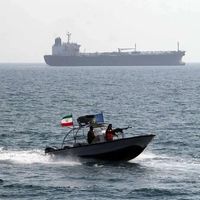
Ahmadi pointed to Iran’s ability to restrict or control shipping in the Strait of Hormuz as a decisive factor in prolonging the conflict. As long as Tehran maintains that leverage over one of the world’s most critical energy chokepoints, he argued, the war is unlikely to end quickly.
“Israel seeks the collapse and incapacitation of Iran, not merely political concessions,” he said, arguing that Washington’s goals were more limited and often diverged from that of Israel.
Despite their different emphases, the three former diplomats share a similar underlying assessment: the current conflict risks evolving into a prolonged regional crisis whose consequences could reshape the Middle East for years.
US Marines disembark from a U.S. Navy Landing Craft Utility (LCU) during amphibious operations in Arroyo, Puerto Rico, December 9, 2025
Some Tehran commentators say any US attempt to seize Iranian islands in the Persian Gulf could play directly into the IRGC’s long-standing strategy of capturing American troops for leverage.
Much of the commentary in Iranian media and political circles frames such a scenario as an opportunity rather than a risk for Tehran, arguing that deploying US forces on Iranian territory would expose them to capture by the Islamic Revolutionary Guard Corps (IRGC) and potentially inflict a political humiliation on Washington.
The idea has deep roots in Iran’s political rhetoric. Mohsen Rezai, the former IRGC commander who once floated the proposal of capturing US troops and demanding large sums for their release, now serves as a senior military adviser to Iran’s new Supreme Leader, Mojtaba Khamenei.
Former IRGC commander Hossein Kanani Moghaddam said last week that one scenario allegedly considered by the United States involved focusing on Iran’s southern islands and attempting to seize them to gain control over Persian Gulf oil routes.
“If Trump were to deploy air and naval forces along with Delta Force commandos in a ground operation, the battlefield would shift entirely in our favor,” Kanani Moghaddam said. “By killing or capturing American soldiers, we could raise the level of US losses to a point where they would quickly regret their actions.”
He added that such losses could trigger a political backlash in Washington and even lead to impeachment proceedings against President Donald Trump.
The prospect of an occupation of an Iranian island has also been linked in Iranian commentary to the broader diplomatic standoff between Tehran and Washington.
Despite Trump’s references to “constructive negotiations,” Iranian officials argue that US military threats undermine any possibility of diplomacy.
On March 25, Foreign Ministry spokesman Esmail Baghaei said Iran had already experienced “two catastrophic examples” of trusting US diplomacy. “Over the past nine months, the United States has attacked Iran twice in the middle of negotiations,” he said. “This was a betrayal of diplomacy.”
In a March 23 interview with the Iranian outlet Fararu, Jalal Sadatian, Iran’s former chief diplomat in London, said Trump could not simultaneously threaten military action against Iranian territory while expecting Tehran to accept ceasefire proposals.
Sadatian also warned that Iranian retaliation could expand beyond direct confrontation with US forces. He pointed to the IRGC’s earlier warnings that electricity-generation facilities and desalination plants in regional countries could be targeted if Iran’s own critical infrastructure were attacked.
According to Sadatian, Tehran had long warned that any attack on Iran would trigger a broader regional war. He argued that Washington underestimated Iran’s willingness and ability to strike US bases across the region.