Iranians defy crackdown at fire festival as Israel signals support
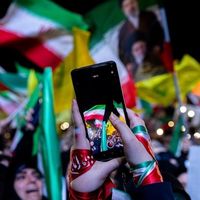
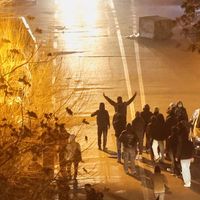
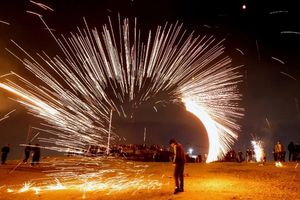
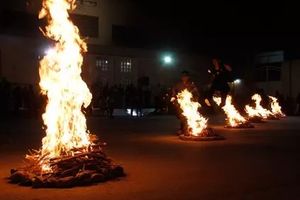
Iranians celebrating Chaharshanbe Suri in Tehran on March 17, 2026
Iranians across many cities took to the streets late Tuesday to celebrate Chaharshanbe Suri, defying warnings and attempted crackdowns by security forces as the country remains under sustained military pressure.
Videos sent to Iran International showed crowds gathering in Tehran, Karaj, Shiraz, Mashhad and other cities, lighting fires, dancing and chanting slogans, including “Javid Shah,” in apparent response to calls by exiled prince Reza Pahlavi to mark the pre-Islamic festival despite restrictions.
In several locations, including Chitgar in western Tehran and parts of Karaj, security forces were seen attempting to disperse gatherings, with footage showing police vehicles approaching crowds.
But the celebrations persisted, with people singing patriotic songs such as “Ey Iran” and setting off fireworks in residential neighborhoods and public spaces.
Chaharshanbe Suri, traditionally held on the eve of last Wednesday of the Iranian calendar year, has long been viewed with suspicion by the Islamic Republic.
In recent years it has increasingly become a flashpoint for anti-government expression, particularly during periods of unrest.
This year’s celebrations unfolded against the backdrop of ongoing conflict and heightened security pressure, with reports of surveillance and efforts by authorities to deter gatherings.
Israeli support
“An unprecedented event took place last night, as Israeli drones targeted Basij and police patrols attempting to approach celebration sites,” an Israeli official told Iran International.
“For the first time, the people of Iran benefited from active support that paralyzed the repression apparatus and effectively provided an ‘air umbrella’ for the crowds,” the official said.
Israeli Prime Minister Benjamin Netanyahu had earlier signaled support, saying in a video message that Israeli forces were targeting what he described as “terrorist operatives” to enable Iranians to celebrate.
“Our aircraft are striking terrorist elements in city squares and intersections to allow the brave people of Iran to celebrate the fire festival,” he said. “Celebrate. Happy Nowruz. We are watching from above.”
Iran has executed a Swedish-Iranian man identified as Kourosh Keyvani after convicting him of espionage for Israel, according to reports by the judiciary-linked Mizan news agency.
Mizan said Keyvani was executed on Wednesday morning after his death sentence was upheld by the Supreme Court. He had been accused of passing “images and information of sensitive locations” to officers of Israel’s Mossad intelligence agency.
The report said Keyvani was arrested in Savojbolagh on the fourth day of the 12-day war in June. Authorities said the case had gone through legal procedures, but no independent evidence supporting the allegations was made public.
Later in the day, Swedish Foreign Minister Maria Malmer Stenergard said in a statement that a Swedish citizen was executed in Iran without naming him. However, it confirmed that the person was arrested in June.
The legal proceedings leading up to the execution did not meet the standards of due process, she added.
The semi-official Tasnim news agency said Keyvani had been detained by the Revolutionary Guards’ intelligence arm and was found with cash, vehicles and what it described as advanced communication and surveillance equipment.
Tasnim also reported that he had allegedly been recruited through online contact and trained abroad before returning to Iran, though these claims could not be independently verified.
Keyvani is the latest in a series of executions in Iran involving individuals accused of espionage for Israel, particularly since the outbreak of the June war.
Iran has one of the highest execution rates in the world and has long used the death penalty in national security cases, including allegations of spying. Following the conflict, rights groups and international media have reported a sharp increase in arrests and executions on such charges.
The Telegraph reported that executions in Iran have surged since the June war, citing data from human rights group HRANA indicating that the number of executions has risen significantly, including for those accused of links to Israel. The Sunday Times has also reported that dozens more people could face execution on similar charges.
Iranian women shop at the Tajrish Bazaar, ahead of Nowruz, the Iranian New Year, in Tehran, Iran March 15, 2023.
Nowruz is approaching with far less of its usual energy across Iran this year, as many families abandon long-standing New Year preparations while war, economic strain and an atmosphere of uncertainty dampen the festive mood.
Several Iranians told Iran International that familiar rituals that normally fill homes with activity in the weeks before the holiday have stalled.
“This year we did nothing,” Leila, a 38-year-old resident of Tehran, told Iran International. “We didn’t wash carpets and we didn’t do the house cleaning. Every year I would start from early February, but this year we are just looking at the sky, waiting for the fall of this regime.”
Nowruz, the Persian New Year marking the arrival of spring, has been celebrated for more than 3,000 years across Iran and parts of Central Asia and the Middle East.
The holiday usually falls on March 20 or 21 and begins nearly two weeks of family visits, meals and gatherings.
An Iranian person washes a carpet during traditional spring cleaning, known as khaneh-Tekani, ahead of the Nowruz new year celebrations.
‘Shaking the house’
In most years, the weeks before Nowruz transform daily life across Iran. Families traditionally begin with Khaneh Tekaani, a deep spring cleaning whose name literally means “shaking the house.” Carpets are washed, cupboards reorganized and homes refreshed to symbolically welcome the new year.
Another essential ritual is planting Sabzeh — dishes of sprouting wheat, lentils or barley that represent renewal and rebirth and are later placed on the Haft-Seen table, the centerpiece of the celebration alongside candles, colored eggs, a mirror and often a red goldfish.
But this year, some residents say even modest traditions feel out of reach.
“Planting Sabzeh is something we Iranians do every year, but this year with all the news about war we completely forgot about it. God damn the Islamic Republic for ruining everything,” Kamran, a 42-year-old office worker in Hamedan, told Iran International.
An Iranian man installs curtains at home as part of preparations ahead of the Nowruz new year celebrations.
‘No money, no mood’
Markets that normally bustle in the run-up to Nowruz — with families buying sweets for visiting relatives, decorative items for Haft-Seen tables and new clothes for children — have also been quieter this year, residents say.
Some cite the worsening economic situation as a key reason holiday traditions have faded.
“Every year despite inflation we bought at least a few things,” said Golnaz, a 35-year-old shop owner in Karaj. “But this year we had neither the money nor the mood. We are waiting for that final moment.”
Golnaz described how rising prices have weighed heavily on households and small businesses.
“Even if we wanted to prepare and had the energy, prices are so high we simply cannot afford it. Everything has become several times more expensive. I run a small cosmetics shop and this month I have not even earned the rent for the store,” she said.
Her husband, who drives for a ride-hailing service, is working less frequently amid fears of bombings and falling demand as more people stay home.
People look at goldfish displayed for sale at a street market ahead of Nowruz celebrations in Tehran.
‘No ordinary time’
On social media, many Iranians say the emotional tone of the season has shifted sharply compared with previous years.
“If things were normal, I should be excited for next week and finishing my preparations. The scent of night-blooming flowers would be filling the house and the holiday sweets would already be in the refrigerator,” one user wrote.
Another reflected on the contrast with childhood memories: “What burns me is that it is the New Year season. People should now have the mood of buying for the holiday and welcoming the new year in Iran. I remember how excited I was as a child. But those feelings slowly died inside me.”
For generations, the approach of Nowruz has filled Iranian homes with cleaning, cooking and preparations symbolizing renewal. This year, residents say those rituals — once a nationwide signal of spring’s arrival — have been overshadowed by war, rising prices and uncertainty about what the new year will bring.
A traditional Haft-Seen table is arranged at a home ahead of Nowruz, the Persian New Year.
Photo of slain secretary of Iran's Supreme National Security Council Ali Larijani along with his son Morteza and his chief bodyguard General Vahid Fateminejad, all killed in the airstrike early Tuesday.
The Israeli killing of Ali Larijani marks another blow to the Islamic Republic’s capacity for coordination, weakening an already fragmented system and raising the risk of miscalculation under pressure.
Iran confirmed on Tuesday that Larijani—Secretary of the Supreme National Security Council and one of the regime’s central security coordinators— was killed in a morning strike on Tehran.
The strike inevitably recalls the killing of Qassem Soleimani in 2020: another precise removal of a figure who linked diplomacy, intelligence and military power.
Soleimani’s death did more than eliminate a commander. It weakened the regime’s ability to calibrate risk. Radical in purpose, cautious in execution, he pushed proxies forward without inviting existential retaliation.
His absence left a gap no successor fully filled. Coordination frayed, misjudgments mounted and responses grew less predictable. The network endured, but its timing became erratic and its restraint thinner.
Larijani’s role must be understood against that backdrop.
According to a source cited by Christiane Amanpour, Larijani had, as recently as September 2025, been viewed in some Western and Israeli assessments as a potentially acceptable transitional figure before becoming a target by early February 2026.
The account attributes the shift to his role in pressing for domestic crackdowns, adopting a more confrontational posture toward the United States and Israel and assuming a central role in shaping IRGC military operations.
The claims remain unverified but highlight how Larijani straddled internal consolidation and external escalation at a moment of acute pressure.
His career began during the Iran-Iraq War, where he rose within the Islamic Revolutionary Guard Corps to brigadier general, later serving as Speaker of Parliament (2008–2020), where he advanced a hard-line agenda aligned with the consolidation of power in the Office of the Supreme Leader.
In the years that followed, he moved from battlefield to bureaucracy, helping consolidate the regime’s coercive and ideological infrastructure.
As head of Islamic Republic of Iran Broadcasting (1994–2004), Larijani oversaw more than a media organization. The state broadcaster worked closely with the intelligence services and the IRGC, shaping narratives that reinforced loyalty and narrowed the space for dissent.
The 1996 Hoviyyat (Identity) series publicly branded intellectuals and professionals as traitors, airing coerced confessions and drawing sharp limits around permissible thought. At the same time, official memory of the Iran-Iraq War was recast into doctrine: martyrdom elevated, endurance framed as victory.
Over time, this messaging helped consolidate a narrower but more disciplined base embedded across Basij and IRGC networks. Its purpose was not persuasion but enforcement: to secure the regime against a broader, often unwilling society.
That framework endured. It underpinned repression during the 2009 Green Movement, resurfaced during the Woman, Life, Freedom protests in 2022 and shaped the violence of January 2026.
Beyond Iran, the same logic informed Hezbollah’s campaign in Syria, Hamas operations culminating in October 7 and the IRGC’s maritime doctrine of asymmetric pressure.
Despite tensions within the political elite, Larijani remained firmly inside the core leadership. Loyal and disciplined, he embodied continuity across institutions.
Following the death of Supreme Leader Ali Khamenei in the February 28 strike that opened the current phase of war, Larijani’s experience and connections positioned him as a potential stabilizing figure.
His 2025 reappointment as Iran’s security chief reinforced that role. From there he coordinated nuclear policy, crisis management and relations among the regime’s core institutions.
Larijani’s removal would introduce immediate disruption: friction in command and pressure for retaliation. The deeper consequence may be fragmentation.
The Islamic Republic now operates less as a unified state than as a dispersed system under sustained pressure from Israel and the United States. Authority increasingly runs through provincial clerical networks, IRGC commanders and Basij structures. Resources are mobilized locally, repression enforced locally and survival managed locally.
Larijani belonged to the shrinking circle still capable of linking these fragments to a central command. His loss risks accelerating the incoherence the system is already struggling to contain.
Soleimani’s precedent is instructive: decapitation weakens coordination and invites miscalculation, even as the structure endures.
Missile infrastructure remains dispersed across hardened and subterranean sites. Fast naval craft and unmanned vessels continue to threaten shipping in the Strait of Hormuz. Proxy militias operate through channels designed to outlast leadership losses.
What appears as resilience may instead reflect dispersal without coordination — a system that survives but no longer acts as one.
Larijani’s killing tests not only the state’s durability but its capacity to function as a coherent force under sustained pressure. The war may not bring immediate collapse. But without figures such as Soleimani and Larijani, adaptation may hasten, rather than forestall, its demise.
Iran's former Secretary of the Supreme National Security Council Ali Larijani
Israeli forces killed senior Iranian official Ali Larijani and IRGC-Basij commander Gholamreza Soleimani in overnight airstrikes inside Iran, Israel’s defense minister and military said on Tuesday, as Tehran has yet to confirm the deaths.
Defense Minister Israel Katz said Larijani had been killed in the strikes, while the Israeli military confirmed it targeted him in Tehran. The military separately said a strike killed Soleimani, head of the Basij paramilitary force, along with other senior officials.
Katz used stark language in comments released by his office after a security assessment.
“Larijani and the Basij commander were eliminated overnight and joined the head of the annihilation program, Khamenei, and all the eliminated members of the axis of evil, in the depths of hell,” Katz said.
The Israeli military said Soleimani was struck at a tent camp recently established by the Basij after earlier Israeli attacks damaged several headquarters used by the paramilitary organization.
According to the military, the strike also killed the deputy commander of the Basij and several other senior officials.
The Basij, which operates under the Islamic Revolutionary Guards Corps, has long been associated with the enforcement of ideological policies and the suppression of dissent inside Iran.
The reported killings mark one of the most significant decapitation strikes against Iran’s leadership structure since the outbreak of the current conflict.
Larijani: Insider and wartime power broker
Ali Ardashir Larijani, born on June 3, 1945 in Najaf, Iraq, rose to become one of the most influential figures in the Islamic Republic over four decades.
He came from a clerical family originally from Mazandaran province in northern Iran. His father, Hashem Larijani, was a cleric, and several of his brothers also held senior posts within the Iranian state.
Iran's former Secretary of the Supreme National Security Council Ali Larijani
His political career began in the early years after the 1979 Islamic Revolution, when he joined the Islamic Revolutionary Guards Corps and later moved into government posts.
Larijani served as deputy labor minister and later as deputy minister of information and communications technology before he was appointed in 1994 as the head of the state broadcasting organization, Islamic Republic of Iran Broadcasting (IRIB).
He led the state media network for a decade, a role that gave him a position in shaping the government’s propaganda during a politically turbulent period.
In 2005 he was appointed secretary of the Supreme National Security Council, placing him at the center of Iran’s security policy and nuclear negotiations. In that role he served as Iran’s chief nuclear negotiator in talks with European powers.
Larijani later entered parliamentary politics and became speaker of the Iranian parliament in 2008, a position he held until 2020.
He ran for president in 2005 but finished sixth, and later attempted to run again in 2021 and 2024. Both candidacies were blocked by the Guardian Council, which vets candidates for high office.
In August 2025, he returned to the center of national security policy when he was appointed once again as secretary of the Supreme National Security Council.
Following the death of Supreme Leader Ali Khamenei during the 2026 US-Israeli strikes, some analysts and media reports described Larijani as acting as Iran’s wartime leader, relying on long-standing ties to security institutions and clerical networks.
Iran's former Secretary of the Supreme National Security Council Ali Larijani
The United States imposed sanctions on Larijani in January 2026 over his role in the violent suppression of protests inside Iran.
Iranian on social media blame him as the mastermind behind the massacre of around 36,500 protesters during January uprising. Israeli officials said their overnight strike targeted him in Tehran.
Soleimani: Basij commander
Gholamreza Soleimani, born in 1963 in Farsan in Iran’s Chaharmahal and Bakhtiari province, built his career inside the Islamic Revolutionary Guards Corps and the Basij militia.
Despite sharing the surname, he was not related to Qasem Soleimani, the commander of the Guard’s Quds Force who was killed in a US drone strike in Iraq in January 2020.
Iran's former Basij Cheif Gholamreza Soleimani
Soleimani joined the Basij as a volunteer during the Iran-Iraq War in the 1980s and later became a member of the Revolutionary Guards.
He steadily rose through the ranks and eventually became commander of the Basij Organization in 2019.
The Basij, a paramilitary network with branches across Iran, operates under the authority of the Revolutionary Guards and has played a key role in enforcing ideological policies and mobilizing supporters of the Islamic Republic.
The force has also been widely accused by human rights groups of participating in violent crackdowns on protests.
Soleimani was sanctioned by the European Union in 2021 for his role in the repression of those protests.
The United States Treasury placed him on its Specially Designated Nationals list later the same year.
Additional sanctions were imposed by the United Kingdom and Canada in connection with human rights abuses.
Iran's former Basij Cheif Gholamreza Soleimani
The strikes occurred as Israel and the United States continued a broad aerial campaign against Iranian military and nuclear infrastructure.
Meanwhile, Israeli air defenses detected a new ballistic missile launch from Iran toward northern Israel on Tuesday.
People celebrating Chaharshanbeh Suri in Tehran (file photo)
As dusk falls across Iran on Tuesday, bonfires, fireworks and street gatherings are expected to mark Chaharshanbeh Suri, an ancient fire festival that has also become a public act of defiance, this year unfolding under war, heavy security and fears of bloodshed.
Iranian authorities have issued stark warnings ahead of Chaharshanbeh Suri as officials point to what they describe as wartime conditions and the risk of unrest.
Police commander Ahmadreza Radan said this year’s celebrations come under “different circumstances,” adding that the country is effectively in a state of war and that emergency and medical services are on high alert.
He warned that adversaries could exploit the night’s gatherings, saying there is a possibility that “agents” could blend into crowds celebrating the festival and trigger incidents or casualties to inflame the situation.
In a separate notice, the Intelligence Ministry urged citizens to remain vigilant, claiming that “a small number of Israeli soldiers” may attempt sabotage during the festivities and calling on people to report suspicious activity.
The messaging has been reinforced by a broader security buildup. Reports indicate increased coordination among police, intelligence, and judicial bodies, alongside threats of decisive action against what officials describe as dangerous behavior.
In some areas, people have been encouraged to hold events in mosques and controlled spaces rather than in the streets.
An Iranian man lights a firework during the Wednesday Fire celebration (Chaharshanbeh Suri in Persian) at a park in Tehran, Iran. (2024)
Contest over public space, culture and control
Yet Chaharshanbeh Suri has rarely stayed contained.
Celebrated on the eve of the last Wednesday before Nowruz, the festival – marked by bonfires, fireworks, and the ritual of jumping over flames – predates Islam and has endured for centuries. In recent years, it has taken on an added meaning, evolving into one of the few nights when large numbers of people gather spontaneously in public spaces.
That scale has made it difficult to control. It has also turned the festival into a recurring flashpoint.
Last year, crowds across multiple cities poured into the streets despite heavy security presence. Clashes broke out in several areas, leaving at least 19 dead and thousands injured. Videos showed bonfires lighting up neighborhoods as music, chanting, and fireworks filled the air.
In earlier years, the night has gone further, with young people using firecrackers and homemade devices to confront security forces, chanting slogans, and in some cases burning photos of late Supreme Leader Ali Khamenei.
The pattern has become familiar: warnings ahead of the night, followed by mass turnout, and then confrontation.
This year, however, the backdrop is markedly different.
Iran is in the midst of an escalating conflict, with the United States and Israel striking targets linked to military and security structures. A strike announced on Tuesday killed the IRGC Basij commander Gholamreza Soleimani, a key figure in crowd control and repression.
Against that backdrop, officials have framed the festival not only as a safety concern but as a potential security threat.
‘A symbol of resilience’
Exiled Prince Reza Pahlavi, in an interview with Iran International earlier this week, said the festival carries a deeper meaning beyond tradition.
“When we celebrate Chaharshanbeh Suri today, it is not only to preserve our culture,” he said. “It is a powerful message to those who have always tried to erase our identity… an opportunity to show that we exist – to ourselves and to the world.”
He also pointed to a broader generational shift, saying: “Today everyone has reached the conclusion that a secular system is needed… a system built on ideology has, from the beginning, imposed discrimination on society.”
At the same time, he framed the preservation of cultural traditions as central to Iran’s resilience, adding that the country has endured “because of the courage of its people and the preservation of Iranian culture.”
His call to mark the night has been echoed among parts of the diaspora, including appeals for gatherings outside Iranian embassies, while inside the country officials have warned that participation could carry consequences.
The tension between these two narratives – celebration and control – is not new.
As analyst Morad Vaisi has noted, the confrontation over festivals like Nowruz and Chaharshanbeh Suri reflects a deeper struggle.
These traditions, he wrote, have endured not because of official backing, but because of people’s resistance to cultural pressure, becoming a symbol of identity and continuity beyond political systems.
Each year that people gather despite restrictions, the act itself sends a message that Iran’s cultural life extends beyond those in power.
That dynamic is expected to be on full display again tonight.
But this year, the familiar sounds of celebration will unfold alongside something heavier: a country under bombardment, a heightened security presence, and warnings that frame even small gatherings as a potential threat.
In past years, Chaharshanbeh Suri has often blurred the line between festivity and confrontation.
As darkness falls, that line may once again be tested – raising expectations of large turnouts, and concern that the night could end, as it has before, with violence and more lives lost.