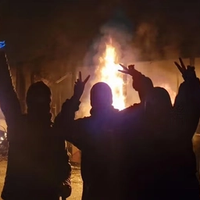
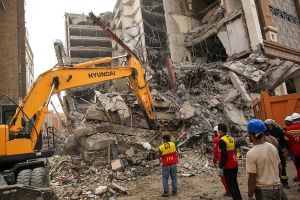
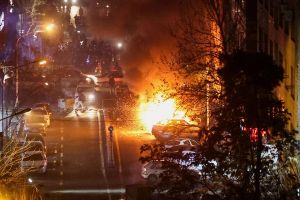
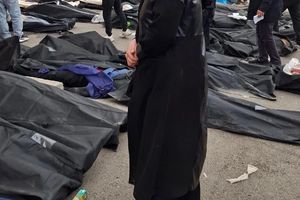
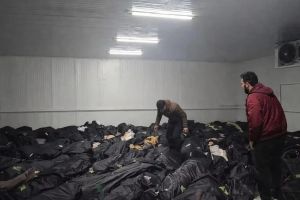
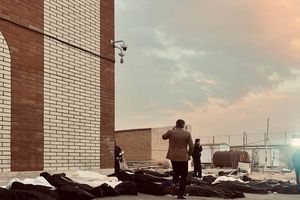
It entered their bodies – in sleepless nights, stomach illness, obsessive counting of the dead, and a persistent sense that something in their relationship to Iran had been permanently altered.
Now, two months later, as the United States and Israel wage war against the Islamic Republic and another far stricter internet blackout grips the country, that earlier rupture is returning with renewed force.
Images of death, the disappearance of communication, and the uncertainty surrounding Iran’s future have reopened a wound many in the diaspora say never fully closed.
A new qualitative study by researcher Nazanin Shahbazi, a PhD student at the University of Manchester, helps explain why.
Based on eight in-depth interviews with politically engaged members of the Iranian diaspora conducted shortly after the January killings and end of internet shutdown, the research explores how people far from the violence nevertheless experienced the uprising and massacre as a personal rupture – one that reshaped their bodies, their sense of time, and even what it meant to say “I am Iranian.”
“The protests, the killings, the internet blackout and the blocked funerals were not separate chapters,” Shahbazi told Iran International. “For the people I spoke with they formed one continuous shock that reorganized their lives.”
Human rights organizations have documented the repression in detail – the shootings, the arrests, the intimidation of families and the pressure placed on relatives of the dead. What those reports cannot capture is how such violence lives on in those who witness it from afar.
“They can tell us what was done to people and roughly how many were killed,” Shahbazi said. “But they can’t show what it feels like to live with that in your body, your sleep, your relationships and your sense of future.”
Body keeps the score
One of the most striking patterns in the interviews is how often the experience of the massacre appeared in the body.
Participants described vomiting after seeing images of burned bodies, sudden weight gain, eczema, IBS flare-ups, breathlessness, grinding teeth and persistent insomnia. Some lost their appetite entirely. Others said their ordinary routines collapsed into constant monitoring of news from Iran.
“When words ran out, people kept returning to their bodies,” Shahbazi said. “Sudden vomiting, weight gained in twenty days, neck spasms or grinding teeth were how they registered what they could not yet fully think or articulate.”
The body, in this sense, became both witness and container.
Political violence was not simply something they analyzed or debated. It was something that settled into digestion, sleep, muscles and skin.
Shahbazi believes those reactions reveal dimensions of suffering that familiar categories like trauma or PTSD sometimes fail to capture.
“Diagnostic labels can flatten experience into symptom lists,” she said. “What people described were very concrete bodily dramas tied to images and events in Iran.”
Safe but summoned
Another recurring theme was the strange moral position created by exile.
The interviewees were physically safe – living in UK, Europe, North America or elsewhere outside Iran – yet many said they did not experience themselves as distant observers.
“I would describe their condition as safe but summoned,” Shahbazi said. “They lived outside the field of bullets but inside a field of responsibility.”
Again and again participants returned to a painful question: why am I here while others were killed?
Exile did not reduce the emotional weight of the uprising. In many cases it intensified it.
“Safety, mobility and an intact body were experienced not simply as privileges,” Shahbazi said. “They were felt as a kind of unpaid debt to those who stayed and faced lethal risk.”
That sense of symbolic debt helps explain why many interviewees described weeks in which work, sleep and daily routines collapsed into constant monitoring of events in Iran.
Some called friends inside the country repeatedly. Others spent hours tracking death tolls or watching newly emerging videos.
They were not simply following the news. They were trying to answer a moral demand they felt placed upon them.
Language at its limit
The scale of the violence also strained language itself. Participants repeatedly reached for extreme words – “catastrophe,” “slaughter,” or “something like a Holocaust” – because ordinary vocabulary seemed incapable of holding what they had seen.
“Everyday language felt too small,” Shahbazi said. “So people borrowed the biggest words they could find.”
Even those words felt insufficient.
Many interviewees hesitated as they spoke, qualifying their descriptions with phrases like “something like” or “nothing else really covers it.”
Numbers became another way of trying to grasp the event.
Several participants described compulsively tracking death tolls or attempting rough calculations of how many people might have been killed.
“Counting was a way of making the killings halfway thinkable,” Shahbazi said.
A different Iranian-ness
Despite the suffering described in the interviews, the research also uncovered something unexpected. Several participants said the uprising had changed how they understood their own identity.
For years, many had associated being Iranian internationally with embarrassment tied to the Islamic Republic’s image abroad. After the protests, that feeling began to shift.
Shahbazi said several participants described a “partial lifting of shame” when saying they were Iranian.
“In its place they spoke about pride in the courage and sacrifices of protesters,” she said.
Some described renewed attachment to Iranian culture, language and land. Others spoke about admiration for the mothers who stood at the forefront of demonstrations.
Shahbazi believes this shift may have political consequences as well.
“It recenters being Iranian around equality, justice and shared humanity,” she said, “rather than around the state’s ideology.”
That transformation remains fragile.
The war now unfolding and the renewed blackout mean that images of violence are again entering Iranian homes and diaspora communities alike.
But if the interviews reveal anything, it is that the event did not remain confined to the streets where it began.
As Shahbazi put it: “For many Iranians in the diaspora, the massacre did not stay on their screens; it cut into their bodies, their sense of time, and even the way they dare to say, ‘I am Iranian.’”