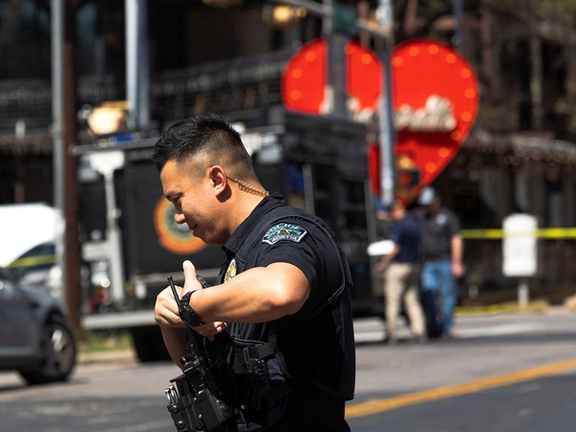
A police officer works at the scene after a deadly mass shooting outside Buford's, a popular roadhouse-style bar in Austin, Texas, US on March 1, 2026.
Concerns over the activation of Iran’s sleeper cells in America have increased after a deadly shooting in Austin involving a suspect with alleged ties to Iran and a separate gun attack on an Iranian dissident’s gym in Canada.
A flag of the Islamic Republic and photographs of Iranian regime leaders were discovered inside the apartment of the suspect in the deadly Austin bar shooting, CBS News reported citing sources.
Authorities identified the suspect as 53-year-old Ndiaga Diagne, a naturalized US citizen originally from Senegal, the Associated Press reported, citing law enforcement officials.
He opened fire early Sunday at a bar in Austin’s West Sixth Street district, killing two people and injuring about 14 others before being shot and killed by police.
The suspect was wearing clothing bearing Islamic references, including a sweatshirt reading “Property of Allah” and a shirt featuring the flag emblem of the Islamic Republic of Iran, and a Quran was found in his vehicle, the report said.
The FBI and the Joint Terrorism Task Force are assisting in the investigation, and officials said there were indicators that could suggest a possible terrorism nexus, according to the Associated Press.
The suspect’s alleged X account shows a reply last year to a post by Iran’s Foreign Minister Abbas Araghchi, who wrote that any strike on Iran would be “immediately reciprocated.” In response, the account identified as Ndiaga Diagne wrote that the “Islamic Revolution is eternal and here to stay until the end of time.”
Canada gym attack
Separately, hours after the announced death of Iran’s Supreme Leader Ali Khamenei following US-Israeli strikes on Tehran, a boxing gym in Richmond Hill, Ontario, run by Iranian-Canadian dissident activist and cruiserweight champion Salar Gholami, was struck by gunfire overnight.
Video shared by Gholami showed multiple bullet holes across the front windows of Saliwan Boxing Club on Yonge Street, some displaying pro-Iranian liberation flags and images. At least two panes were shattered, and an evidence marker was visible above one of the bullet holes.
"Seventeen live rounds were fired randomly at the gym, and it was sprayed with bullets," Gholami told Iran International, describing the shooting as intimidation directed at critics of the Islamic Republic.
"This is the result of shaking hands with the mullahs and delaying action. When the Canadian government leaves the door open for them to enter, this will no longer be a safe place even for Canadians themselves. Seventeen bullets means it could have left behind 17 Canadian bodies."
Salar Gholami's gym in Toronto hit by multiple bullets
Concerns over sleeper cells
Following the US-Israeli strikes on Iran and the killing of Ali Khamenei, retaliatory measures including by Iranian sleeper cells cannot be ruled out, a senior German lawmaker said on Sunday.
“The Iranian regime has repeatedly demonstrated in the past that it carries out its terror beyond its own borders,” Marc Henrichmann told the Sueddeutsche Zeitung newspaper.
Last June, US law enforcement stepped up its monitoring of potential Iran-backed operatives within the United States amid the 12-day Israeli war on Iran which was later joined by the US.
In the days after Israel launched its attacks on Iran, the FBI under its director Kash Patel boosted surveillance over what sources cited by CBS described as Hezbollah-linked sleeper cells.
People walk near a mural featuring an image of Iran's Supreme Leader Ali Khamenei as people gather after Khamenei was killed in Israeli and US strikes on Saturday, in Tehran, Iran, March 1, 2026.
The CIA helped identify a Saturday morning gathering of Iran’s top leaders in Tehran, including Supreme Leader Ali Khamenei, before Israel carried out a strike that killed him and other senior officials, The New York Times reported.
Citing people familiar with the operation and officials briefed on the intelligence, the newspaper said the agency had tracked Khamenei for months and passed “high fidelity” intelligence on his location to Israel ahead of the attack.
According to the report, US and Israeli officials adjusted the timing of their planned strike to take advantage of intelligence that senior political and military figures would gather Saturday morning at a leadership compound housing the offices of the supreme leader, the presidency and the Supreme National Security Council.
Israel had assessed that those present would include Mohammad Pakpour, commander in chief of the Islamic Revolutionary Guard Corps; Defense Minister Aziz Nasirzadeh; Admiral Ali Shamkhani, head of the Military Council; Majid Mousavi, commander of the IRGC Aerospace Force; and Deputy Intelligence Minister Mohammad Shirazi, among others.
The operation began around 8 a.m. Tehran time, when fighter jets took off armed with long-range precision munitions. About two hours later, in Tehran, missiles struck the compound.
Senior national security officials were in one building, while Khamenei was in another nearby structure, the report said.
An Israeli defense official said in a message reviewed by the newspaper that the strike was “carried out simultaneously at several locations in Tehran,” adding that Israel achieved “tactical surprise” despite Iranian preparations for war.
Iran’s state news agency IRNA confirmed on Sunday the deaths of some of the senior military figures Israel said it had killed, including Shamkhani, Pakpour, and Nasirzadeh.
Last June, as plans were underway to strike Iran’s nuclear facilities, President Trump said the United States knew where Khamenei was hiding and could have killed him.
A protester burns images of Supreme Leader Ali Khamenei
Iran’s Supreme Leader Ali Khamenei was killed in Saturday’s airstrikes, marking the end of more than three decades at the helm of the Islamic Republic and closing a chapter in Iran’s modern history that many Iranians had long hoped to see concluded.
While the wound of the massacre of January 2026 where over 36,000 were killed still feels fresh on the body of society, the death of Tehran’s dictator Ali Khamenei has pushed Iran and the region into a sensitive and unprecedented phase.
Khamenei, who for more than three decades was the central pillar of the Islamic Republic, has exited the scene of power at a moment when the Islamic Republic’s political and military structure is on permanent high alert, the economy is under the strain of mass poverty and a severe erosion of legitimacy, society is filled with the anger and mourning of the January massacre, and the Islamic Republic’s future has sunk into a dense fog of ambiguity, fear, and questions about the regime’s own survival.
In his absence, a system whose vital levers—from the judiciary and the armed forces to regional policy and the state broadcaster—were shaped under the guidance at the very top of the pyramid faces a profound crisis: over succession, over managing the consequences of an unfinished war, and over confronting the compressed and accumulated fury that has flared in streets and society in recent years.
Khamenei’s death is not merely the end of one leader’s life, but the end of an era in which ideology, repression, security, and “resistance” were embodied in a single figure.
Now, the Islamic Republic must navigate its future without Khamenei, in an atmosphere of doubt, fear, and intra-elite rivalry.
From Mashhad to the Leader’s Office
Seyyed Ali Hosseini Khamenei was born in April 1939 in Mashhad, a city of major significance in Shiism. His father, Seyyed Javad Khamenei, was a traditional, ascetic cleric who lived simply.
Ali Khamenei entered the seminary as a child and, after studying in Mashhad, went to Qom to continue his religious education—where he became acquainted with figures such as Ruhollah Khomeini and Akbar Hashemi Rafsanjani and, influenced by Khomeini’s political view of Islamic jurisprudence, was drawn into the struggle against the Pahlavi monarchy.
In the 1960s and 1970s, Khamenei was repeatedly arrested, imprisoned, and exiled for revolutionary activities against the Shah’s rule. These experiences—especially alongside his speeches and ideological translations of works by Arab Islamists—played an important role in shaping his intellectual identity.
He also became an active figure in transmitting the concept of “Islamic government” to a younger generation of clerics and revolutionaries.
Consolidation after 1979 Revolution
After the 1979 revolution, Khamenei quickly entered the Islamic Republic’s power structure. He became a member of the Revolutionary Council, played a role in rebuilding the army and establishing the Islamic Revolutionary Guard Corps (IRGC), and was also active in the Islamic Republic’s propaganda apparatus.
In the first decade of the Islamic Republic, Khamenei was considered part of the central decision-making core—both because of his closeness to Khomeini and because of his skill in building networks of loyalty among clerical and military ranks.
In 1981, while delivering a speech at the Abuzar Mosque in Tehran, he was targeted in a bombing. The explosion of a tape recorder placed in front of him permanently paralyzed his right arm.
The incident turned him into a symbol of a “cleric harmed on the path of the revolution” and, symbolically, cemented his standing in the memory of the regime’s supporters.
The presidency and the bond with the IRGC
After the assassination of then-president Mohammad-Ali Rajaei, Khamenei became president in 1981 and remained in office for two four-year terms.
His presidency coincided with the Iran–Iraq war. In practice, he played the role of mediator between the IRGC and the government of the time led by Prime Minister Mir-Hossein Mousavi.
Although the presidency had limited power in the Islamic Republic’s structure, Khamenei—backed by influential Khomeini ally Akbar Hashemi Rafsanjani, who prevented him from being sidelined—used the opportunity to establish strategic ties with IRGC commanders and security circles, networks that later became the foundations of his absolute leadership.
An unexpected selection, powerful consolidation
In June 1989, after Khomeini’s death, the Islamic Republic faced a challenge in choosing his successor.
The Constitution at the time deemed only a “source of emulation” (marjaʿ-e taqlid) qualified to lead, but Khamenei did not hold that clerical rank. Even so, in an emergency session of the Assembly of Experts—and with Hashemi Rafsanjani playing a prominent role—he was chosen as interim leader.
In that session, he openly declared his own opposition to being selected as leader.
In parts of his remarks at the meeting (later released as audio and video), Khamenei stressed that he neither had the requisite jurisprudential qualification for leadership nor agreed with the principle of concentrating power in one person.
He even said in a protesting tone: “One really must weep tears of blood for an Islamic society in which even the possibility [of leadership] of someone like me is raised…”
But after consultations, political pressure within the Assembly, and the prominent and decisive role of Hashemi Rafsanjani—who said in the session, “I heard in the Imam’s will that he considered Mr. Khamenei fit for leadership”—the meeting moved toward selecting Khamenei as interim leader.
At the end of the session, he accepted the responsibility and said: “If you have decided so, I do not object, but I say clearly that this is heavier for me than anything.”
A few months later, the Constitution was amended and the requirement of being a “source of emulation” was removed.
In November 1989, the Assembly of Experts convened again and formally and permanently appointed Khamenei as leader of the Islamic Republic.
That session was one of the most important turning points in the Islamic Republic’s history, because it showed that leadership was shaped not only on the basis of jurisprudential stature, but through a mixture of political expediency, structural cohesion, and behind-the-scenes interventions.
What was initially seen as a temporary and conservative choice, in practice became the beginning of building one of the most powerful and centralized person-centered structures in the Islamic Republic.
Absolute authority: from guardianship of the jurist to a parallel state
Khamenei gradually turned the institution of the Supreme Leader into an all-encompassing power that had the final say in every arena—from security and foreign policy to the economy and culture.
He turned the Execution of Imam Khomeini’s Order Headquarters (Setad) into one of Iran’s wealthiest economic institutions and, through it, oversaw vast holdings in real estate, industry, banks, and media.
Institutions such as the judiciary, the Guardian Council, the IRGC, the state broadcaster, and even the Supreme National Security Council were effectively subordinate to the leader’s direct view. Khamenei became not only commander-in-chief, but also the ultimate arbiter of the judiciary and the Islamic Republic’s principal policymaker.
Under his leadership, the IRGC shifted from a revolutionary military force into the main actor in politics, the economy, and security within the Islamic Republic.
By directly delegating powers, massive budgets, and transnational missions to the IRGC, Khamenei turned it into the backbone of regime preservation and the executive arm of the guardianship of the jurist.
Khamenei’s political mindset was deeply conspiratorial. In most of his speeches, he spoke of an “enemy” using terms such as “global arrogance” and a “network of infiltration,” and attributed every domestic event—from student protests and the Green Movement to the uprisings of 2017, 2019, 2022, and 2025—to designs from London, Washington, and Tel Aviv.
Within this framework, demands such as civil liberties, women’s rights, or protests against the economic crisis were portrayed not as genuine social grievances, but as part of an “enemy project”—both to make repression appear legitimate and to cast any criticism of the system as treason and foreign dependence.
Regional strategy: 'Axis of Resistance'
With the aim of confronting Israel and the United States, Khamenei established a regional strategy known as the “axis of resistance”: an uneven alliance of proxy groups and aligned governments formed through the Islamic Republic’s financial, military, and ideological support.
From Hezbollah in Lebanon and Shiite militias in Iraq to the Houthis in Yemen and Bashar al-Assad’s regime in Syria, this axis expanded over two decades under Khamenei’s direct supervision.
But in 2024 and 2025, this strategy came under repeated blows. Israeli attacks shattered Hamas’s military structure in Gaza; Syria after Bashar al-Assad’s fall moved to redefine its relations with Tehran’s axis; and the United States’ military campaign against the Houthis in the Red Sea and Yemen severely weakened the Islamic Republic’s influence in that region.
Structural hostility to the West, especially the United States, along with chronic distrust of Europe, pushed Khamenei toward the doctrine of “looking to the East.” Throughout his years of leadership, he repeatedly emphasized that “the East should be preferred over the West,” and in practice, by deepening strategic dependence on Russia and China—from long-term economic and military contracts to security coordination—he sought to define the Islamic Republic’s survival under the protective umbrella of those two powers.
This pivot both placed Iran in a more subordinate geopolitical position vis-à-vis Moscow and Beijing and entrenched its isolation from the Western world.
Confrontation with the West, the nuclear program, and isolation
Khamenei was always deeply suspicious of the West, especially the United States, and repeatedly warned that “Western cultural infiltration” was a fundamental threat to the Islamic Republic.
Internationally, Tehran’s nuclear program was one of the central files of his leadership.
Despite a religious decree against nuclear weapons, he advanced the enrichment program and in 2015 gave conditional support to the JCPOA, but after the United States withdrew from it in 2018, he replaced diplomatic engagement with a strategy of “active resistance,” and the Islamic Republic’s ties with Russia and China strengthened.
In June 2025, this approach faced unprecedented military responses by Israel and the United States. Israel launched an operation against nuclear and missile facilities in Iran, including attacks on the enrichment sites at Natanz and Fordow and military facilities in Isfahan.
The strikes were accompanied by the simultaneous killing of nearly 30 senior IRGC commanders and figures tied to Iran’s nuclear program.
A few days later, the United States also carried out an independent operation dubbed “Midnight Hammer,” launching a series of precise airstrikes against Iran’s nuclear infrastructure deep inside the country.
Protests, repression, and the accumulation of grievance
In confronting popular protests, Khamenei consistently resorted to the “foreign enemy” scenario.
From the 1999 student movement to the 2009 Green Movement, the economic protests of 2017 and 2019, the “Woman, Life, Freedom” uprising of 2022, and the 2026 Lion and Sun Revolution, all were met with severe security repression.
During the 2009 protests, in an unusual Friday prayer sermon, instead of listening to the voice of millions of protesters, he complained: “You can’t compete within the framework of the system with those who do not accept the system.”
He portrayed himself as the victim of an enemy plot whose target was not the election but “the very principle of the guardianship of the jurist.” From then on, this became his fixed template for interpreting every form of protest: protests had no social, economic, or gender roots; they were all directed from London, Tel Aviv, and Washington.
In the case of the state killing of Jina (Mahsa) Amini, he even refused to meet the Amini family and in his speeches described the young protesters as duped by “American-Zionist projects.”
His understanding of the uprising of women and youth was largely framed not as a legitimacy crisis but through the language of conspiracy and infiltration.
This approach pushed the gap between the people and the apex of power to its peak, and the question of the regime’s legitimacy became a broad, pervasive, even intergenerational public issue.
The brutal massacre of January 2025
In the final months of Khamenei’s political life, the accumulated social and economic crisis turned into a nationwide explosion in January 2026 whose scale and intensity reached unprecedented dimensions even compared with the uprisings of 1999, 2009, 2017, 2018, 2019, and 2022.
From late December 2025, strikes and protests by merchants and shopkeepers in Tehran against the free fall of the rial and runaway price surges quickly spread to dozens and then hundreds of cities, and in less than two weeks became a full-scale uprising with explicit demands for overthrowing the ruling system and directed against Khamenei personally.
On the evenings of 8 and 9 January 2026, millions poured into the streets across all 31 provinces, and the streets of Tehran, Mashhad, Isfahan, Shiraz, Tabriz, Ahvaz, and dozens of other cities fell out of government control for hours.
Khamenei ordered the protests to be suppressed “by any means necessary,” and security and military forces moved in under an explicit order to “shoot to kill.” The order came alongside a complete cutoff of the internet and communications, paving the way for the bloodiest street crackdown in the Islamic Republic’s history.
Reports from hospitals, leaked security documents, and estimates by international media speak of tens of thousands killed and hundreds of thousands wounded. Some sources have spoken of more than 36,000 deaths in just the two days of 8 and 9 January and hundreds of thousands wounded in clashes in more than 400 cities and flashpoints, while even the government’s official figures acknowledge thousands killed.
The January massacre was not only Khamenei’s last major repressive decision, but also a pivotal point in the complete collapse of his political legitimacy and that of the system he ruled.
From that point on, even parts of the “gray” segment of society—previously suspended between fear, caution, or indifference—came to view the ruling power not as merely an incompetent government, but as an overtly criminal structure and an occupier vis-à-vis its own society.
Regionally and internationally, the January massacre also fixed the image of the Islamic Republic’s leader as a dictator ready to resort to mass killing to preserve power, and it redefined the meaning of “stability” under his rule in the blood of thousands of Iranian citizens.
The end of a dictator
Khamenei steered the Islamic Republic through crises after the revolution’s early years, the war, intra-elite conflicts, and the succession vacuum after Khomeini, bringing it to an apparently durable cohesion. But the cost of that “stability” was paid not by the governing structure but by Iranian society: repeated political repression, social closure, the crushing of civil institutions, exile of dissenting voices, and global isolation.
By turning the office of the Supreme Leader into the center of gravity for all decisions, he effectively concentrated the system around himself and reduced elected structures to ceremonial, ineffectual bodies.
Independent institutions were shut down or absorbed one after another. The state broadcaster, the judiciary, the army, education, culture, even the economy ultimately shared one thing: “the leader’s satisfaction.”
His personality was a mix of an outwardly humble appearance, a literary manner, and an inward intolerance. Though he spoke of morality and justice, in practice he tolerated no discordant voice.
His dealings with opponents—from insiders labeled reformists to street protesters—were either in the language of threat or through the instruments of repression.
He was surrounded not by critical elites but by a narrow circle of loyal security figures, aligned clerics, and IRGC men.
This intellectual closure became political closure and ultimately led to the collapse of the relationship between the system and the people.
Now, without him, the Islamic Republic faces the greatest test of its survival from within and without.
A machinery that had built power around one man must now stand without him.
Khamenei’s death could be the start of collapse, a power vacuum, disorder, and fissures at the apex of the Islamic Republic—or perhaps a historic opportunity for reconstruction and reconsideration.
The Khamenei chapter in Iran’s history has closed—a chapter in which the ruler defined himself as above the law, above society, and even above the revolution.
Whether this end marks the beginning of a transition or the start of a new crisis, the shadow he cast over contemporary history will remain for years to come.
Smoke rises in the sky after blasts were heard in Manama, Bahrain, February 28, 2026.
Explosions were reported across parts of the Persian Gulf on Saturday after Iran’s Revolutionary Guards launched multiple waves of regional attacks, prompting several countries to activate air defense systems.
Air raid sirens sounded in Kuwait, the United Arab Emirates, Qatar and Bahrain in the early hours, news agencies reported.
Iran’s Guards said they had begun an operation dubbed “True Promise 4.”
In Qatar, a government official told Agence France-Presse that air defenses intercepted an Iranian missile, adding that US-made Patriot systems destroyed the projectile.
Qatar hosts the Al Udeid Air Base, the largest US military installation in the region. Qatar’s Interior Ministry later said the attack caused no damage.
Bahrain said a facility linked to the US Navy’s Fifth Fleet had been targeted in a missile attack, according to a statement carried by the country’s national communications center, without giving further details.
Kuwait’s military said it had dealt with missiles in its airspace, state news agency KUNA reported.
Jordan’s military said it had shot down two ballistic missiles targeting the country.
Residents in Abu Dhabi told AFP they heard loud explosions, and the UAE state news agency said one person was killed after Emirati forces intercepted Iranian missiles.
The UAE condemned the attack as a “flagrant violation” of its sovereignty and international law and said it reserved the right to respond.
Explosions were also reported in Riyadh, Saudi Arabia’s capital, according to AFP. Saudi authorities did not immediately comment.
Smoke rises following an explosion, after Israel and the US launched strikes on Iran, in Tehran, Iran, February 28, 2026.
Israel, acting in coordination with the United States, launched strikes in Iran on Saturday, hitting multiple targets as explosions were reported in Tehran and other cities.
Among the most significant reported targets was the office complex of Supreme Leader Ali Khamenei in central Tehran. Reuters, citing Iranian officials, said Khamenei was not at the location at the time of the strike, though this could not be independently confirmed.
Videos circulating online appeared to show black plumes of smoke rising from an area associated with the Supreme Leader’s headquarters — long considered the symbolic and operational center of the regime’s authority.
Footage shared on social media also showed some Iranians reacting with disbelief and celebration, with witnesses heard laughing and referring to the site as the “leader’s house,” while others were seen thanking Israel as strikes unfolded.
Explosions were reported across Tehran and multiple Iranian cities early Saturday, including Tabriz, Qom, Karaj, Khorramabad, Kermanshah and Ilam, as Israeli officials confirmed a preemptive operation aimed at dismantling what they described as imminent threats posed by Iran’s missile and military infrastructure.
Iranian state media said the southern port city of Bushehr was also attacked, though it remains unclear whether nuclear-related facilities were damaged.
Israeli authorities said the operation, named “Lion’s Roar,” had been planned for months and carried out in coordination with Washington.
A US official confirmed American participation through air and sea strikes, with the US Air Force involved, though details regarding targets and damage assessments remain limited.
Iran’s Civil Aviation Organization closed the country’s airspace for six hours following the strikes.
Semi-official news agency ISNA reported that thousands of members of the Islamic Revolutionary Guard Corps were killed or wounded in attacks on military installations.
US President Donald Trump said Washington had begun what he described as “major combat operations,” framing the action as a defensive effort aimed at preventing Iran from advancing its nuclear and long-range missile programs.
“Our objective is to defend the American people by eliminating imminent threats from the Iranian regime,” Trump said in a video message, adding that the United States would ensure Iran does not obtain a nuclear weapon.
Shortly after the strikes, the Israeli military said missiles were launched from Iran toward Israeli territory, triggering air raid sirens across northern Israel as air defense systems attempted interceptions — an early indication of Tehran’s retaliation.
An Iranian official told Reuters the country’s response would be “crushing,” raising fears the confrontation could rapidly expand into a broader regional conflict.
Inside Iran, authorities began restricting communications as the attacks unfolded.
Internet monitoring group NetBlocks reported national connectivity dropping to roughly 54 percent of normal levels, while Iranian media said mobile networks and messaging services were being disrupted. Several Iranian news websites were also reportedly hacked amid wider cyber activity.
The escalation comes only weeks after security forces carried out a nationwide crackdown in which tens of thousands of Iranians were killed — widely described as one of the worst massacres in the modern history of the world.
The strikes now unfold against a backdrop of deep internal anger and unprecedented pressure on the ruling establishment.
Exiled crown prince Reza Pahlavi called on Iranians to prepare to return to the streets, describing the Islamic Republic as nearing collapse while urging citizens to remain calm and await further instructions.
US President Donald Trump said on Saturday that American forces had begun “major combat operations” in Iran, launching what he described as a massive and ongoing campaign to eliminate nuclear and missile threats from the Iranian regime.
“Our objective is to defend the American people by eliminating imminent threats from the Iranian regime,” Trump said in a video address, accusing Tehran of decades of attacks against US forces and allies and of continuing efforts to rebuild its nuclear program.
Trump said the operation would target Iran’s missile capabilities, naval forces and what he called its “terrorist proxies,” vowing to “destroy their missiles and raze their missile industry to the ground” and to “annihilate their navy.”
He said the United States would ensure that Iran never obtains a nuclear weapon.
The president cited past attacks blamed on Iran or its proxies, including the 1983 Marine barracks bombing in Beirut and assaults on US forces in Iraq, and accused Tehran of backing militant groups across the region.
Trump acknowledged that US casualties were possible, saying American service members could be at risk as the operation unfolds. He said his administration had taken steps to minimize threats to US personnel in the region.
In a direct appeal to Iranian security forces, Trump urged them to lay down their weapons, warning they would face “certain death” otherwise.
He also addressed the Iranian public, telling them to remain sheltered during the strikes and saying “the hour of your freedom is at hand.”