F/A-18F aircrafts are seen on the deck of USS Abraham Lincoln in the Gulf of Oman near the Strait of Hormuz in this file photo taken July 15, 2019.
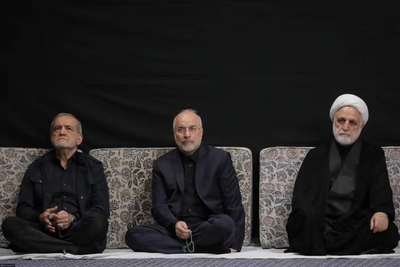
Senior Iranian clerics used Friday Prayers to attack the course of negotiations with Washington and issue warnings of retaliation, as a major US military buildup in the region fuels fears of renewed conflict.
Tehran’s interim Friday prayer leader said on Friday that Israel is “unwilling to attack Iran” after the “12-day war,” saying the episode showed Iran’s strength.
Mohammad Hassan Aboutorabi Fard said the experience of the 12-day conflict meant that “the Zionists are seriously preventing aggression against Iran,” because they fear war and “know they have no defense shield against Iran’s power.”
Aboutorabi argued that the confrontation last year, which included US strikes on Iranian nuclear sites during Israel’s 12-day campaign, altered the regional balance. He linked that assessment to the current round of talks with Washington, saying negotiations are unfolding within a broader strategy set by Supreme Leader Ali Khamenei.
Tehran’s interim Friday prayer leader Mohammad Hassan Aboutorabi Fard
“These negotiations are one of the important issues that have affected the political atmosphere of the world, the region and the country,” Aboutorabi said. “The strategy determined by the Supreme Leader has enabled the effective and commanding presence of the diplomatic teams on the international stage.”
Negotiations, he said, are advancing in close connection with active diplomacy, nuclear policy and military capability, arguing that continued threats from the United States would be costly and unproductive.
The rhetoric comes as Washington expands its military presence in the Middle East. US officials say 13 warships are now deployed in the region, including the aircraft carrier USS Abraham Lincoln, supported by destroyers and littoral combat ships. A second carrier, the USS Gerald R. Ford, is en route with additional escorts. Fighter jets and refueling aircraft have also been repositioned.
US media also reported that American forces could be ready to launch strikes within days, although President Donald Trump has not announced a final decision. Trump has repeatedly warned that military action remains an option if talks fail to produce a new agreement to replace the 2015 nuclear deal he withdrew from in 2018.
White House Press Secretary Karoline Leavitt said there had been “a little bit of progress” in Iran talks held in Geneva but acknowledged that significant gaps remain. She added that there are “many reasons and arguments” for a potential strike and said Iran would be “very wise” to reach a deal.
Hardline messaging from provinces
In Mashhad, Friday Prayer leader Ahmad Alamolhoda questioned the value of negotiations, saying if talks result in what he described as a “wrong and foolish” outcome, their course must be tightly defined.
Alamolhoda threatened that Iran can close the Strait of Hormuz, pointing to what he described as a “heroic exercise” there and warning that Tehran has the ability to shut the strategic waterway and “entangle and exhaust the world.”
“That is the message,” he said. “This is who we are. Can you confront us? Can you match us?”
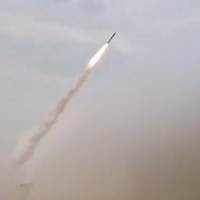
In Karaj, cleric Mohammad Mahdi Hosseini Hamedani referred to the unveiling of a hypersonic missile by the Islamic Revolutionary Guards Corps, saying its speed and multiple-warhead capability sent a message to Iran’s adversaries. The United States, not Iran, is in greater need of negotiations, he said.
Separately, Iranian lawmaker Amir Hayat Moghaddam said it is possible that a US warship could be sunk and American forces captured if war breaks out, warning that Iran would respond forcefully to any attack.
“If the Americans attack, we will immediately give a crushing response,” Moghaddam told Didban Iran.
Moghaddam, a member of parliament’s national security and foreign policy commission, said Iran could target all US bases in the region and that any response would not be “limited or symbolic.”
“In case of war, we can harm American forces, whether soldier or general,” he said, adding that Iran could also target the United States itself, including “the palace of Trump.”
At the same time, parliamentarian Salar Velayatmadar sought to temper alarm over US naval deployments, saying the proximity of American vessels does not automatically signal war. Such movements, he said, do not necessarily indicate imminent conflict, even as he warned that US bases in the region remain within Iran’s reach.
Araghchi pushes back on zero enrichment reports
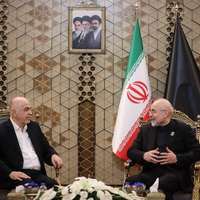
Meanwhile, Iran’s Foreign Minister Abbas Araghchi said on Friday that the United States has not asked Tehran to permanently halt uranium enrichment, countering reports that Washington was demanding zero enrichment as a condition for a deal.
Speaking on MSNBC’s Morning Joe, Araghchi described recent talks in Geneva as “constructive” and said both sides had agreed on guiding principles for a possible agreement.
“The US side has not asked for zero enrichment,” Araghchi said, adding that Iran had not offered to suspend enrichment either.
“What we are now talking about is how to make sure that Iran’s nuclear program, including enrichment, is peaceful and would remain peaceful forever,” he said.
Araghchi said there was “no military solution” to Iran’s nuclear program and that diplomacy remained the only viable path forward, though he added that Iran was prepared for both negotiation and war.
According to Araghchi, the two sides have agreed to begin drafting a framework for a potential agreement at their next meeting, calling it “a normal way of any international negotiations.”
He also warned that if Iran were attacked again, it would defend itself, saying that after the previous 12-day conflict its “enemies had no way but to ask for an unconditional ceasefire.”
Three Iranians working as engineers in Silicon Valley were charged with stealing sensitive trade secrets from leading US technology firms and transferring confidential data to unauthorized locations, including Iran, US authorities said on Thursday.
A federal grand jury in the Northern District of California indicted Samaneh Ghandali, 41, Mohammadjavad Khosravi, 40, and Soroor Ghandali, 32, on counts including conspiracy to commit trade secret theft, theft and attempted theft of trade secrets, and obstruction of justice. The three, all residents of San Jose, were arrested and made initial court appearances on Thursday.
According to the indictment, the defendants gained employment at major technology companies involved in developing mobile computer processors. Samaneh Ghandali and her sister Soroor Ghandali worked at Google before moving to another firm identified as Company 3, while Khosravi, who is married to Samaneh Ghandali, worked at a separate company identified as Company 2.
Prosecutors allege the defendants used their positions to access confidential information, including trade secrets related to processor security and cryptography. The indictment says they transferred hundreds of sensitive files to unauthorized third-party platforms, personal devices, and work devices linked to each other’s employers, as well as to Iran.
“As alleged, the defendants exploited their positions to steal confidential trade secrets from their employers,” United States Attorney Craig H. Missakian said. “Our office will continue to lead the way in protecting American innovation and we will vigorously prosecute individuals who steal sensitive advanced technologies for improper gain or to benefit countries that wish us ill.”
FBI Special Agent in Charge Sanjay Virmani described the alleged conduct as a “calculated betrayal of trust,” saying the defendants took deliberate steps to evade detection, including submitting false affidavits and manually photographing computer screens to avoid digital tracking.
The indictment also details travel to Iran in December 2023, when prosecutors say some of the exfiltrated material was accessed from a personal device.
If convicted, each defendant faces up to 10 years in prison for each trade secret-related count and up to 20 years for obstruction of justice.
Tehran skyline at sunset, with the city's iconic Milad Tower rising in the distance, January 2026
Iran stands at a pivotal moment. If political change brings institutional reform, the country could break decades of stagnation and return to sustained growth. But without credible governance, any transition risks replacing one failed equilibrium with another.
Iran’s recent nationwide protests, which were met with a deadly crackdown unmatched in the country’s modern history, stem directly from five decades of Islamic Republic rule.
More than half the population lives near or below the $3-a-day abject poverty line. The national currency is in free fall, with hyperinflation and famine in sight. The state seeks to control every aspect of citizens’ lives. Add to this systemic corruption, international isolation, apocalyptic environmental devastation, and a catastrophic brain drain that has driven more than 5% of Iranians to live outside the country.
During a period when most developing countries achieved major gains in living standards, Iran’s GDP per capita under the Islamic Republic has remained below its pre-revolution level for nearly half a century. Once competitive among middle-income nations, Iran’s per capita income has fallen behind war-torn Iraq and now more closely resembles that of low-income neighbors such as Pakistan.
The rulers in Tehran have proven unable to address urgent and mounting economic challenges: soaring inflation, a bankrupt financial system, a shrinking capital stock, and non-viable state-owned enterprises (SOEs).
Beyond these immediate crises, Iran faces deep structural problems that will persist for decades. The population is aging and the demographic window is closing. Soon, ever-larger cohorts will reach retirement with little or no savings. The water crisis is also unlikely to improve, constraining agricultural output and heightening food security risks.
These compounding crises, especially under external pressure, could trigger the Islamic Republic’s collapse—or at least force fundamental changes in its governing structure. Regardless of what political system emerges, Iran’s institutions must be aligned with both political and economic development objectives.
We believe any strategy capable of generating a virtuous cycle of change must prioritize one core objective: building a credible, stable, and legitimate state. Without this foundation, prescriptions for “sound” macroeconomic policy or state-capacity reforms will remain technocratic exercises that fail to take hold, endure, or deliver.
At the highest level, these political transformations can be summarized as follows:
1. State: scaling back
While Iran’s formal central government budget is relatively small (about $50 billion), the state’s true economic footprint is far larger, encompassing well over half of economic activity through para-statal foundations (bonyads), state-linked banks, and SOEs. Some efficiency gains may be possible through spending cuts, including transfers to ideological or religious bodies. But the core challenge is to rationalize and properly govern this broader quasi-state sector.
This requires consolidating and privatizing SOEs, gradually strengthening tax collection, and integrating off-budget entities into a transparent and accountable fiscal framework, while addressing longer-term structural challenges.
2. Democratic accountability
While democracy is an end in itself, strengthening democratic accountability plays a vital role in providing the legitimacy needed for the state to implement painful economic reforms and address short-term dislocations. A political leader elected through a free and meaningful process can better shield technocratic reformers from political pressures and enable difficult but necessary policy decisions.
3. Rule of law
Reforming the rule of law is the slowest and most complex task. While formal legal rules can be changed rapidly, transforming institutional practices and cultural norms is far more difficult. It is unlikely that any future judicial system will immediately apply the law equally to ordinary citizens and elites. But even a “good enough” system—as seen in countries such as China—could be sufficient to support sustained economic growth.
A successful transformation of political institutions could launch a new period of sustained growth. Optimism about a post-Islamic Republic Iran rests on its human capital, natural resources, and a highly capable diaspora able to invest and reconnect the economy to global markets.
Under a stable and legitimate system, near- to medium-term gains could come from lifting sanctions, activating underused capacity—especially in energy—attracting domestic and foreign investment, improving productivity, and expanding tourism and trade.
We estimate these channels could add $100–150 billion to output over five years, raising average incomes by only $3–5 per person per day. Claims of a trillion-dollar economy, as stated by some commentators, are as unrealistic as the Islamic Republic’s long record of unfounded projections.
History offers wide variation in the outcomes of institutional reform in post-authoritarian states. In the post-communist transition, for example, Russia endured a severe contraction of more than 40% of GDP, while Poland pivoted relatively quickly toward sustained growth. A decisive factor in Poland’s success was the prospect of joining the European Union, which provided a powerful external anchor for reform.
Unfortunately, Iran’s trajectory of political and economic transformation appears more likely to resemble Russia’s experience than Poland’s.
In the MENA region, Tunisia and Iraq have undergone post-authoritarian institutional reforms in recent decades. Tunisia, initially viewed as the Arab Spring’s only democratic success, has since regressed into authoritarianism, and its per-capita GDP remains roughly at pre-revolution levels.
Iraq, following the 2003 invasion, has seen per-capita GDP rise from about $1,500 to over $6,000, largely driven by increased oil production, while inflation has generally remained stable. Yet progress in controlling corruption has been limited, with only modest improvements in corruption perceptions.
A post-Islamic Republic government may initially enjoy high legitimacy, but that window will be brief. It must deliver tangible results quickly while managing overlapping crises and unavoidable distributional conflicts over who gains, who loses, and who must wait. Economic recovery and political stability will be tightly linked—and failure in one will undermine the other.
Experience from other transitions is sobering. Beyond early gains, post-authoritarian growth is often slow, fragile, and reversible. Stagnant living standards can create fertile ground for populist politicians who promise shortcuts.
Iran therefore needs a development strategy that integrates political and economic reform. Without it, the country risks remaining trapped in its current low equilibrium.
Protesters hold pre-1979 Iranian flags during a rally against Islamic Republic, in Munich, Germany on February 14, 2026.
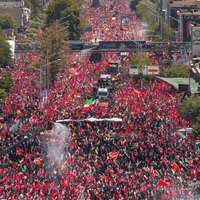
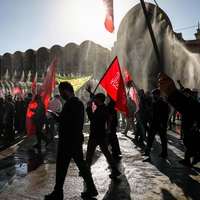
Widespread rallies by Iranians abroad, held in response to a call by exiled Prince Reza Pahlavi, drew an outpouring of support from inside Iran, with many describing the gatherings as a renewed source of hope and unity.
German authorities said nearly 250,000 people attended the Munich rally, calling it the largest protest by Iranians in Europe to date. Organizers and local officials also reported large turnouts in Toronto and Los Angeles, each estimated at around 350,000, as well as 50,000 in London and 45,000 in Vancouver.
Speaking at the Munich event, Prince Reza Pahlavi addressed people inside Iran directly. “Know and see that you are not alone and that your voice has reached the world,” he said.
Messages sent to Iran International and widely shared on social media described what contributors called an unprecedented display of cohesion and discipline across continents.
Messages from inside Iran
One viewer wrote: “Salute to our honorable compatriots outside Iran. Seeing the beautiful images of unity, harmony, civility and order brought tears of joy to our eyes inside the country.”
Another message read: “We were tired and disappointed, but when we saw you in the gatherings abroad, we cried for all of us. Who can separate us from each other?”
A resident of Tehran wrote, “We bow our heads in respect to all our compatriots around the world. We saw your gatherings everywhere and wept.”
From Shiraz, a viewer addressed the authorities, writing: “Every bullet you fired at our young people united our hearts more. We are now united, aware and full of faith.”
Others described the rallies as a turning point after weeks of pressure at home. “Yesterday, after 37 days, for the first time we were not sad or hopeless. Everyone was talking about you, and there was excitement in their eyes,” one message said.
Several framed the demonstrations as evidence of a shared national purpose transcending borders. “It was proven that the power of love for Iran and Iranians does not fit within political and geographical boundaries,” one viewer wrote.
“With seeing you, every moment was tears and emotion. We hope to celebrate our freedom soon on our own soil,” another message said.
Support extended beyond messages sent directly to Iran International. Similar posts circulated widely across social media platforms, echoing themes of unity, perseverance and anticipation of political change.
The scale of the February 14 rallies prompted criticism from state media, officials and pro-government online activists, who questioned attendance figures and accused organizers of exaggeration.
Responses ranged from attempts to downplay the gatherings to verbal attacks on participants abroad. Supporters inside Iran, however, portrayed the demonstrations as a morale boost amid continuing domestic restrictions.
“Your presence is a bridge of hope and solidarity that lights many hearts inside the country,” another Tehran resident wrote.
Iran’s President Masoud Pezeshkian on Tuesday urged police to manage public unrest with the least possible cost, over a month after a sweeping crackdown on protests in which more than 36,500 people were killed.
Speaking at a graduation ceremony for police cadets, Pezeshkian said authorities must maintain order while minimizing harm to security forces and civilians, as Iran continues to grapple with the aftermath of nationwide unrest.
“We must be able, as far as possible, to manage the country and society with the least damage and establish peace and security within it,” Pezeshkian said.
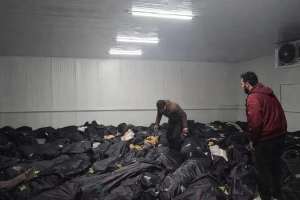
The protests were suppressed in a crackdown that left 36,500 people dead over two days in January, one of the deadliest episodes of unrest in modern history.
Pezeshkian said preventing unrest from escalating into crisis should be a priority.
“If there is dissatisfaction or a problem in society, we must not allow it to turn into a crisis. It must be prevented and treated,” he said. “In the third step, when an incident occurs, it must be managed with the minimum cost to the parties involved.”
At the same time, he stressed that those deemed responsible for disturbances should be detained firmly.
“You must manage the scene in such a way that the person who has created disorder is arrested with strength, authority and safety and handed over to the judiciary to be dealt with according to the law,” he said.
The president called for equipping police and security forces with new technologies to manage incidents without injury to officers, adding that the government would support law enforcement.
“We must not allow the health of our police forces to be put at risk,” he said. “All our efforts must be that none of you, as far as possible, are harmed in any scene.”
Iranian authorities have described the unrest as part of foreign-backed efforts to destabilize the country, while protesters have demanded political change and economic relief.
Pezeshkian said public security was essential and credited law enforcement as “the creators of security in Iran.”
Iran’s Supreme Leader Ali Khamenei addresses a gathering of people from East Azarbaijan province in Tehran on February 17, 2026.
Iran’s Supreme Leader Ali Khamenei said the United States will never succeed in toppling the Islamic Republic and warned that even the world’s strongest military can suffer crippling blows.
“The US president said in one of his recent remarks that for 47 years America has been unable to eliminate the Islamic Republic; he complained about it to his own people. For 47 years, America has not been able to eliminate the Islamic Republic. That is a good admission,” Khamenei said at a meeting with people from East Azarbaijan province on Tuesday.
“I say: You, too, will not be able to do this.”
His comments come days after Trump said regime change “would be the best thing that could happen.”
Khamenei also addressed remarks by the US president that the American military is the strongest in the world.
“The strongest army in the world may at times receive such a slap that it cannot rise,” he said.
“They keep saying we have sent an aircraft carrier toward Iran. Very well, an aircraft carrier is a dangerous device, but more dangerous than the carrier is the weapon that can send it to the bottom of the sea.”
His statements come amid heightened rhetoric between Tehran and Washington over military deployments and regional security and at the time a new round of negotiations mediated by Oman is underway in Geneva.
Talks with US
US threats and demands, Khamenei added, reflected an attempt to dominate Iran. “These statements by the US president, sometimes threatening, sometimes saying this must be done or that must not be done, mean they seek domination over the Iranian nation,” he said.
“Iran will not pledge allegiance to corrupt leaders currently in power in the United States.”
“They say let us negotiate about your nuclear energy, and the result of the negotiation should be that you do not have this energy,” he continued. “If a negotiation is to take place, and there is no place for negotiation, determining its result in advance is wrong and foolish.”
Iran’s Supreme Leader Ali Khamenei meets with people from East Azarbaijan province in Tehran on February 17, 2026.
US presidents and some senators, he went on, were making an “absurd” demand by setting conditions before any dialogue.
January protest remarks
In the same speech, Khamenei said those killed during the January protests are mourned as martyrs.
“Blood was shed. We are grieving. I say we are in mourning for the blood that was shed,” he said, adding that not all of the dead fell into the same category.
Security forces responded to the latest nationwide protests with lethal force, mass arrests, and communication blackouts. At least 36,500people killed in the recent wave of unrest, while authorities acknowledge a far lower figure of about 3,117.
Security forces, according to the Amnesty International, moved quickly after the killings to impose sweeping controls aimed at silencing survivors, intimidating families of victims and preventing documentation of what it described as unlawful mass killings carried out to crush what it called a popular uprising.
The measures included arbitrary mass arrests, enforced disappearances, bans on gatherings, night-time curfews, and a near-total internet blackout, alongside the deployment of heavily armed patrols across cities and inter-city roads, Amnesty International said.
Khamenei argued some were “corrupt elements and instigators,” while others were not involved in organizing the protests. He divided the dead into three groups, beginning with what he described as "defenders of security" – police, Basij and Guards members and those alongside them – calling them “among the greatest martyrs.”
He described a second group as bystanders. When turmoil breaks out in a city, he said, “innocent people walking toward their workplace or their homes are also killed,” adding that they too should be considered martyrs because their deaths occurred within “the enemy’s sedition.”
A third group, he said, consisted of those who had been misled. “They were deceived, inexperienced… they are also ours; they are our children,” he said, adding that some later wrote to him expressing regret. Officials, he said, were right to count those killed from this group as martyrs.
“Therefore, the circle of our fallen whom we count as martyrs is a wide one,” he added, excluding only what he called “the ringleaders and those who took money and weapons from the enemy.”
Khamenei concluded by offering prayers for mercy and forgiveness for those he described as misled participants, framing the uprising as an enemy-driven plot rather than a domestic protest movement.