• العربية
  • فارسی
Brand
  • Iran Insight
  • Politics
  • Economy
  • Analysis
  • Special Report
  • Opinion
  • Podcast
  • Iran Insight
  • Politics
  • Economy
  • Analysis
  • Special Report
  • Opinion
  • Podcast
  • Theme
  • Language
    • العربية
    • فارسی
  • Iran Insight
  • Politics
  • Economy
  • Analysis
  • Special Report
  • Opinion
  • Podcast
All rights reserved for Volant Media UK Limited
volant media logo

Iran, US edge toward deal to end war and reopen Hormuz

May 23, 2026, 22:17 GMT+1
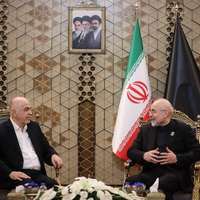
Pakistani Field Marshal Asim Munir hugs Iran's President Masoud Pezeshkian in a meeting in Tehran on May 23, 2026

Iran and the United States appeared to move closer Saturday to a framework to end the war and reopen the Strait of Hormuz, after President Donald Trump said an agreement had been largely negotiated and regional leaders urged Washington to accept a deal.

The latest signs of movement followed a flurry of regional diplomacy involving Pakistan, Qatar, Saudi Arabia, the United Arab Emirates, Turkey, Egypt, Jordan and Bahrain, as several Middle Eastern leaders urged Washington to accept a deal and prevent a renewed escalation.

Trump said in a Truth Social post that an agreement involving the United States, Iran and several regional countries had been “largely negotiated” and was awaiting finalization.

“Final aspects and details of the Deal are currently being discussed, and will be announced shortly,” Trump said, adding that “the Strait of Hormuz will be opened.”

Trump said the statement followed what he called a “very good call” with leaders from Saudi Arabia, the UAE, Qatar, Pakistan, Turkey, Egypt, Jordan and Bahrain concerning Iran and “a Memorandum of Understanding pertaining to peace.”

He also said he had spoken separately with Israeli Prime Minister Benjamin Netanyahu, describing that call as having gone “very well.”

Trump's remarks came after Iran submitted a revised proposal to the United States through Pakistani mediators to end the war and reopen the Strait of Hormuz, with a US response expected by Sunday, Reuters reported citing two Pakistani sources familiar with the negotiations.

Several Middle Eastern leaders involved in Trump’s call urged him to accept a deal with Iran, Axios reported citing a source briefed on the call. A regional source said the message from Arab and Muslim leaders was: “Please stop the war for the benefit of the whole region.”

Reuters separately reported citing a Pakistani security official briefed on Pakistani army chief Asim Munir’s visit to Tehran that an MoU was being “fine-tuned” to end the US-Iran war.

The official said Munir’s visit had made “significant progress” on points discussed in the Islamabad talks, describing the interim deal as “fairly comprehensive to terminate the war,” while cautioning: “It is never over till it is done.”

The Pakistani military said in a statement Saturday that negotiations conducted during Munir’s visit, after he returned to Islamabad as a mediator, had produced “encouraging progress toward a final understanding.”

'A deal very far and very close'

In Tehran, Foreign Ministry spokesman Esmail Baghaei said the parties were finalizing a 14-point memorandum of understanding that would create a temporary framework for diplomacy.

Parliament Speaker and head of Iran’s negotiating team, Mohammad-Bagher Ghalibaf, recently appointed Baghaei as the team’s spokesman.

Speaking on state television Saturday, Baghaei stressed that “Iran’s focus at this stage is on ending the war.”

Under the proposed arrangement, he said, Iran and the United States would spend 30 to 60 days after signing the memorandum negotiating the details of the most contentious issues, including Iran’s nuclear program, sanctions relief, the release of frozen Iranian assets and disputes over the Strait of Hormuz.

Baghaei nevertheless cautioned against assuming a breakthrough was imminent. “It cannot be said that an agreement is near,” he said, adding that the differences between Tehran and Washington are “so deep and extensive” that no one can expect several rounds of meetings over a few weeks or months to necessarily produce results.

In a phrase that quickly circulated across Iranian media and social platforms, Baghaei summarized the uncertainty surrounding the talks by saying: “The agreement is both very far and very close.”

US Secretary of State Marco Rubio also struck a cautious tone Saturday, saying “some progress” had been made in talks on Iran and suggesting there could be news soon, while warning that no breakthrough was certain.

“There may be news later today. I don’t have news at this very moment, but there might be some news a little later today,” Rubio told reporters in New Delhi. “There may not be. I hope there will be, but I’m not sure yet.”

He added that there was “a chance” the United States could have something to say “whether it’s later today, tomorrow, in a couple days,” but said the issue needed to be solved “one way or another.”

The Financial Times reported citing mediators and people briefed on the talks that the United States and Iran were close to extending their ceasefire by 60 days under a framework that would gradually reopen the Strait of Hormuz and launch discussions over Tehran’s highly enriched uranium stockpile.

'Collapse of talks still likely'

Despite these cautiously positive signals, skepticism remains widespread in both political circles and the Iranian public.

Fada-Hossein Maleki, a member of the Iranian parliament’s National Security Committee who attended Saturday’s meeting between Asim Munir and Ghalibaf, accused Washington of undermining the talks.

In comments to the Iranian Students News Agency, Maleki claimed that both Iranian and Pakistani officials agreed that the United States itself had created many of the obstacles threatening the negotiations.

He specifically accused US envoy Steve Witkoff of providing “unrealistic reports” to Trump, saying Trump’s social media posts based on those reports had “created sensitivity in Iran and even upset our Pakistani friends.”

According to Iran’s state news agency IRNA, the process “could collapse at any moment because of America’s maximalist approaches.”

The IRGC-linked Fars news agency reported citing a source close to the Iranian negotiating team that talks would fail unless the United States showed flexibility.

The source said Tehran would not discuss its nuclear program at this stage and would make any such talks conditional on US confidence-building measures.

Fars reported that the release of Iran’s blocked funds was among Tehran’s main conditions for starting negotiations, while rules for ship passage through the Strait of Hormuz remained another point of dispute.

Despite Washington accepting some of Tehran’s positions, the three issues remain unresolved and Iran is preparing other options, Fars reported citing the source.

Talks will fail, war will resume: poll

Public opinion inside Iran also appears deeply pessimistic about the prospects for a lasting agreement.

In an online poll conducted by the conservative Iranian website Tabnak, nearly 70 percent of more than 110,000 respondents predicted that no agreement would ultimately be reached and that the war would resume.

Trump kept the military option on the table Saturday, saying it was a “solid 50/50” whether the sides would reach an agreement or the US would “blow them to kingdom come.”

“I think one of two things will happen: either I hit them harder than they have ever been hit, or we are going to sign a deal that is good,” Trump said.

Most Viewed

Hope for US-Iran deal faces hardliner hostility in Tehran
1
INSIGHT

Hope for US-Iran deal faces hardliner hostility in Tehran

2

Iran, US edge toward deal to end war and reopen Hormuz

3
EXCLUSIVE

Iran demands access to $12B in Qatar funds as precondition for US MoU

4

Iran executes another political prisoner, bringing tally to 37 since March

5
VOICES FROM IRAN

Citizens voice anger, distrust over possible US-Iran deal

Banner
Banner

Spotlight

  • Trump’s strongest leverage over Tehran may run through Beijing
    PODCAST

    Trump’s strongest leverage over Tehran may run through Beijing

  • Pakistan continues quiet push to stop another Iran war
    ANALYSIS

    Pakistan continues quiet push to stop another Iran war

  • Iran scrambles for Omani back channel around the Hormuz blockade
    INSIGHT

    Iran scrambles for Omani back channel around the Hormuz blockade

  • From pulpits to parliament, why Iran’s officials speak in threats
    OPINION

    From pulpits to parliament, why Iran’s officials speak in threats

  • Why oil giant Iran struggles to supply gasoline
    ANALYSIS

    Why oil giant Iran struggles to supply gasoline

  • The strange afterlife of Iran’s firebrand president
    INSIGHT

    The strange afterlife of Iran’s firebrand president

•
•
•

More Stories

Hope for US-Iran deal faces hardliner hostility in Tehran

May 23, 2026, 03:37 GMT+1
•
Behrouz Turani

Hope for a limited US-Iran agreement gained momentum Friday as regional mediators intensified efforts to stabilize the ceasefire, but the fragile diplomacy faced hostility from Iranian hardliners who cast negotiations as a prelude to renewed conflict.

Iranian Foreign Ministry spokesman Esmail Baghaei said Friday morning that despite growing speculation surrounding the talks, “no significant progress” had been made.

Diplomatic sources say discussions have focused on a possible memorandum of understanding envisioned as a first step toward broader negotiations, including over Iran’s nuclear program.

The proposed framework would reportedly seek to stabilize the ceasefire and establish mechanisms for managing shipping and navigation disputes in the Strait of Hormuz.

Such an arrangement could provide both sides with temporary political breathing room while reducing pressure on global energy markets already shaken by weeks of conflict and shipping disruptions.

But neither Tehran nor Washington has ruled out military escalation if negotiations collapse before an agreement is finalized.

The Trump administration was preparing on Friday for a fresh round of military strikes against Iran, CBS reported citing sources familiar with the planning, even as indirect diplomacy continues.

The fragility of the process was also underscored Friday by continued attacks from Iranian hardliners who argue the ceasefire itself represented a strategic mistake.

Tehran University lecturer Mohammad Sadegh Koushki said in an interview with the IPTV program Zoom, affiliated with the Fararu website, that Iran had halted military operations just as it had gained the upper hand.

“It’s like a football team that is up by a goal and can score one or two more,” he said. “The momentum of battle was brought to a screeching halt under the name of negotiations and a ceasefire.”

Koushki dismissed the idea that Iran’s conflict with the United States could ultimately be resolved through diplomacy, arguing that years of negotiations had only resulted in greater sanctions and pressure.

Similar arguments appeared across hardline political circles Friday. MP Alireza Salimi said Iran’s control over the Strait of Hormuz was “not negotiable” and that Tehran alone would define and enforce the strait’s “new rules.”

Diplomatic activity nevertheless appeared to intensify throughout Friday as Pakistani Interior Minister Mohsin Naqvi returned to Tehran, with CBS citing a senior Pakistani official as saying his meetings had helped negotiations move “in an important direction,” prompting Pakistan’s Field Marshal Asim Munir to join the mediation effort.

Reuters also reported that a Qatari negotiating team arrived in Tehran in coordination with the United States to help secure an agreement aimed at ending the war and resolving outstanding disputes.

Still, similar moments of optimism earlier in 2025 and again in early 2026 ultimately collapsed into waves of US and Israeli strikes on Iran, leaving deep skepticism about the durability of diplomacy.

In a widely circulated post on X, establishment academic Foad Izadi argued that Washington had paid too little a cost for the conflict to abandon long-term pressure on Iran.

“The cycle of attack, ceasefire, negotiation and attack will repeat,” Izadi wrote, warning against rapid concessions or reopening the Strait of Hormuz too quickly.

The remarks reflected broader hardline skepticism toward the diplomatic push even as intensified mediation efforts suggested Tehran and Washington may still see a narrow path toward a limited deal.

Trump’s strongest leverage over Tehran may run through Beijing

May 22, 2026, 21:50 GMT+1
•
Negar Mojtahedi

The Trump administration’s most powerful pressure point against Tehran may not lie in military action but in China’s deep financial and energy ties with Iran, a former US Treasury sanctions official told the Eye for Iran podcast.

Max Meizlish, a senior research analyst at the Foundation for Defense of Democracies and a former US Treasury official focused on sanctions enforcement, said China may be the real pressure point against Iran as it buys most of Tehran’s oil, helps it evade sanctions and provides the economic oxygen keeping the Islamic Republic alive.

“There’s really no more important enabler of Iranian malign influence and Iranian sanctions evasion than China,” Meizlish told this week’s episode of Eye for Iran.

China buys roughly 90 percent of Iran’s oil exports — a revenue Meizlish says directly finances the Islamic Revolutionary Guard Corps (IRGC), Tehran’s ballistic missile programs and its regional proxy network.

“Chinese purchases of that oil are directly supporting the IRGC, the hardline elements of the Iranian regime,” he said. “All of that is funded and backed by China.”

His comments come as tensions rise over Iran’s efforts to exert greater control over the Strait of Hormuz, including reports that Tehran is exploring formalized transit systems and toll mechanisms for ships crossing one of the world’s most critical waterways.

But while global attention remains focused on Iran’s actions in the Persian Gulf, Meizlish argues Washington’s most effective pressure point may lie elsewhere: the financial networks helping Tehran survive economically.

One of the most significant, he says, is Hong Kong.

“If the United States really wanted to, it could bring a lot of pressure there by threatening to cut off all dollar access to Hong Kong as an entire jurisdiction,” Meizlish said.

He pointed specifically to Section 311 of the USA PATRIOT Act, a rarely used mechanism allowing Washington to effectively sever foreign banks from the dollar system by restricting correspondent banking access.

“When we think about Chinese sanctions evasion benefiting Iran, a lot of that money goes through Hong Kong,” he said. “Hong Kong is a global financial hub, and it relies on access to dollars to do that.”

Despite years of “maximum pressure” rhetoric from Washington, Meizlish argues the United States has yet to fully use the economic tools available to it.

“For all the talk of maximum pressure, maximum pressure has been a really effective bumper sticker,” he said. “We need to move from the period of bumper stickers into the period of behavior change.”

The hesitation, he argues, stems largely from fears of Chinese retaliation.

Beijing dominates the mining and processing of rare earth minerals critical to global manufacturing, electronics and defense industries. China could also retaliate against Western firms operating in the country or invoke anti-sanctions laws designed to punish compliance with US restrictions.

“There are a lot of steps that the Chinese could take,” Meizlish warned.

Still, he argues China may be more economically vulnerable than many policymakers assume.

“China’s banking sector is quite fractured. It’s quite vulnerable to economic coercion,” he said, pointing to bad debt, youth unemployment and the country’s prolonged housing crisis.

Meizlish also cited signs Beijing fears the consequences of secondary sanctions. After the United States sanctioned a Chinese “teapot refinery,” he noted, Chinese regulators reportedly warned banks not to extend loans to such firms over concerns they too could become targets.

“To me, all of that supports the idea that the US actually could bring a lot more pressure to bear right now because China is uniquely vulnerable to economic coercion,” he said.

For Meizlish, the broader question is whether Washington is prepared to absorb the economic costs of confronting Beijing more aggressively in order to weaken Tehran.

“We’re in the middle of potentially a once-in-a-lifetime opportunity to fully degrade the Iranian regime’s capacity to exert influence in the region,” he said.

But achieving that, he argues, would require moving beyond symbolic pressure campaigns toward far more aggressive financial enforcement targeting China itself.

“There’s no more important country to tackle than China,” he said. “And there are all these unique economic vulnerabilities that we should be taking advantage of.”

Pakistan continues quiet push to stop another Iran war

May 22, 2026, 20:07 GMT+1
•
Maryam Sinaiee

Pakistani top general Asim Munir’s trip to Tehran has fueled speculation about a possible temporary Iran-US agreement to end the war and resume broader talks, although Tehran says the high-profile visit does not necessarily mean a deal is close.

Munir’s visit on Friday follows days of lower-level negotiations that have reportedly narrowed some of the major disagreements between Tehran and Washington.

The Pakistani commander visited Tehran last month as well, where he held meetings with senior Iranian civilian and military officials.

Pakistan’s Interior Minister Mohsin Naqvi also traveled twice to Tehran and remained there on Friday as negotiations continued.

Iranian and Pakistani media reports described the visit as part of Islamabad’s broader mediation effort aimed at reducing tensions over Iran’s uranium enrichment program and the closure of the Strait of Hormuz.

Axios reported on Friday that Munir’s visit could represent a “final push” by Pakistan to secure a temporary agreement under which both sides would halt hostilities and continue negotiations for another 30 days over unresolved disputes, including Iran’s nuclear program.

Media speculation

However, expectations of an imminent breakthrough remain cautious.

An Iranian source close to the negotiations told the Arabic outlet Al-Araby Al-Jadeed that Pakistan’s interior minister had not delivered any new American proposal to Tehran and that reports about a finalized draft agreement were “media speculation.”

According to the source, “the visits by Pakistani officials to Tehran are aimed at strengthening Islamabad’s mediation role and preventing further escalation.”

Iran’s Foreign Ministry spokesman downplayed the significance of the Pakistani top general's trip to Tehran, saying, "Despite becoming more frequent, such exchanges are a continuation of the same diplomatic process. We cannot necessarily say we have reached a point where a deal is near."

“The differences between Iran and the United States are so deep and extensive that it cannot be said we must necessarily reach a result after a few rounds of visits or negotiations within a few weeks," Iran's foreign ministry spokesman Esmaeil Baghaei said on Friday.

Iranian outlet Farda News, considered close to parliament speaker Mohammad Bagher Ghalibaf who is leading Iran’s negotiating team, wrote that “Islamabad is not merely a messenger, but is playing a role beyond transmitting messages and below that of a direct negotiator.”

Pakistan, Iran’s eastern neighbor, has emerged over the past two months as the principal intermediary between Tehran and Washington.

Its mediation efforts accelerated after Islamabad helped broker a ceasefire on April 7. But the first round of direct talks between Iran and the United States failed to produce a lasting agreement, and recent weeks have shown signs of growing diplomatic deadlock.

‘Unprecedented progress’

Oman had previously served as the primary mediator. Talks between Tehran and Washington were underway in Muscat before US and Israeli strikes on Iran began on February 28.

At the time, Omani Foreign Minister Badr Albusaidi publicly said that “significant and unprecedented progress” had been achieved before diplomacy collapsed following the outbreak of war.

Unlike Oman, which largely positioned itself as a neutral intermediary, Pakistan enters the process with closer security ties to Saudi Arabia.

Some analysts argue this complicates Islamabad’s role. Pakistan signed a defense agreement with Saudi Arabia in 2025 committing both countries to support one another in the event of an attack. Iran repeatedly targeted Saudi territory during the war, raising questions among some observers about Pakistan’s neutrality.

London-based Amwaj Media wrote that the Islamabad-Riyadh defense pact demonstrates “the limits of Pakistan’s neutrality” in mediating between Iran and the United States.

Iranian state news agency IRNA described Pakistan’s primary concern as preventing the conflict from spreading beyond Iran into the wider region.

The report said Pakistan fears the war could spill into South Asia and destabilize its western border regions at a time when Islamabad is already managing tensions with India along its eastern frontier.

‘The limits of Pakistan’s neutrality’

At the same time, Pakistani officials appear to see strategic opportunities in successful mediation.

IRNA argued that if Islamabad helps secure a diplomatic settlement, it could strengthen Pakistan’s regional standing and deepen economic ties with a post-sanctions Iran.

“Honest mediation by Islamabad could elevate Pakistan’s position in a future Iran free from sanctions and transform it into an important partner,” IRNA wrote.

Pakistan’s mediation effort has also drawn support from China, one of Tehran’s closest strategic partners. Pakistani Prime Minister Shehbaz Sharif has confirmed that Islamabad’s diplomatic efforts are backed by Beijing.

Although Beijing has avoided taking on a direct mediation role, Chinese Foreign Minister Wang Yi recently said China supports Pakistan playing a “greater role” in resolving the conflict.

Why Tehran threatens Trump while pursuing diplomacy

May 20, 2026, 03:37 GMT+1
•
Negar Mojtahedi

Even as Tehran engages in hardheaded diplomatic maneuvering with Washington, it is advancing a parliamentary proposal offering a €50 million reward for President Trump’s killing.

The ruling establishment, they argue, is trying to project strength after weeks of military and political pressure while using the prospect of talks not as a concession but as another arena of confrontation.

“The Iranian regime is trying to, in their own mind, basically say that we are on par,” Dr. Shahram Kholdi, a Middle East historian, told Iran International. “Even if you're not on par with Trump, we are actually beating him at all levels.”

The proposed bounty, he said, should be read partly as psychological warfare against Trump.

“This award to be passed as a piece of legislation by the Islamic Republic Parliament is effectively part of that psychological war that the Islamic Republic thinks it has to unleash upon Trump,” Kholdi said.

But the rhetoric is unfolding alongside more concrete threats. Tehran has also signaled it could disrupt navigation through the Persian Gulf and the Strait of Hormuz, while pro-government voices have floated attacks on satellite infrastructure, including systems such as Starlink.

'Not rational'

That combination of assassination rhetoric, military pressure and possible diplomacy may appear irrational from the outside. Kholdi argues the problem is that Washington is not dealing with a conventional negotiating actor.

“The problem with these people is that they think … if they behave sanely and rationally, that's insane and irrational,” he said. “That’s the kind of actor Trump is dealing with … The art of the deal does not work with an irrational actor.”

Dr. Eric Mandel, founder of the Middle East Political Information Network (MEPIN), framed the issue as a clash of political cultures and timelines. Western governments may look at the damage inflicted on Iran’s military and industrial infrastructure and conclude Tehran should be searching for a way out. The regime may see the same moment very differently.

“This is a perfect opportunity to realize they don't think like us,” Mandel said.

From Tehran’s perspective, he argued, the fact that the regime has survived is itself a form of victory.

“The Iranians think we have survived. We have survived and that means we are victorious,” he said. “We could outlast the Americans and eventually they're going to have to acquiesce to us.”

The time factor

That survival-first mindset helps explain why Tehran may threaten Trump while still leaving room for talks. In Mandel’s view, negotiations, ceasefires and delays all serve a purpose: they buy time.

“The Iranians got a ceasefire. They rebuilt, they rearm, they dug out missiles that were buried because they know that the longer they can either prolong negotiations, the longer they have ceasefires, that they believe that time will eventually make them the winner here,” he said.

This is why the apparent contradiction may not be a contradiction at all. The threats signal defiance. The talks buy time. The survival narrative sustains the regime internally.

Former State Department appointee Shayan Samii said Tehran’s assassination rhetoric may also backfire by strengthening Washington’s case for escalation.

“These numbskulls in Tehran don't understand that by the mere fact of just saying we want to assassinate the President of the United States—mind you, the sitting President of the United States—we're not talking about a national security threat anymore,” Samii said. “We're talking about a government apparatus coming under attack.”

That, he said, could allow the United States to frame any military response not simply as regional intervention, but as self-defense.

“They can tell the world these guys wanted to assassinate our president, we're not going to sit by,” Samii said.

'Military readiness'

Samii also rejected the idea that Trump’s latest delay should be read mainly as a response to pressure from Persian Gulf Arab states. He said the timing was more likely tied to military planning and target selection.

“It has nothing to do with the request of the Arab countries of the Persian Gulf region,” he said. “It has everything to do with machinations and military readiness and coming up with a solution for the targets that they want to hit.”

The danger, analysts say, is that both sides may be using time for very different purposes. Trump may be waiting for better military and economic conditions. Tehran may be trying to stretch the crisis into a war of attrition.

“They think that they are going to run the United States out of the stamina,” Kholdi said.

For Mandel, that gap in thinking is central to the crisis. American politics operates on elections, markets and public pressure. The Islamic Republic, he said, operates with a far longer and harsher sense of time.

“We're dealing with, trying to say from so many different angles, the calculus that they're making is so different than what ours is,” he said.

That difference may be what makes the current moment especially volatile. Tehran appears to believe threats increase leverage. Washington increasingly risks viewing those same threats as proof diplomacy cannot work.

Tehran and Washington betting the other side blinks first

May 19, 2026, 21:32 GMT+1
•
Behrouz Turani

The competing narratives surrounding the latest US-Iran standoff have become so stark that even basic questions—who is deterring whom, who wants talks and who fears escalation—now produce entirely different answers depending on which capital is speaking.

On Monday, President Donald Trump said he had halted plans to attack Iran following requests from Qatar, Saudi Arabia, the UAE “and some others in the region.”

The same day, Iran’s state television claimed Trump had backed down from threatening military action “at least five times in recent weeks” because he feared Iran’s “firm response.”

On Tuesday, Trump again underscored the volatility of the standoff, saying the United States “may have to give them another big hit” and claiming Tehran was “begging” for a deal.

Rahman Ghahramanpour, a Middle East politics expert, told Tehran-based Khabar Online that both Tehran and Washington increasingly see the confrontation as a “competition over resilience,” with each believing renewed brinkmanship could strengthen its negotiating position.

Khabar Online journalist Mohammad Aref Moezzi described the current dynamic as a familiar “neither war nor peace” scenario: sustained pressure and confrontation without a clear decision to escalate into full conflict or pursue a comprehensive agreement.

Both sides, he argued, still believe they can force concessions without paying the cost of war.

For Iran’s leadership, the overriding objective remains survival and persuading Washington to abandon any notion of regime change.

Ghahramanpour argues that Tehran is trapped in a struggle for survival while Washington faces what he calls a “credibility trap.” The United States wants a visible strategic victory; the Islamic Republic increasingly treats simple endurance as success.

Despite striking numerous military targets in Iran, Washington has yet to achieve a major political breakthrough. In the United States, particularly amid partisan rivalries, that is often framed as a failure for Trump. In Iran, the same reality is presented as proof the Islamic Republic withstood American pressure.

He also noted that many in Israel believe Trump’s presidency may represent the best opportunity to secure full US cooperation against Iran, adding to pressure for a more decisive confrontation before political circumstances change.

The widening gap between Iranian and American perceptions has effectively frozen negotiations.

Although some hardliners in Tehran advocate pre-emptive action, the government appears unwilling to be seen as the side that starts a war.

Washington, meanwhile, continues tightening sanctions and maintaining pressure while also signaling that military action remains an option if diplomacy stalls.

Another Iranian scholar, Ali Asghar Zargar, told Fararu on Tuesday that neither side benefits from the current deadlock.

He described the standoff as a mix of attrition, geopolitical rivalry and competing political narratives in which Iran remains under heavy pressure while the United States has yet to achieve its core objectives.

Zargar also argued that Washington cannot realistically use the Strait of Hormuz as a unilateral pressure tool given the global dependence on the waterway, warning that the longer the impasse continues, the greater the risk of escalation or miscalculation.

What increasingly unites both Iranian and American analysts is the sense that the current stalemate may be unstable, and that neither side has yet found a credible path out of it.