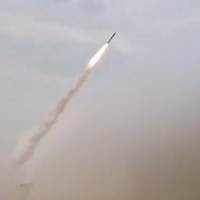
Fireworks at Jamkaran Mosque near Qom. February 3, 2026
State-backed celebrations of Shiite Imam Mahdi’s birthday this week have angered many Iranians mourning tens of thousands killed in recent protests, highlighting a widening divide over grief, faith and public displays of joy.
Government authorities and supporters marked the birthday of the 12th and final Shiite Imam, Mahdi, with widespread street decorations, fireworks at religious sites and city squares, and tents distributing tea, sweets and food to passersby.
State media extensively covered the festivities, while pro-government social media users portrayed public participation as evidence of continued support for the authorities and the country's return to normalcy.
In the days leading up to the public holiday, state-organized celebrations are held not only in religious venues but also across government offices and schools. During this period, authorities, municipalities and private citizens decorate streets with lights and offer sweets and drinks to pedestrians.
This year’s main ceremony took place at the Jamkaran Mosque near the holy city of Qom, where large crowds gathered for fireworks and light displays. Since the 1979 Islamic Revolution, the once-obscure mosque has expanded dramatically into a major pilgrimage and tourist complex.
Widespread opposition to the celebrations
Opposition to the celebrations has come from many who say festivities are inappropriate while millions grieve.
The official death toll from the February 8–9 protests, announced by the government — more than 3,000 people — nearly matches the total number of deaths recorded during the previous monarchy between 1963 and 1979.
An X user identified as Homayoun wrote: “When the state breeds death, theatrical joy is merely the mask of shamelessness. Celebrating over fresh wounds is neither faith nor hope; it is only the habit of witnessing the suffering of others.”
Religious and political figures boycott the festivities
At least two prominent clerics — Grand Ayatollah Asadollah Bayat-Zanjani, a senior religious authority and former reformist politician, and Grand Ayatollah Mostafa Mohaqeq-Damad, an Islamic scholar known for criticizing the state’s harsh response to protesters — announced they would refrain from holding birthday celebrations in solidarity with mourners.
Bayat-Zanjani’s son, Mohsen Bayat-Zanjani, a well-known philanthropist, said on X that his father’s office would cancel its annual event. The Institute for Religious Enlightenment, overseen by Mohaqeq Damad, issued a statement saying he would not host a celebration this year.
Neither cleric has publicly condemned the killings, prompting sharp criticism from some X users, though others praised the move. Hadi Mehrani, a former Iran-Iraq war veteran and ex-political prisoner who now openly supports the overthrow of the Islamic Republic, commended them for “standing with the people and honoring the dead.”
Beyond these two figures, no other senior clerics have been reported to oppose the festivities, and neither cleric explicitly blamed the government for the deaths.
Azar Mansouri, head of the Reform Front, wrote on X: “In the midst of this exhausting collective mourning and the deep wound inflicted on the nation’s soul, what celebration?” Pro-government commenters responded that celebrating the Imam’s birth is obligatory regardless of circumstances.
Historical precedence
Boycotting religious celebrations during periods of mourning has historical precedent in Iran. In July 1978, after dozens of demonstrators were killed in Tehran’s Jaleh Square, Ayatollah Ruhollah Khomeini declared public mourning and urged people to avoid festivities for Mahdi’s birthday, emphasizing unity in the political struggle.
In 1962, Grand Ayatollah Mohammad Reza Golpayegani similarly called for canceling the celebration in protest against the Shah’s “White Revolution” reforms.
Protesters respond with slogans
Citizen journalists have circulated reports of residents chanting slogans from windows during the festivities.
One X user said members of the Basij militia set up a booth in the Chitgar district of western Tehran playing religious music and Quran recitations, prompting apartment residents to shout slogans in opposition. A video posted by the user captured voices chanting “Death to the Islamic Republic” and “Death to the Basij.”
Outside Iran, a group of supporters of exiled prince Reza Pahlavi gathered Tuesday outside the Islamic Centre of Manchester, disrupting a planned Mahdi birthday celebration with chants and protests.
File photo shows the front page of Iranian daily Etemad which features Iranian and US chief negotiators Abbas Araghchi and Steve Witkoff
As Iran and the United States reshuffle the format and venue of their talks amid military threats, deep mistrust, and hardline red lines, skepticism over a breakthrough appears widespread.
The talks, originally scheduled for Friday in Istanbul with several regional countries expected to attend, were moved to Oman at Iran’s request and narrowed to bilateral discussions between Tehran and Washington.
Tehran had also reiterated its insistence on indirect negotiations, with Foreign Minister Abbas Araghchi sitting in a separate room from Steve Witkoff and Jared Kushner, relying on Omani mediators to shuttle messages between the two sides.
State media further reported that the talks would focus exclusively on the nuclear issue, as in previous rounds.
However, The New York Times reported on Thursday that while Iran’s nuclear program would be the main focus, the two sides agreed that negotiations would also cover missiles and Tehran’s support for militant groups.
The newspaper cited three Iranian officials and one Arab official as saying the US agreed to hold the talks in Oman and exclude regional actors, while Iranian officials agreed to face their American counterparts.
Negotiations to avoid war—or merely delay it?
While diplomats maneuver, hardliners continue to float threats of preemptive strikes on Israel and closing the Strait of Hormuz, while claiming that Iran’s military posture has forced Trump to reconsider his repeated threats of military action.
Former foreign minister and lawmaker Manouchehr Mottaki said the likelihood of a US attack has dropped “from 100 percent to around 50 percent,” attributing the change to Washington’s doubts about achieving victory.
Journalist Hossein Yazdi, however, cited three developments over the past few days—the IRGC’s harassment of a US vessel in the Persian Gulf, the US downing of an IRGC Shahed-139 surveillance drone in the Arabian Sea, and Iran’s insistence on moving talks to Oman without Arab observers—as evidence that negotiations are not serious.
“Both sides have their hands on the trigger,” he wrote.
Iran’s red lines remain intact
It remains unclear whether Iran, facing Trump’s threats and the risk of war, is willing to reconsider positions that contributed to the collapse of previous negotiations.
“Any decision regarding these stockpiles must be designed with maximum distrust toward the other side’s intentions,” he wrote. “Handing them over in one go—under any title—is not goodwill or strategic rationality. It is voluntary disarmament under military threat.”
Others echoed familiar red lines. Esmail Kowsari, a member of parliament’s national security committee, said Iran’s missile capabilities and regional activities are “absolutely none of America’s business.”
Former deputy speaker Ali Motahari likewise cited enrichment rights, missile range, support for the so-called Axis of Resistance, and refusal to recognize Israel as all non-negotiable.
Few expect a breakthrough
Given Iran’s insistence on these red lines, its past negotiating record, and recent mass killings of protesters that have plunged the Islamic Republic into a severe legitimacy crisis, few analysts express optimism.
Political analyst Ruhollah Rahimpour told Iran International that the Islamic Republic is, for the first time, confronting both a real external threat and a profound internal legitimacy crisis. “This combination is deadly,” he said, adding that Tehran can no longer assume it can cross Trump’s red lines and face only rhetorical consequences.
Former diplomat Nosratollah Tajik was blunt: “It is unlikely this round of mediation will go anywhere due to structural issues, the gap between goals and expectations, and the unfinished business of the previous two stages of Iran–US conflict.”
Mottaki also expressed doubt, saying: “These talks will not produce tangible results, but they may deter the US from imposing war.”
Yazdi argued there are no signs of serious negotiations, noting that Iran wants to resume narrow nuclear talks in Oman, while Trump and Israel seek far broader concessions. “From their perspective, destroyed nuclear facilities are no longer the top priority,” he wrote.
A user on X warned that failed talks would only make a Trump-led war against Iran appear more justified in the eyes of the international community.
Who really decides?
President Masoud Pezeshkian weighed in with a rare post on X on Tuesday, saying he had instructed the foreign minister to pursue talks “if there is a suitable, threat-free atmosphere.”
The wording sparked controversy, as few doubt that foreign policy is ultimately controlled by Supreme Leader Ali Khamenei. A community note was even added to the post.
"The person who makes the decisions in Iran is the Supreme Leader. The President doesn't really matter," US Vice-President J.D. Vance said on Wednesday.
"The Foreign Minister seems to talk to the Supreme Leader and that's mainly the person that we've communicated with. But it's a very weird country to conduct diplomacy with when you can't even talk to the person who's in charge of the country."
Researcher Abbas Gheidari interpreted Pezeshkian’s phrase “I instructed” as an attempt to preemptively assume responsibility for a potential nuclear concession to protect Khamenei.
Vice President Jafar Ghaempanah tried to soften the debate, writing: “No war is good, and not every peace is surrender.” Some conservatives such as Abdolreza Davari read this as a sign of an imminent deal. Ultra-hardline lawmaker Mehdi Koochakzadeh, however, warned that “the peace imposed by the architects of the JCPOA will bring humiliation worse than surrender.”
Protesters’ anger and pressure on Trump
Some Iranian activists and social media users have reacted angrily to what they describe as Trump’s flexibility, saying Tehran is once again buying time.
“This is what they’ve done for nearly 30 years,” one user wrote. “Trump prioritizes extracting concessions, not regime change—otherwise he wouldn’t have stopped Israel in the 12-day war.”
One image sent by a citizen to Iran International showed graffiti reading: “President Trump: Don’t negotiate with the killers of the Iranian people.”
Hardliner lawmakers chant Death to America in Iran's parliament, January 11, 2026
As hopes for talks with the United States flicker and fade, Iran’s chronic factional infighting once again appears to have torpedoed a diplomatic opening—even before it properly began.
With negotiations now hanging in the balance, conflicting signals from Tehran have reinforced a familiar pattern: internal rivalries routinely overwhelm coherence at moments requiring discipline.
On Wednesday, Axios reported that the planned talks were no longer expected to go ahead, while Israel’s Channel 12 went further, citing officials as saying the process had been cancelled altogether.
Iranian and US officials have not publicly confirmed that account, but the drift has been unmistakable.
The unraveling followed days of public discord inside Iran’s political establishment.
After President Masoud Pezeshkian said he had “ordered” Foreign Minister Abbas Araghchi to travel to Turkey to discuss arrangements for talks, ultraconservative MP Amir Hossein Sabeti attacked the move in a post on X.
“Mr. Araghchi, our people are waiting for a pre-emptive action against the enemy, not negotiations. And you got up and went to Turkey?!”
The remarks ignored—or deliberately blurred—the fact that decisions on negotiations with the United States rest with the Supreme Leader, not the president. They also illustrated how calls for escalation are often deployed less as strategy than as factional positioning, regardless of the risks such rhetoric may invite.
A second episode followed when ultraconservative MP Hamid Rasai targeted Vice President Jafar Ghaempanah over an X post responding to Pezeshkian’s message about Araghchi’s trip.
After Ghaempanah wrote, “No war is good, and no peace necessarily means surrender,” Rasai questioned his loyalty and invoked his U.S.-based son, escalating the attack with religious language.
Such exchanges are not aberrations. Factional conflict has been embedded in the Islamic Republic since its inception.
Early struggles between Islamic liberals and religious fundamentalists gave way to rivalries among clerical factions, later morphing into competition between reformists and conservatives, and, since the mid-2000s, a sharper divide between hardliners and moderates.
For years, the Supreme Leader functioned as a broker among these camps, preserving a degree of political coherence. As power has become more centralized and alignments more rigid, that balancing role has weakened.
Vested interests across the system have repeatedly shown a willingness to obstruct—and at times actively sabotage—diplomatic processes rather than allow rivals to claim credit for engagement with Washington.
As many commentators, including former President Hassan Rouhani, have long observed, the fiercest resistance to talks has often come not from principled opposition to diplomacy itself, but from fear of who might benefit politically if diplomacy succeeds.
The result is a recurring pattern in which negotiations collapse not only under external pressure, but under the weight of Iran’s own internal rivalries.
Medical staff checking reports in a Tehran hospital, in this undated file photo
Rights groups and activists are sounding the alarm over what they describe as a widening campaign of pressure, arrests and intimidation against Iranian doctors and nurses who treated injured protesters.
Iran International has reviewed information from multiple sources inside Iran suggesting that at least 32 members of the country’s medical staff have been detained, with no public information available about the status of their cases.
Doctors who treated wounded protesters in cities including Qazvin, Rasht, Tabriz, Mashhad and Gorgan have been arrested or have gone missing, according to the reports.
Most of the reported arrests are said to have taken place after January 8, following the escalation of protests and the ensuing security crackdown.
‘Normalization of arrests’
Iran Medical Council chief Mohammad Raiszadeh confirmed that 17 of its members had faced judicial or security cases linked to the recent unrest, but insisted that none had been prosecuted for providing medical treatment and that no verdicts had been issued.
The Medical Council is formally a civil body but operates under heavy state oversight.
Raiszadeh, who is close to conservative political circles and previously led the establishment-aligned Basij Doctors Organization, said the council had followed up the cases with security and judicial authorities and had been told that none of the individuals were arrested solely for treating patients.
His remarks prompted criticism within the medical community.
Mahdiar Saeedian, editor-in-chief of a medical science magazine in Iran, wrote on X that the council’s position amounted to normalizing state pressure on healthcare workers.
“More unpleasant than silence is the normalization of arrests and pressure on medical staff by the Medical Council,” he wrote. “This is the result of fully turning a professional organization into a state-controlled body.”
Reported cases
UK-based outlet Kayhan London reported that doctors Masoud Ebadi-Fard Azari and his wife, Parisa Porkar, were arrested in Qazvin for allegedly treating injured protesters, adding that their whereabouts remain unknown.
Another reported case involves Golnaz Naraqi, a 41-year-old emergency medicine specialist at Hasheminejad and Shohada-ye Tajrish hospitals in Tehran, who was reportedly arrested at her home more than ten days ago.
Social media users have also reported growing pressure on medical staff accused of helping protesters anonymously.
In one account, a viewer message sent to Iran International said Farshid Pourreza, head of Golsar Hospital in Rasht, was dismissed and expelled from the hospital for supporting protesters and treating the wounded.
Health Minister Mohammad Reza Zafarghandi wrote on X that providing “the best possible medical services to every patient in a safe healthcare environment,” regardless of “any external factors,” was the health system’s top priority.
The remarks drew swift criticism online.
“As a colleague, I am waiting to see whether you remain loyal to your oath, or whether an ‘external factor’ stands in the way of it,” Nakisa Serafinincho, an Iranian doctor based in Romania, wrote on X.
Another user responded: “You can’t even protect medical staff. How can you talk about patient safety?”
A mocking segment aired on Iran’s state television about the bodies of protesters killed in January has sparked public outrage and renewed calls, including from Islamic Republic loyalists, for the removal of the head of the national broadcaster.
The public anger erupted after a host on Ofogh TV, a channel operated by Iran’s state broadcaster IRIB and affiliated to the Revolutionary Guards, referred to reports that thousands killed during the January 8–9 crackdown were transported in refrigerated trailers.
Addressing viewers, he asked sarcastically: “What type of refrigerator do you think the Islamic Republic keeps the bodies in?”
He then offered mock multiple-choice answers, including a “side-by-side fridge,” an “ice cream machine,” and a “supermarket freezer,” before adding a fourth option in a joking tone: “I’m an ice seller—don’t ruin my business.”
For many Iranians, the episode has become a stark illustration of a state media apparatus increasingly detached from the pain, grief, and anger of the society it claims to represent.
The remarks were widely shared on social media and immediately drew condemnation from across Iran’s political and social spectrum. Many users accused the program of dehumanizing the dead and humiliating grieving families.
Removal of network director
Following the backlash, Iran’s state broadcaster announced that Sadegh Yazdani, the director of Ofogh TV, had been removed for what it described as “disrespect toward those killed in the January protests.” The program was pulled from the air.
Mohammad Reza Javadi-Yeganeh, a sociology professor at the University of Tehran, wrote that dissatisfaction with IRIB was one of the rare issues uniting an otherwise deeply polarized society. “In this organization,” he wrote, “neither human life nor blood has sanctity.”
Journalist Sina Jahani went further, writing: “For even one frame of this broadcast, not only the director of Ofogh TV but the head of IRIB himself must be immediately dismissed.”
IRIB, headed by Peyman Jebelli, is widely viewed as dominated by hardliners linked to the ultra-conservative Paydari (Steadfastness) Party and figures close to Saeed Jalili, the supreme leader’s representative on the Supreme National Security Council.
Calls for the removal of IRIB chief
While the Ofogh TV director was removed, the fate of IRIB’s leadership remains entirely in the hands of Iran’s supreme leader, who appoints and oversees the broadcaster’s chief. Many users expressed skepticism that deeper accountability would follow.
Journalist Seyed Ali Pourtabatabaei argued that even Jebelli’s removal would be insufficient. “If any other media outlet had done this, it would have been immediately shut down and prosecuted,” he wrote, adding that he held little hope such action would actually occur in this case.
Another user wrote on X: ‘The person who must order change—the leader—apparently believes any change demanded by people or elites is weakness.’”
Conservative alarm over public anger
The mocking tone of the Ofogh TV host also angered conservative figures who warned that such rhetoric risks inflaming public rage and prolonging unrest.
Conservative journalist Ali Gholhaki wrote: “By mocking the martyrs and those killed on January 8 and 9, state TV is setting fire to the hearts of their parents. What exactly must happen in Iran for officials to decide to change course? Do we want to see people back on the streets again?”
Strategic analyst Hossein Ghatib stressed that such broadcasts are never accidental. “An item like this passes through multiple editorial and supervisory filters,” he wrote. “When you knowingly air it, the aim is not a mistake or bad taste—it is a direct assault on the dignity of thousands of grieving families. This is not stupidity or moral collapse; it is betrayal.”
Ghatib compared the outrage to a pivotal media miscalculation before Iran’s 1979 revolution, when an article attacking Ayatollah Ruhollah Khomeini was published in the newspaper Ettela’at. Historians widely regard that piece as a strategic error that ignited mass protests and helped accelerate the fall of the monarchy.
“This program follows the same dangerous logic: provoking public sentiment,” Ghatib wrote. “Why deliberately mess with collective memory and pain?”
A crisis of trust
The incident has reignited long-standing criticism of IRIB, whose head is appointed and overseen directly by the supreme leader and which receives substantial public funding. Despite this, official surveys show that large segments of the population distrust its news coverage, relying instead on foreign-based Persian-language media.
Critics say IRIB routinely insults and discredits opponents, airs coerced confessions, and broadcasts allegations of foreign ties against dissenters. Recent attempts by the broadcaster to discredit a widely shared video showing a father searching for his son’s body among hundreds of victims instead backfired, further eroding its credibility.
An Iranian woman, Samaneh, tries to connect to the internet to check on her visa status for her migration process, after a nationwide internet shutdown since January 8, 2026, following Iran's protests, in Tehran, Iran, January 25, 2026.
When Iran cuts off internet access, millions are plunged into more than digital silence. Mental health experts say the blackouts intensify anxiety, isolation, and trauma in a society already under extreme strain.
The Iranian outlet Khabar Online has argued that the fear of being digitally cut off from unfolding events can resemble a form of mass FOMO, anxiety driven not by social media envy, but by enforced disconnection.
Beyond personal stress
The article says that the consequences extend far beyond individual stress. “Cutting the internet is not just a trauma at the individual level; it severely destroys interpersonal bonds and trust,” it said.
It also warned of what it called “anticipatory anxiety.” Even after access is partially restored, society remains on edge.
“Every slight drop in internet speed triggers waves of stress and panic over another shutdown,” the article added.
US-based psychotherapist Azadeh Afsahi said the effects mirror enforced isolation. “Clinically, shutting down the internet is equivalent to enforced isolation and the sudden loss of multiple coping mechanisms at once,” Afsahi told Iran International.
“Isolation is a well-established driver of anxiety and depression and significantly increases the risk of suicidal ideation and suicide attempts.”
She added that Iran’s psychological baseline is already fragile.
Decades of repression, violence, economic instability, and chronic uncertainty have severely compromised mental health, she said, and internet shutdowns “compound the existing trauma” and can “push already vulnerable individuals closer to psychological collapse.”
From isolation to overload
Afsahi said prolonged digital silence creates a dangerous psychological cycle: after days or weeks of isolation, people are suddenly exposed to graphic images and devastating news once access is partially restored.
The abrupt flood of information, she said, can overwhelm the nervous system, triggering panic attacks, dissociation, intrusive thoughts, trauma-related symptoms resembling PTSD, and an increased risk of suicide.
“This cycle – isolation followed by psychological overload – creates cumulative, long-term harm,” Afsahi said.
The effects are not confined to those inside Iran. Families, journalists, activists, and content creators abroad are also affected, as their mental wellbeing depends on connection and community.
Shutdown as a tool of control
Internet disruptions have become a familiar reality for Iranians in recent years. Sometimes nationwide, sometimes regional or temporary, shutdowns have emerged as a central tool used by authorities to control protests, slow the spread of information, and suppress evidence of repression.
During crises, restricted access heightens public anxiety while crippling digital businesses and essential online services.
The most recent shutdown followed the 12-day war with Israel in June, when internet access was disrupted for roughly six days. This time, however, several days of complete blackout were followed by only limited access to a heavily censored domestic intranet.
Nearly 25 days later, the restrictions persist, with only a trickle of tightly restricted access returning. Many people and businesses still lack access.
Some Iranians have traveled to border regions or neighboring countries to send business files, upload videos documenting the January 8-9 crackdown, or contact family members.
Meanwhile, informal volunteer networks abroad have attempted to provide access through anti-censorship tools such as Psiphon and its Conduit feature, offering slow and unstable connections to the outside world.
The government says the shutdown is necessary to protect national security and citizens’ lives. Concerns over potential cyberattacks may also play a role.
Technology researcher Mohammad Rahbari warned in Khabar Online that prolonged communication blackouts can undermine society’s psychological stability.
“The continuation of communication shutdowns, even if intended to protect citizens’ physical safety, can seriously damage psychological security – which is a core component of overall security,” he said.