An Israeli woman dances as demonstrators take part in a rally against the Islamic Republic, in Holon, Israel, January 24, 2026.
Israelis and Iranians have been cast as enemies for so long, but during Iran’s uprisings their voices tell a different story as Iranians drew a line between themselves and the Islamic Republic.
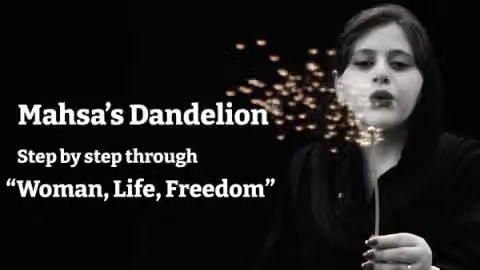
In late September 2022, when a young Iranian woman named Mahsa Amini was killed for showing her hair, Iran erupted. Millions of brave Iranians, women and men, young and old, took to the streets.
What followed was not just a protest against compulsory hijab laws, but one of the clearest rejections of the Islamic Republic since 1979: Woman. Life. Freedom.
At the time, I was head of digital operations at the Israel ministry of foreign affairs, leading Israel’s public diplomacy online in six languages, including Persian.
From the start, we distinguished between the Islamic Republic and the Iranian people. That distinction guided everything we did. We launched one of the only official digital campaigns anywhere in direct solidarity with Mahsa Amini and the protesters, including a filter viewed more than a million times.
Our Israel in Persian accounts exploded. Posts expressing support reached millions. Every day, we received thousands of messages from inside Iran: “Thank you for seeing us,” they said, “be our voice.”
In January 2026, they did the same.
For more than four decades, the Islamic Republic has insisted that hatred of Israel is central to Iranian identity. But millions of Iranians have told us otherwise.
A GAMAAN survey published in 2025 found that roughly two thirds of Iranians said the government should stop its “destroy Israel” rhetoric, and a similar majority viewed the recent 12 day conflict as between the Iranian regime and Israel, not between Israel and ordinary Iranians.
Loyal supporters of Iran's theocratic rule, the same voices that celebrated October 7, want you to believe Iranians hate Israel and that the protests are foreign engineered fantasies.
They flood social media with trolls, lies, and fake AI videos. But the people have already spoken. Across ideology and geography, they are saying the same thing: Not death to Israel. Not death to America. Death to the Islamic Republic.
Hundreds of thousands of Iranian Jews live around the world today, many still speaking Persian, cooking Iranian food, and aching for the country they were forced to leave.
People hold a banner, as Israelis rally in support of the nationwide protests happening in Iran, in Holon, Israel, January 14, 2026.
Israel is home to about 200,000 Iranian Jews. Long before modern politics, Cyrus the Great liberated the Jews from exile and allowed them to return to Jerusalem, an event recorded in both Jewish and Persian history.
That shared past still lives between our peoples. And it lives in everyday encounters.
Every Iranian I have ever met has responded to me as a Jewish Israeli with warmth, curiosity, and respect. Never hatred.
Israelis are taught that Iran wants them wiped off the map. Iranians are taught that Israel is satanic and responsible for their suffering. But we both know the truth. It is the Islamic Republic that threatens both of us.
The rulers in Tehran have destroyed Iran’s economy, murdered teenagers for defying religious rule, and crushed dissent. They send money to their armed allies in the region while ordinary Iranians struggle to afford food and medicine.
Inside Iran, protesters chant, “Not Gaza, not Lebanon, my life for Iran.”
For Israelis, the danger is existential. The same regime that brutalizes its citizens openly calls for Israel’s destruction and races toward nuclear capability.
Israelis and Iranians do not need permission to recognize each other. Beneath decades of forced slogans lies something older and stronger than propaganda.
When Iranians rose up, Israelis didn’t see enemies in the streets of Tehran. We saw courage. And just as Iranians amplified Israeli voices after October 7, we understand that now it is our turn to speak for them.
This is not a Zionist conspiracy. It is human beings standing up for human beings.
The Islamic Republic fears that if Israelis and Iranians ever meet as people rather than caricatures, its mythology would collapse. So we stand with our Iranian brothers and sisters as allies, determined to answer their call for help.
For Jews, “Next year in Jerusalem” is a prayer for freedom. Today, that prayer has an echo: Next year in Tehran.