US Senator Cruz says American people back Iran protests
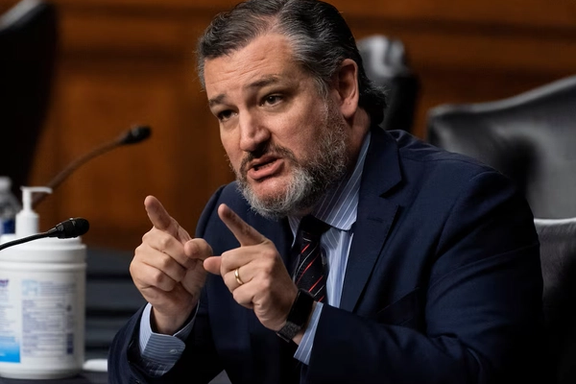
US Senator Ted Cruz gestures in this file photo
US Senator Ted Cruz told Iran International on Wednesday that the American people back ongoing protests in the country against theocratic rule and credited President Donald Trump for attacks on Iranian nuclear sites in June.
"I absolutely support the (Iranian) people. They’re rising up against a tyrannical regime, a regime that is theocratic, that is corrupt, that murders and tortures the Iranian people and the American people are cheering for the people of Iran to shake free this yoke of oppression, to have a free and democratic society," Cruz said.
The hawkish Texas lawmaker is close to Trump and is a strong backer of Israel and muscular US military stance in the Middle East.
Protests have roiled Iranian cities since December 28 and 34 demonstrators along with two members of the security forces have died according to US-based rights group HRANA.
Economic grievances sparked the unrest, which quickly transformed into anti-government rallies throughout the country.
"I think the people of Iran want to stand with America," Cruz added. "They want to stand with freedom. They want to stand with the West. And tragically, they have suffered under this radical Islamist regime."
"The Ayatollah is a zealot. He is He is a murderer, and I think the regime is fatally weakened as a consequence of losing the war. Not only did the Ayatollah lose the war," Cruz continued.
Israel launched a surprise military campaign against Iran in June which was capped off by US attacks on three key nuclear facilities. US President Donald Trump said the strikes "obliterated" Iran's atomic program.
"I will say President Trump showed bold leadership. Taking out the Iranian nuclear facilities, very few things would produce greater peace in Iran, across the world than seeing the end to this to radical regime."
Iranian authorities have said legitimate protest against economic hardships will be tolerated but what they have deemed riots will be put down. Iran has quashed with deadly force previous waves of unrest against authorities.
A young woman holds a print of Iran's supreme leader Ali Khamenei at a state-sponsored rally in Tehran, December 31, 2025
Iran may not be Venezuela, but the Islamic Republic may at its most vulnerable point in its near 50-year existence as pressure builds from the streets, foreign intelligence services and inside the clerical establishment, analysts told Iran International.
US forces captured Venezuelan President Nicolas Maduro in a daring, deadly raid over the weekend and launched a surprise attack on Iranian nuclear sites in June.
His maverick military style may visit Iran once again after he twice warned Washington's sworn enemies in the Islamic theocracy against killing protestors, after which over 25 people have been killed.
The question now confronting Washington is whether Donald Trump will stick to pressure and covert tools or move toward a more dramatic confrontation.
Those who follow Trump’s foreign policy decisions see a clear pattern. He favors actions that create leverage without committing the US to open-ended wars.
Drawing on that record, Dr. Mehrzad Boroujerdi, Vice Provost and Dean at Missouri University of Science and Technology and a longtime scholar of Iranian politics, described a president inclined toward targeted operations rather than large deployments.
Trump, he explained, “prefers low risk and no boots on the ground model of a surgical attack.”
In the most extreme versions of surgical-strike planning, even the Supreme Leader appears as a hypothetical target, especially after Trump said during hostilities in June that the United States was well aware of his hiding place.
A broader conflict, Boroujerdi added, would come with serious complications.
“Any type of serious military intervention, meaning boots on the ground, in a place like Iran is going to be politically risky, legally contested and strategically rather complex.”
Is a Venezuela-style scenario possible?
The dramatic operation that removed Venezuela’s Nicolás Maduro has raised questions about whether something similar could unfold in Iran.
Alex Vatanka, director of the Iran Program at the Middle East Institute in Washington, pointed to the depth of foreign intelligence penetration in Iran’s security apparatus.
“If we look at the 12 day war we just had in the summer of 2025, clearly Israel, certainly in the United States, I’m sure they have many eyes and ears inside the Iranian regime. Otherwise they could not have done the sort of targeted assassinations that they achieved.”
During the 12-day war, Israeli airstrikes targeted Iran’s nuclear and military infrastructure, killing senior commanders such as Revolutionary Guards Brigadier General Davoud Sheikhian and several nuclear scientists including Abdolhamid Minouchehr and Mohammad Mehdi Tehranchi.
That level of access, Vatanka said, creates the possibility of deals inside the ruling elite if they decide the current path is unsustainable.
“That suggests defections. That suggest a good part of an existing regime decides, you know what, going forward things have to change and they might have cut a deal.”
Boroujerdi said Washington may not rely on exiled figures. Instead, it could negotiate with people already in power.
“The Venezuela model definitely shows … that instead of choosing an opposition figure, the Trump administration is quite content with striking a deal for a negotiated transition with the elements of the regime,” he said.
But Iran’s internal structure makes such transitions unpredictable. The Revolutionary Guard dominates key sectors of the economy and the security state.
Eric Mandel, director of the Middle East Political Information Network and a frequent adviser on regional security issues, warned that power might consolidate around them.
“I think the regime change in Iran could be one where the IRGC picks up the pieces because they're the most organized force.”
Prince Reza Pahlavi, the most prominent opposition figure outside Iran and son of the deposed last shah of Iran, has taken the opposite view. In recent interviews and opinion pieces, he argued that Iran does not need foreign intervention or a Venezuela-style operation.
“We don’t need a single boot of your military on the ground in Iran,” he told the Wall Street Journal in an interview published on Monday, saying the Islamic Republic is weakening from within and that a planned transition led by Iranians themselves could prevent chaos. Supporters see him as a potential unifying figure.
Many protest videos from inside Iran feature chants invoking Prince Reza Pahlavi to return.
Do Iranians actually want an attack?
Years of inflation, corruption and repression have pushed some Iranians to consider outside intervention as a price worth paying. Yet analysts caution against assuming most people are calling for war.
Boroujerdi emphasized the economic reality first. In his assessment, “hardly anyone is asking for war because that is going to amount to even worse economic conditions.”
Protesters in Iran have appealed to US President Donald Trump for help, according to videos sent to Iran International on Tuesday, with posts and signs reading 'Trump don't let them kill us.'
US President Donald Trump said on Sunday night aboard Air Force One that the United States was monitoring developments in Iran closely and warned that if Iranian authorities killed protesters, the country would face a strong response.
Meanwhile, the make-up of protests is shifting. Demonstrations are less concentrated among Tehran’s elite and increasingly driven by smaller cities and working-class families, once supporters of the clerical establishment and pillars of the 1979 Islamic Revolution.
“Right now, 70 plus cities and towns are protesting. This is a nationwide phenomena … It’s inflation, it’s unemployment, it’s the corruption,” said Vatanka.
Police in Abdanan, in Ilam Province, are seen in footage viewed by Iran International waving and cheering on protesters - an unusual scene in a system built on loyalty to the state.
What happens if there is an attack?
Mandel believes escalation remains possible, especially around Iran’s missile program.
“I think there’s a good chance that there will be a war with Iran,” he said, warning that Tehran could also strike first to distract from domestic crises and attempt to rally nationalist sentiment.
Iran’s newly formed Defense Council warned on Tuesday that the country could respond before an attack if it detected clear signs of a threat. Israeli Prime Minister Benjamin Netanyahu said on Monday that he and Trump would not permit Iran to restore its ballistic and nuclear program.
For Iranians already living with inflation, repression and unrest, the question is no longer whether pressure will continue. It is what form it will take, and how high the price will be.
A screengrab shows security forces outside Imam Khomeini Hospital in Ilam, western Iran. (January 2026)
An Iranian newspaper reported that security forces blocked blood donations and took wounded protesters from a hospital after opening fire on demonstrations in the western town of Malekshahi, a rare domestic account of alleged abuses that has drawn condemnation from rights groups.
The reformist daily Ham-Mihan said on Wednesday, citing eyewitnesses, that security forces shot at demonstrators protesting in Malekshahi, near the Iraqi border, and later entered Imam Khomeini Hospital in the provincial capital Ilam, where injured protesters had been taken for treatment.
According to the newspaper, security forces prevented people from donating blood for the wounded and removed some injured protesters from the hospital without allowing them to receive medical care.
Witnesses quoted by the paper said forces also sought to take the bodies of those killed in the unrest to prevent public mourning ceremonies.
The paper reported that four wounded protesters died shortly after arriving at the hospital, while two others later died from their injuries. Hospital staff said about 11 critically injured protesters were admitted.
One eyewitness told the newspaper that none of the demonstrators had been carrying weapons and that the shooting followed a peaceful march. Another said security forces restricted access to the hospital to prevent photographs or videos from circulating.
Ham-Mihan said about 30 people were wounded when security forces fired on protests in Malekshahi this week. Iran International had independently verified the identities of four people killed in the unrest.
Medical workers quoted by the newspaper described gunshot wounds to the head, chest, abdomen and limbs. One nurse said a young man hit by three Kalashnikov bullets died after surgery.
Amnesty International said Iranian security forces carried out repeated raids on Imam Khomeini Hospital, using tear gas and shotguns, smashing doors and beating people inside, including medical staff, and arresting injured protesters and family members.
Iranian President Masoud Pezeshkian has ordered an investigation into the hospital incident. Iran’s health minister said medical staff were obliged to treat all patients regardless of political or social affiliation.
The US State Department described the hospital raid as a crime against humanity. Iranian officials have said the government recognizes economic protests but rejects what it calls violence and disorder.
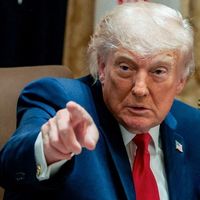
US President Donald Trump addresses House Republicans at their annual issues conference retreat, at the Kennedy Center, renamed the Trump-Kennedy Center by the Trump-appointed board of directors, in Washington, January 6, 2026.
Iran’s foreign minister said on Wednesday that protests roiling the country could be resolved by the country's government and people, calling the unrest an internal matter in an apparent rebuke to US solidarity with demonstrators.
“We see that through interaction between the government and the people, any protests or outstanding issues can, God willing, be resolved, and I am very hopeful that this will happen,” Abbas Araghchi told reporters on the sidelines of a cabinet meeting in Tehran.
At least 36 people have been killed in anti-government demonstrations which began on Dec. 28. US President Donald Trump has vowed to intervene if authorities killed protestors, in comments which have ramped up anticipation about his intentions.
Araghchi appeared to address the comments by saying the unrest was a domestic matter. "Iran’s internal affairs were not the concern of any foreign government," he said.
Relations between Tehran and Washington are at a low ebb and talks between the longtime foes on Iran's disputed nuclear program ended when Israeli launched a surprise military campaign in June capped off by US attacks on Iran nuclear sites.
“Now the conditions are not right for negotiations due to US policies,” Araghchi added.
“Iran has never left the negotiating table,” Araghchi added, sayingTehran had always been ready for talks based on mutual respect and interests.
Israel Hayom reported on Tuesday that Trump had rejected a proposal by his special envoy, Steve Witkoff, to pursue further talks with Tehran and instead chose to increase pressure on Iran.
Meanwhile, protests and strikes continued on Wednesday as shopkeepers shut stores and joined rallies in multiple cities.
Araghchi also said he would travel to Beirut on Thursday, adding that an economic delegation would accompany him and that Iran wanted to expand long-standing ties with Lebanon and its government.
Security forces stand behind a gate outside Sina Hospital in Tehran, where witnesses said some protesters had sought refuge during clashes, January 6, 2026
State media in Iran are portraying the country as calm, even as rights groups and videos emerging from streets point to expanding protests and intensifying repression.
As the tenth day of unrest wraps up, Tehran appears to be pursuing a dual control strategy: widespread arrests of individuals described as riot leaders, alongside intensified news censorship and tighter restrictions on internet access.
The website Asr-e Iran reported on Tuesday that not a single reporter or photographer from non-state outlets is currently permitted to conduct field coverage of demonstrations.
During the early days of the unrest, state media—including the national broadcaster—unexpectedly aired limited and heavily censored coverage of protests.
Some appeared to validate people’s right to protest, signaling a brief opening toward a more conciliatory stance.
Since then, official rhetoric has again turned confrontational, even as protests and strikes have continued to spread.
On Monday night, large crowds took to the streets in eastern Tehran, an area traditionally regarded as a conservative stronghold.
On Tuesday, bazaar merchants once again closed their shops and took to surrounding streets in numbers not previously seen in online videos since the protests began.
Footage circulating on social media appears to show a noticeable increase in the number of demonstrators in several other cities as well.
It also points to the spread of strikes to Kurdish regions, where political parties have called on residents to join work stoppages starting Thursday.
‘Enemy conspiracy’
Despite this, official and semi-official outlets have insisted that the unrest is fading.
The Revolutionary Guards-affiliated Fars News Agency claimed on Tuesday that “riotous movements” had declined sharply since Monday night and were limited to a few locations.
“People, despite having grievances about living conditions and high prices, have shown no support for these riots or even street protests,” Fars asserted.
Hossein Shariatmadari, the editor of the hardline Kayhan, which is funded by the office of the Supreme Leader, went further, claiming that a planned “enemy conspiracy” had been neutralized thanks to the “vigilance, faith and devotion” of bazaar merchants and the public.
Feeble administration
The administration of President Masoud Pezeshkian, by contrast, has sought to strike a more restrained tone—though with limited influence over events unfolding on the streets.
On Tuesday, Mehdi Tabatabei, one of the president’s deputies, wrote on X that it was the government’s duty to hear protesters’ voices and respond to their “reasonable” demands, arguing that the line between protest and “riot” lay in avoiding violence.
Writing in the daily Ham-Mihan, moderate pundit Abbas Abdi warned that officials were mistaken to believe the unrest could simply be “wrapped up” without addressing its underlying causes.
A society protesting for multiple reasons, he wrote, including economic hardship, retains a high potential for renewed unrest even after periods of enforced silence.
One defining feature of the current wave of protests has been its expansion into smaller towns grappling with poverty and unemployment.
Another, more telling—and ignored characteristically by pundits who address Pezeshkian and not Khamenei—is the growing irrelevance of the civilian administration at moments like this, when the confrontation crystalises into protesters against the security apparatus.
Protesters gathering in Tehran Bazaar, January 6, 2025 - File photo
Exiled Prince Reza Pahlavi on Tuesday issued his first public call for protests since the latest nationwide uprising began, urging coordinated chanting on Thursday evening, hours after Kurdish opposition parties separately called for a general strike that day.
In a video message addressed to Iranian people, Pahlavi said he had closely followed demonstrations over the past week, singling out protests in Tehran’s bazaars as a sign of growing resistance despite what he described as the Islamic Republic's violent crackdown.
He said repeated large-scale gatherings had forced security forces to retreat in some cases and led to what he described as increased defections.
Calling discipline and mass participation “critical,” Pahlavi urged Iranians to chant simultaneously at exactly 8:00 p.m. on Thursday and Friday, January 8 and 9, whether in the streets or from inside their homes.
Separately, seven Iranian Kurdish opposition parties issued a joint statement urging a general strike on Thursday in support of nationwide protests and in condemnation of what they described as the Islamic Republic's actions in the Kurdish-majority provinces of Kermanshah and Ilam as well as Lorestan.
The statement denounced the crackdown on demonstrations and the detention of protesters as a long-standing policy of the Islamic Republic and called on political parties and civil organizations across the country to take a “united and collective stance” by joining the strike.
The call was signed by the Kurdistan Democratic Party of Iran, Komala Party of Iranian Kurdistan, Kurdistan Free Life Party (PJAK), Komala, Kurdistan Organization of the Communist Party of Iran, Revolutionary Komala of Toilers of Iranian Kurdistan, and the Kurdistan Organization of Khabat.
Thursday now appears set to become a focal point for coordinated protest and labor action across Iran.