Security forces blocked blood donations, seized wounded protesters - paper
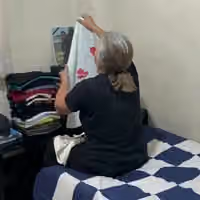
A screengrab shows security forces outside Imam Khomeini Hospital in Ilam, western Iran. (January 2026)
An Iranian newspaper reported that security forces blocked blood donations and took wounded protesters from a hospital after opening fire on demonstrations in the western town of Malekshahi, a rare domestic account of alleged abuses that has drawn condemnation from rights groups.
The reformist daily Ham-Mihan said on Wednesday, citing eyewitnesses, that security forces shot at demonstrators protesting in Malekshahi, near the Iraqi border, and later entered Imam Khomeini Hospital in the provincial capital Ilam, where injured protesters had been taken for treatment.
According to the newspaper, security forces prevented people from donating blood for the wounded and removed some injured protesters from the hospital without allowing them to receive medical care.
Witnesses quoted by the paper said forces also sought to take the bodies of those killed in the unrest to prevent public mourning ceremonies.
The paper reported that four wounded protesters died shortly after arriving at the hospital, while two others later died from their injuries. Hospital staff said about 11 critically injured protesters were admitted.
One eyewitness told the newspaper that none of the demonstrators had been carrying weapons and that the shooting followed a peaceful march. Another said security forces restricted access to the hospital to prevent photographs or videos from circulating.
Ham-Mihan said about 30 people were wounded when security forces fired on protests in Malekshahi this week. Iran International had independently verified the identities of four people killed in the unrest.
Medical workers quoted by the newspaper described gunshot wounds to the head, chest, abdomen and limbs. One nurse said a young man hit by three Kalashnikov bullets died after surgery.
Amnesty International said Iranian security forces carried out repeated raids on Imam Khomeini Hospital, using tear gas and shotguns, smashing doors and beating people inside, including medical staff, and arresting injured protesters and family members.
Iranian President Masoud Pezeshkian has ordered an investigation into the hospital incident. Iran’s health minister said medical staff were obliged to treat all patients regardless of political or social affiliation.
The US State Department described the hospital raid as a crime against humanity. Iranian officials have said the government recognizes economic protests but rejects what it calls violence and disorder.
State media in Iran are portraying the country as calm, even as rights groups and videos emerging from streets point to expanding protests and intensifying repression.
As the tenth day of unrest wraps up, Tehran appears to be pursuing a dual control strategy: widespread arrests of individuals described as riot leaders, alongside intensified news censorship and tighter restrictions on internet access.
The website Asr-e Iran reported on Tuesday that not a single reporter or photographer from non-state outlets is currently permitted to conduct field coverage of demonstrations.
During the early days of the unrest, state media—including the national broadcaster—unexpectedly aired limited and heavily censored coverage of protests.
Some appeared to validate people’s right to protest, signaling a brief opening toward a more conciliatory stance.
Since then, official rhetoric has again turned confrontational, even as protests and strikes have continued to spread.
On Monday night, large crowds took to the streets in eastern Tehran, an area traditionally regarded as a conservative stronghold.
On Tuesday, bazaar merchants once again closed their shops and took to surrounding streets in numbers not previously seen in online videos since the protests began.
Footage circulating on social media appears to show a noticeable increase in the number of demonstrators in several other cities as well.
It also points to the spread of strikes to Kurdish regions, where political parties have called on residents to join work stoppages starting Thursday.
‘Enemy conspiracy’
Despite this, official and semi-official outlets have insisted that the unrest is fading.
The Revolutionary Guards-affiliated Fars News Agency claimed on Tuesday that “riotous movements” had declined sharply since Monday night and were limited to a few locations.
“People, despite having grievances about living conditions and high prices, have shown no support for these riots or even street protests,” Fars asserted.
Hossein Shariatmadari, the editor of the hardline Kayhan, which is funded by the office of the Supreme Leader, went further, claiming that a planned “enemy conspiracy” had been neutralized thanks to the “vigilance, faith and devotion” of bazaar merchants and the public.
Feeble administration
The administration of President Masoud Pezeshkian, by contrast, has sought to strike a more restrained tone—though with limited influence over events unfolding on the streets.
On Tuesday, Mehdi Tabatabei, one of the president’s deputies, wrote on X that it was the government’s duty to hear protesters’ voices and respond to their “reasonable” demands, arguing that the line between protest and “riot” lay in avoiding violence.
Writing in the daily Ham-Mihan, moderate pundit Abbas Abdi warned that officials were mistaken to believe the unrest could simply be “wrapped up” without addressing its underlying causes.
A society protesting for multiple reasons, he wrote, including economic hardship, retains a high potential for renewed unrest even after periods of enforced silence.
One defining feature of the current wave of protests has been its expansion into smaller towns grappling with poverty and unemployment.
Another, more telling—and ignored characteristically by pundits who address Pezeshkian and not Khamenei—is the growing irrelevance of the civilian administration at moments like this, when the confrontation crystalises into protesters against the security apparatus.
Exiled Prince Reza Pahlavi on Tuesday issued his first public call for protests since the latest nationwide uprising began, urging coordinated chanting on Thursday evening, hours after Kurdish opposition parties separately called for a general strike that day.
In a video message addressed to Iranian people, Pahlavi said he had closely followed demonstrations over the past week, singling out protests in Tehran’s bazaars as a sign of growing resistance despite what he described as the Islamic Republic's violent crackdown.
He said repeated large-scale gatherings had forced security forces to retreat in some cases and led to what he described as increased defections.
Calling discipline and mass participation “critical,” Pahlavi urged Iranians to chant simultaneously at exactly 8:00 p.m. on Thursday and Friday, January 8 and 9, whether in the streets or from inside their homes.
Separately, seven Iranian Kurdish opposition parties issued a joint statement urging a general strike on Thursday in support of nationwide protests and in condemnation of what they described as the Islamic Republic's actions in the Kurdish-majority provinces of Kermanshah and Ilam as well as Lorestan.
The statement denounced the crackdown on demonstrations and the detention of protesters as a long-standing policy of the Islamic Republic and called on political parties and civil organizations across the country to take a “united and collective stance” by joining the strike.
The call was signed by the Kurdistan Democratic Party of Iran, Komala Party of Iranian Kurdistan, Kurdistan Free Life Party (PJAK), Komala, Kurdistan Organization of the Communist Party of Iran, Revolutionary Komala of Toilers of Iranian Kurdistan, and the Kurdistan Organization of Khabat.
Thursday now appears set to become a focal point for coordinated protest and labor action across Iran.
Protesters in Iran have appealed directly to Donald Trump for protection according to new videos sent to Iran International on Tuesday after the US president twice warned Tehran not to kill demonstrators or face US intervention.
In one clip, a woman holds a sign reading, "Trump, a symbol of peace. Don't let them kill us," while another shows the same message spray painted in red on a concrete wall.
The woman holds the sign in English while she says in Farsi, "Help, we need HELP."
A viewer sent in a video from Yazdanshahr in Esfahan Province showing protesters standing and resisting in the street as government security forces opened fire.
Addressing Donald Trump, the protester says: "Do something, Trump! If not now, then when? Step forward."
US Senator Lindsey Graham on Monday posted a picture of himself alongside Trump, who was holding a signed "Make Iran Great Again" cap. The President had invoked the slogan on June 22, the day he launched surprise attacks on Iranian nuclear sites.
Another video shows a young man jumping up to paste a sticker reading "Trump Street" in Farsi over a road sign on a wall.
Trump earlier warned Iran that the United States will "hit (Iran) very hard" if security forces kill protesters.
The US president also posed with a "Make Iran Great Again" hat in a picture shared by Republican senator Lindsey Graham.
The MIGA slogan was earlier used by Trump in a post on his Truth Social in June.
"It's not politically correct to use the term, 'Regime Change' but if the current Iranian Regime is unable to MAKE IRAN GREAT AGAIN, why wouldn't there be a Regime change??? MIGA!!" the president wrote at the time.
Also in late December, Israeli minister Gila Gamliel posted a selfie wearing a MIGA cap, tagging exiled Prince Reza Pahlavi and captioning it "Soon."
Elon inspires protesters
A Persian phrase used by Elon Musk in reply to a post by Iran’s Supreme Leader on X also made its way into the ongoing protests in Iran.
Protesters in Chenar village in Asadabad, Hamadan, chanted the phrase — which roughly translates as “what a futile delusion” or “in your dreams”.
Musk used the phrase in response to a post by Khamenei that said, “We will not give in to the enemy.”
At least 36 people have been killed during ongoing protests in Iran, a US-based human rights group said, as merchant strikes and street demonstrations spread to 285 locations across 92 cities nationwide on the tenth day of unrest.
The Human Rights Activists News Agency (HRANA) said at least 34 protesters and two members of Iran’s security forces have been killed since the unrest began on Dec. 28.
Four of those killed were under the age of 18. Dozens more protesters have been injured, many by pellet and plastic bullets.
Protests have now been recorded in 27 provinces, with security forces arresting more than 2,000 people, the report said.
The crackdown on protests has extended to hospitals and medical centers treating wounded demonstrators in Ilam and Tehran, according to eyewitness reports and videos obtained by Iran International.
The most significant development on the tenth day of protests was a widespread strike and demonstration by bazaar merchants, particularly in Mashhad's commercial centers and Tehran’s Grand Bazaar.
Large sections of the gold, currency, fabric, footwear and household goods markets were reported fully or partially closed. Security forces increased their presence around major commercial hubs and blocked some gatherings, but the strike disrupted daily economic activity and reduced foot traffic, highlighting the growing overlap between street protests and economic dissent.
HRANA also documented an escalation in force by security units, including the use of pellet guns, tear gas and direct assaults on demonstrators. Rights monitors said official accounts of some deaths conflict with eyewitness testimony and remain under investigation.
Ilam protests
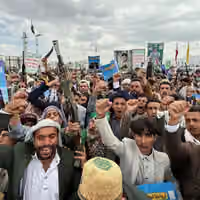
The Kurdish-majority Ilam province in western Iran remained a flashpoint of protests on Tuesday, as funerals in the city of Malekshahi for slain protesters turned into scenes of massive anti-government protests. Huge crowds in the city of Abdanan also poured into the streets with chants against the Supreme Leader.
Seven Iranian Kurdish opposition parties have issued a joint call for a general strike on Thursday, in support of nationwide protests and in condemnation of what they described as the “crimes of the regime in Kermanshah, Ilam and Lorestan.”
They said they strongly condemned the crackdown on demonstrations and the detention of protesters, describing it as a "long-standing policy of the Islamic Republic regime."
The parties called on all political parties and civil organizations to “take a united and collective stance against the crimes of the Islamic Republic regime and join this call.”
Exiled Prince Reza Pahlavi also issued his first call for protests in a video message on Tuesday, calling on Iranian protesters to chant slogans at 8 pm (local time) on Thursday and Friday.
Hospital intrusions
In a major point of concern, security forces were reported to have entered at least two hospitals. In Ilam, witnesses said tear gas was fired inside Imam Khomeini Hospital as forces attempted to arrest wounded protesters transferred from Malekshahi.
In Tehran, reports said security personnel entered Sina Hospital and detained injured demonstrators, creating fear among patients and families.
Iran’s government said it had ordered an investigation into unrest in Ilam after rights groups condemned reports that security forces raided a hospital where injured protesters were being treated.
The public relations office of Tehran University of Medical Sciences, which oversees Sina Hospital, also said tear gas was not deliberately fired inside the hospital during Tuesday’s protests, according to a statement carried by Revolutionary Guards-affiliated Tasnim.
Iran’s government said it had ordered an investigation into unrest in the western province of Ilam after rights groups condemned reports that security forces raided a hospital where injured protesters were being treated.
Tensions in Ilam peaked this week after clashes between security forces and demonstrators in Malekshahi, a town near the Iraqi border, where forces fired live rounds to disperse protesters, killing several people and injuring dozens.
The situation escalated late on Sunday when security forces entered Imam Khomeini Hospital, where wounded demonstrators had been taken for treatment, according to rights groups.
Amnesty International said on Tuesday, “The Iranian security forces’ attack on a hospital in Ilam, where injured protesters are seeking medical care or shelter, violates international law.”
The rights group said information it gathered showed that on January 4, Revolutionary Guards and police special forces surrounded the hospital, used shotguns and fired tear gas into the grounds, smashed glass doors to gain access, and beat those inside, including medical workers.
Amnesty cited informed sources as saying that security forces had entered the hospital on multiple occasions, arresting injured protesters receiving treatment and their family members.
Rights groups also said security personnel attempted to seize the bodies of protesters killed in the unrest to prevent public mourning ceremonies.
President Masoud Pezeshkian ordered the interior minister on Monday to assemble a team of relevant officials to examine the incidents in Ilam, the causes behind the unrest and how authorities responded, and to submit a comprehensive report to the president’s office as soon as possible, according to a government statement.