• العربية
  • فارسی
Brand
  • Iran Insight
  • Politics
  • Economy
  • Analysis
  • Special Report
  • Opinion
  • Podcast
  • Iran Insight
  • Politics
  • Economy
  • Analysis
  • Special Report
  • Opinion
  • Podcast
  • Theme
  • Language
    • العربية
    • فارسی
  • Iran Insight
  • Politics
  • Economy
  • Analysis
  • Special Report
  • Opinion
  • Podcast
All rights reserved for Volant Media UK Limited
volant media logo
ANALYSIS

2026 will test the limits of Tehran’s endurance

Shahram Kholdi
Shahram Kholdi

International Security and Law Analyst

Jan 5, 2026, 15:20 GMT+0Updated: 22:26 GMT+0
Iran's supreme leader Ali Khamenei waves to supporters in an event to commemorate IRGC's slain commander Qassem Soleimani, Tehran, January 3, 2026

Prolonged economic exhaustion and a broader loss of confidence in the Iranian state after historic military and foreign policy setbacks in 2025 means 2026 may be the Islamic Republic's hardest ever year.

Popular unrest is not unfolding in isolation. It comes amid sustained external pressure, legal constraint and strategic exposure that have narrowed the Islamic Republic’s room for maneuver.

The protests are best understood not as a discrete domestic episode, but as the internal manifestation of a broader convergence: sanctions enforcement, legal isolation, military attrition and fiscal strain now intersect more directly with the regime’s ability to manage society.

At the center of this convergence lies a structural tension.

Tehran has long prioritized the maintenance of its coercive apparatus as the ultimate guarantor of regime survival, assuming it could continue to fund and mobilize those forces even as the wider population absorbed economic pain. The present unrest tests that assumption.

The question is no longer simply whether the state can repress protest—it has done so repeatedly—but whether it can sustain that approach under prolonged economic pressure.

The war that reshaped Iran’s strategic landscape

In June 2025, the Islamic Republic faced sustained direct military action against core elements of its nuclear and missile infrastructure, followed not by rapid diplomatic de-escalation but by heightened scrutiny and enforcement.

While Tehran avoided immediate escalation beyond the conflict, the war unsettled long-standing assumptions about deterrence, sanctuary and escalation control.

In its aftermath, the state’s survival was framed domestically as vindication. Yet continuity did not amount to recovery. Vulnerabilities exposed by the war could not be addressed simply through rebuilding or rhetorical reaffirmation.

Iran’s leadership has often equated endurance with strategic success. In this case, endurance masked erosion. The post-war environment became more constrained, not more permissive.

Sanctions and their toll

The reactivation of pre-2015 United Nations sanctions through the snapback mechanism in September 2025 constituted a second rupture—less visible, but no less consequential.

These measures reimposed binding legal constraints independent of the JCPOA framework.

Whatever Tehran’s posture toward negotiations, its obligations under revived Security Council resolutions and the Nuclear Non-Proliferation Treaty remain formally intact.

Iran’s refusal to comply with inspection-related understandings, alongside renewed threats to withdraw from the NPT, reflected a strategy of legal brinkmanship. But brinkmanship has limits.

Snapback has proven difficult to circumvent, constraining access to finance, insurance and energy markets. Even states inclined to engage Iran have struggled to shield it from the broader effects of renewed enforcement.

These constraints have translated into economic pressure. The protests now visible across Iran are therefore not only political acts; they are also the social consequence of legal and economic containment.

Missiles and strategic trade-offs

Under this pressure, Tehran has prioritized strategic reconstruction, particularly in its ballistic missile program. Facilities linked to missile development and solid-fuel production have shown signs of renewed activity, even as nuclear infrastructure remains under close scrutiny.

This reflects a belief that missile capability can restore leverage by raising the costs of external pressure.

Missile reconstruction aims to reconstitute coercive leverage and recover lost influence. Yet the strategic context has shifted. Measures once tolerated as incremental are now interpreted as preparatory, intensifying scrutiny and compressing decision timelines.

The domestic trade-offs are significant. Resources directed toward military-industrial reconstruction are resources unavailable for economic stabilization or social relief.

Iran’s rulers appear to have judged that sustaining coercive capacity outweighs the risks of popular discontent—a calculation that depends on continued loyalty within the security apparatus, even as economic conditions worsen.

A narrowing set of options

During the war, US President Donald Trump publicly raised the prospect of regime change—not as declared policy, but as a conceivable outcome should Iran prove unable to govern or stabilize the country.

While ambiguous, the remarks widened the range of interpretations available to Tehran.

As protests spread, that signalling evolved. In early January, Trump warned that violent suppression of peaceful protesters would provoke an American response. The emphasis shifted from missiles and enrichment to repression itself.

Taken together, these statements suggest a growing linkage in US rhetoric between Iran’s internal conduct and its external confrontation, though how far this would translate into policy remains uncertain.

For a system long reliant on compartmentalization—treating internal repression and external escalation as separate domains—this rhetoric further narrows room for maneuver.

Repression now carries not only domestic costs, but potential external risk.

Resilience—and its limits

None of this points to inevitability. The Islamic Republic has weathered previous crises, including acute pressure in 2009 and again in 2022, through repression, fragmentation of opposition and strategic patience.

Those precedents caution against linear narratives of collapse.

Yet the present unrest differs in one important respect: it is embedded in sustained economic degradation rather than episodic political mobilization. Repression can suppress protest, but it cannot substitute for economic viability indefinitely.

In 1978, prolonged disruption in Iran’s oil sector did not immediately bring down the state, nor did repression collapse. What faltered was the state’s capacity to function as revenues declined and administrative coherence eroded.

The parallel should not be overstated. But it underscores a familiar pattern: regimes rarely fail at the height of coercion; they falter when the material foundations of governance erode to the point that authority can no longer translate power into control.

Whether the Islamic Republic is approaching such a threshold remains uncertain. What is clearer is that its margin for error has narrowed. The 12-day war did not end Iran’s confrontation with its adversaries, it reshaped it.

The unrest now visible across the country is not separate from that confrontation—it is one of its most consequential domestic expressions.

Most Viewed

Iran negotiators ordered to return after internal rift over Islamabad talks
1
EXCLUSIVE

Iran negotiators ordered to return after internal rift over Islamabad talks

2
ANALYSIS

US blockade enters murky phase as tankers spoof signals and buyers hesitate

3
ANALYSIS

Why the $100 billion Hormuz toll revenue is a myth

4

US tightens financial squeeze on Iran, warns banks over oil money flows

5
ANALYSIS

US blockade targets Iran oil boom amid regional disruption

Banner
Banner

Spotlight

  • Hardliners push Hormuz ‘red line’ as US blockade tests Iran’s leverage
    INSIGHT

    Hardliners push Hormuz ‘red line’ as US blockade tests Iran’s leverage

  • Ideology may be fading in Iran, but not in Kashmir's ‘Mini Iran'
    INSIGHT

    Ideology may be fading in Iran, but not in Kashmir's ‘Mini Iran'

  • War damage amounts to $3,000 per Iranian, with blockade set to add to losses
    INSIGHT

    War damage amounts to $3,000 per Iranian, with blockade set to add to losses

  • Why the $100 billion Hormuz toll revenue is a myth
    ANALYSIS

    Why the $100 billion Hormuz toll revenue is a myth

  • US blockade targets Iran oil boom amid regional disruption
    ANALYSIS

    US blockade targets Iran oil boom amid regional disruption

  • Iran's digital economy battered by prolonged blackout
    INSIGHT

    Iran's digital economy battered by prolonged blackout

•
•
•

More Stories

Iran says food prices to jump as currency subsidies end

Jan 5, 2026, 14:10 GMT+0

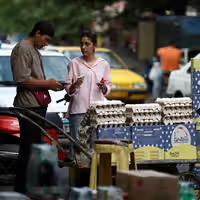
Prices of basic goods in Iran are expected to rise by 20% to 30% in the coming weeks, with sharper increases likely for chicken, eggs and cooking oil, government spokesperson said on Monday.

Fatemeh Mohajerani said the increase was the result of the government’s decision to end subsidized dollars for essential imports in an effort to stabilize the foreign exchange market and curb corruption, a move that has pushed up the local-currency cost of imports of goods and raw material.

“It is evident that by ending or reducing subsidized and preferential official foreign currency exchange rates, the prices of some items will rise,” she said.

Earlier on Monday, parliament said it had approved the general outlines of the budget for the next Iranian year, which begins in March, after the bill was initially rejected and subsequently amended by the government.

  • As Tehran fixates on the dollar, protests move beyond it

    As Tehran fixates on the dollar, protests move beyond it

  • Iran president says government will stop subsidized dollar handouts

    Iran president says government will stop subsidized dollar handouts

  • From Tehran’s Bazaar to the middle class, anger outpaces government

    From Tehran’s Bazaar to the middle class, anger outpaces government

The government described the changes as reforms aimed at improving livelihoods, as authorities seek to ease ongoing anti-government protests and strikes.

The revisions are said to include a pay rise of up to 43% instead of 20%, a cut in value-added tax to 10% from 12%, and the allocation of $8.8 billion in subsidized foreign exchange to curb price rises for basic goods.

The budget was also reported to earmark funds for guaranteed wheat purchases to supply bread and for adjusting pensioners’ salaries.

Lawmakers approved the budget framework with 171 votes in favor, 69 against and six abstentions, out of 246 lawmakers present.

Meanwhile, nationwide protests entered a ninth day on Monday, with merchant strikes continuing in parts of the country.

The unrest began after the rial fell to record lows in late December and has since broadened into a wider test of the government’s ability to manage a country under sustained economic strain.

Iran accuses US, Israel of interference as protests continue

Jan 5, 2026, 09:41 GMT+0

As protests continued across Iran for a ninth day, the foreign ministry on Monday accused the United States and Israel of interfering in Iran’s internal affairs and encouraging violence through their public statements.

Spokesperson Esmail Baghaei said statements by some American and Israeli officials amounted to interference in Iran’s internal affairs and incitement to violence under international norms and rejected what he described as foreign efforts to present themselves as supportive of the Iranian public.

“Actions or statements by figures such as the Israeli prime minister or certain radical and hardline US officials regarding Iran’s internal affairs amount, under international norms, to nothing more than incitement to violence, terrorism, and killing.”

Protests have been reported in 222 locations nationwide, including rallies in 78 cities across 26 provinces, according to the US-based Human Rights Activists News Agency (HRANA).

US President Donald Trump said on Sunday night aboard Air Force One that the United States is following developments in Iran very closely, warning: “If they start killing people like they have in the past, I think they are going to get hit very hard by the United States.”

Baghaei said Iranians remained deeply distrustful of Washington and Israel, citing past actions by the two countries and arguing that the public would not be swayed by what he called “deceptive rhetoric.”

He also said Iran would not base its security posture on remarks from Israeli officials, accusing Israel of misleading statements and signaling continued military vigilance.

“We are not going to trust or rely on the statements of officials from the Zionist regime,” he said. “The regime’s pattern of deception is clear to us.”

According to HRANA, at least 19 demonstrators and one member of security forces have been killed so far as the unrest continues.

Why Iran should take Trump’s threat seriously

Jan 3, 2026, 17:15 GMT+0
•
Bozorgmehr Sharafedin

Unlike his predecessors who largely stayed silent in the early days, Donald Trump issued an unusually blunt warning over the killing of demonstrators in Iran, a message Tehran appears unable to dismiss lightly given its speed, tone, and source.

On the second day of protests, he condemned the Iranian government for firing on demonstrators. On day six, he went further, warning that if the killing of protesters continued, US forces “will come to their rescue.”

This amounts to the fastest and most explicit reaction by an American president to a wave of unrest in Iran in the past 45 years. The question is whether this posture translates into concrete diplomatic steps or credible military pressure—or remains a largely symbolic deterrent message.

Read the rest of the article

100%

Why Iran should take Trump’s threat seriously

Jan 3, 2026, 17:15 GMT+0
•
Bozorgmehr Sharafedin

Within a week of the outbreak of protests in Iran against the Islamic Republic and its rulers, US President Donald Trump weighed in twice with direct comments.

On the second day of protests, he condemned the Iranian government for firing on demonstrators. On day six, he went further, warning that if the killing of protesters continued, US forces “will come to their rescue.”

This amounts to the fastest and most explicit reaction by an American president to a wave of unrest in Iran in the past 45 years. The question is whether this posture translates into concrete diplomatic steps or credible military pressure—or remains a largely symbolic deterrent message.

In 2009, former US president Barack Obama responded cautiously to Iran’s Green Movement protests. At the time, he had sent a second letter to Iran’s supreme leader, Ali Khamenei, and had yet to receive a reply. Obama feared that open support for protesters could undermine the secret backchannel he was attempting to establish with Khamenei to resolve the nuclear standoff.

At the same time, his advisers warned that overt US backing could backfire: protesters might be branded as “foreign agents,” giving the government a pretext to crack down even harder.

Those concerns are far less salient for Trump, at least for now. On one hand, there is currently no meaningful or active diplomatic channel between Tehran and Washington that a sharp US stance could weaken or shut down.

On the other hand, Iranian officials have for years accused protesters of being agents of hostile powers—a charge repeated by Khamenei himself in a recent speech on the unrest—rendering the label largely meaningless. There is little indication that demonstrators now fear either foreign support or accusations of outside ties.

Years later, Obama acknowledged that his cautious approach to the Green Movement had been a mistake, arguing that the United States should support popular, pro-freedom movements wherever they arise. Trump’s swift and blunt reaction suggests he has avoided a similar error.

The Obama administration’s experience also underscores another lesson: firm rhetoric is not enough. In 2012, Obama declared that the use of chemical weapons by the Syrian President Bashar al-Assad constituted a US “red line.”

Yet a year later, a sarin gas attack on Eastern Ghouta, a rebel-held suburb to the east of Damascus, killed hundreds of civilians, but the United States did not launch a military strike. Instead, Obama pursued a diplomatic route to remove Syria’s declared chemical weapons stockpiles.

That effort reduced—but did not end—the use of chemical weapons in Syria, and it significantly weakened Obama’s standing, and that of the United States, among Syrian opposition groups.

Trump, by contrast, appears keenly aware that unfulfilled threats erode both his personal authority and the projection of American power. He has acted on threats toward Iran twice: first, with the killing of Qassem Soleimani exactly six years ago, on January 3, 2020, and second, with a strike on Iranian nuclear facilities around 200 days ago.

On Saturday, Trump also followed through on recent threats against Venezuelan President Nicolas Maduro, announcing that the United States had carried out a major operation against Venezuela and detained Maduro and his wife, removing them from the country.

Tehran moved quickly to respond to Trump’s threat against the Islamic Republic’s repressive forces targeting protesters, suggesting that Khamenei is attentive to the speed and clarity of the message and the prospect of its implementation.

Khamenei labels protesters ‘enemy mercenaries,’ green-lights crackdown

Jan 3, 2026, 11:06 GMT+0

Iran’s supreme leader on Saturday called the nationwide protests the work of foreign-backed agitators and urged a harsher crackdown, in his first public speech since demonstrations began seven days ago

“A number of agitated people, enemy mercenaries, had positioned themselves behind bazaar merchants and chanted slogans against Islam, against Iran and against the Islamic Republic,” Ali Khamenei said, according to state media.

“Protest is legitimate, but protest is different from rioting,” Khamenei added. “Officials should speak with protesters. Speaking with a rioter is pointless. Rioters must be put in their place,” he said.

The comments marked Khamenei’s first public response to the latest wave of demonstrations, which have intensified amid economic strain and currency volatility.

Khamenei’s language echoed his stance during earlier nationwide protests, including the 2022 “Woman, Life, Freedom” uprising and demonstrations in November 2019, when security forces used lethal force to suppress unrest.

At least eight protesters have been killed so far after being shot by security forces during the current unrest, according to human rights groups. Independent organizations, including Iran Human Rights Organization, previously documented 551 deaths – among them 68 children – during the 2022 protests.

Currency crisis blamed on ‘the enemy’

Khamenei also attributed the protests to economic grievances while assigning responsibility for the currency crisis to foreign adversaries. “These gatherings were mainly by bazaar merchants,” he said, adding that sharp and unstable exchange-rate swings were “not natural” and were “the work of the enemy.”

He accused unnamed actors of exploiting merchants’ complaints to cause “damage and insecurity,” saying such actions were “unacceptable.”

The remarks came as protesters in several cities have chanted for the overthrow of the Islamic Republic and mainly voiced support for the exiled prince Reza Pahlavi.

Confrontation with ‘the enemy’

Khamenei closed by insisting the Islamic Republic would not retreat. “The enemy will not sit quietly and uses every opportunity,” he said, adding that authorities “were and will be present in the field.”

  • Protesters back in Tehran streets following Trump’s message on sixth day

    Protesters back in Tehran streets following Trump’s message on sixth day

On Friday, US President Donald Trump warned that if Iranian authorities shoot peaceful protesters, the United States would act to help the people.

"If Iran shots and violently kills peaceful protesters, which is their custom, the United States of America will come to their rescue. We are locked and loaded and ready to go," Trump wrote in a message published on his Truth Social account.

Iranian officials responded with warnings toward the United States and Israel.