Teen protester shot by security forces in western Iran dies in hospital
Reza Moradi
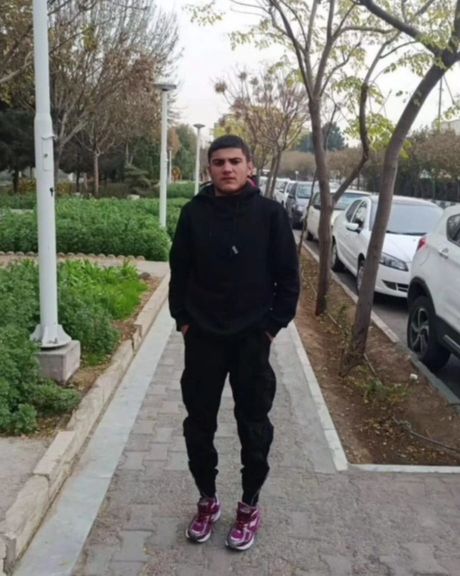
Reza Moradi, a 17-year-old protester from the city of Azna in Lorestan province, died in hospital on Monday after being shot by security forces during demonstrations in western Iran last week, a source close to the family told Iran International.
The source told Iran International that Reza was shot by security forces during the protests on Thursday, January 1, 2026 in front of Azna’s central police station.
Security forces shot him with two bullets, one to the head and another to the lower torso, the source added.
The source said Reza was from the Abdolvand tribe, part of Iran’s Lur minority.
Video evidence verified and analyzed by Iran International from the evening of January 1 shows Reza unconscious and bleeding from the side of his head. Two sources identified the teenager in the footage as Reza.
After he was shot, citizens at the scene transferred him to Valian Hospital in Aligudarz. The source said the hospital was under heavy security and visits were not allowed, adding that only once, after repeated insistence, was Reza’s mother allowed to see him briefly.
Reza Moradi at Valian Hospital in Aligudarz, Lorestan, Iran.
The source said Reza died in hospital on Monday around 10am local time.
The source added that the family has approached several state institutions on Monday, including the police and the Revolutionary Guards, to receive Reza’s body, but authorities have so far refused to hand it over to family for burial.
Reza was the eldest child in the family and his father is a labourer, the source said.
“The family’s financial situation was poor," the source said adding that Reza dropped out of school and worked as an auto body repair and paint apprentice.
Asked about Reza’s motivation for joining the protests, the source said it was due to “poverty, hardship and rising prices,” adding that he was interested in sports, particularly wrestling.
Australia condemns violence by Iranian authorities and urges Tehran to respect the rights of peaceful protesters, a Department of Foreign Affairs and Trade spokesperson told Iran International.
Canberra said it continues to strongly advocate for the human rights of the Iranian people and reiterated that Iran remains a “do not travel” destination due to a volatile security situation and a high risk of detention, adding that Australia’s consular assistance capacity is extremely limited.
The government said it has taken strong action against Iran, including expanding its autonomous sanctions framework and sanctioning 200 Iran-linked individuals and entities since September 2022, nearly 100 of them linked to the Islamic Revolutionary Guards Corps.
State Department says the latest protests in Iran are an expression of the people’s 'understandable anger' at their government’s failures, a US official told Iran International.
“The protests reflect the understandable anger of the Iranian people at their government's failures and excuses,” the official said in a written statement on Thursday.
The statement said Tehran has neglected the country’s economy, agriculture, water, and electricity “for decades” in order to “squander billions on terrorist proxies and nuclear weapons research,” while also carrying out acts of "terrorism against the United States and its allies."
Iran's Zolfaghar short-range solid fuel ballistic missile on display at an exhibition of IRGC Aerospace military equipment
Iran's Islamic Revolutionary Guard Corps (IRGC) is developing biological and chemical warheads for the country's long-range ballistic missiles, informed military sources told Iran International on Sunday.
The IRGC Aerospace Force is working on the unconventional warheads for ballistic missiles as it transfers missile launchers to eastern regions of Iran, the sources said.
The sources, who requested anonymity due to the sensitivity of the matter, said these activities have accelerated in recent months and are being pursued amid rising regional tensions and Tehran’s concerns about the possibility of another direct confrontation with Israel and the United States.
Israeli Prime Minister Benjamin Netanyahu is in Florida to meet the US president on Monday, when he plans to brief Donald Trump on options for potential future strikes against Iran, amid concerns that Tehran is rebuilding ballistic missile production facilities and repairing air defenses damaged during a brief war in June.
Iran International’s sources say these programs are largely carried out under the supervision of the IRGC Aerospace Force and include optimizing ballistic missiles to carry chemical and biological agents, as well as upgrading the associated command-and-control systems.
The Revolutionary Guard, anticipating scenarios of large-scale conflict, is building capabilities that, in the view of the Islamic Republic’s decision-makers, would serve as a “complementary deterrent factor” alongside Iran’s conventional missile program, one source said.
The pursuit of chemical and biological warheads comes six months after Iran’s foreign minister described his country as “the largest victim of chemical weapons in modern history,” citing Saddam Hussein’s chemical attack on Sardasht in western Iran, which, according to OPCW documentation, killed more than 100 people in a large-scale mustard gas assault.
Asked about the contradiction, one source told Iran International, “The Iranian leadership views potential Israeli and American attacks as a threat to its very existence and intends, in the event of a conflict, to significantly raise the cost for the opposing side.”
There is a perception at the highest decision-making levels of the Islamic Republic that “the use of unconventional weapons can be justified in situations of existential threat," the source added.
Last week, Iran International reported that Western intelligence agencies had identified “unusual” activities by the IRGC Aerospace Force and had increased monitoring and surveillance of these movements.
Sources said intelligence services were tracking command-and-control signals as well as deployments and logistical movements linked to the force.
'Drastic change in Mideast deterrence balance'
Military analysts told Iran International that if these reports are confirmed, the development of chemical and biological warheads could drastically alter the region’s deterrence balance and trigger broad international reactions.
The deployment of such weapons would face widespread global condemnation and could pave the way for additional sanctions and intensified pressure on Tehran.
Tehran has consistently denied any effort to acquire unconventional weapons and has declared itself committed to its international obligations.
Over recent years, Iran has steadily increased the range, accuracy, and variety of its ballistic missiles, a program that has been one of the main sources of concern for Western countries and regional states.
Venezuela’s President Nicolas Maduro attends a Christmas celebration in the San Agustin neighborhood, in Caracas, Venezuela, December 23, 2025.
Iran’s Supreme National Security Council has instructed domestic media outlets to refrain from publishing what it described as biased or false reports about Venezuela, according to a directive reviewed by Iran International.
The directive, circulated to editors and media managers, warned that Western media coverage of Venezuela in recent weeks and months formed part of what it called a US-led campaign of economic and psychological pressure against the government of President Nicolas Maduro.
Without citing specific examples, the council said such reporting aimed to wage “psychological warfare” and urged Iranian media to verify information before publication and avoid highlighting narratives that could, in its words, reinforce US pressure on the Venezuelan state and population.
The Supreme National Security Council, chaired by President Masoud Pezeshkian, did not specify which reports it considered misleading or inaccurate.
Iranian authorities have repeatedly issued editorial guidance to domestic media over coverage of foreign policy issues, national security matters and relations with the United States and its allies.
Several such directives, including earlier instructions on how to report remarks by US President Donald Trump in Israel’s Knesset, have previously been obtained by Iran International.
Iran and Venezuela have maintained close political, economic and security ties for years, dating back to the presidency of Hugo Chavez. The relationship has deepened as both countries face US sanctions and diplomatic isolation.
Iran’s Supreme Leader Ayatollah Ali Khamenei recently criticized US pressure on Venezuela and condemned the seizure of a Venezuelan-linked oil tanker in the Caribbean.
President Pezeshkian also reaffirmed Tehran’s support for Caracas in a recent phone call with Maduro, describing Venezuela as a “friend and ally.”
Tehran and Caracas signed a 20-year cooperation agreement in 2022 covering sectors including energy, trade and industry. Both governments have also acknowledged cooperation in defense-related fields, though details remain limited.
Western governments and research institutions have reported that Iran has assisted Venezuela with drone technology and energy infrastructure, allegations that both countries have either denied or declined to comment on.
The United States has closely monitored Iran-Venezuela ties. US Secretary of State Marco Rubio said in recent comments that Venezuela served as a platform for Iranian influence in Latin America, remarks rejected by both Tehran and Caracas.
Iran’s foreign ministry has said it supports the Venezuelan government, which faces ongoing international disputes over electoral legitimacy. The United States, the European Union and several Latin American countries do not recognize Maduro’s current administration.
File photo shows Iran launching a ballistic missile during military drills
Western intelligence agencies have detected unusual activity involving Iran’s Islamic Revolutionary Guard Corps (IRGC) Aerospace Force, prompting heightened monitoring, sources familiar with the assessments told Iran International.
The activity involves movements and coordination beyond normal patterns, including Iranian drone, missile and air-defence units, the sources said.
The developments could be linked to military exercises, Western officials with knowledge of the matter told Iran International but added that the scale and synchronization had drawn closer scrutiny.
Intelligence services are tracking command-and-control signals, deployments and logistical movements associated with the IRGC Air Force, the sources said.
The assessments come amid continued tensions between Iran and Western countries over Tehran’s nuclear and missile programs, and speculation about the possibility of renewed Israeli or even US attacks on Iran.
NBC News reported earlier today that Israeli officials are preparing to brief US President Donald Trump on options for possible new military strikes on Iran, citing concerns that Tehran is expanding its ballistic missile program.
Israeli officials believe Iran is rebuilding facilities linked to ballistic missile production and repairing air defenses damaged in a 12-day war in June, which they view as more urgent concerns than nuclear enrichment and fears of Tehran acquiring a nuclear weapon, NBC reported.
Iran denies seeking a nuclear weapon but the United States and Western countries want Iran to end uranium enrichment, curb its missile power and rein its aid for armed groups in the region like Hamas and Hezbollah. Tehran has rejected the conditions.
Earlier this month, Iran’s Supreme Leader Ali Khamenei dismissed speculations about a possible fresh round of war on Iran, calling it part of “enemy propaganda”.
“Today, beyond these military confrontations — which have existed, as you have seen, and whose likelihood is constantly being talked up, with some even deliberately fanning the flames to create anxiety, though they will not succeed, God willing — we are facing a propaganda and media confrontation,” Khamenei said.