• العربية
  • فارسی
Brand
  • Iran Insight
  • Politics
  • Economy
  • Analysis
  • Special Report
  • Opinion
  • Podcast
  • Iran Insight
  • Politics
  • Economy
  • Analysis
  • Special Report
  • Opinion
  • Podcast
  • Theme
  • Language
    • العربية
    • فارسی
  • Iran Insight
  • Politics
  • Economy
  • Analysis
  • Special Report
  • Opinion
  • Podcast
All rights reserved for Volant Media UK Limited
volant media logo

Russia calls for talks with Iran as Trump backs possible Israeli strikes

Dec 30, 2025, 09:35 GMT+0
US President Donald Trump points his finger towards Israeli Prime Minister Benjamin Netanyahu as they shake hands during a press conference after meeting at Trump’s Mar-a-Lago club in Palm Beach, Florida, US, December 29, 2025.

The Kremlin said on Tuesday it sees dialogue with Iran as necessary and urged restraint after President Donald Trump warned Tehran against rebuilding its missile and nuclear programs and said he would back possible Israeli strikes.

“We believe it is necessary to develop a dialogue with Iran,” the Kremlin said, urging parties “to refrain from escalation” after President Donald Trump warned Tehran against rebuilding missile and nuclear capabilities.

Trump, speaking Monday alongside Israel’s Prime Minister Benjamin Netanyahu in Florida, said the US would hit Iran hard if it recovers militarily from the June war and that he would back possible Israeli strikes if Iran continues missile development.

Asked about support for strikes, Trump said: “If they will continue with the missiles, yes… The nuclear… absolutely.”

"I hope Iran is not trying to build up, as I've been reading, that they're building up weapons and other things. And if they are, they're not using the sites that we obliterated, but they're using possibly different sites. We know exactly where they're going, what they're doing, and I hope they're not doing it, because we don't want to waste the fuel on B-2, it's a 37-hour trip both ways. I don't want to waste a lot of fuel," he said.

The United States held five rounds of negotiations with Iran over its nuclear program earlier this year, for which Trump set a 60-day deadline.

When no agreement was reached by the 61st day on June 13, Israel launched a surprise military offensive followed by US strikes on June 22 targeting key nuclear facilities in Isfahan, Natanz and Fordow.

The attacks killed nuclear scientists along with hundreds of military personnel and civilians. Iranian counterattacks killed 32 Israeli civilians and an off-duty soldier.

Iran denies seeking nuclear weapons and says its nuclear program is for peaceful purposes. Supreme Leader Ali Khamenei has said dealing with Trump is beneath the dignity of the Islamic Republic, while Iranian officials have rejected US demands to end uranium enrichment and curb missile capabilities.

Most Viewed

Iran negotiators ordered to return after internal rift over Islamabad talks
1
EXCLUSIVE

Iran negotiators ordered to return after internal rift over Islamabad talks

2
EXCLUSIVE

Iran’s central bank warns economy may take 12 years to rebuild after war

3
INSIGHT

Iran's digital economy battered by prolonged blackout

4
ANALYSIS

US blockade enters murky phase as tankers spoof signals and buyers hesitate

5
ANALYSIS

Why the $100 billion Hormuz toll revenue is a myth

Banner
Banner

Spotlight

  • Hardliners push Hormuz ‘red line’ as US blockade tests Iran’s leverage
    INSIGHT

    Hardliners push Hormuz ‘red line’ as US blockade tests Iran’s leverage

  • Ideology may be fading in Iran, but not in Kashmir's ‘Mini Iran'
    INSIGHT

    Ideology may be fading in Iran, but not in Kashmir's ‘Mini Iran'

  • War damage amounts to $3,000 per Iranian, with blockade set to add to losses
    INSIGHT

    War damage amounts to $3,000 per Iranian, with blockade set to add to losses

  • Why the $100 billion Hormuz toll revenue is a myth
    ANALYSIS

    Why the $100 billion Hormuz toll revenue is a myth

  • US blockade targets Iran oil boom amid regional disruption
    ANALYSIS

    US blockade targets Iran oil boom amid regional disruption

  • Iran's digital economy battered by prolonged blackout
    INSIGHT

    Iran's digital economy battered by prolonged blackout

  • Trump says he'd ‘absolutely’ back possible Israeli strikes on Iran

    Trump says he'd ‘absolutely’ back possible Israeli strikes on Iran

  • Khamenei aide vows harsh response to any aggression after Trump warning

    Khamenei aide vows harsh response to any aggression after Trump warning

•
•
•

More Stories

Khamenei aide vows harsh response to any aggression after Trump warning

Dec 29, 2025, 20:40 GMT+0

A senior aide to Iran’s supreme leader warned on Monday that any new aggression would draw a harsher response, following comments by US President Donald Trump about possible further attacks on Iran.

“Iran’s missile and defensive capabilities are neither containable nor in need of permission. Any act of aggression will be met with a harsh, immediate response beyond the imagination of its planners,” Ali Shamkhani, a top adviser to Supreme Leader Ali Khamenei, posted on X.

His comments came after Trump said on Monday he would support possible Israeli strikes on Iran if the Islamic Republic develops its ballistic missile or nuclear programs, warning Tehran against rebuilding military capabilities destroyed in a brief June war.

“I’m hearing that Iran is trying to recover — if that happens, we’ll have to hit them hard,” Trump said. Asked whether he would support Israeli strikes on Iran if it further develops its ballistic missile and nuclear programs, he replied: “If they continue with missiles, yes, quickly. If they continue with nuclear, immediately.”

Shamkhani, a member of Iran's Supreme Defense Council, warned that “in Iran’s defense doctrine, some responses are determined before a threat even reaches the execution stage."

The United States held five rounds of negotiations with Iran over its nuclear program earlier this year, for which Trump set a 60-day deadline. When no agreement was reached by the 61st day on June 13, Israel launched a surprise military offensive, followed by US strikes on June 22 targeting key nuclear facilities in Isfahan, Natanz and Fordow.

The attacks killed several Iranian officials and nuclear scientists as well as hundreds of military personnel and civilians, while Iranian counterattacks killed 32 Israeli civilians and an off-duty soldier.

Iran denies seeking nuclear weapons and says its nuclear program is for peaceful purposes, and Khamenei has said dealing with Trump is beneath the dignity of the Islamic Republic, while Iranian officials have rejected US demands to end uranium enrichment and curb missile capabilities.

Iran developing unconventional warheads for ballistic missiles, sources say

Dec 29, 2025, 00:30 GMT+0

Iran's Islamic Revolutionary Guard Corps (IRGC) is developing biological and chemical warheads for the country's long-range ballistic missiles, informed military sources told Iran International on Sunday.

The IRGC Aerospace Force is working on the unconventional warheads for ballistic missiles as it transfers missile launchers to eastern regions of Iran, the sources said.

The sources, who requested anonymity due to the sensitivity of the matter, said these activities have accelerated in recent months and are being pursued amid rising regional tensions and Tehran’s concerns about the possibility of another direct confrontation with Israel and the United States.

Israeli Prime Minister Benjamin Netanyahu is in Florida to meet the US president on Monday, when he plans to brief Donald Trump on options for potential future strikes against Iran, amid concerns that Tehran is rebuilding ballistic missile production facilities and repairing air defenses damaged during a brief war in June.

Iran International’s sources say these programs are largely carried out under the supervision of the IRGC Aerospace Force and include optimizing ballistic missiles to carry chemical and biological agents, as well as upgrading the associated command-and-control systems.

The Revolutionary Guard, anticipating scenarios of large-scale conflict, is building capabilities that, in the view of the Islamic Republic’s decision-makers, would serve as a “complementary deterrent factor” alongside Iran’s conventional missile program, one source said.

The pursuit of chemical and biological warheads comes six months after Iran’s foreign minister described his country as “the largest victim of chemical weapons in modern history,” citing Saddam Hussein’s chemical attack on Sardasht in western Iran, which, according to OPCW documentation, killed more than 100 people in a large-scale mustard gas assault.

Asked about the contradiction, one source told Iran International, “The Iranian leadership views potential Israeli and American attacks as a threat to its very existence and intends, in the event of a conflict, to significantly raise the cost for the opposing side.”

There is a perception at the highest decision-making levels of the Islamic Republic that “the use of unconventional weapons can be justified in situations of existential threat," the source added.

Last week, Iran International reported that Western intelligence agencies had identified “unusual” activities by the IRGC Aerospace Force and had increased monitoring and surveillance of these movements.

Sources said intelligence services were tracking command-and-control signals as well as deployments and logistical movements linked to the force.

'Drastic change in Mideast deterrence balance'

Military analysts told Iran International that if these reports are confirmed, the development of chemical and biological warheads could drastically alter the region’s deterrence balance and trigger broad international reactions.

The deployment of such weapons would face widespread global condemnation and could pave the way for additional sanctions and intensified pressure on Tehran.

Tehran has consistently denied any effort to acquire unconventional weapons and has declared itself committed to its international obligations.

Over recent years, Iran has steadily increased the range, accuracy, and variety of its ballistic missiles, a program that has been one of the main sources of concern for Western countries and regional states.

Iran launches three satellites from Russia in joint Soyuz mission

Dec 28, 2025, 13:19 GMT+0

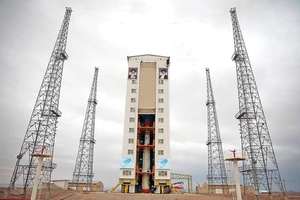
Iran on Sunday launched three domestically built satellites into low Earth orbit aboard a Russian Soyuz rocket, deepening space cooperation between Tehran and Moscow in a program Western governments say draws on technologies applicable to long-range missiles.

The satellites were placed into orbit from Russia’s Vostochny Cosmodrome in a multi-payload launch that Iranian officials described as the country’s seventh satellite mission carried out using Russian launch vehicles.

“These satellites were designed and manufactured by Iranian scientists, and both government bodies and the private sector have been involved,” Iran’s ambassador to Russia, Kazem Jalali, said in remarks published ahead of the launch.

“Two of the satellites belong to the government and one belongs to the private sector, and our knowledge-based companies and universities are active in this field.”

Jalali said Iran had continued to advance its space capabilities despite international pressure. “Despite all the threats and sanctions that exist, we have something to say in this field.”

Iran’s space agency chief, Hassan Salarieh, said the launch reflected what he described as Iran’s standing among a small group of countries with end-to-end space capabilities.

“Iran is among 10 or 11 countries in the world that simultaneously possess the capability to design and build satellites, launch vehicles and the infrastructure for launching, receiving data and processing images,” he said.

Salarieh said Iran aimed to expand both the number and precision of its satellites. “What is necessary for us is increasing the number of satellites, improving their accuracy and quality, and developing different classes of satellites,” he said.

  • Iran set to orbit three satellites in joint launch from Russia

    Iran set to orbit three satellites in joint launch from Russia

  • Iran plans first launch from Chabahar space center as three satellites near liftoff

    Iran plans first launch from Chabahar space center as three satellites near liftoff

Iranian media identified the satellites as Paya, also known as Tolou-3, Zafar-2, and a prototype satellite called Kowsar-1.5. The spacecraft were launched alongside a large cluster of mainly Russian satellites into a sun-synchronous low Earth orbit.

Paya (Tolou-3), built by the Iranian Space Agency, is Iran’s heaviest Earth-observation satellite to date, weighing about 150 kilograms.

Iranian officials say it is capable of producing black-and-white images with a resolution of about five meters and color images with a resolution of around 10 meters, and is intended for applications including agriculture, water management, environmental monitoring and disaster assessment.

Zafar-2, developed by Iran University of Science and Technology, is also an Earth-observation satellite designed for mapping, environmental monitoring and tracking natural hazards.

Kowsar-1.5 combines imaging and internet-of-things capabilities and is aimed primarily at agricultural and farm-monitoring uses, Iranian officials say.

Jalali described Iran’s space cooperation with Russia as extensive and said Moscow’s experience had played a key role.

“Russia is advanced in the space field, including satellites, launch vehicles and satellite launches, and we have been able to transfer part of the technology and work together,” he said.

He also described the Soyuz rocket as highly reliable. “Before Russia’s relations with the West deteriorated, many Western satellites were launched using Soyuz,” Jalali said.

The launch also carried Russian Earth-observation satellites, internet-of-things platforms and university-built spacecraft, according to launch data, as well as satellites from partner countries including Belarus, Kuwait and Montenegro.

Iran says its space program is civilian and focused on scientific and economic goals, but Western governments argue that satellite launch technology overlaps with systems used to develop intercontinental ballistic missiles.

Iran-linked hacking group claims access to phone of Netanyahu aide

Dec 28, 2025, 11:19 GMT+0

An Iranian-linked hacking group on Sunday said it had gained access to the mobile phone of Israeli Prime Minister Benjamin Netanyahu’s chief of staff, Tzachi Braverman, and threatened to publish material it said would link him to a political scandal.

The group, known as Handala, said in a post on the social media platform X that it had hacked an iPhone belonging to Braverman and would release documents later in the day related to what it called “Bibi Gate,” an apparent reference to allegations surrounding Netanyahu’s inner circle.

Israel’s Prime Minister’s Office said no breach had been identified. “No breach has been found. The issue is being investigated,” it said in a statement.

Handala has previously claimed responsibility for cyber intrusions targeting Israeli figures and institutions.

Earlier in December, the group said it had accessed data from the phone of former prime minister Naftali Bennett, though Bennett later said his device itself had not been hacked and that unauthorized access had instead been gained to his Telegram account.

On Sunday, the group released what it described as initial files allegedly taken from Braverman’s phone, including lists of phone numbers it said belonged to senior Israeli officials and individuals close to Netanyahu, as well as documents and videos that appeared to relate to official government matters.

In its posts, the group alleged it possessed encrypted communications, financial records and other sensitive information. It did not provide evidence supporting those claims. Iran International could not independently verify the authenticity of the material.

  • Iran-linked hacker group offers $30,000 bounty for Israel's military info

    Iran-linked hacker group offers $30,000 bounty for Israel's military info

The alleged threat comes amid heightened political tensions in Israel over investigations known collectively as the “Qatargate” affair, in which two advisers to Netanyahu are accused of having worked for Qatar while employed in the prime minister’s office. Netanyahu and his aides have denied wrongdoing.

One of the advisers, Eli Feldstein, has separately admitted leaking classified information to Germany’s Bild newspaper, according to Israeli media, in a case Israeli authorities say is under investigation. Feldstein has alleged that Braverman was aware of an internal military probe into the leak, an accusation Braverman has denied.

Braverman, who has been named as Israel’s next ambassador to Britain, has rejected any link to the scandals.

Cybersecurity researchers and Western officials have widely described Handala as being tied to Iran’s Ministry of Intelligence, though Tehran has not publicly acknowledged any connection.

The group is believed to be part of a broader cyber operation that researchers link to a unit known as “Banished Kitten,” which has been associated with attacks on Israeli infrastructure, public institutions and media organizations.

Handala has also been linked by researchers to cyber operations targeting Iran International, a London-based Persian-language broadcaster critical of the Iranian government.

Russia says Iran exercised restraint after Israeli strikes

Dec 28, 2025, 07:58 GMT+0

Russian Foreign Minister Sergei Lavrov said Iran has shown restraint and pursued dialogue despite what he described as direct Israeli and US attacks on Iranian nuclear-related facilities, warning that Middle East tensions remain highly volatile.

In an interview with Russia’s TASS news agency, Lavrov said 2025 had seen “unprecedented events,” including Israeli strikes on Iran, carried out together with Washington, that targeted facilities linked to Iran’s nuclear program despite those sites being under International Atomic Energy Agency safeguards.

“Iranians have been exercising maximum restraint and composure by responding to all the provocations and blackmail on behalf of the West by stating their commitment to dialogue and resolving the lingering differences by political means.”

Russia has firmly condemned the attacks, which Lavrov said violate international law and universally recognized moral norms. “They are completely at odds with international standards and universally recognized moral imperatives.”

Lavrov warned that Israeli officials’ statements about being prepared to use force against Iran again were a “matter of grave concern,” adding that tensions in the region risk remaining volatile.

He also criticized European countries, saying some were “adding fuel to the fire” by seeking to deepen divisions in the Middle East rather than encouraging regional cooperation.

Against that backdrop, Lavrov said Iran had responded to provocations and what he described as Western pressure and blackmail by reaffirming its commitment to dialogue and political solutions to resolve outstanding disputes.