• العربية
  • فارسی
BrandBrand
  • Iran Insight
  • Politics
  • Economy
  • Analysis
  • Special Report
  • Opinion
  • Podcast
  • Live TV
  • Iran Insight
  • Politics
  • Economy
  • Analysis
  • Special Report
  • Opinion
  • Podcast
  • Live TV
  • Theme
  • Language
    • العربية
    • فارسی
  • Iran Insight
  • Politics
  • Economy
  • Analysis
  • Special Report
  • Opinion
  • Podcast
  • Live TV
All rights reserved for Volant Media UK Limited
volant media logo

Iran plans first launch from Chabahar space center as three satellites near liftoff

Nov 18, 2025, 13:53 GMT+0Updated: 23:54 GMT+0
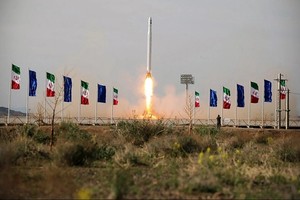
File photo of an Iranian satellite launch site

Iran said on Tuesday it will soon launch three Earth-observation satellites and carry out the first test launch from its new Chabahar space center, signaling a further expansion of its space program amid Western concerns over the dual-use nature of Iranian rocket technology.


Hassan Salarieh, head of the Iranian Space Agency, told a media event in Semnan that the Zafar-2, Paya and the second batch of Kosar imaging satellites are ready for launch. 

He said Iran’s space sector had advanced to the point where “satellites with one-meter and sub-five-meter imaging resolution are now under construction.”

Salarieh said the first experimental launch from the Chabahar Space Center – a coastal site under development in Iran’s southeast – will take place next year. 

“Chabahar is becoming one of the most important launch centers in West Asia,” he said, adding that its construction began in 2023 and that the site is designed to support heavier, liquid-fuel launch vehicles.

His comments come as Iran accelerates work on Chabahar’s second development phase. In April, the agency said the facility would eventually handle semi-heavy liquid-fuel rockets and serve as Iran’s main space gateway, with a geographic position suited for placing satellites into sun-synchronous and geostationary orbits.

Salarieh said Iran had also signed its first private-sector contracts for satellite constellations, including the narrow-band Kosar system intended for emergency data transfer, and highlighted recent milestones such as the launch of private-built satellites on a Russian rocket, the successful 2023 flight of the solid-fuel Sorayya launcher, and the deployment of the Nahid-2 communications satellite in 2025.

Iran has long said its space program is civilian and scientific, though Western governments argue that technologies used for orbital launches can advance long-range ballistic missile capabilities. 

President Masoud Pezeshkian has said Iran’s missile and space work supports national deterrence, while Defense Minister Aziz Nasirzadeh has said Tehran could eventually offer launch services to allied states.

Salarieh said domestic expertise had raised Iran’s launch capacity to “several hundred kilograms” and that efforts in propulsion, solid-fuel and liquid-fuel systems had advanced in parallel over the past three years. 

Iran’s space program has picked up pace since the 2009 launch of the Omid satellite, with universities and state-linked research centers producing a series of experimental spacecraft. 

In 2023 and 2024, Iran also carried out multiple sub-orbital tests, launched reconnaissance satellites via foreign rockets and unveiled new satellite buses and transfer stages, including the Saman-1 upper stage designed for higher-altitude orbits.

Salarieh said the government sees space as a strategic industry with economic, security and industrial implications. “We have strong human capital and significant infrastructure,” he said. “The development of space capability will continue rapidly.”

Most Viewed

Iran's oil output plunges below pre-war domestic needs
1
ANALYSIS

Iran's oil output plunges below pre-war domestic needs

2

Iran threatens Armenia as US-run Trump Route clears Yerevan’s parliament

3

Cash-strapped Iranians put multiple organs up for sale

4
INSIGHT

Iranian hardliners urge Iraq to push back against US pressure

5
ONE-ON-ONE

Americans ‘a bit naive’ about influence campaigns by Iran, Russia, China

Banner

Spotlight

  • Locks for cash: inside Iran's booming hair trade

    Locks for cash: inside Iran's booming hair trade

  • Seven years after ‘Bloody November,’ Iran rations gasoline it dares not reprice

    Seven years after ‘Bloody November,’ Iran rations gasoline it dares not reprice

  • Iran's oil output plunges below pre-war domestic needs
    ANALYSIS

    Iran's oil output plunges below pre-war domestic needs

  • Iranian hardliners urge Iraq to push back against US pressure
    INSIGHT

    Iranian hardliners urge Iraq to push back against US pressure

  • Cash-strapped Iranians put multiple organs up for sale

    Cash-strapped Iranians put multiple organs up for sale

  • Iran's intelligence merger debate signals possible security shake-up
    INSIGHT

    Iran's intelligence merger debate signals possible security shake-up

Banner
Banner
Banner
Banner
Banner
Banner
  • Iran plans maiden launch of its first satellite constellation by March

    Iran plans maiden launch of its first satellite constellation by March

  • Iran says upgraded communication satellite ready for December launch

    Iran says upgraded communication satellite ready for December launch

  • Iran developing Chabahar space center for heavier liquid-fuel rockets

    Iran developing Chabahar space center for heavier liquid-fuel rockets

  • US restores India waiver for operations at Iran’s Chabahar Port

    US restores India waiver for operations at Iran’s Chabahar Port