• العربية
  • فارسی
Brand
  • Iran Insight
  • Politics
  • Economy
  • Analysis
  • Special Report
  • Opinion
  • Podcast
  • Iran Insight
  • Politics
  • Economy
  • Analysis
  • Special Report
  • Opinion
  • Podcast
  • Theme
  • Language
    • العربية
    • فارسی
  • Iran Insight
  • Politics
  • Economy
  • Analysis
  • Special Report
  • Opinion
  • Podcast
All rights reserved for Volant Media UK Limited
volant media logo
PODCAST

Was the Iran war leverage or a lifeline for Tehran?

Negar Mojtahedi
Negar Mojtahedi

Iran International

May 30, 2026, 09:42 GMT+1
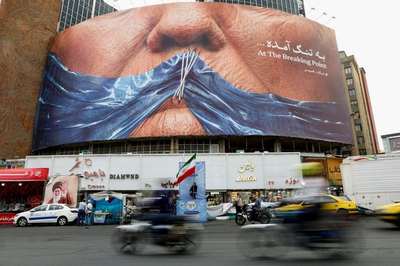
An Iranian woman walks next to an anti-Israeli mural on a street in Tehran, Iran, May 30, 2026.

The Iran war left the Islamic Republic weaker than it had been in years. The question now is whether Washington will turn that weakness into leverage – or give Tehran room to recover through a new deal.

That debate is becoming increasingly urgent as Washington and Tehran move closer to a potential agreement that could extend the current ceasefire and launch a new phase of negotiations over Iran’s nuclear program.

President Donald Trump has suggested a deal may be within reach, while officials on both sides have signaled progress despite major unresolved disputes.

For supporters of the military campaign, the logic is straightforward: Iran entered the talks weaker than it has been in years. For critics, the concern is that diplomacy could give Tehran breathing room just as years of economic pressure, domestic unrest and military setbacks had left it vulnerable.

Speaking to Eye for Iran, former US Treasury official Miad Maleki and national security expert Thomas Juneau offered different answers to the same question: what exactly did the war achieve?

A Regime under pressure

While the two experts differ on what should happen next, both agree that the Islamic Republic emerged from the conflict significantly weakened.

"They've never been so weak. They've never been so vulnerable that they are today, militarily, politically, economically," Maleki said.

The Islamic Republic, he argued, faces mounting economic pressure at home while struggling to maintain the image of strength it has projected for decades. Tehran’s military infrastructure has suffered significant damage, senior figures have been killed, and the economy was already under strain before the conflict began.

Juneau reached a similar conclusion, though from a different angle.

"The regime was clobbered," he said.

Beyond the military and economic damage, Juneau argued that one of Tehran’s core strategic assumptions collapsed during the conflict.

For decades, Iran invested heavily in Hezbollah, Hamas and other regional allies as part of what officials often described as a forward defense strategy. The idea was that any direct attack on Iran would trigger retaliation across the region, deterring adversaries from striking the country itself.

"That failed," Juneau said.

Maleki argues that the regime's losses go beyond military hardware.

The conflict exposed weaknesses in Iran’s air defenses, damaged key infrastructure and further strained a system already struggling with economic collapse, inflation and public discontent. In his view, Tehran entered negotiations not from a position of strength, but because it had few alternatives.

Victory, leverage or lifeline?

Where the two experts diverge is over what happens next.

For Maleki, the central question is why negotiations are taking place now, at a moment when many observers believe the Islamic Republic is under greater pressure than at any point in recent years.

He pointed to growing frustration among some Iranians who believe the conflict exposed vulnerabilities that could have accelerated political change.

"There's some level of disappointment that the fact that the US is negotiating with this regime is bad for the future of a free Iran," he said.

The concern is not that Iran emerged stronger from the war. Rather, it is that Tehran survived a period of extraordinary pressure and may now receive economic or diplomatic relief before those pressures fully take effect.

Juneau sees a different risk.

While acknowledging that the regime has been weakened, he argues that ordinary Iranians may ultimately bear the greatest cost.

"The Iranian people have been thrown under the bus," he said.

The economy, already battered by sanctions, corruption and years of mismanagement, now faces the additional burden of reconstruction. At the same time, Juneau warns that a weakened regime does not necessarily become a more moderate one.

In fact, he believes future protests could face even harsher repression than previous waves of unrest.

"This is a regime now that will have even less tolerance for any kind of popular protests in the future," he said.

The disagreement reflects a broader uncertainty surrounding the talks themselves.

If the objective of the war was to weaken the Islamic Republic’s military capabilities, there is broad agreement that it succeeded. Iran’s regional posture has been damaged, key infrastructure has been hit and some of its most senior figures are gone.

But if the objective was to fundamentally alter Tehran’s behavior, improve conditions for ordinary Iranians or create a pathway toward meaningful political change, the answer remains far less clear.

Maleki believes the conflict became unavoidable as Iran expanded its missile, drone and regional capabilities.

"The conflict was unavoidable. It was coming sooner or later," he said.

Juneau is more cautious.

Asked whether the war was ultimately worth it, he declined to offer a simple yes-or-no answer.

"The negative implications of the war outweigh the positive implications," he said.

That may ultimately be the central dilemma facing policymakers in Washington and the region.

The war weakened the Islamic Republic. Few dispute that.

The unanswered question is whether the diplomacy now taking shape will build on that weakness or alleviate it.

Most Viewed

Iran factions clash over interim US deal as Trump weighs final call
1
INSIGHT

Iran factions clash over interim US deal as Trump weighs final call

2
EXCLUSIVE

Qatar rejects Iran’s demand for unrestricted release of $12 billion in funds

3

Greek man charged in Britain over alleged targeting of Iran International journalist

4
SPECIAL REPORT

Witnesses describe gunfire, blocked exits and deadly market fire in Rasht

5
INSIGHT

How four Khamenei family names map the Islamic Republic’s inner circle

Banner
Banner

Spotlight

  • Was the Iran war leverage or a lifeline for Tehran?
    PODCAST

    Was the Iran war leverage or a lifeline for Tehran?

  • Hardline rallies turn Iran’s streets into pressure front against US talks

    Hardline rallies turn Iran’s streets into pressure front against US talks

  • Names of some Iran protest victims vanish from Tehran cemetery database

    Names of some Iran protest victims vanish from Tehran cemetery database

  • How four Khamenei family names map the Islamic Republic’s inner circle
    INSIGHT

    How four Khamenei family names map the Islamic Republic’s inner circle

  • Witnesses describe gunfire, blocked exits and deadly market fire in Rasht
    SPECIAL REPORT

    Witnesses describe gunfire, blocked exits and deadly market fire in Rasht

  • Iran’s lion-and-sun flag at center of FIFA row before 2026 World Cup

    Iran’s lion-and-sun flag at center of FIFA row before 2026 World Cup

•
•
•

More Stories

Hardline rallies turn Iran’s streets into pressure front against US talks

May 30, 2026, 07:25 GMT+1
•
Maryam Sinaiee
Hardline rallies turn Iran’s streets into pressure front against US talks
100%
Pro-government "janfada" volunteers' motorcycle parade in Tehran on May 22.

What began as street mourning for Ali Khamenei has become a nightly stage for Iran’s hardliners to attack negotiations with Washington, promote wartime defiance and pressure officials to follow the Supreme Leader’s red lines.

Many of the nightly gatherings – known in Iran’s political and media sphere simply as “the street” – began as collective mourning ceremonies for Supreme Leader Ali Khamenei, who was killed, in squares and streets across Iranian cities before gradually evolving into highly organized political events.

Speakers, most of them from the hardline camp, describe Iran as the victor of the war and oppose negotiations with the United States in many of these events.

The rallies were initially large, but as their rhetoric became more radical attendance gradually declined. Witnesses say most now attract between 100 and 200 people at a time.

Slogans and placards at the anti-negotiation rallies focus on “fully observing the leader’s conditions” and avenging Ali Khamenei and others killed in US and Israeli attacks.

Speakers have branded not only moderates such as former Foreign Minister Mohammad-Javad Zarif but also some conservatives, including Mohammad-Bagher Ghalibaf, head of the negotiating team and an ally of President Masoud Pezeshkian, as “advocates of surrender.”

Social media users say those who favor negotiations and an end to the war do not feel safe attending the rallies or expressing their views there.

The hardline outlet Raja News recently wrote: “The experience of the negotiating team’s mistakes in the Islamabad talks, and the (current) Supreme Leader’s wise decision to halt that flawed process, proved that not ‘unconditional support for negotiators’ but ‘standing firm on the Supreme Leader’s conditions and red lines’ is the people’s primary duty in the arena.”

Amir-Hossein Sabeti, a hardline member of parliament who frequently attends and speaks at the rallies, dismissed negotiations with the United States as futile in a Telegram post on Wednesday.

“The continuation of public gatherings in the streets and demands on officials to preserve the Supreme Leader’s red lines will certainly be influential and will affect officials’ decisions,” he wrote.

He added that lawmakers appear in squares and streets to voice “the people’s demands and the Supreme Leader’s red lines so that no one can easily act against them.”

Journalist Saeed Maleki, reacting to the burning of an effigy of Zarif at one rally in the city of Gorgan earlier this week, described the act as an attempt to break national unity and deepen social divisions.

“How long are we supposed to tolerate this small minority in the streets? If Zarif has committed treason, deal with him. And if he hasn’t, confront this minority before another sedition erupts,” he wrote.

Political analyst Ruhollah Rahimpour told Iran International television that empty streets during a crisis create “a sense of fear and anticipation of disaster.” For that reason, he said, the Islamic Republic attempts to fill public spaces with ceremonies that project a narrative of power.

State media promotion

Television channels run by Iran’s state broadcaster, which is largely controlled by hardliners, have extensively covered the rallies and promoted attendance.

Even so, Mohammad-Hossein Kashkouli, director of Ofogh TV, recently said during a speech at one gathering that the broadcaster was under pressure not to air demonstrators’ slogans and banners.

“Despite the pressure, as long as you remain in the streets, we will stick your placards before their eyes and we will not silence your voices, because the Supreme Leader places hope in your voice,” he said. He added that people would remain in the streets until the Leader himself asked them to leave.

Emphasis on diversity among participants

State and pro-government media have repeatedly emphasized the diversity of participants at the rallies. If a participant appears with looser hijab or an appearance outside the conventional image of government supporters, photos and videos of them are widely circulated.

Images from the gatherings show women and girls without hijab, or wearing forms of hijab that would not normally be accepted in government offices, chanting slogans, waving Islamic Republic flags and even participating in motorcycle parades — despite the government still refusing to issue motorcycle licenses to women.

Many social media users argue that this tolerance reflects not a genuine policy shift but hypocrisy.

Carnival atmosphere

Especially after the ceasefire, many of the gatherings have taken on a carnival-like atmosphere, with families attending alongside children.

Booths and tents set up around streets and squares distribute balloons, ice cream and snacks, reportedly funded voluntarily by participants. Missile mock-ups displayed to attract children are sometimes painted pink. Children’s war-themed drawing activities are also organized.

Since the ceasefire, wedding ceremonies have also become common at the rallies. Clerics perform marriage ceremonies before crowds of spectators. One event in Tehran’s Imam Hossein Square, where 110 couples were married, was broadcast on television.

Weapons training

Recently, some rallies have also included firearms training for participants, including children.

One citizen, in a message sent to Iran International, said: “In Kashan, they’ve set up tents at every intersection and square and are teaching women and children how to shoot and use guns. They are exploiting children who should be kept away from these things.”

The rallies also include registration drives for civilians volunteering to defend the country. Volunteers, both male and female, and of all age groups, are given the title “Janfada,” meaning someone willing to sacrifice their life. State media say there are more than 30 million such volunteers.

Complaints from residents

Many social media users complain about the noise created by participants, who often block streets late into the night with cars and motorcycles while playing religious mourning songs on loudspeakers.

One user on X wrote: “It’s becoming really hard for me to tolerate these flag-waving crowds in the streets. From unnecessary traffic and noise pollution until midnight to the anger caused by discrimination — discrimination in the right to occupy the streets and express opinions, which they enjoy, but not us. For the authorities, we are second-class citizens.”

Qatar rejects Iran’s demand for unrestricted release of $12 billion in funds

May 30, 2026, 00:46 GMT+1
Qatar rejects Iran’s demand for unrestricted release of $12 billion in funds
100%
Parliament Mohammad Bagher Ghalibaf (right) and Foreign Minister Abbas Araghchi (left) depart for Doha on Tuesday, 5/25/2026

The recent high-stakes visit of a senior Iranian delegation to Doha, led by Parliament Speaker Mohammad Bagher Ghalibaf, has ended in a major diplomatic setback for Tehran, an informed source with knowledge of the negotiations told Iran International.

Despite Tehran’s firm demands for the immediate and unconditional release of $12 billion in cash upon the signing of an initial Memorandum of Understanding (MoU) with the United States, Qatari officials rejected the request, agreeing to release only half of the amount under strict limitations, the source said.

According to a source close to a Qatari official involved in the discussions, Doha refused to transfer the funds directly or in cash to Iran. Instead, the money will only be made available as credit for Tehran to purchase essential goods and products directly from Qatar.

The restriction comes amid strong US opposition to granting Iran direct, unrestricted access to liquid financial assets.

Washington raised concerns that direct cash injections would provide the Iranian government with vital economic breathing room, allowing it to pay delayed public salaries and procure military equipment or other goods from foreign countries during a time of intense regional strain.

Iran International previously reported that Tehran had set the unrestricted release of the $12 billion held in Qatar as a strict, non-negotiable precondition before it would advance any preliminary diplomatic understanding or sign the proposed framework agreement.

While Speaker Ghalibaf explicitly requested liquid financial assistance to ease Iran's severe domestic economic pressures, Qatar’s counteroffer effectively bars Iran from using the capital at its own discretion in a blow to Tehran’s strategy in US talks.

Rather than gaining direct access to the cash, Tehran is now forced to spend the capped credit line solely within the Qatari market for essential commodities.

To prevent the dispute from derailing the broader, highly sensitive framework talks with the United States, which aim to secure a regional ceasefire and reopen the strategic Strait of Hormuz, all participating parties have reportedly agreed to keep the details of this financial disagreement strictly confidential.

Iran factions clash over interim US deal as Trump weighs final call

May 29, 2026, 16:26 GMT+1
•
Maryam Sinaiee
Iran factions clash over interim US deal as Trump weighs final call
100%
People ride past an anti-US billboard depicting Donald Trump and the Strait of Hormuz, in Tehran. May 25, 2026

The prospect of an interim agreement between Tehran and Washington has exposed deep divisions in Iran, with some officials presenting it as diplomatic progress while hardliners warn it could cross the Islamic Republic’s red lines.

US President Donald Trump said on Friday he was heading to the White House's Situation Room to make a final decision on an emerging deal with Iran, after saying parts of the arrangement had been agreed.

The remarks came one day after the US military struck an Iranian drone facility near the Strait of Hormuz. Iran’s Revolutionary Guards reportedly responded by targeting an American base in the region, believed to be located in Kuwait.

In Tehran, lawmakers aligned with Parliament Speaker Mohammad Bagher Ghalibaf — who is also leading Iran’s negotiating team — reacted positively to reports of progress, while hardline factions sharply criticized the negotiations.

Fada-Hossein Maleki, a member of parliament’s National Security Commission, spoke of “significant quantitative and qualitative progress” in the talks and claimed that “most proposals of the Islamic Republic have been accepted.”

According to Maleki, Iran’s main concern is “Trump’s unpredictability.” He also said Ghalibaf’s recent trip to Qatar focused on frozen Iranian assets and had produced positive results for Tehran.

By contrast, National Security Committee spokesman Ebrahim Rezaei criticized concessions in the negotiations during a televised interview. “Why should we even commit to the United States not to build a nuclear weapon?” he said.

Another lawmaker, Ruhollah Izadkhah, accused Ghalibaf of sidelining parliament. “Apparently, they intend to keep parliament shut so they can reopen the strait,” he said, adding: “The people will not allow it.”

Abolfazl Aboutorabi, another lawmaker, claimed that Supreme Leader Mojtaba Khamenei’s “red lines” regarding the Strait of Hormuz, the nuclear issue and compensation demands had been violated in the talks.

He accused Washington of trying to deceive Iran by offering “a lollipop” — referring to a proposed $300 billion reconstruction fund without binding guarantees — in exchange for reopening the Strait of Hormuz. He also predicted that the United States would attack Iran again after the World Cup and US congressional elections.

Parisa Nasr, a market specialist, accused the negotiators of “surrenderism”. Writing online, she said: “First they turn Iran’s strategic assets into bargaining chips; then they effectively transform these into burned cards and worthless leverage; and finally, by arguing that ‘we have no winning cards left,’ they drag the country from one pit into another colonial surrender agreement.”

Doubts about a lasting agreement

Some Iranian social media users argue that even a signed agreement would not prevent future war. Others fear that if a temporary arrangement evolves into a durable settlement, hopes for political change inside Iran will fade significantly. Many in this camp believe Trump has abandoned the Iranian people and left them alone.

Saeed Mohammadi-Jazi, a trader and financial analyst, wrote on X that within a few months either a comprehensive agreement would be reached — ensuring the survival of the current system — or the region would face a “big and final” war that would determine the fate of the Islamic Republic.

Another user wrote: “A real nuclear agreement seems unlikely. Both sides will use this temporary calm to prepare for the next round of conflict — a conflict that may resume within months.”

Some ordinary users have also criticized Washington for negotiating with the Islamic Republic.

One user wrote on X: “A temporary Iran-US agreement — if it is signed — will not end Iran’s crisis. A regime emerging from this war will be weaker externally but stronger internally, and financially integrated into the global economy without the slightest accountability for what it has done.”

“The people who came into the streets in January and were killed were used as bargaining chips in this equation and then discarded once the deal was completed,” the user added.

A nation suspended between war and peace

Many Iranians are following developments minute by minute with growing anxiety. Ordinary citizens say the prolonged atmosphere of uncertainty has become more exhausting than anything else.

Sima, a Tehran resident, said the feeling of living in a “neither war nor peace” situation has affected every aspect of her life and the lives of those around her.

“So many times we thought a deal was close, and then within hours everything suddenly changed, and the threat of war escalated again — like last night’s clashes in the Persian Gulf and Bandar Abbas,” she said. “I truly felt again as if I could hear planes and missiles above my head. Fortunately, so far, neither side has said these clashes mean the ceasefire has collapsed.”

On Iranian news websites, reports on gold and currency prices continue to dominate headlines. Amid soaring inflation and political instability that have weakened the national currency, many Iranians have turned to buying foreign currency and gold. Yet a temporary agreement could sharply reduce the value of those investments if markets suddenly fall.

Morteza, a Tehran-based engineer, said he converted all of his savings intended for buying a home into US dollars several months ago. Although he believes an agreement — especially one leading to sanctions relief — could improve the economy, he says the uncertainty keeps him awake at night.

“When I was a child, after the end of the Iran-Iraq war, many people — including my father — suffered huge losses when Iran accepted the ceasefire resolution,” he said.

Greek man charged in Britain over alleged targeting of Iran International journalist

May 29, 2026, 13:27 GMT+1
Greek man charged in Britain over alleged targeting of Iran International journalist
100%

A Greek national has been charged under Britain’s National Security Act with assisting a foreign intelligence service, believed to be Iran’s, over the targeting of a journalist at London-based Iran International, British police said.

Counter Terrorism Policing London said Ioannis Aidinidis, 46, who lives in Munich, Germany, was charged under section 3(2) of the National Security Act 2023.

Aidinidis was due to appear at Westminster Magistrates’ Court later Friday.

Police said a 46-year-old man was arrested in West Sussex on May 16 by detectives from Counter Terrorism Policing London, with support from officers from Counter Terrorism Policing South East.

He was detained under section 27 of the National Security Act 2023 and taken to a London police station. Police said warrants for further detention were obtained from Westminster Magistrates’ Court, allowing him to remain in custody until May 30, before charges were authorized after liaison with the Crown Prosecution Service.

The Metropolitan Police said officers did not believe there was any wider threat to the public in relation to the case.

“We know this may cause concern for many people here in the UK, and particularly those working in Persian-language media,” Commander Helen Flanagan, head of Counter Terrorism Policing London, said.

She said police were continuing to work with organizations and individuals to provide safety and security advice, including the person and organization linked to the investigation.

Police said Counter Terrorism Policing continues to work with Persian-language media organizations and others in Britain over threats projected into the UK from Iran.

The case comes amid continued security concerns around Iran International and its staff in Britain.

In a separate case, three people were charged in April over an alleged attempted arson attack on premises linked to the broadcaster in northwest London. Police said that incident caused no damage or injuries.

Two Romanian men are also on trial in London over the 2024 stabbing of Iran International presenter Pouria Zeraati near his home in Wimbledon. British prosecutors have told the court the attack was ordered by a third party acting on behalf of the Iranian state. Tehran has denied involvement.

How four Khamenei family names map the Islamic Republic’s inner circle

May 28, 2026, 13:53 GMT+1
•
Mansoureh Hosseini Yeganeh
How four Khamenei family names map the Islamic Republic’s inner circle
100%
The symbolic chair and a picture of the late Supreme Leader of Iran, Ayatollah Ali Khamenei, are displayed near his office in Tehran, Iran, May 6, 2026.

Names on a memorial poster for four relatives and in-laws of Ali Khamenei offer a rare snapshot of how family ties link Iran’s ruling household to parliament, elite universities and the Supreme Leader’s office.

The poster, announcing a memorial ceremony at the Abdol-Azim shrine in Rey, south of Tehran, lists Zahra Sadat Haddad-Adel, Boshra Hosseini Khamenei, Mesbah al-Hoda Bagheri and Zahra Mohammadi Golpayegani as among the dead.

Each name connects the Khamenei household to one of the families or institutions that have shaped the Islamic Republic’s political, cultural and administrative elite for decades: the parliament, the Supreme Leader’s office, the Supreme Council of the Cultural Revolution, Imam Sadegh University and the network of institutions around the leader’s office.

The ceremony itself is religious and familial. But the names on the poster point to something larger: a closed circle of family relationships through which access, influence and institutional power have long moved inside the Islamic Republic.

The poster of the ceremony
100%
The poster of the ceremony

The Haddad-Adel connection

One of the most recognizable names is Zahra Sadat Haddad-Adel, wife of Mojtaba Khamenei and daughter of Gholam-Ali Haddad-Adel.

Haddad-Adel served as speaker of Iran’s seventh parliament from 2004 to 2008 and is known as the first non-clerical speaker of the Islamic Republic’s parliament. He also served as a lawmaker in several parliamentary terms and remains head of the Academy of Persian Language and Literature.

His influence extends beyond parliament. He is a member of the Supreme Council of the Cultural Revolution, an adviser to the slain Supreme Leader and founder of the private Farhang school, which critics have described as one of the symbols of special educational access for families close to the ruling system.

For critics, Haddad-Adel’s presence across political, cultural and educational institutions, combined with his family tie to the Khamenei household, reflects the concentration of power within a limited circle of families close to the state.

His name also appears on the US Treasury Department’s sanctions list.

Imam Sadegh University and the Bagheri Kani family

The name Mesbah al-Hoda Bagheri draws attention to another powerful network: the Bagheri Kani family and the institutions around Imam Sadegh University.

Mesbah al-Hoda Bagheri Kani was the husband of Hoda Khamenei, Ali Khamenei’s daughter, and the son of Mohammad-Bagher Bagheri Kani, an influential cleric who served in the Assembly of Experts and headed Imam Sadegh University.

The same family also includes Ali Bagheri Kani, a senior diplomat who has held key posts in Iran’s foreign policy establishment, including political deputy foreign minister, acting foreign minister, senior nuclear negotiator and senior positions in the Supreme National Security Council.

  • Iran’s invisible 'First Lady': who was Khamenei’s wife?

    Iran’s invisible 'First Lady': who was Khamenei’s wife?

Their uncle, Mohammad-Reza Mahdavi Kani, was one of the Islamic Republic’s most influential clerics. He served as head of the Assembly of Experts, secretary-general of the Combatant Clergy Association, briefly as prime minister in 1981, and for decades as head of Imam Sadegh University.

Imam Sadegh University expanded after the 1979 revolution and became one of the main training grounds for state managers. Many officials in Iran’s political, security, media and diplomatic institutions are graduates of Imam Sadegh University.

  • Khameneism after Khamenei: why Mojtaba represents continuity, not change

    Khameneism after Khamenei: why Mojtaba represents continuity, not change

Through these links, the Bagheri Kani family connects the Khamenei household to one of the Islamic Republic’s most important pipelines for training and placing loyal officials in diplomacy, security, politics and state administration.

The Supreme Leader’s office

Another name on the poster, Zahra Mohammadi Golpayegani, points directly to the Supreme Leader’s office.

The 14-month-old child was connected to two of the most influential families in the Islamic Republic. On one side, she was the granddaughter of Mohammad Mohammadi Golpayegani, the longtime head of Ali Khamenei’s office. On the other, she was a granddaughter of Ali Khamenei.

Mohammad Mohammadi Golpayegani headed the Supreme Leader’s office since 1989, the year Khamenei became leader. He is one of the most influential but least publicly visible figures in the Islamic Republic’s power structure.

  • From shadow to power: who is Mojtaba Khamenei?

    From shadow to power: who is Mojtaba Khamenei?

Because of his position, Golpayegani has played a central role in the messages, decisions and administrative machinery of the leader’s office. The US Treasury sanctioned him in 2019 over his role acting on behalf of that office.

His family link to Khamenei, as reflected in the name of Zahra Mohammadi Golpayegani, shows how the leader’s office is not only an institution but also part of a wider web of personal and familial ties.

Boshra Khamenei

The poster also lists Boshra Hosseini Khamenei, Ali Khamenei’s eldest daughter.

Unlike some other members of the Khamenei family, Boshra Khamenei has rarely appeared in public, and little information has been published about her personal life or activities.

  • Why Khamenei’s funeral keeps changing

    Why Khamenei’s funeral keeps changing

In recent weeks, state media have referred to her as “martyr Boshra Khamenei.” Some reports have mentioned her educational background and interest in literature.

Tabnak, in a report framed as a student’s note for “martyr Boshra Khamenei,” referred to her as “Ms. Hosseini” and described her connection to education and literature.

Her presence on the poster alongside the other names brings the focus back to the Khamenei family itself, a household that has remained mostly shielded from public life while remaining central to the structure of power.

A compressed image of power

The memorial poster is striking because it brings together four names that would otherwise appear in different corners of the Islamic Republic’s elite: the Haddad-Adel family, the Bagheri Kani family, the Mohammadi Golpayegani family and the Khamenei household.

  • A wartime succession in Iran: why the IRGC backed Mojtaba Khamenei

    A wartime succession in Iran: why the IRGC backed Mojtaba Khamenei

Together, they form a compressed image of how power has been organized around the leader’s family and its closest allies.

For critics of the Islamic Republic, the connections point to a familiar pattern: influence concentrated among a small circle of trusted families whose proximity to the leader’s office can open paths across the state.

The memorial in Rey is therefore more than a family or religious ceremony. It offers a glimpse of how, at the top of the Islamic Republic, family names often double as signs of political access, institutional reach and long-standing power.