Russia says Iran exercised restraint after Israeli strikes
Russian Foreign Minister Sergei Lavrov
Russian Foreign Minister Sergei Lavrov said Iran has shown restraint and pursued dialogue despite what he described as direct Israeli and US attacks on Iranian nuclear-related facilities, warning that Middle East tensions remain highly volatile.
In an interview with Russia’s TASS news agency, Lavrov said 2025 had seen “unprecedented events,” including Israeli strikes on Iran, carried out together with Washington, that targeted facilities linked to Iran’s nuclear program despite those sites being under International Atomic Energy Agency safeguards.
“Iranians have been exercising maximum restraint and composure by responding to all the provocations and blackmail on behalf of the West by stating their commitment to dialogue and resolving the lingering differences by political means.”
Russia has firmly condemned the attacks, which Lavrov said violate international law and universally recognized moral norms. “They are completely at odds with international standards and universally recognized moral imperatives.”
Lavrov warned that Israeli officials’ statements about being prepared to use force against Iran again were a “matter of grave concern,” adding that tensions in the region risk remaining volatile.
He also criticized European countries, saying some were “adding fuel to the fire” by seeking to deepen divisions in the Middle East rather than encouraging regional cooperation.
Against that backdrop, Lavrov said Iran had responded to provocations and what he described as Western pressure and blackmail by reaffirming its commitment to dialogue and political solutions to resolve outstanding disputes.
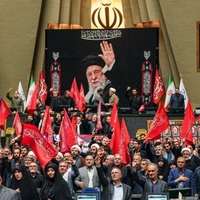
Photos of a torn US flag and President Donald Trump during a state-organized anti-US rally in Tehran.
Iraq is seeking to broker a face-to-face meeting between Iranian and US officials in Baghdad, Iraqi Prime Minister Mohammed Shia al-Sudani said on Saturday, more than six months after Israeli and US attacks on Iran put bilateral talks on hold.
"Iraq is trying to arrange a bilateral meeting between Tehran and Washington in Baghdad, but the issue needs some reassurances," al-Sudani told Lebanese TV channel Al-Mayadeen.
The Iraqi prime minister said there has been dialogue in more than one place on the issue, but "commitments and the language of threats stand as obstacles."
"Part of my conversation with (US envoy) Tom Barrack when he visited Baghdad, was to bring the views between Tehran and America closer, and he asked me how to deal with the situation, and I told him that it should be treated with respect."
The United States held five rounds of negotiations with Iran over its disputed nuclear program earlier this year, for which Trump set a 60-day deadline.
When no agreement was reached by the 61st day on June 13, Israel launched a surprise military offensive, followed by US strikes on June 22 targeting key nuclear facilities in Isfahan, Natanz, and Fordow.
"Iran needs trust, because it is not acceptable to reach an agreement and then, hours later, see an attack take place," Al-Sudani said in his meeting with Tom Barrack, according to his interview with Al-Mayadeen.
Iran’s Foreign Minister Abbas Araghchi said in November that US President Donald Trump’s letter to Supreme Leader Ali Khamenei, sent shortly before the war, explicitly presented two options: continued war and bloodshed, or direct negotiations aimed at completely eliminating Iran’s nuclear enrichment and ballistic missile programs.
Tehran has rejected US demands, saying that uranium enrichment is its inalienable right and that no other country has any say over its missile program.
Earlier this week, the United States and Iran traded sharply worded accusations at the United Nations Security Council, with Washington offering conditional talks while Tehran blamed the standoff on US withdrawal from the 2015 nuclear deal and strikes on Iranian nuclear sites.
Speaking during the session, Morgan Ortagus, counselor of the US Mission to the United Nations, said Washington remained open to formal negotiations but only if Iran agreed to direct talks and abandoned uranium enrichment.
“In both administrations, President Trump extended the hand of diplomacy to Iran,” she said. “But instead of taking that hand of diplomacy, you continue to put your hand in the fire. Step away from the fire, sir, and take President Trump’s hand of diplomacy.”
Iran rejected that framing. “We appreciate any fair and meaningful negotiation but insisting on zero enrichment policy is contrary to our rights as a member of the NPT," Tehran's UN envoy Amir Saeed Iravani said.
"Iran will not bow down to any pressure and intimidation.”
A man with body paint in the colors of the national flag of Somaliland participates in a street parade to celebrate the 24th self-declared independence day for the breakaway Somaliland nation from Somalia in capital Hargeysa, May 18, 2015.
Twenty-one Arab and Islamic countries including Iran issued a joint statement on Saturday denouncing Israel's move to recognize the self-declared Republic of Somaliland, describing it as a threat to regional peace, according to Iran's foreign ministry.
Israel on Friday became the first country to formally recognize Somaliland as an independent and sovereign state. The decision drew the immediate condemnation of the Organization of Islamic Cooperation (OIC) which rejected it as "a violation of the sovereignty of the Federal Republic of Somalia, its national unity, and its territorial integrity."
The OIC's statement on Friday was followed by a similar joint statement by 21 mostly Middle Eastern or African countries which rejected the recognition “given the serious repercussions of such unprecedented measure on peace and security in the Horn of Africa, the Red Sea and its serious effects on international peace and security as a whole.”
The joint statement also fully rejected "any potential link between such measure and any attempts to forcibly expel the Palestinian people out of their land.”
Syria also rejected Israel’s decision in a separate statement.
On Saturday, Iran's foreign ministry spokesman condemned what it described as Israel’s blatant violation of Somalia’s sovereignty and territorial integrity.
"Israel’s actions amount to a gross breach of Somalia’s sovereignty and territorial integrity through efforts to advance a plot to fragment the Islamic country," Esmail Baqaei said.
"They constitute a clear violation of the fundamental principles of the United Nations Charter and international law."
Somaliland is a largely arid region along the Gulf of Aden, opposite Yemen and bordering Djibouti, a small country that hosts military bases for the United States, China, France and several other nations.
After signing a joint declaration of mutual recognition with Israel's prime minister, Somaliland's president Abdirahman Mohamed Abdullahi said his country would join the so-called Abraham Accords, calling it a step toward regional and global peace.
The 2020 accords were brokered by US President Donald Trump's first administration and included Israel formalizing diplomatic relations with the United Arab Emirates and Bahrain, with other countries joining later.
Iran’s president said on Saturday the country is facing a full-scale confrontation with the United States, Israel, and Europe, describing the pressure campaign against Tehran as more complex and damaging than the Iran–Iraq war.
“In my view, we are in an all-out war with the United States, Israel, and Europe; they do not want our country to stand on its own feet,” Masoud Pezeshkian said in an interview with the Supreme Leader’s official website.
He said the current war is worse than the Iraq war in the 1980s. “If one understands it properly, this war is far more complex and more difficult than that war.”
“In the war with Iraq, the situation was clear; they fired missiles, and it was clear where we would strike back. But here, they are now besieging us in every respect, putting us under pressure and in tight corners, creating problems—economically, culturally, politically, and in terms of security.”
Pezeshkian made the comments on the eve of Israeli Prime Minister Benjamin Netanyahu's trip to the United States, where he plans to brief President Donald Trump on options for potential future strikes against Iran, amid concerns that Tehran is rebuilding ballistic missile production facilities and repairing air defenses damaged during the June conflict, according to NBC News.
Israel has told the United States that the recent Iranian missile drills may conceal preparations for a potential strike, Axios reported last Sunday, one day after Iran International reported unusual Iranian air activity spotted by Western intelligence agencies.
Israeli Chief of Staff Eyal Zamir raised the issue directly with Brad Cooper, head of US Central Command, warning that recent missile movements could serve as a cover for a surprise operation against the Jewish state.
Pezeshkian said on Saturday that Iran is "stronger than during the 12‑day war" with Israel in terms of equipment and manpower. "If the enemy chooses confrontation, they will naturally face a more decisive response."
In June, Israel carried out airstrikes and covert operations against Iranian military and nuclear sites, killing more than 1,000 people including senior officials and nuclear scientists.
Iran retaliated by launching hundreds of missiles and drones at Israel, killing at least 33 people, among them an off-duty soldier.
The United States helped Israel intercept Iranian attacks and later joined the Israeli campaign, bombing three Iranian nuclear facilities on June 22.
Pictures of slain IRGC commanders and Islamic Republic’s founder Rouhollah Khomeini at a state-organized anti-US rally in Tehran
Iran’s theocracy exits 2025 battered yet still standing, with analysts telling Eye for Iran that Tehran is interpreting survival after a punishing war with Israel, regional losses and domestic strain as grounds for taking greater risks in 2026.
At the start of 2024, Iran appeared to be riding high — expanding regional reach, edging closer to nuclear threshold status and projecting confidence at home and abroad. That trajectory began to reverse in late 2024 and accelerated into 2025.
The past year brought direct confrontation with Israel and later the United States, the weakening of Tehran’s regional proxy network and mounting domestic pressures. What it did not bring was collapse.
That survival, analysts warn, may now be shaping how the Islamic Republic approaches 2026 — not as a moment for restraint, but as proof that it can endure unprecedented pressure and press forward.
The defining moment of the year was the June war with Israel, a confrontation that punctured long-held assumptions about Iran’s deterrence while stopping short of triggering a regime change.
On Eye for Iran, Middle East analyst and former Israeli intelligence official Avi Melamed who directs the Inside the Middle East fellowship program for policy and security professionals; journalist and investigative reporter Jay Solomon, author of The Iran Wars; and historian Shahram Kholdi assessed what the Islamic Republic’s survival says about the year that is about to end and why its interpretation of that survival could make the coming year more volatile.
Fear is breaking — but survival is being reframed
Avi Melamed pointed to a psychological shift inside Iran as one of the most consequential developments of 2025.
“The most significant one is that I think that we are witnessing now a very significant shift in Iran in the sense that many Iranian people are no longer afraid of this regime,” he said.
That erosion of fear has coincided with widespread social defiance, particularly among younger Iranians and women, even as repression continues.
Shahram Kholdi said that Tehran is not reading this moment as a loss. Instead, he argued, the leadership is internalizing 2025 through a survivalist lens — one that encourages defiance rather than restraint.
“If something that can kill you doesn’t destroy you, it makes you stronger,” Kholdi said, describing what he sees as the clerical establishment’s core mentality after the June war with Israel.
That belief, he argued, helps explain why executions have continued and why the Islamic Republic is signaling resolve despite suffering unprecedented blows.
A strategic reversal — interpreted as a test passed
Externally, 2025 marked a sharp break from the trajectory that once favored Tehran. Jay Solomon described the year as a reversal after decades in which Iran expanded influence through proxies and deterrence.
“The word I’d use for the year is weakness,” he said.
Solomon pointed to Israeli strikes, the degradation of Hezbollah and Hamas, and Iran’s struggle to manage overlapping crises — from inflation and water shortages to public dissent.
Yet despite expectations of mass bloodshed following the June conflict, the Islamic Republic ultimately pulled back, reinforcing its own perception that it had weathered the storm.
Why 2026 may be more volatile
For the analysts the biggest concern for 2026 was the risk ahead.
Iran’s deterrence model has been punctured but not abandoned. Instead, Tehran appears determined to rebuild — restoring proxy leverage, advancing missile capabilities and reasserting influence amid uncertainty.
The outlet cited an Israeli security source saying that Israel's military intelligence had conveyed the assessment to the United States in an indication that Israel is urging Washington to again act to address the alleged threat.
Melamed warned that this environment heightens the risk of miscalculation. Kholdi argued that the belief that Iran “didn’t lose” the June war makes confrontation more likely, not less. Solomon added that shifting political currents in the United States are being closely watched in Tehran and Tel Aviv alike, narrowing the window for restraint.
The danger, the panel suggested, is that survival itself is being treated as victory.
As 2026 begins, the Islamic Republic may be weaker — but convinced it has passed a test. That conviction could shape the year ahead more than any battlefield outcome.
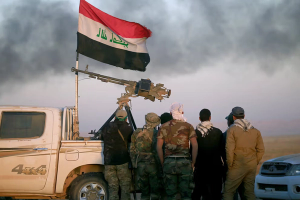
Harakat Hezbollah al Nujaba, an Iraqi militia allegedly trained by Iran's Revolutionary Guards
Tehran is prepared to step in to protect Iraq’s political system from collapse if formally requested, Iran’s ambassador to Iraq said on Friday.
Iran would respect Iraq’s sovereignty but stood ready to act if the Iraqi government sought assistance, Mohammad Kazem Al-e Sadegh said in an interview reported by the ISNA news agency.
“Iran is ready to protect the political system in Iraq from collapse if officially requested,” he said, without elaborating on what such protection would entail.
Iran supports Iraqi groups through financing, training, and arms, primarily focusing on Shia militias that are often integrated into the official Popular Mobilization Forces (PMF).
This support helps groups like the Badr Organization and Kata'ib Hezbollah exert military and political influence, though some factions like Harakat Hezbollah Al-Nujaba have focused more on military operations. The support allows Iran to pursue its regional objectives, gain influence, and destabilize Iraqi politics while coordinating attacks against US forces.
Iran’s ambassador to Iraq Mohammad Kazem Al-e Sadegh
Armed groups and ‘independent decisions’
Al-e Sadegh addressed recent Iraqi initiatives aimed at consolidating weapons under state control, a sensitive issue given the power of Iran-aligned armed factions. The Iran-backed groups, he said, were hesitant about weapons monopolisation due to concerns over its consequences, but insisted they had reached a level of maturity that allowed them to make decisions independently.
“Our relationship with these groups is longstanding, but they have reached a stage where they can decide for themselves,” he said, rejecting descriptions of the factions as Iranian proxies.
On regional tensions, the ambassador said Iran was “fully prepared” to respond to any hostile action by Israel, adding that Israel had sought US mediation to secure a ceasefire.
Iraq has balanced relations with both the United States and Iran, but faces mounting risks to its financial system if it falls foul of global sanctions regimes.
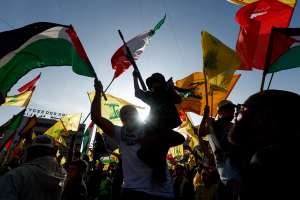
Hezbollah and the Houthis are key members of a broader network of Iran-backed groups across the region.
Iran views Iraq as a strategic economic and political partner amid Western sanctions, while Baghdad remains wary of being drawn into US efforts to squeeze Tehran and its regional allies.