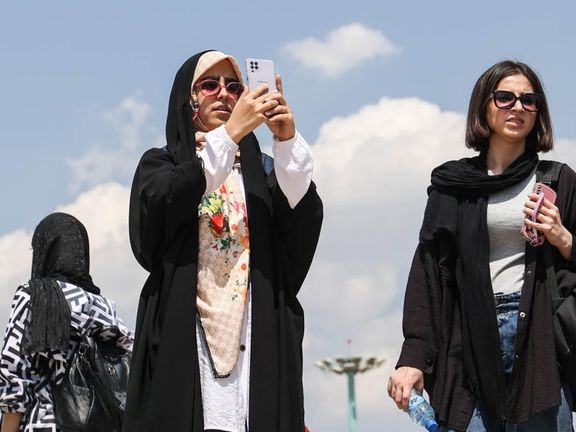
Two Iranian women stand next to each other in this file photo.
An annual cultural celebration of women and mothers in Iran falling on the birthday of the Prophet Muhammad's daughter Fatimah has galvanized critics of the theocracy's rights record for women even as supporters come to its defense.
After the 1979 revolution, the holiday replaced the pre-revolution tradition of observing Mother’s Day on December 15 as well as March 8, International Women’s Day.
The official website of Iran’s Supreme Leader published a message praising Fatimah as a model of “piety, justice-seeking, jihad, guidance, wifehood and motherhood.”
Across the country this year, state schools and government offices held ceremonies honoring Fatimah’s virtues and celebrating mothers and women, complete with religious speeches. The Social Security Organization also distributed a small cash gift—worth roughly $10—to women covered by retirement support programs.
But many women — and some men — responded to the government’s pageantry with sharp criticism.
'Absurd without rights'
A woman named Homa Dokht challenged the very premise of the day, pointing to Fatimah’s childhood marriage in a video posted on X.
Congratulating Mother’s Day on Fatimah’s birthday is absurd, she argued, because it is tantamount to endorsing child marriage, referring to accounts that place Fatimah’s marriage at age nine and childbirth around age ten.
“For the smallest things — like enrolling children in school, opening a bank account for them, or even getting their exam results — only the father is qualified (legally),” she said. “And if a child needs surgery, only the father’s or paternal grandfather’s signature is valid.”
For activists, the contrast between state-sanctioned celebrations and daily lived realities encapsulates a central grievance: symbolic reverence for motherhood does not translate into legal equality.
Iran mandates women wear the Islamic face veil, even as enforcement had slackened in recent year. A young woman named Mahsa Amini whose death in morality police custody stoked mass protests in 2022. The unrest was quashed with deadly force.
Iranian law, which Islamic authorities say is based on religious precepts, systematically prioritizes men in criminal, family and financial cases.
Gender equality activist Leila Forough Mohammadi wrote on X: “On a day named for women, a single woman, a divorced woman, a woman without children simply does not exist — as if she is incomplete.
"Here, the system defines the woman only as spouses, and bestows the highest status on a woman whose reproductive role serves the population policy,” she added.
Iran ranks 143 out of 146 countries in the latest World Economic Forum Global Gender Gap Report.
Amnesty International has documented systemic gender discrimination in Iran in its 2024 report, including up to 74 lashes for defying hijab rules and frequent impunity for honor killings.
Mansoureh Hosseini Yeganeh, a women’s rights activist based in the UK, wrote: “We want not just Mother’s Day, but child custody rights, the right to obtain a birth certificate for our children, the right to leave the country, government support, citizenship respect, and all the things mothers enjoy in other civilized countries. And we want gifts too!”
“What Mother’s Day?” journalist Maryam Shokrani asked: “when mothers and women in this country are deprived of their most basic rights, when you don’t even include their names on their children’s birth certificates, when they have no custody … You should be ashamed!”
Men in solidarity
A post on X by Khamenei this month highlighting income inequality between women and men in the West stoked criticism by users who pointed to the Islamic theocracy's record on women's rights.
The nearly 50-year-old system over which Khamenei presides views the veil as an emblem of Islamic identity and chastity.
Some Iranian men voiced support for the current holiday amid the criticism.
Mehrshad Ahmadian, CEO of a steel company, wrote: “Go sit with your father after you’re done congratulating Mother’s Day, ask him why your mother has no right to divorce? Why doesn’t she have custody of the child she gave birth to? Why does she need permission to obtain a passport?”
Supporters of the government’s agenda defend the official celebrations and the religious framing.
“Whenever we speak of women in the Islamic view, we speak of dignity, not a show," a user on X asserted.
"Islam defines women by the Fatimah model, not by the standards of capitalist markets. Today’s Iranian woman is an example of this great truth.”
A view from the Imam Reza Shrine, the mausoleum of the eighth Imam in Shi’ite Islam, in Mashhad, the province of Razavi Khorasan
A senior Iranian cleric said the northeastern city of Mashhad should be treated primarily as a religious destination rather than a leisure tourism hub, arguing that recreational tourists should visit other provinces such as northern province of Mazandaran instead.
Ahmad Alamolhoda, the Supreme Leader’s representative in Razavi Khorasan province and Friday prayer leader in Mashhad, said the city’s identity was rooted in pilgrimage to the shrine of Imam Reza, one of Shi’ite Islam’s holiest sites.
“Mashhad is not a city for tourists; it is a city for pilgrims,” he was quoted as saying by Iranian media.
He cited comments attributed to some Arab visitors from Iraq who he said had indicated they might travel to Tehran and then head to the Caspian coast for leisure, which he said showed Mashhad’s role as a pilgrimage destination and the need to distinguish between religious tourism and recreational or historical tourism in other cities such as Isfahan or Shiraz.
Alamolhoda also addressed women’s attendance at sports stadiums, saying he had no religious objection in principle but favored designated seating areas for women separate from men to prevent behavior he said could lead to social “abnormalities.”
On the enforcement of Islamic dress codes, he cautioned against confrontational approaches toward women not wearing the hijab. Instead, he urged a compassionate approach, likening it to caring for an ill loved one, saying: “This is not good for you; don’t do it.”
Narges Mohammadi, the 2023 Nobel Peace Prize winner, addresses mourners in Mashhad on Dec. 12, 2025
Iranian Nobel Peace Prize laureate Narges Mohammadi, who was violently detained after attending a memorial service for a human rights lawyer, told her family she has been accused of cooperating with the Israeli government, according to her X account.
Mohammadi said during a brief phone call on Sunday night that she does not know which security agency arrested her, the post on her X account said.
She added that she was beaten with batons during the arrest on Friday and has since been taken to the emergency room twice due to the severity of her injuries.
Mohammadi and several other activists were arrested during a heated gathering of mourners attending a memorial ceremony for Khosrow Alikordi in the northeastern city of Mashhad.
Alikordi, a former political prisoner who represented jailed protesters, was found dead under unclear circumstances in his office in Mashhad last week, with fellow lawyers and activists questioning the official account of cardiac arrest and alleging possible involvement by security forces.
"Khosrow Alikardi was devoted to freedom and justice, but he never bowed his head to oppression," Mohamadi told attendees in a speech.
The Nobel laureate whose arrest sparked international outcry said during the phone call that she was attacked with repeated, heavy baton blows to the head and neck and was then violently detained.
"At the same time as the beating, she was threatened and told, “We will put your mother in mourning.”
The Norwegian Nobel Committee on Friday condemned her arrest and called on Tehran to "specify Mohammadi’s place of detention, ensure her safety and well-being and release her unconditionally."
Her foundation posted online that activists Sepideh Qolian, Pouran Nazemi, Hasti Amiri and Aliyeh Motalebzadeh were also arrested, among others.
Mashhad governor Hassan Hosseini told state media that the arrests were made for the detainees' safety as the crowd turned unruly.
"This was done to protect them, because in such circumstances other groups might also take confrontational action. For this reason, the prosecutor’s office intervened to ensure that no problems would arise for these individuals," he told state media.
File photo of women in Iran’s southern Hormozgan province
A study on female genital mutilation (FGM) in Iran’s southern Hormozgan province finds the practice is sustained chiefly by family dynamics, gender stereotypes and local customs that often outweigh religious mandates.
Published by researchers at Islamic Azad University, the peer-reviewed paper appears in Social Problems of Iran (Autumn 2025) and uses grounded-theory interviews with 15 women (2022–23) to map causal drivers, intervening factors, strategies, and outcomes.
The authors report that cutting persists within kinship networks that link family honor to control over female sexuality, while misinformation and limited access to alternative medical or religious views reinforce continuity.
“The central category indicates the impact of religious and family institutions in the continuation and reproduction of the traditional pattern,” the paper said, adding that “local customs outweigh religious mandates, with religion serving more as a legitimizing discourse.”
They say women’s responses evolve from silence and avoidance in childhood to negotiation, alliance-building and seeking medical advice in adulthood, with education, urbanization and social-media advocacy widening pathways to change.
Reported outcomes include physical pain, reduced sexual satisfaction, traumatic recall and social withdrawal. “FGM causes physical, sexual or psychological harm or suffering to women.”
According to the paper, common misconceptions about the practice include beliefs that FGM preserves a girl’s “purity,” prevents immoral behavior or is a religious obligation.
“I had no idea what circumcision was until they did this to us,” said one 42-year-old participant.
Another woman described the experience as sudden and violent. “I was confused and completely unprepared. Like a chicken you grab to slaughter. Two female relatives held me down, tightly gripping my arms and legs, and then they took out the blade.”
FGM is practiced in several regions of Iran, particularly in western and southern provinces including Hormozgan, Kordestan, Kermanshah, West Azarbaijan, Ilam and Lorestan.
There is no comprehensive national data on its prevalence, but small-scale studies have reported varying rates across these areas.
The most common form documented in Iran is Type I FGM, involving partial or total removal of the clitoris or prepuce. Procedures are typically carried out by traditional midwives or elderly women using basic tools such as razor blades, often without anesthesia.
Iranian law does not explicitly criminalize FGM. There have been no known prosecutions, and official responses have largely been muted.
Women take part in a pro-government rally in Iran, carrying an Iranian flag and a mock missile as supporters gather during a demonstration organized by authorities amid heightened regional tensions.
Iranians are increasingly discontented with how their country is run but the Islamic Republic persists because of its ability and willingness to crush dissent by force, ex-CIA analyst and National Security Council director Ken Pollack told Eye for Iran.
Pollack’s assessment comes as Iran faces overlapping crises at home and abroad.
The country is under intense economic strain, social dissent has become more visible and the Islamic Republic is recalibrating after military setbacks suffered by the June war with Israel.
Yet despite the pressure, Pollack said the system remains intact for a simple reason.
“Revolutions only succeed when regimes lose either the capacity or the willingness to use force,” he said. “The Islamic Republic learned from 1979. It is determined not to repeat the Shah’s mistake.”
“There is no question this country is in a pre-revolutionary state,” Pollack added. “They’re trying to have a revolution.”
Pollack pointed to Iran’s long cycle of unrest, tracing repeated efforts to challenge the Islamic Republic back to the 1999 student uprising.
Since then, protest waves have erupted every few years, including nationwide demonstrations and the women-led revolt that followed the death of Mahsa Amini in morality police custody.
Each time, he said, the population pushed harder, experimented with new tactics and widened the social base of dissent.
What stopped those efforts, Pollack said, was not a lack of public anger but the clerical establishment's consistent readiness to deploy force.
Pollack said episodes of unrest, such as at a public memorial service on Friday for a lawyer who died under mysterious circumstances, highlight the paradox defining Iran today: visible cracks in social control paired with an unflinching security response.
Looking ahead, Pollack identified the eventual death of Supreme Leader Ali Khamenei as the most serious potential inflection point.
At 86, the health of the veteran theocrat has become a subject of quiet speculation even inside Iran. Succession, Pollack warned, can destabilize authoritarian systems by exposing elite rivalries or paralyzing decision-making.
“Succession can just as easily lead to chaos, fragmentation or something worse,” he warned. “These systems often survive by becoming more repressive, not less.”
Pollack also criticized US policy for focusing too narrowly on Iran’s nuclear program while sidelining Iran's regional behavior and domestic repression. He warned that treating nuclear negotiations as the central problem risks missing broader forces shaping Iran’s future.
“The nuclear program is an irritant,” he said. “The real issue is the regime’s drive to dominate the region and its willingness to repress its own population to survive.”
For now, Pollack said, Iran remains suspended in a dangerous middle ground: a society actively trying to change its political fate and a state still capable of stopping it.
“These regimes can endure for a long time,” he said. “But when they finally break, it usually happens faster than anyone expects.”
Nobel Peace Prize laureate Maria Corina Machado reacts from a balcony of the Grand Hotel, after her daughter Ana Corina Sosa Machado, accepted the award on her behalf, in Oslo, Norway, December 11
Iranian activist Masih Alinejad met Venezuelan Nobel Peace Prize laureate Maria Corina Machado in Norway, saying in a post on social media that Tehran menaced the South American country too.
“The Islamic Republic has invaded Venezuela alongside its allies Russia and its proxy Hezbollah. To those who claim with outrage that Venezuela’s democratic opposition asked the US government to ‘invade,’ let’s be serious and deal in facts,” Alinejad wrote on X on Friday.
“The real and ongoing violation of Venezuela’s sovereignty is already happening. Iran’s regime, Hezbollah and their terrorist proxy networks are operating inside Venezuela, strengthening repression, corruption and criminal networks that serve dictators, not citizens,” she added.
Machado arrived in Oslo this week after her daughter accepted the Peace Prize on her behalf. The veteran opposition figure said the United States had facilitated her exit from Venezuela, where she had been living in hiding.
US forces have mounted the largest military buildup in the Caribbean since the 1962 Cuban Missile Crisis. The move appears to be a bid to pressure Venezuelan President Nicolas Maduro to resign after he declared victory in polls against Machado's allies last year even as pollsters found he had lost.
The administration of US President Donald Trump has been attacking alleged drug boats off Venezuela and in the Pacific, in strikes Democratic opponents and some human rights groups say violate the laws of war.
Trump and his military and legal leadership say the campaign is a legitimate operation against narco-terrorism led by Maduro, and US forces on Wednesday seized a tanker off Venezuela it said carried sanctioned Venezuelan and Iranian oil.
The Norwegian Nobel Committee said on Wednesday that Iran was among various forces backing Maduro.
“Authoritarian regimes learn from each other. They share technology and propaganda systems. Behind Maduro stand Cuba, Russia, Iran, China and Hezbollah — providing weapons, surveillance and economic lifelines. They make the regime more robust, and more brutal,” its chief Jorgen Watne Frydnes said.
“Opposition groups did not start the imprisonments in Belarus, the executions in Iran — or the persecution in Venezuela. The violence comes from authoritarian regimes, as they lash out against popular calls for change,” Frydnes added.
US Secretary of State Marco Rubio this month cast Venezuela as a regional launchpad for Iranian influence, describing Maduro’s government as a narcotics transit hub that hosts Iran’s Revolutionary Guards and its Lebanese ally Hezbollah
Little public evidence exists about the security relationship Venezuela has with Iran or its armed allies. Tehran and Caracas boosted ties under Maduro's predecessor Hugo Chavez, who cast himself as a bulwark against what he called American imperialism.
Machado said on Wednesday that their influence in Venezuela amounted to an invasion while not directly addressing whether she supported stepped up US military attacks on the country to bring about Maduro's downfall.
“Venezuela has already been invaded,” she said at a news conference alongside the Norwegian Prime Minister Jonas Gahr Store on Thursday.
“We have the Russian agents, we have the Iranian agents, we have terrorist groups such as Hezbollah, Hamas, operating freely in accordance with the regime. We have the Colombian guerrillas, the drug cartels.”