US says tanker it seized had shipped oil from Venezuela and Iran
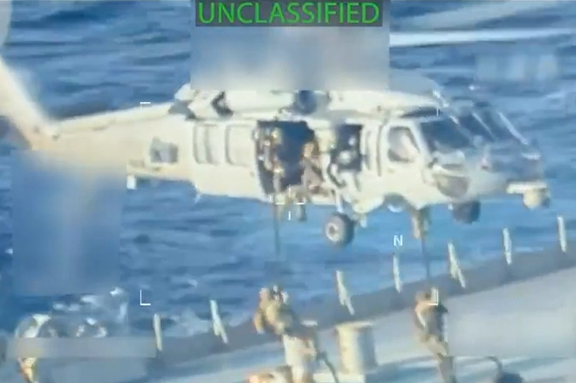
US coast guard executed a seizure warrant for a crude oil tanker used to transport sanctioned oil from Venezuela and Iran, December 10, 2025, Screen grab from official footage release
Attorney General Pam Bondi announced on Wednesday that US forces had seized a tanker for shipping oil from Venezuela and Iran, publishing footage of troops rappelling onto the vessel by helicopter.
"Today, the Federal Bureau of Investigation, Homeland Security Investigations, and the United States Coast Guard, with support from the Department of War, executed a seizure warrant for a crude oil tanker used to transport sanctioned oil from Venezuela and Iran," Bondi posted on X.
"For multiple years, the oil tanker has been sanctioned by the United States due to its involvement in an illicit oil shipping network supporting foreign terrorist organizations, she added.
The vessel, is called Skipper but had previously gone by the name Adisa, British maritime risk management group Vanguard reported.
"This seizure, completed off the coast of Venezuela, was conducted safely and securely—and our investigation alongside the Department of Homeland Security to prevent the transport of sanctioned oil continues," Bondi said.
A 2022 US Treasury sanctions notice said a Gulf-based businessman, Viktor Artemov along with other individuals were involved in a network "to illegally transport Iranian oil abroad and procure funds on behalf of Hizballah and the IRGC-QF," referring to the Islamic Revolutionary Guards and its external branch, the Quds Force.
The Adisa was listed among the vessels controlled by Artemov under a front company in which the Treasury said he had a 50% stake, Petro Naviero.
"Artemov used his companies to buy and sell oil tankers that were then used to transport blended Iranian oil on behalf of the oil smuggling network," the Treasury said.
The United States has ramped up a military deployment in the Caribbean as part of a pressure campaign on Venezuela and its leader Nicolas Maduro. US attacks on alleged drug boats there and in the Pacific have killed at least 87 people, in attacks which Democratic opponents and rights groups say violate the laws of war.
US Secretary of State Marco Rubio last week cast Venezuela as a regional platform for Iranian influence, describing Maduro’s government as a narcotics transit hub that hosts Iran’s Revolutionary Guards and its Lebanese ally Hezbollah.
Maduro has rejected US accusations that he runs a narco-terrorist cartel and dismisses the largest American military buildup in the region in decades as an attempt to impose Washington's will on his oil-rich country.
Major General Ebrahim Jabari, advisor to the IRGC CommPresident Donald Trump talks with Israel's Prime Minister Benjamin Netanyahu at the Knesset, Monday, Oct. 13, 2025.
A senior Islamic Revolutionary Guard Corps (IRGC) commander said on Wednesday that US President Donald Trump and Israeli Prime Minister Benjamin Netanyahu blessed an elaborate plot to overthrow the Islamic Republic during a June war.
"On June 14, a meeting was held in one of the European countries—I won’t name it. The meeting lasted 12 hours. All anti-revolutionary elements, agents of American and Israeli services and leaders of the opposition—including separatists, monarchists, and even Islamic State leaders—were present," Major General Ebrahim Jabari, an adviser to the IRGC Commander-in-Chief, told a Tehran conference on Tuesday.
"Under the guidance of Trump and Netanyahu, they planned that if an attack began, these elements would enter our country from various points along the borders," he added, saying the gathering aimed to form "a government-in-exile."
The United States held five rounds of negotiations with Tehran over its disputed nuclear program earlier this year, for which President Donald Trump set a 60-day ultimatum.
When no agreement was reached by the 61st day, Israel launched a surprise military offensive on June 13, followed by US strikes on June 22 targeting key nuclear facilities in Isfahan, Natanz and Fordow.
'Monarchists arrested'
Jabari referred to cases of military defections and said those involved in “running and operating” the plot had been detained.
“Iranian intelligence arrested around 123 ringleaders of a monarchist group called the ‘Javidan Guard' (Immortal Guard). Authorities also detained Christian convert leaders previously recruited by foreign services,” Jabari said.
The Javidan Guard was one of the most elite military units of the ousted Pahlavi dynasty responsible for protecting the Shah, the royal family and major palaces, particularly the Niavaran Palace complex.
Its name was inspired by the Achaemenid-era Immortals, a military grouping which ancient chronicles credit with strength and courage on the battlefield.
In the final months of the monarchy, the Javidan Guard was deployed against protesters amid escalating revolutionary unrest but ultimately was unable to prevent the collapse in 1979 and the victory of the Islamic Revolution.
“The plot is part of a long-term plan by the US and Israel. Preparations began 22 years ago and intensified eight years ago through recruitment of domestic rabble,” Jabari said.
Videos circulating last month on social media showed a man introducing himself as Colonel Ebrahim Aghaei Kamazani, delivering a speech to the people of Iran and calling on them to overthrow their leaders.
“We too are playing a role in the country's destruction through our indifference. Rise up on November 25. People, hear your son's voice. Long live the Shah; long live Iran,” he said. It was not clear if the appeal was new or he was a genuine military officer.
‘Recruiting thugs’
Jabari said agents were recruited inside Iran after training abroad before returning as operational agents.
“These individuals were taken to Turkey, Dubai, Qatar and other countries for political courses and training costing up to $25,000 per person, with corruption and immorality used as bait,” he asserted.
“Israel previously assassinated Iranian nuclear scientists directly but now uses Iranian ‘thugs’ trained abroad.”
Since at least 2010, Israel has allegedly conducted dozens of attacks inside Iran, targeting sensitive nuclear and military installations and carrying out assassinations of individuals deemed a threat.
These attacks intensified after July 2020, when an explosion at the Natanz uranium enrichment site destroyed a building.
In November that year, Mohsen Fakhrizadeh, a key figure in Iran’s nuclear program, was assassinated in a roadside attack near Tehran.
Western and Israeli intelligence had long suspected Fakhrizadeh of being the architect of Iran’s covert nuclear weapons program.
Israeli attacks in June killed over 20 senior commanders, including Mohammad Bagheri, Chief of Staff of Iran's Armed Forces; Hossein Salami, Islamic Revolutionary Guards Corps (IRGC) Commander-in-chief; and Gholamali Rashid, Head of Khatam al-Anbiya Central Headquarters.
Along with hundreds of military personnel killed, the Israeli strikes killed hundreds of civilians. Iranian counterattacks killed 32 Israeli civilians and an off-duty soldier.
A demonstrator cuts her hair during a protest against Iran's mandatory veiling policies amid in front of the Brandenburg Gate in Berlin, Germany, September 23, 2022.
Iran’s Ministry of Intelligence is intensifying efforts to recruit dissidents in Germany as informants by blackmailing their relatives back home, according to an investigation by the Die Welt newspaper.
The report details the chain of events and techniques agents use through social media and messaging platforms like WhatsApp to turn exiles into “disposable informants” in espionage parlance.
The recruitment campaign typically begins with agents seizing a relative’s phone in Iran to access contacts abroad. They then pressure the family and escalate to threatening to sabotage the exile’s asylum case in Germany.
Recruited informants are asked to attend opposition rallies and gatherings, identifying active participants.
In one case documented by Die Welt, Javid Navari, a 48-year-old asylum seeker from Shiraz living in Weimar with his family, was contacted via WhatsApp by an agent using the alias “Mahdi.”
The agent threatened Navari’s relatives in Iran and demanded information about opposition protests in Germany and Europe, including names and contacts of the dissidents.
Die Welt identified “Mahdi” as an active Iranian intelligence operative who has used the same number under multiple pseudonyms in at least five separate cases. His social media profiles present him as a real estate broker.
The National Council of Resistance of Iran (NCRI) told the paper it has recorded 97 similar cases in 2025 alone, describing an unprecedented escalation.
The Mujahideen-e-Khalq (MEK) group, which is banned in Iran, is the largest component of the NCRI whose leaders are based in Paris.
Germany’s Federal Office for the Protection of the Constitution (BfV) confirmed to Die Welt a sharp rise in Iranian espionage activities, adding that the entire diaspora opposition is targeted, with groups like the NCRI particularly exposed.
Victims often face threats of losing asylum status if they refuse cooperation or report the contacts, and many avoid going to police due to fear of being labeled regime collaborators, the report added.
The campaign coincides with a sharp rise in executions in Iran. Over 1,000 people have been put to death in the first nine months of 2025, most of them over alleged drug offenses.
New laws have expanded the definition of espionage to include contact with foreign or exiled media introduced after a 12-day war with Israel and the United States in June.
Iranian commander Qassem Soleimani and Iraqi militia leader Abu Mahdi al-Muhandis were killed in a US airstrike at Baghdad airport in January 2020.
A draft US defense budget for 2026 set to be mulled by Congress will for the first time condition aid for the Iraqi military on verifiable steps to rein in militias backed by Washington's Mideast arch-nemesis Tehran.
The over 3,000-page $900 billion plus National Defense Authorization Act outlines US military priorities around the globe. A compromise version of the proposed legislation emerged on Sunday.
It contains provisions to repeal the 1991 and 2002 Authorizations for Use of Military Force (AUMFs) against Iraq passed by Congress to confront US foe Saddam Hussein, in a win for the legislative branch's powers to declare war which remain a flashpoint.
According to the text, no more than half of the funds allocated for Iraq's military can be delivered until the Secretary of Defense submits to Congress a verification that Baghdad has implemented "credible steps" to rein in Tehran-backed militias.
These include steps "to reduce the operational capacity of Iran-aligned militia groups not integrated into the Iraqi Security Forces," moves to strengthen the authority of the Iraqi Prime Minister as commander in chief of the security forces.
It further requires Iraq to "investigate and hold accountable members of militias or members of security forces operating outside the formal chain of command who engage in attacks on United States or Iraqi personnel or otherwise act in an illegal or destabilizing manner."
The NDAA allows for a waiver of 180 days if the Secretary of Defense invokes national security reasons.
Recent elections
Emerging from years of civil war which followed a US invasion in 2003, Baghdad is caught between the competing influence of Tehran and Washington.
Tehran-aligned groups such as the Popular Mobilization Forces and Kata’ib Hezbollah fielded candidates in parliamentary polls last month, rebranding themselves as civilian organizations even as their armed presence persists.
Prime Minister Mohammed Shia al-Sudani, who has plied a middle course between the two foreign rivals vying over the future of the war-battered Arab nation, looks set to stay in office after months of bargaining wraps up.
He has taken few steps to defang the armed groups even as overall security nationwide has improved, earning criticism from hawks in Washington.
Republican Representative Joe Wilson of South Carolina
'Make Iraq Great Again'
"It does not matter who wins elections or forms a government, as the entire country is deeply infiltrated by Iran," Republican Congressman Joe Wilson said on Tuesday.
"Congress will not continue to issue blank checks forever," he added in the post on X. Baghdad, he said, "should take sovereign decisions on behalf of their own people rather than obeying the dictates of Iran and its puppet militias and kleptocrats."
The administration of US President Donald Trump has stepped up sanctions on Iraqi people and entities it accuses of helping enrich Tehran, and his special envoy to Baghdad Mark Savaya has vowed to "Make Iraq Great Again."
Hamstrung by US and international sanctions, Iran shares long historical and religious ties with parts of Iraq and views it as a valuable conduit for conducting international business.
Tehran armed and funded the militias which helped the country defeat Islamic State militants but which lingered after their defeat and continue to exert a strong influence over the security forces and government.
Iranian Revolutionary Guard ground force members carry out a mission in southeastern Iran, File photo.
Three members of Iran’s Revolutionary Guards Ground Force were killed on Wednesday "during a mission to secure the country’s borders" in a southeastern area near Zahedan, Iranian state media said.
The forces were part of the IRGC’s Quds Base unit and were killed during what authorities described as an encounter with armed militant groups near the border in Sistan-Baluchestan province.
State media said pursuit operations were under way, but added that few details had been released so far.
Iran’s southeast, which borders Pakistan and Afghanistan, has long been a focus of unrest and armed violence. The mainly Sunni Baluch region has seen repeated attacks on security forces, courts and government buildings by militant groups.
The incident follows a deadly attack earlier this year on a courthouse in Zahedan in which nine people, including three assailants, were killed, according to state media. Militants opened fire inside the building before shooting at civilians outside.
Jaish al-Adl, a Baluch Sunni militant group, later said it carried out the courthouse attack. The group has staged previous assaults on Iranian security forces and is designated a terrorist organization by both Iran and the United States.
Contract workers from Iran’s oil and power sectors and welfare organization staff from cities across the country gather for a protest outside parliament in Tehran, December 10, 2025.
Employees of Iran’s welfare organization and contract workers from the oil, gas and power sectors gathered outside parliament in Tehran on Wednesday to protest low wages and insecure employment, local labor groups said.
Staff from the State Welfare Organization said their salaries do not meet living costs despite long years of experience. Some told ILNA news agency that wide pay gaps between provincial workers and central office staff have fueled anger. Protesters voiced frustration over rising expenses and what they described as stalled government promises.
Oil, gas and power-sector contract workers joined the protest, urging lawmakers to remove intermediary contractors and implement legislation intended to shift temporary workers into permanent roles. They said the lack of progress has left many without stable income or benefits.
The protests come as Iran faces rising inflation and a sharp fall in its currency. This week, the rial slid to a new record low, with the US dollar trading at about 1.26 million rials, while gold prices also hit record levels.
Finance Minister Ali Madanizadeh has said the currency slide reflects the impact of a brief war with Israel earlier this year, while economists point to long-standing economic problems and renewed UN sanctions as key drivers of inflation.
Wednesday’s rally followed one of the largest labor actions in years at the South Pars gas hub in Asaluyeh, where at least 5,000 contract workers stopped work on Tuesday over wages and job security.
Labor unrest has increased across Iran as rising prices and currency volatility strain households, with rights groups reporting thousands of labor protests and strikes across the country over the past year.