• العربية
  • فارسی
Brand
  • Iran Insight
  • Politics
  • Economy
  • Analysis
  • Special Report
  • Opinion
  • Podcast
  • Iran Insight
  • Politics
  • Economy
  • Analysis
  • Special Report
  • Opinion
  • Podcast
  • Theme
  • Language
    • العربية
    • فارسی
  • Iran Insight
  • Politics
  • Economy
  • Analysis
  • Special Report
  • Opinion
  • Podcast
All rights reserved for Volant Media UK Limited
volant media logo
OPINION

Anatomy of a massacre, and the mothers who refuse to let November end

Kambiz Hosseini
Kambiz Hosseini

Host of nightly show The Program

Nov 15, 2025, 18:13 GMT+0Updated: 23:55 GMT+0
Mahboubeh Ramezani (left) holds a photo of her slain son Pejman Qolipour, alongside Rahimeh Yousefzadeh, who holds a photo of her slain son Navid Behboudi.

Six years after Iran’s blackout and mass killings, two women keep alive the month the Islamic Republic tried to bury.

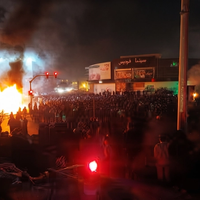
Six years ago, on a cold, rainy November night, the price of gasoline in Iran tripled at midnight. By morning, the streets were burning. The state would later compress that nationwide protests into a bureaucratic phrase, “the gasoline protests,” yet inside Iran it endures as something far more elemental, a breaking point, the moment a long-strained relationship between rulers and ruled finally gave way.

An overnight decree, issued without warning, landed on a society already thinned by corruption, sanctions, and the slow corrosion of trust. Gasoline was not merely fuel; it was the last fragile order of an ordinary life.

By dawn on November 15, unrest had spread through more than a hundred cities. The slogans outgrew the price hike almost instantly. Within hours, the government offered not explanation but silence, plunging the country into a nationwide internet blackout that severed families, stifled communication, and obscured what would unfold in the dark.

Inside that manufactured quiet, the killing quickened. Snipers appeared on rooftops. Live rounds struck torsos and heads. Amnesty International confirmed at least 304 deaths; internal figures passed abroad placed the toll far higher, closer to fifteen hundred. Leaked hospital logs, morgue records, and satellite images of hurried burial sites supported the higher count. No official list of the dead has ever been released, but the names that remain are the ones families refused to let vanish.

The Program

On my Persian-language call-in show, “The Program,” broadcast from Iran International, a Persian-language satellite television channel, two mothers recently spoke to a worldwide audience. Their voices — steady, unadorned — carried the weight of those missing lists, two fragments of a record the state has never acknowledged.

One mother introduced herself not with biography but with loss: “I am the mother of Navid Behboudi. Twenty-three years old. Born in 1998. They killed my child.”

Another spoke with the same stripped-down clarity: “I am Mahboubeh Ramazani, the mother of Pejman Gholipour. My son was eighteen. Born in 1998. They killed him because of the price of gasoline.”

Neither woman had sought confrontation with the state. They wanted what any parent wants — a future for their children, a degree, a job, the possibility of a wedding. Instead, they entered a world of interrogations and quiet threats designed to smother even private grief. Cameras now watch over their children’s graves. Intelligence agents monitor who comes to mourn. In Iran, even grief carries a political charge.

The mothers speak with a precision that feels almost liturgical, as though exactness might preserve what the state has tried to erase.

One recounts the final hours of her son’s life: “At 7:30, I called him. My Pejman was still breathing. At 8:20, they shot my son.”

His clothes still hang untouched behind his bedroom door. “When I go out,” she said, “and my child comes home, he will look for his clothes.” She speaks in the present tense. Grief has its own grammar.

The other mother remembered the moment she saw her son’s body. She had once imagined seeing him in wedding clothes. Instead, she saw him prepared for burial. “I asked him, Navid, open your eyes and look at me,” she said. “He never opened his eyes.”

The machinery of silence

What followed the killings was a choreography of pressure and containment. Families were summoned to Kahrizak, a notorious detention center long synonymous in Iran with torture and coerced confessions. Officials demanded written pledges: no public grief, no interviews, no large funerals.

Even the burial was not theirs to decide. “They told us we had no right to choose where to bury him,” one mother said.

Another recalled being instructed: “Do not cry. Do not gather people. Go home.”

Many families discovered cameras mounted above the graves. “Not just my son’s,” a mother told me. “All of them.” She described visiting the cemetery on her son’s birthday, arriving at 10:30 a.m. and staying until nine at night. “They locked the doors,” she said. “No one was allowed in. We were not allowed to mourn.”

This system is built not only to punish dissent but to prevent solidarity. Silence becomes ritual. Mourning becomes a private burden, watched and circumscribed.

Inside Iran, no independent investigation has ever been allowed. The same institutions implicated in the killings oversee the judiciary. But abroad, a coalition of rights groups convened the Aban Tribunal in London, a people’s court modeled on historical international inquiries. After reviewing hundreds of pieces of evidence, the panel concluded that Islamic republic authorities had committed crimes against humanity, including murder, torture, and sexual violence.

The judgment has no legal force, but for families denied even the vocabulary of justice, the act of naming the crime offered its own narrow, necessary recognition.

The mothers of Aban

The mothers of Aban — Aban being the Iranian month that corresponds roughly to November — have never let November end. Each year, as the month approaches, they begin a ritual that resists the state’s enforced forgetting.

“Today my son was alive,” they tell one another. “Tomorrow he was still alive.” They measure the month not by dates but by the life still present before the gunshots.

One mother described the conversations she continues to hold with her son: “I tell him, Pejman, do you know what happened that day? Maybe we were not careful. Maybe we lost you by mistake.”

She knows precisely who fired the bullets, but maternal instinct searches for any version of the story in which the ending might be undone. “I still cannot accept that he is gone,” she said. “I still cannot accept that he will not walk through that door.”

Amid the devastation, a narrow line of resolve endures. Not hope for happiness — “I will never be happy again,” one mother told me — but hope for a future in which no parent is ordered not to cry at a grave.

“I hope our voice reaches the world,” she said. “We have not lived for five years. Our life is black. Full of tears.”

Their plea is disarmingly simple: that their children not disappear into the silence the state demands, that remembering become a form of resistance, that the world not look away.

The state tried to bury the victims of November 2019 twice — once in the ground and once in memory. The mothers refuse the second burial.

“This government is even afraid of our children’s graves,” one of them said. “If they fear the graves, imagine how afraid they are of the living.”

Holding a candle in the cold November rain

The internet can be shut down. Protests can be crushed. Cemeteries can be lined with cameras. But on a November night, a mother can speak her son’s name into a static-filled line on “The Program,” and a country can still hear its echo.

That night’s show was heavy for all of us on The Program. When I finally walked home through the rain, the city felt emptied out, as if carrying the weight of those two voices. By the time I reached my door, the rain had stopped. I took my dog outside for a walk, put on my headphones, and, almost without thinking, whispered into the dark:

“Nothing lasts forever, not even cold November rain.”
Most Viewed

Iran diplomacy wobbles as factions compete to avoid looking soft on US
1
INSIGHT

Iran diplomacy wobbles as factions compete to avoid looking soft on US

2
ANALYSIS

The politics of pink: how Iran uses cuteness to rebrand violence

3

Scam messages seek crypto for ships’ safe passage through Hormuz, firm warns

4
EXCLUSIVE

Family told missing teen was alive, then received his body 60 days later

5
INSIGHT

Is Iran entering its Gorbachev moment?

Banner
Banner

Spotlight

  • Diplomacy tolls at Hormuz as conflict returns to its doorstep
    OPINION

    Diplomacy tolls at Hormuz as conflict returns to its doorstep

  • Opposition to US talks grows in Tehran as ceasefire deadline nears
    INSIGHT

    Opposition to US talks grows in Tehran as ceasefire deadline nears

  • Tehran moderates see ‘no deal–no war’ limbo as worst outcome
    INSIGHT

    Tehran moderates see ‘no deal–no war’ limbo as worst outcome

  • The future has been switched off here
    TEHRAN INSIDER

    The future has been switched off here

  • Lights out, then gunfire: Witnesses recount Mashhad protest crackdown
    VOICES FROM IRAN

    Lights out, then gunfire: Witnesses recount Mashhad protest crackdown

  • Is Iran entering its Gorbachev moment?
    INSIGHT

    Is Iran entering its Gorbachev moment?

  • Grieving Mothers Speak Out On Anniversary Of Iran’s Bloody November

    Grieving Mothers Speak Out On Anniversary Of Iran’s Bloody November

•
•
•

More Stories

The death of a street vendor: who killed Ahmad Baledi?

Nov 14, 2025, 16:28 GMT+0
•
Kambiz Hosseini

At dawn on a November morning in Ahvaz, a city in Iran’s oil-rich southwest, municipal enforcers arrived at Zeytun Park to demolish a small food kiosk that had sustained one family for more than two decades.

By noon, the stand was rubble. Ahmad Baledi, a twenty-one-year-old university student, watched as the officers came to dismantle his father’s livelihood. Then he poured gasoline over his body and lit a match.

He died a few days later, burned beyond recognition in a hospital bed.

Baledi’s death was not an act of madness, it was the death of a promise. The Islamic Republic came to power in 1979 vowing to defend the poor. Forty-six years later, the same government polices them with bulldozers.

Across Iran, municipal squads clear vendors, confiscate carts, destroy kiosks, and often humiliate those who resist. Unconfirmed reports suggest that Baledi warned an officer he would set himself on fire. “Go ahead, let’s see,” the officer allegedly said. And Baledi did it.

That exchange -accurate or not- is entirely believable by Iranians exposed to something more corrosive than cruelty, a state so practiced in coercion that the sees value of life as negotiable.

Bouazizi moment

The scene echoed another young man, thousands of miles away. In 2010, Mohamed Bouazizi, a Tunisian fruit seller, set himself on fire after officials seized his cart, igniting the Arab Spring.

But where Bouazizi’s death cracked open a political order, Baledi’s has been met mostly with silence, a measure of how exhaustion now tempers outrage in a country smothered by inflation, censorship and despair.

Ahvaz, the capital of Khuzestan Province, is a city of contradictions: immense petroleum wealth, staggering poverty and air so thick with refinery dust it dims the sun. For years, residents have lived under a system in which the law is elastic for the powerful and absolute for the weak.

In the hours after Baledi’s death, a wave of grief and anger shook this system in a way the authorities had not anticipated. His self-immolation, captured in trembling phone videos, forced the local government into an uncharacteristic retreat.

The mayor of Ahvaz, Reza Amini, resigned, and the Khuzestan governorate announced the dismissal of four senior municipal officials.

Days later, the prosecutor acknowledged that the mayor and one of his deputies had been arrested and briefly jailed before being released on bail, with additional cases opened against several municipal employees.

But the rush of resignations and arrests sharpened an underlying truth. In Iran, impunity is procedural. Investigations are ritual gestures, designed less to reveal responsibility than to contain it.

Ground truth

Each tragedy is framed as excess zeal at the bottom rather than intent at the top. The machine stays intact.

For many outside Iran, the country registers as an abstraction: centrifuges spinning in Natanz, proxy fights in the Persian Gulf, headlines about sanctions or war with Israel.

But its political reality begins at ground level, in moments like this —a family’s livelihood crushed at dawn, a young man driven to flame.

These are not aberrations; they are the daily grammar of a state that has turned humiliation into an instrument of order.

Baledi’s father later said the family had paid “fees” for years to keep their stand open, bribes functioning as rent to local authorities. It is a metaphor for the nation itself, citizens renting their survival from the very state that claims to protect them.

Bouazizi’s act in Tunisia derived its force from recognition. People saw in his burning the reflection of their own submission and, for a moment, turned that recognition into revolt. In Iran, recognition has hardened into fatigue.

Outrage flares, then recedes beneath the next injustice. The Islamic Republic has mastered the art of exhausting empathy.

Yet Ahmad Baledi’s fire endures as a warning. It exposes a government that mistakes fear for stability and silence for peace. It reminds us that dignity is not ornamental, it is political. Baledi did not die because of gasoline or flame. He died because no one in authority believed his life mattered.

Who killed Ahmad Baledi? The answer, written in fire, is that people eventually stop asking for mercy and start asking to be seen.

Iranian prosecutors set to target anti-hijab groups

Nov 14, 2025, 13:39 GMT+0

Iran’s judiciary chief instructed prosecutors nationwide to work with security and police agencies to identify what he called “organized groups linked to foreigners” involved in “social irregularities,” escalating the state’s campaign to enforce the mandatory hijab.

Gholamhossein Mohseni Ejei delivered the directive on Friday in the religious city of Qom, warning that foreign adversaries sought to exploit issues such as unveiled women and online activity.

“One manifestation of the enemy’s efforts is in the matter of nudity and lack of hijab, and another is the virtual space,” he said.

He urged officials to avoid amplifying internal disputes. “We must be alert to the enemy’s mischief and not inadvertently play on its field,” he said. “A small domestic issue should not be framed in a way that gives the enemy an opportunity.”

Senior officials call for tougher enforcement

Ejei’s comments align with a series of recent directives by senior Iranian officials favoring stricter enforcement of the mandatory hijab, a policy advanced in recent months with judiciary backing and active support from security institutions and state-aligned media.

Kayhan, a newspaper overseen by a representative of Iran’s supreme leader, wrote on Wednesday that hijab was “the first defensive shield of Islamic identity,” warning that its erosion would open the way for broader cultural decline.

Prosecutors were also obliged to act with seriousness against women who do not observe the compulsory dress code, Prosecutor General Mohammad Movahedi Azad said on Sunday.

Days earlier, Esfahan’s judiciary chief, Asadollah Jafari, called for action against what he described as “norm-breaking behavior.”

Iranian women look at jewellery displayed in a store in Tehran, Iran, September 27, 2025.
100%
Iranian women look at jewellery displayed in a store in Tehran, Iran, September 27, 2025.

More than 80,000 so-called promoters of virtue had been organized to monitor women’s clothing in public spaces, Ruhollah Momen-Nasab, head of Tehran’s headquarters for the Promotion of Virtue and Prevention of Vice said in October.

Clerics intensify pressure

In Mashhad, senior cleric Ahmad Alamolhoda renewed warnings on Friday, saying unveiled women posed a threat. “We must fight lack of hijab. Today, lack of hijab has reached nudity,” he said. He likened the situation to a house fire, urging officials to intervene directly.

Alamolhoda also criticized domestic streaming platforms, accusing them of exposing young viewers to inappropriate content at a vulnerable age.

Critics argue the state’s expanding enforcement apparatus shows that the priority is social control rather than easing economic hardship.

Despite mounting threats, civil resistance to the mandatory hijab persists, with many women appearing in the public without hijab to reject the policy.

Iran gives jail term to comedian over Ferdowsi joke amid nationalism push

Nov 13, 2025, 22:00 GMT+0

A joke about a 10th century Persian poet Ferdowsi landed an Iranian female comedian a six-month prison term and mandatory homework on the bard amid the Islamic Republic's broader pivot toward nationalism following the June war with Israel.

Zeinab Mousavi had joked about the revered author of the national epic the Shahnameh (Book of Kings) in a comedy segment, incurring the stint behind bars and an order to prepare a supervised thesis on the poet.

Mousavi, known for her online satirical persona “Empress Kuzcooo” — a parody character of an elderly villager whose tightly worn hijab exposes only her nose — was convicted over the controversial segment posted on her social media in August.

The sketch, which recited verses from the Shahnameh with irreverent commentary, drew condemnation online and from prominent cultural figures who described it as an insult to Iran’s heritage.

According to a copy of the ruling published by her husband on social media, Mousavi must prepare a compulsory thesis under the supervision of the Ferdowsi Foundation and an instructor approved by the institution.

The thesis must address topics such as “Ferdowsi’s place in Iran’s national identity and culture” and “the importance of the Shahnameh in Persian literature.”

“The defendant is obligated, under the supervision of the Ferdowsi Foundation and with the guidance of an approved instructor, to prepare a compulsory thesis over a six-month period and defend it,” the verdict said.

The court also ordered her to conduct at least 120 hours of storytelling sessions for children and teenagers in underprivileged areas, using material from the Shahnameh, in coordination with the Institute for the Intellectual Development of Children and Young Adults and the Education Ministry.

The sentencing comes as Iranian authorities move to invoke nationalism and glorify Iran’s ancient history to promote unity, emphasizing nationalist symbols more heavily in public messaging following the June war with Israel.

Symbols of Iran’s pre-Islamic past had long been shunned by the theocracy.

The Shahnameh largely recounts the tales of Iranian kings before the Arab conquest and the advent of Islam during the 7th and early 8th centuries.

Mousavi has been arrested several times on charges such as “insulting religious sanctities,” often in connection with satire aimed at the country’s compulsory hijab laws.

She was detained for around a month in October 2022 during Iran’s nationwide Woman, Life, Freedom protests sparked by the death in morality police custody of 22-year-old Mahsa Amini.

Canada foiled multiple Iranian attempts against dissidents, spy chief says

Nov 13, 2025, 21:05 GMT+0

Canada disrupted multiple potentially fatal plots by Iranian intelligence services targeting perceived enemies on Canadian soil, spy chief Dan Rogers said on Thursday.

“In particularly alarming cases over the last year, we’ve had to reprioritize our operations to counter the actions of Iranian intelligence services and their proxies who have targeted individuals they perceive as threats to their regime,” Rogers said in a public speech streamed live in Ottawa.

“In more than one case, this involved detecting, investigating and disrupting potentially lethal threats against individuals in Canada,” added Rogers, who leads the Canadian Security Intelligence Service (CSIS).

Canada severed diplomatic relations with Iran in 2012 and has issued a series of sanctions over Tehran’s human rights abuses and designated Iran's Islamic Revolutionary Guard Corps (IRGC) a terrorist entity in 2024.

There are nearly 300,000 people in Canada of Iranian descent according to a 2021 Census, making it the world's second-largest diaspora community after the United States.

Rogers described the actions of Iran, along with those of India and China, as "transnational repression" which his agency along with law enforcement were determined to confront.

Canada has levied a series of sanctions on Iran for human rights abuses since the Women, Life Freedom protest movement after the death of a young woman, Mahsa Amini, in morality police custody in 2022.

In March, Canada imposed sanctions under the Special Economic Measures (Iran) Regulations against three Iranian individuals and four entities for what it described as gross human rights violations, including repression of women and girls.

The move meant 208 Iran-linked individuals and 254 entities in total were sanctioned by authorities.

Christian convert broke spine, denied care in Iran prison - rights group

Nov 13, 2025, 18:46 GMT+0

A Christian convert detained in Tehran’s Evin Prison was denied adequate medical care after suffering a spinal fracture from a fall, London-based rights group Article 18 reported.

Article 18, which promotes freedom of religion in Iran and documents the persecution of Christian converts, said Aida Najaflou, 44, fell from her top bunk in the early hours of October 31, fracturing her T12 vertebrae.

She was taken to Taleghani Hospital for an X-ray but returned to prison the same day on a stretcher, still in severe pain and without the surgery doctors recommended.

Protests from fellow prisoners later prompted officials to transfer her to Shahid Tajrish Hospital, where doctors again advised urgent surgery and physiotherapy.

Despite this, the group said Najaflou remains in prison without proper medical treatment.

Najaflou, who suffers from rheumatoid arthritis, had repeatedly warned prison authorities that climbing to the top bunk was unsafe, but her requests for a lower bed were ignored.

She was still recovering from a nine-hour operation when Ministry of Intelligence agents arrested her in February and has been denied adequate care throughout her detention, including during 65 days of solitary confinement in Ward 209 of Evin Prison.

Article 18 said she remains behind bars because her family cannot afford the $130,000 bail set for her in May, part of a broader pattern of heavy bail conditions imposed on Christian detainees.

As another example, the group said the Lida Alexani, the wife of Iranian-Armenian pastor Joseph Shahbazian was released after a month only after posting $50,000 bail.

Under Iranian law, only ethnic Armenians and Assyrians born into Christianity are recognized as Christians. Conversion from Islam is prohibited.

According to US-based rights group Human Rights Activists in Iran (HRANA), around 11 percent of victims of religious-minority rights violations in Iran over the past decade have been Christians, particularly converts.

HRANA said Christians accounted for more than 9 percent of such cases last year.

Najaflou is being prosecuted in an Islamic Revolutionary court alongside two other Christian converts Joseph Shahbazian and Nasser Navard Gol-Tapeh.

They were charged earlier this year with gathering and collusion and propaganda against the Islamic Republic of Iran over ordinary Christian activities such as prayer meetings and baptisms, according to Article 18.

Article 18 said Najaflou also faces two additional charges — propaganda activity against Iran in cyberspace and propaganda in favor of groups opposed to Iran — over alleged posts on social media supporting the 2022 protests that erupted after the death of a young woman, Mahsa Jina Amini, in morality police custody.

She is also accused of allegedly criticizing slain Hezbollah leader Hassan Nasrallah on social media.