Iran government says hijab cannot be restored by force
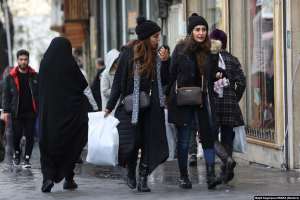
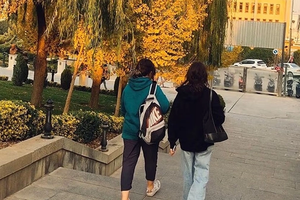
A woman without a headscarf walks past a cleric on a street in Tehran.
Iran’s government spokesperson said on Tuesday that the administration does not believe coercion can restore compliance with Iran’s hijab laws, amid renewed debate over enforcement and the deployment of tens of thousands of volunteers in Tehran.
Speaking at her weekly press briefing, Fatemeh Mohajerani said, “Hijab cannot be restored to society by force... The president has repeatedly said that we certainly cannot bring hijab back to people through coercion.”
She added that the government respects all existing laws but emphasized that social norms should be upheld through cultural engagement rather than force.
Mohajerani added that the government seeks to prevent the hijab debate from deepening social divisions.
“We must ensure,” she said, “that defending social values does not come at the cost of dividing our people.”
“We are a Muslim society,” she pointed out. “We must take care not to create divisions. While we believe inappropriate public behavior should be addressed, it is something that requires the cooperation of all citizens.”
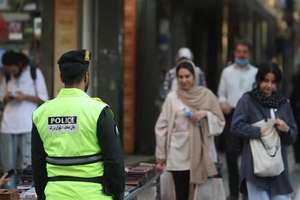
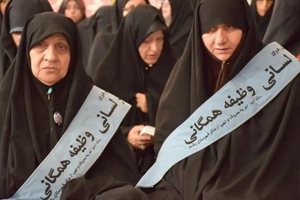
Her remarks came after Tehran’s Promotion of Virtue and Prevention of Vice headquarters said this month that 80,000 trained volunteers would be deployed across the capital as part of a new “hijab and chastity situation room.”
The initiative, announced by conservative officials, will rely on local monitoring and cooperation with cyber police and prosecutors.
No extra budget for hijab enforcement
Mohajerani also denied that any dedicated funding had been assigned for the recently announced mobilization, saying that “no special budget has been allocated for such programs.”
She added that Iran’s Supreme National Security Council (SNSC) -- headed by the president -- remained the ultimate authority on matters related to social order and security.
The new hijab enforcement drive has drawn concern among reformist politicians and clerics who warn that policing public behavior risks further division.
Cleric Abdolkarim Behjatpour, a senior member of Iran’s Institute for Islamic Culture and Thought, told ILNA news agency this week that if the campaign “turns into arrests and imprisonment, it will harm the system.”
He said moral guidance “must be delivered politely, with compassion and dignity, not through enforcement that creates social rifts.”
Another senior cleric and member of the Society of Seminary Teachers in Qom, Mohsen Faghihi, said on Tuesday that “inviting people to observe hijab should not involve confrontation, morality patrols, or imprisonment,” warning that such measures only create tension and division.
However, Abbas Ka'bi, a senior cleric and member of Iran’s Assembly of Experts, warned earlier this week against what he described as neglect over hijab enforcement, calling it a religious and legal duty of all state institutions.
He described hijab as an asset "protecting Iran’s Islamic identity from Western moral decline," and urged coordinated, well-planned action by cultural, security, and judicial bodies to prevent what he called the spread of immorality.
Since the 2022 death of Mahsa Amini in the custody of Iran’s morality police, enforcing compulsory hijab has become increasingly difficult, and the state’s ability to impose the rules has sharply eroded, particularly in major cities.
Since then, many women have continued to appear unveiled in public despite warnings, fines, and the return of hijab patrol vans, turning defiance into a daily act of resistance.
In recent months, however, authorities have revived enforcement drives through mobile patrol vans, increased fines, and business closures targeting cafés and shops accused of noncompliance.
Judiciary spokesman Ali-Asghar Jahangir said earlier this month that hijab laws remain in force, though enforcement methods have shifted toward targeting businesses rather than individuals.
Commuters walk along the tracks after a breakdown halted trains on Tehran’s Line 5 metro linking the capital and Karaj on October 21, 2025.
Passengers on Tehran’s subway shouted anti-government slogans on Tuesday after a major service disruption left commuters stranded between stations, according to videos sent to Iran International.
Footage from the Tehran–Karaj line showed frustrated passengers exiting carriages through emergency doors and walking along the tracks after a train broke down on Line 5, which links the capital with its western suburbs.
Some could be heard chanting “Death to Khamenei,” “Death to the dictator,” and “Reza Shah, bless your soul,” a reference to the founder of Pahlavi dynasty and Shah of Iran from 1925 to 1941.
Local news site DidbanIran reported that train services on Line 4, running east–west through central Tehran, were also disrupted earlier in the morning after a train stopped between two stations due to a technical failure. The stoppage caused long delays as following trains were held up along the line.
Tehran Metro’s public relations office said in a statement that technical teams resolved the issue completely, and service has returned to normal.
City Council Chairman Mehdi Chamran described the incident as unavoidable, saying “such disruptions can always happen” and that parts of the metro network are in urgent need of overhaul.
Similar outbursts of protests have occurred before. in August, passengers at Aliabad and Khazaneh stations shouted slogans against the Islamic Republic following long delays.
Iranian national Mahdieh Esfandiari has been put forward in a prisoner exchange arrangement with France, Deputy Foreign Minister Vahid Jalalzadeh said on Tuesday.
“The foreign minister announced that Ms. Esfandiari was placed in the exchange framework, and we have prepared a political and consular package that both countries must carry out,” Jalalzadeh said.
“We hope this will happen soon and that we will see Ms. Esfandiari back in our beloved country.”
Jalalzadeh said Iran had pursued legal and consular measures in Esfandiari’s case, including appointing a lawyer and holding ten consular meetings since her detention.
He accused France of holding her over “support for the Palestinian people,” saying her case was politically motivated.
Esfandiari, a student in Lyon, was arrested earlier this year over social media posts that prosecutors said violated counterterrorism laws.
Foreign Ministry spokesman Esmaeil Baghaei also said on Monday that Iran was seriously pursuing the issue of detainees with France and that “both sides have the necessary will to resolve it,” according to state media.
Similar remarks were made in September, when Foreign Minister Abbas Araghchi told state television that talks on a prisoner swap with France were “in their final stages.”
The comments came amid continuing diplomatic friction between Tehran and Paris over detained nationals in both countries.
France last week condemned lengthy prison sentences handed to citizens Cécile Kohler and Jacques Paris, who were convicted in Iran of espionage. French officials called the charges baseless and their detention arbitrary.
Foreign Minister Jean-Noël Barrot said there were “strong prospects” for bringing the two home following a meeting last month between President Emmanuel Macron and Iranian President Masoud Pezeshkian in New York.
Iranian officials have suggested that Esfandiari’s case could be part of a broader dialogue with France on consular matters, but no timetable has been announced.
Iranian protester, Arya Ostad Ebrahimi, lives in exile with 80 pellets in his body
An Iranian protester shot during the 2022 Woman, Life, Freedom uprising is living in constant pain with more than 80 lead pellets lodged in his body — and now fears deportation from Turkey to Iran, where he could face severe punishment.
Speaking to Iran International, 22-year-old Arya Ostad Ebrahimi described how he was gravely wounded by security forces during protests in the Kurdish city of Mahabad in November 2022 and forced to flee the country after repeated threats against him and his family.
“I was injured by the oppressive forces of the Islamic Republic,” he said. “That day, I helped a woman and her little son escape when they attacked the crowd. I saved their lives — but I was shot at close range and severely injured.”
Ebrahimi said both of his legs were struck by shotgun pellets.
“They took me to a village instead of a hospital because Mahabad was under military rule,” he told Iran International. “They removed some of the bullets, but around 80 are still inside my body.”
Doctors, he said, later confirmed that many of the pellets were lodged near his knees and arteries, making surgery impossible.
“The pain never stops,” Ebrahimi said. “When I sleep, if I roll onto my side or put my hand under my head, I wake up from the pain. It’s like someone is pressing a syringe into my wrist.”
From protest to exile
Before the uprising, Ebrahimi was a boxer and runner preparing to study law. His life changed the day he attended the funeral of slain protester Zanyar Abubakri — one of the bloodiest days of the Mahabad demonstrations.
“The people of Mahabad were brutally beaten and shot,” he recalled. “I couldn’t stand by and do nothing.”
After being shot, he hid in safe houses to avoid arrest.
Security forces raided his family home several times, threatening to kidnap his nine-year-old sister if he failed to surrender. “They came in the middle of the night with guns,” he said. “My little sister still hasn’t recovered from the fear of those nights.”
Eventually, he fled Iran and sought refuge in Turkey. But even there, he said, he has not found safety. His asylum status has been revoked, and he must regularly report to authorities — a process he fears could lead to his arrest and deportation.
“The Turkish government took away my residence and asylum status,” he explained. “Now, through a lawyer, I’m just buying time. I have to go every few weeks to sign at the immigration office, and I’m terrified each time. I’ve seen how others like me — political refugees — have been arrested while signing and sent back to Iran.”
He said that fear has made daily life unbearable. “I can’t sleep. I’m afraid they’ll come to my house one day and take me away. If they send me back, it will be a death sentence. I know what will happen to me in Iran.”
A growing crisis for Iranian refugees
Ebrahimi’s ordeal is part of a wider crisis facing Iranian asylum seekers in Turkey. Iran International has previously reported on how political dissidents and protesters who fled Iran are being detained, mistreated, and in some cases prepared for deportation.
In January, Iran International profiled 35-year-old Iranian refugee Sina Rostami, held in a Turkish deportation camp.
Also a former protester in the “Woman, Life, Freedom” movement, Rostami said he was routinely awakened by guards striking him with batons and forced to live in overcrowded, filthy quarters.
“The way they treat us here is like we’re not humans,” Rostami said at the time.
In February, Iran International reported on Iranian refugee and LGBTQ+ activist Nahid Modarresi, who lost her protected-person status after the United Nations handed asylum responsibilities to Ankara.
“I hide myself because I am too afraid to go outside,” she said.
Legal advocates estimate that thousands of Iranians once under UN protection have had their status revoked, leaving them at risk of detention and deportation.
Together, these cases reveal a growing pattern of pressure on Iranian refugees in Turkey. Human rights groups warn that political exiles are being left without protection and face possible repatriation to Iran, where they risk torture, imprisonment, or execution
Despite his injuries and uncertainty, Arya Ostad Ebrahimi remains determined to keep speaking out.
“I didn’t commit any crime,” he said softly. “I just wanted freedom.”
A screen-grab from a leaked video that appears to show Iran's former security chief Ali Shamkhani in his daughter's wedding
Tehran's establishment is defending former security chief Ali Shamkhani on privacy grounds after a video of his daughter’s wedding leaked online, angering many Iranians who say the elite shields itself while invading the privacy of ordinary citizens.
Shamkhani, a member of Iran’s Defense Council and a senior adviser to Supreme Leader Ali Khamenei, briefly appears in footage from a women-only ceremony where some guests were unveiled.
In his first reaction to the leaked video, Shamkhani told state media, “As I said earlier: Hey you bastards, I’m still alive,” referencing a quote from Papillon (1973).
He had previously used the same line when addressing Israel after surviving an airstrike on his home in Tehran during June’s war.
Shamkhani also posted the same line on his X account in Hebrew, implicitly accusing Israel of involvement in the leak of his daughter's wedding video. An X account allegedly run by Mossad earlier hinted at possible Israeli role.
Shortly after the leak, state-aligned media closed ranks around him.
The IRGC-affiliated Javan newspaper declared that “addressing personal ethical or behavioral misconduct is prohibited,” insisting the event involved neither alcohol nor “moral corruption.” It cited eyewitnesses who described Shamkhani’s behavior as “proper and acceptable.”
‘Revenge’
Ezzatollah Zarghami, former head of state broadcaster IRIB, likened the hacking of private gatherings to “a new form of Israeli assassination,” while moderate cleric Mohammad-Ali Abtahi rejected any wrongdoing, saying the video merely showed unveiled women in a female-only section.
Abdullah Ganji, a pro-government commentator and adviser to Tehran’s mayor, called the leak “immoral” and “revenge by any means.”
But critics argue that the real insult lies in the establishment’s double standard.
“Their message to people like us is always the opposite — that your private life is fair game,” said a female civil activist who was imprisoned during the 2022 protests.
She told Iran International that interrogators repeatedly pried into her personal life: “They said, if you continue your activities, we will shame you publicly before your family and colleagues by exposing details of your private life.”
Two rules for all
Authorities routinely surveil and punish citizens—sometimes costing them jobs—for unveiled photos or mixed-gender gatherings.
“When ordinary people are humiliated for the slightest breach, calls to respect the privacy of the powerful ring hollow,” one social media user wrote.
Leaked images have destroyed the careers of environmental official Kaveh Madani and parliamentary candidate Minou Khaleghi, while detainees have reported being threatened with the release of personal photos to extract confessions.
Despite the uproar, few expect consequences for Shamkhani, one of Khamenei’s closest allies who has survived previous allegations of corruption involving his family.
‘Private is political’
Germany-based journalist Massoud Kazemi, who has investigated Shamkhani’s economic dealings, described him as “one of the leaders of Iran’s mafia networks—in oil, shipping, and security,” adding that “using such leaks to oust him is improbable.”
The timing of the leak may point to internal rivalries.
In a recent interview, Shamkhani revisited the 2020 downing of a Ukrainian passenger jet, claiming he immediately informed then-President Hassan Rouhani—a statement Rouhani’s team has denied.
The hardline daily Vatan-e Emrooz suggested those comments might have provoked “revenge” from rival factions.
Regardless of who was behind it, the episode has exposed the growing fragility of Iran’s ruling elite and the public’s deep resentment of its privileges.
As one online commentator put it, “When power is above scrutiny, even privacy becomes political.”
About 120,000 Iranians die each year from nutrition-related causes, an Iranian official said on Monday, as soaring food prices and declining consumption of key staples such as dairy, meat, fruits, and vegetables deepen the country’s public health crisis.
Out of 400,000 to 420,000 annual deaths in the country, roughly 35% are linked to malnutrition, Ahmad Esmailzadeh, director of the Nutrition Improvement Office at Iran’s Health Ministry, said at a World Food Day event.
“Deficiencies in diet and lack of essential nutrients have become a major contributor to mortality,” he said.
Government data show that nutritional imbalances—ranging from vitamin and mineral deficiencies to obesity in children and expectant mothers—are escalating nationwide.
Each year, about 10,000 Iranians die due to insufficient intake of omega-3 fatty acids, another 10,000 from not consuming enough fruits and vegetables, and 25,000 from low consumption of whole grains and bread.
Vitamin D deficiency, affecting between 50% and 70% of the population, remains widespread and directly impacts bone and immune health.
Rising prices, falling nutrition
Much of the crisis is attributed to soaring food inflation, which has sharply reduced household access to healthy diets, Tehran-based Rouydad24 wrote on Monday. The consumption of dairy and meat, two vital protein sources, has fallen to less than half of recommended levels.
Even vitamin supplements have become unaffordable for many families, particularly in deprived provinces such as Sistan and Baluchestan, Kerman, and Hormozgan, according to the outlet.
The consequences extend beyond mortality. Rouydad24 quoting nutrition experts reported alarming increases in obesity among children, stunted growth in poorer provinces, and rising rates of chronic illnesses such as hypertension and diabetes.
Research cited by the outlet shows that one in five children and adolescents is overweight or obese, while 30% of pregnant women experience unhealthy weight gain.
Economic and social costs
The financial burden of maintaining a balanced diet is straining family budgets, added the report. As inflation continues, more households are forced to cut back on basic food items, fueling a vicious cycle of malnutrition, illness, and poverty. Experts warn the crisis could have long-term effects on human development, including reduced cognitive performance in children.
“If iodine deficiency in pregnant women continues, the IQ of future generations will decline,” Esmailzadeh cautioned. “Nutrition is not only a health issue but a vital economic and social concern.”
Without comprehensive intervention, the daily warned, Iran will continue to face silent deaths and a worsening decline in public health.