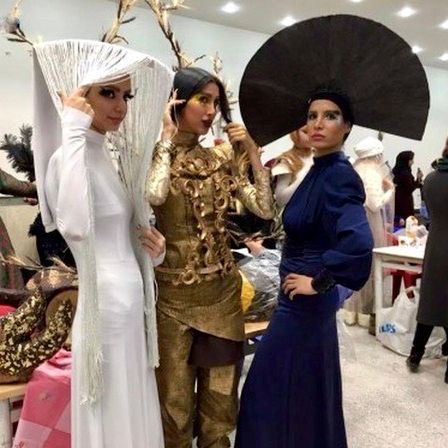
The debut of Tehran Fashion Week, held as part of Tehran Design Week, has set social media abuzz as the officially sanctioned fashion on show looked nothing like its past editions which extolled Islamic modesty.
For decades, Iran’s Public Culture Council and the National Foundation for Islamic-Iranian Fashion and Clothing have strictly overseen what they call “chaste attire.”
Tehran held fashion events in 2014 and 2015, where the designs were limited to “modest fashion”—long coats, scarves and loose forms approved by authorities. No later editions followed the events due to the official denial of permits.
This year’s revival of Tehran Fashion Week was folded into Tehran Design Week, a government-approved initiative showcasing design, furniture and art. Yet despite official oversight, photos and videos showed a strikingly freer atmosphere.
Some female models appeared at the events without headscarves, wearing tight-fitting western-style outfits, and many visitors ignored the mandatory hijab altogether. Women were seen in some social media videos walking bareheaded through the galleries in jeans and dresses.
The contrast is shocking to conservatives who have long treated fashion as a state-controlled domain. Yet for many Iranians, it simply reflects what the streets already look like after nearly two years of weakening hijab enforcement.
Private runways and changing tastes
Bita, a Tehran resident, told Iran International that private fashion shows have quietly flourished in major cities in the past two decades. “They are often underground, mixed-gender, and without hijab,” she said. “The clothes are usually exclusive and extremely expensive—far beyond what ordinary people could afford.”
The social shift since 2022, she added, has reshaped the industry itself and these private fashion events.
“The hijab barely exists anymore in many places,” she said. “Designers who once made luxury scarves and manteaux have turned to new lines because their former clients—the wealthy women who followed fashion—have mostly abandoned the hijab. Only a small group of very rich religious women still buy such expensive clothing, and their taste is totally different.”
Bita said she saw online ads for the Design Week fashion section, held at a well-known Tehran gallery, though she didn’t attend. “But my friends who went say it largely looked like seriously testing limits.”
Cultural paradox
Earlier this year, several clothing sellers at Tehran’s Grand Bazaar were prosecuted for hosting a women’s fashion show in which models appeared without scarves or with hair visible on the red carpet. Officials accused them of “violating public morality”, and their shops were shut down.
Independent news website Rouydad24 published a commentary published an analysis arguing that clothing in Iran has become not just a cultural or social question but a political and even security issue.
“In a country where just a few years ago shop mannequins were banned, stores were closed for selling open-front manteaux, and a small fashion show at the Bazaar caused a scandal," the commentary pondered, "how can Fashion Week possibly align with the realities of society?”
Iran’s political establishment is once again flirting changing laws to allow women to ride motorcycles even as women and girls have already spent years doing it without waiting for an official green light.
A senior official rekindled the debate on Monday when he said parliament should “decide” whether the law needs clarification on women’s licensing.
“If religious standards are observed, motorcycling does not contradict most sharia rulings,” said Abdolhossein Khosropanah, secretary of the Supreme Council of the Cultural Revolution.
Several news outlets quickly framed the remark as permission for women to ride, while conservative lawmakers bristled at the ball being tossed into their court, insisting that no such issue was on parliament’s agenda.
Khosropanah also warned that some women already ride “without proper hijab,” effectively acknowledging that the genie is out of the bottle.
Arezoo Abedini, the first Iranian female motorcyclist to compete in the Asian Cup in Thailand.
Reality on the streets
The supposed “green light” may not herald imminent policy change—and few seem to be waiting for it anyway.
Women on scooters and motorcycles have become increasingly common. Many now zip through traffic on lipstick-red, lilac, and canary-yellow bikes, taking children to school or commuting to work. Groups of young women even ride together in social clubs, sharing videos that draw thousands of likes.
Only a generation ago, even car driving was restricted in some areas, with families forbidding it despite valid licenses.
Women have also competed internationally since 2016, when MAFIRI opened motocross events to women despite the lack of a dedicated track. Earlier this year, the Women’s International Motorcycle Association launched an Iran chapter.
One rider told the moderate daily Etemad that her husband “stood up to relatives” who disapproved. “Sharing my rides on social media brought more clients,” she said. Another scooter rider said public reactions are largely positive: “People cheer us on, but some traffic police still treat us badly.”
The Sharia barrier
Supreme Leader Ayatollah Ali Khamenei has ruled that women’s cycling “in public view of men is haram because it attracts attention.”
While he did not mention motorcycles, many clerics apply the same logic, arguing that riding prevents wearing the hijab properly and exposes body movements.
Proponents counter that Islamic law never banned women from horse-riding and that women have long been allowed to ride as passengers on motorcycles without police interference.
Iranian law does not explicitly ban women from riding motorcycles, but no licensing system exists for them because the traffic code refers only to “men”—a gap police interpret as exclusion.
Without licenses, women cannot obtain insurance and may be liable for full blood money in accidents. Penalties for riding without a license include fines, bike confiscation, and up to two months in jail, rising to six months for repeat offenders.
Public pushback
A landmark 2019 lawsuit briefly forced police to issue a license before being overturned on appeal, but it galvanized public debate and encouraged more women to ride openly.
The Presidential Parliamentary Office recently said it is drafting a bill to modify Article 20 of the Law on Driving Offenses to allow women to obtain motorcycle licenses.
Legal scholar Mohsen Borhani wrote on X: “Opponents of women motorcyclists have no rational, moral, or religious basis. This discrimination is as absurd as Saudi Arabia’s old ban on female drivers.”
Commentator Sahand Iranmehr added: “Clinging to outdated rules only raises the cost. A law that resists social reality becomes obsolete and loses legitimacy.”
An illustration showing an ancient Iranian soldier and a Revolutionary Guard member holding a weapon together, displayed during a November 7 ceremony in Tehran where a statue of pre-Islamic Persian King Shapur I was unveiled.
Tehran’s unveiling of a towering statue depicting the Roman Emperor Valerian kneeling before pre-Islamic Persian King Shapur I has renewed criticism of the Islamic Republic’s appeal to nationalist sentiment following the June war with Israel.
For over forty years, the theocracy purged ancient Persian history from schoolbooks, replacing it with post-Islamic narratives. But after the 12-day conflict with Israel, officials have turned to the distant pre-Islamic past to rally a divided society.
From murals of ancient kings and soldiers to patriotic songs added to Shi’ite mourning ceremonies performed before Supreme Leader Ali Khamenei, Tehran now embraces imagery once deemed heretical by its own revolutionary ethos.
The statue unveiled in Tehran's Revolution Square
'Kneel before Iran' campaign
Tehran’s Revolution (Enghelab) Square was the scene of an unusual spectacle on Friday as officials unveiled a massive bronze statue depicting Roman Emperor Valerian kneeling in submission before Sassanid King Shapur I, commemorating Iran’s victory at the Battle of Edessa (260 AD).
The event was held under the slogan “Kneel before Iran,” part of what authorities describe as a campaign to project “national unity and historical pride” following the June war with Israel.
Tehran Mayor Alireza Zakani, a staunch ultraconservative, said on X: “Enmity with Great Iran can only end in kneeling before this historic nation.”
Municipal official Davood Goodarzi said the installation would be accompanied by visual displays depicting “other victories of Iranians over foreign aggressors,” including the defeat of British forces by local commander Rais-Ali Delvari, Mirza Kuchak Khan’s resistance against Russian troops, and Surena’s triumph over Rome at the Battle of Carrhae in 53 BCE.
The goal, Goodarzi said, is “strengthening concepts such as national dignity, social unity, and Iranian identity.”
The statue, he said, would remain temporarily at Revolution Square before being moved to a city gateway “where it will stand as the first emblem of Iran before diplomats and foreign visitors.”
Unveiled women were allowed to attend the unveiling ceremony—an uncommon scene at events organized by Tehran’s ultra-hardline municipality.
The turn to the pre-Islamic past
The sharp reversal also recalls remarks once made by Khamenei. In a 2011 speech, he asserted that “all the great military victories of this nation came after Islam,” dismissing pre-Islamic accounts as “things that are not documented.”
In 1987, he had said that prophets triumphed over kings such as Cyrus and that “nothing remains of these monarchs in history but names remembered with derision.”
Nevertheless, pro-government social media accounts have now gone so far as to circulate posters equating Khamenei himself with Shapur, showing him standing with a staff as Benjamin Netanyahu and Donald Trump kneel before him. The caption reads: “You will kneel before Iran.”
Image circulating by hardliners on social media
'Hypocrisy'
Pro-government figures have hailed the move as a patriotic success. Conservative political reporter Hossein Saremi posted: “Today’s grand Iranian gathering showed that people and the state share one essence: Iran itself. Nothing can take our homeland away.”
Others, however, called the spectacle “hypocrisy.” Journalist Gholamhossein Pashaei wrote on X: “Every year you close Pasargadae to stop people from celebrating Cyrus Day, yet you unveil Shapur’s statue in Enghelab Square with drums and fireworks during Fatimiyya (mourning period)!”
Dissident commentator Hamid Asafi called the ceremony “a perfect snapshot of the Islamic Republic’s contradictions.”
On Telegram he wrote: “A week ago they closed Cyrus’s tomb out of fear of the crowds, and now they glorify Shapur in the same breath. The Islamic Republic fears living history but poses for selfies with its corpse.”
He added: “They know people no longer respond to rosaries and sermons. That’s why they’ve brought history back to the stage—in a controlled costume. If they can’t erase the past, they’ll try to own it.”
The irony deepened as UNESCO formally recognized Cyrus’s Charter as one of the earliest human-rights documents.
President Masoud Pezeshkian wrote on X: “Iran, the cradle of dialogue, justice, and coexistence, can still inspire peace today.”
Users swiftly replied, questioning how such pride could coexist with a government that blocks access to Cyrus’s tomb each year to those wishing to visit it on his birthday.
Hijab enforcers in the city of Rasht in northern Iran
Hardliners in Iran have seized on oblique remarks made by Supreme Leader Ali Khamenei earlier this week as a green light to crack down on women who have shunned the hijab amid lax enforcement in recent years.
Speaking at a ceremony marking the anniversary of the 1979 US embassy takeover on Monday, Khamenei urged women to remind those around them to observe Islamic dress codes.
“Remind the women around you to view the hijab as a religious, Islamic, Zahra-like and Zeynab-like matter,” he said, referring to early Islamic matriarchs.
The word choice was careful and subtle, but more than enough for the intended audience.
Following the speech, Judiciary Chief Gholamhossein Mohseni Ejei told prosecutors and citizens they “have a duty to carry out (the religious duty of) commanding good and forbidding evil,” promising full judicial backing for such actions.
Conservative voices quickly circulated Khamenei’s comments on social media, portraying them as permission to confront unveiled women.
“Does our dear Leader’s order mean anything but jihad of explanation and to command good? May those who claim he has compromised on Sharia and hijab be struck dumb!” one ultra-hardliner wrote on X.
Another posted: “Once again the Leader of the Ummah himself intervened, reminding us of the duty to enjoin hijab and forbid indecency—both in positive and preventive ways.”
Writer Mohammad Nikbakht interpreted the remarks as signaling a softer, bottom-up approach, arguing that Khamenei meant that hijab enforcement should start within families, “not through morality police, legislation, fines, or arrests.”
Rare intervention
Khamenei has rarely addressed hijab directly in the past year.
In April 2023, he accused foreign intelligence services of encouraging Iranian women to disobey the mandatory hijab and declared such defiance “religiously and politically haram.”
That statement spurred a short-lived official campaign to restore control after the Woman, Life, Freedom protests.
He did not revisit the issue publicly until now, and earlier this year appeared to sidestep an ultra-hardline lawmaker’s question about why the law had not been implemented.
Law stalled
Iran’s Parliament passed the “Hijab and Chastity Law” in September 2024, imposing sweeping new restrictions. But the Supreme National Security Council quietly suspended its enforcement amid fears of renewed unrest.
That decision was widely viewed as carrying Khamenei’s consent, but his latest remarks are now being read by hardliners as a cue to resume implementation.
A user named Seyyedeh lamented online: “How many people can we warn? How long can we walk the streets? Unveiling has spread everywhere like locusts. God, take our revenge on these traitorous, indifferent officials who have no honor!!”
Political rift, rising defiance
Officials fear that reviving morality patrols or tightening hijab rules amid economic hardship could reignite mass protests.
President Masoud Pezeshkian has said he cannot enforce the law and insists that only “dialogue” can persuade women—a stance conservatives blame for paralysis.
Senior Revolutionary Guards general Hassan-Nia rebuked him this week: “Dialogue won’t fix the problem. Firm action is required. If the Leader permits, we will tear the skin off their heads.”
Meanwhile, defiance keeps growing, even in religious cities such as Qom and Mashhad.
In Tehran, unveiled women now outnumber those covered in many neighborhoods, and social media is filled with scenes of mixed gatherings, music, dancing, and women in crop tops.
“Yes, we say there shouldn’t be excessive policing,” former conservative parliament deputy speaker Ali Motahari told Pezeshkian, “but who is supposed to stop a woman who walks around with her belly button exposed?”
Vigilantes protest against lifting internet filtering in Tehran, October 24, 2024
Reports that YouTube access had been restored for students at the University of Tehran while it remains blocked for the wider population, though denied swiftly by officials, triggered outrage among critics of Iran's censorship of the internet.
The report appeared first on university channels and student groups, claiming that Iran's flagship institution of higher education had lifted the YouTube ban on its internal network, allowing direct access for "educational and research purposes."
Iran's communications regulator denied any formal directive or even plans for such move. But critics were unconvinced, not least because of Tehran's long record of quiet, selective exemptions.
Many activists, technologists and legal experts pointed out that the idea of selective access reinforces inequality by creating digital privilege for a small, already advantaged group.
Prominent jurist Mohsen Borhani described the concept as “a combination of internet apartheid and a control system.”
“Such class-based privileges gradually serve to justify the actions of anti-freedom controllers and their so-called councils,” he wrote on X.
Meshkat Asadi, CEO of the New Businesses Group, echoed the concern: “Allocating a higher level of access while the rest of society does not have it constitutes a form of class-based internet.”
Obstacles to digital freedom
For nearly two decades, initiatives such as “emergency internet for businesses” and “journalists’ internet,” along with unrestricted SIM cards for foreign tourists, have entrenched a divide in access based on occupation or status.
Such decisions are made by Iran’s Supreme Cyber-Space Council (SCC), formally chaired by President Masoud Pezeshkian but dominated by appointees of Supreme Leader Ali Khamenei and conservative bodies including the Revolutionary Guards and the Organization for Islamic Propagation.
This entrenched structure is widely seen as the key obstacle to any meaningful policy shift.
Abdolhossein Firouzabadi, the council’s former secretary said last week that at least ten members strongly oppose lifting major filters.
“The council’s composition should be reconsidered if we want to see real change in the country’s digital landscape,” he told moderate news-site Entekhab.
‘Fragmenting the nation’
Advocates of free access argue that those benefiting from such a system become complicit in the injustice imposed on the wider population.
“The authorities are fragmenting the nation into smaller and weaker groups in order to resist the collective will of the people,” Saeed Soozangar told tech outlet Zoomit.
Cybersecurity expert Vahid Farid told Zoomit that authorities appear to be considering limited openings to reduce the “growing damages caused by filtering,” even as they avoid a full reversal of the nationwide ban.
‘The right to learn’
Many also stress YouTube’s everyday educational value far beyond campuses.
“Someone may not have the opportunity to attend university, but they can learn through YouTube,” Pouya Pirhosseinlou of the Iranian E-Commerce Association pointed out on X. “When access to this resource is blocked, it effectively says: ‘You do not have the right to learn.’”
Legal advocacy group Dadban added that restricting online access endangers rights ranging from education to healthcare, employment, and a dignified life.
Internet-freedom collective Filterban asked: “If YouTube is safe and useful, why is it only good for a few universities? If it’s dangerous, why is it harmless for students but dangerous for ordinary people?
“ This isn’t reforming the filtering system,” the advocacy group said on X, “it’s the reproduction of discrimination in the digital age.”
A worker carries produce at Tehran’s central fruit and vegetable market, March 2021.
Iran’s latest attempt to curb soaring food prices—delegating the distribution of staple goods in Tehran to the city’s municipality—has again exposed a deeper truth about the country’s economic crisis: quick fixes rarely work when the foundations are broken.
The proposal, reported Thursday by the IRGC-linked daily Javan, would put Mayor Alireza Zakani in charge of supplying essential goods to households in the capital.
Zakani claims the plan, approved by President Masoud Pezeshkian, could reduce prices by up to 40 percent. Residents quoted by Javan said municipal-run markets already sell cheaper goods than elsewhere in the city.
But even at face value, the initiative seems to be yet another reactive measure in a system afflicted by deep structural problems. The question is less whether this plan can work and more why such plans keep reappearing.
Moderate outlet Fararu this week laid out the structural flaws driving Iran’s crisis: contradictory decision-making by overlapping institutions, a budget tied to unstable oil revenues, and an absence of dependable data that leaves officials governing by instinct rather than information.
Economic policy, the outlet said, is shaped by ministries, the Central Bank, the Planning and Budget Organization, and an array of parallel bodies that often work at cross-purposes.
“Most economic decisions in Iran are made overnight,” it wrote, warning that real change requires slow, coordinated reform across government—something the Islamic Republic has resisted for decades.
‘Bipolar economy’
The centrist daily Sazandegi pointed to another symptom of this dysfunction: chaotic decision-making that thrives in the grey zones created by sanctions.
The paper highlighted the clash between hardline MP Amir Hossein Sabeti and Babak Zanjani—the ‘sanctions-fixer’ once sentenced to death but pardoned and now tapped again to recover Iran’s oil revenues.
“Iran’s economy exists in a bipolar state,” Sazandegi wrote, “caught between a revolutionary pursuit of social justice that resists globalization and a rentier capitalism that thrives on sanctions.”
The public spat between two privileged insiders, Sazandegi argued, is evidence of an economy pulled between ideological theatrics and rent-seeking networks—a system that’s neither competitive nor transparent.
Bleak outlook
Despite their scathing critiques, both outlets chose to not mention the elephant in the room—as is almost always the case in Iran: a foreign policy that has produced decades of isolation and tightening sanctions.
With the return of UN sanctions in late September—and Tehran’s continued combative stance—the situation is likely to deteriorate further before any improvement is possible.
Seen through that lens, Zakani’s food-distribution proposal is less a solution than another reflex: an attempt to patch symptoms without addressing the machinery underneath.