US warns citizens against Iran travel after Tehran repatriation drive
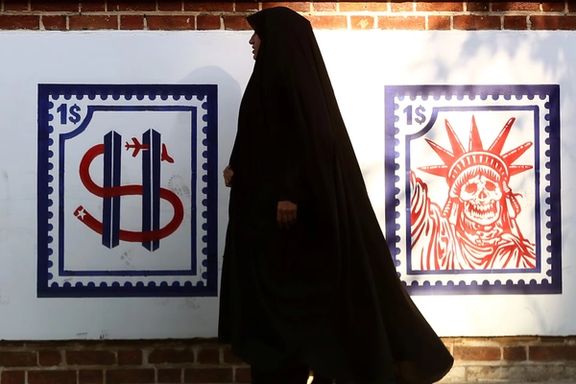
A woman walks past an anti-US mural on the former U.S. embassy's wall in Tehran, January 03, 2020.
The US State Department on Thursday told Iran International that now more than ever, citizens and dual nationals should avoid travel to Iran despite a new initiative by Tehran aiming to woo back émigrés.
Iran's foreign minister Abbas Araghchi on Wednesday said a new official website can allow Iranians abroad to return home risk-free by checking in advance whether they face any outstanding legal or security issues.
Concerns of official retribution give many Iranians outside the country pause about returning home.
Faced with deepening sanctions, Tehran is seeking to revitalize its isolated economy with investment and talent from its sizable diaspora.
Iranians can enter their details on a Foreign Ministry’s portal called Porseman to check whether they are “problem-free” to travel to Iran, Araghchi said. Those with a clean legal bill of health are given pre-approval in the form of a green tick.
Washington begged to differ, and in a response to an Iran International query on the new initiative by Tehran said its stern warning that Iran be avoided stands.
"The Department of State has long warned Americans not to travel to Iran and that is particularly true now. Anyone with a US connection, including dual US-Iranian nationals, is at significant risk of questioning, arrest, and detention in Iran."
Bitter foes since the 1979 Islamic Revolution and US embassy hostage crisis in Tehran, Iran and the United States have eyed each other with deep suspicion.
Ties hit a new low amid a 12-day US-Israeli military campaign against Iran in June.
In August, the state department said US citizens should steer clear of Iran to avoid being swept up in a post-war espionage dragnet there.
"The Iranian regime, following the 12-day war with Israel, is in the midst of unprecedented paranoia and a crackdown on spies and regime opponents," the State Department said in a post on its Persian X account USA Beh Farsi.
"Anyone considering travel to Iran should reconsider their decision. We repeat: US citizens should not travel to Iran!" it added.
While Iran says it welcomes the return of refugees, the country’s laws criminalize a wide range of behavior — including political dissent, activism, homosexuality and refusal to comply with compulsory hijab rules — issues which caused many Iranians to flee.
Smoke billows following missile attack from Iran on Israel, at Tel Aviv, Israel, June 13.
Iran’s Supreme National Security Council Secretary was challenged over his interpretation of a study by the Jewish Institute for National Security of America on the June 2025 Israel-Iran conflict, after he cited the report in remarks posted on X last week.
The Iranian security chief Ali Larijani “cites my 12-Day War report but skips the part where Iran lost: Iran’s missile and drone attacks were overwhelmingly defeated by US and Israeli defenses and Israel’s crushing strikes against Iran,” Ari Cicurel, Associate Director of Foreign Policy at JINSA and author of the report “Shielded by Fire,” wrote on X.
The Iranian official had written that “Iran's armed forces demonstrated power in the war against the Zionists,” invoking the JINSA study to back his argument. But the report, released in August 2025, found that Iran’s missile and drone attacks were mostly neutralized through integrated US-Israel air and missile defenses.
US defenses decisive
The 29-page study said Iran launched 574 ballistic missiles and more than 1,000 drones between June 13 and 24, yet only 49 missiles impacted populated areas or infrastructure. It attributed Israel’s limited damage to the combined interception network, which it said achieved an 85 percent success rate.
“The vast majority of the over 500 ballistic missiles fired by Iran did no damage to Israel, that success due in large part to ad hoc US-led air defense cooperation,” the report said.
The analysis credited Washington’s role as decisive, noting that the United States deployed two THAAD missile defense batteries and several Aegis-equipped destroyers to support Israel and provided over 230 interceptors -- around a quarter of its total stockpile.
Contrasting narratives
Israel’s counterstrikes destroyed hundreds of Iranian launchers and reduced its missile stockpile from 2,500 to roughly 1,000 - 1,500, forcing Tehran to scale back its offensives, according to the report.
The report concluded that Israel and the United States must expand interceptor production and formalize their missile defense coordination to prevent Iran from regaining its offensive capacity.
A security personnel walks past a gate of the office of Directorate of Enforcement in New Delhi, India, March 13, 2024.
Indian police have arrested a 59-year-old man accused of running an espionage and fake passport racket and maintaining contact with nuclear scientists overseas, including in Iran and Russia, Indian media reported on Wednesday.
The suspect, identified as Mohammad Adil Hussaini, had travelled to several countries, including Pakistan, and was allegedly involved in sharing sensitive material abroad, India Today reported, citing police sources.
During questioning, Hussaini allegedly said he obtained nuclear-related designs from a Russian scientist and passed them to a contact in Iran, the report said.
Police said Hussaini earned large sums from the exchange, investing part of the money in property in Dubai. Officials are investigating whether any classified information was shared, saying the matter involves foreign contacts and remains under inquiry.
Delhi Police said Hussaini, also known by several aliases, was found with one original and two forged Indian passports. He is suspected of using fake documents to obtain multiple identity cards linked to sensitive installations.
Additional Commissioner of Police (Special Cell) Pramod Singh Kushwah said the racket had been operating for years and was run from the eastern city of Jamshedpur, where forged passports were produced. “Several others are under the scanner,” Kushwah said on Tuesday.
Police said Hussaini’s brother, Akhtar Hussaini, had been arrested in Mumbai for helping secure fake IDs and travelling to Persian Gulf countries to expand the network. A cafe owner linked to the operation has also been detained.
Hussaini has been remanded in seven days of police custody for questioning, Delhi Police said.
UN nuclear watchdog chief Rafael Grossi holds a press conference on the opening day of the International Atomic Energy Agency's (IAEA) quarterly Board of Governors meeting in Vienna, Austria, September 8, 2025
International Atomic Energy Agency (IAEA) chief Rafael Grossi said on Wednesday there were no signs of suspicious activity at Iranian nuclear sites bombed by the United States in June, adding that inspectors had gradually resumed some work in Iran.
"We do not see anything that would give rise to hypotheses of any substantive work going on there," IAEA Director General Rafael Grossi said in New York.
"These are big industrial sites where there is movement, there is activity going on and we are very quick to indicate that this does not imply that there is activity on enrichment," he added.
Iran suspended cooperation with IAEA inspectors after a 12-day war in June against Israel and the United States, codified via a new law passed by parliament.
Grossi told reporters that inspectors had no access to the to sites stricken in June, but confirmed that some inspection was under way.
"We are trying to build it back, and we are inspecting in Iran," he said, "not at every site where we should be doing it - but we are gradually coming back."
Respecting NPT
In September, Iran and the agency agreed in Cairo to restart inspections. However, after Germany, France and the United Kingdom triggered the reimposition of UN sanctions, it remained unclear whether Iran would comply.
Foreign Ministry spokesman Esmaeil Baghaei said on Tuesday that Iran's commitments under the Non-Proliferation Treaty (NPT) safeguards agreement with the agency remain in place.
"In fulfilling these safeguards obligations, we are maintaining interactions with the IAEA while taking into account parliament's law, which designates the Supreme National Security Council (SNSC) as the authority responsible for decisions on cooperation with the agency," official media cited Baghaei as saying.
Under the new law, inspections proceed via SNSC approval for limited IAEA access at non-stricken sites, maintaining safeguards obligations under conditional cooperation while excluding full reporting and NPT oversight.
The Center for Strategic and International Studies (CSIS) reported on Tuesday citing satellite imagery that Iran has continued construction at a major underground nuclear site near Natanz.
Qatar's Prime Minister and Foreign Minister Sheikh Mohammed bin Abdulrahman Al Thani speaks at the Council for Foreign Relations, New York, Iran, October 29, 2025
Qatar’s Prime Minister Sheikh Mohammed bin Abdulrahman Al Thani said on Wednesday his country is working to revive US-Iran nuclear negotiations ended by a war in June, adding Iran’s stability is vital for regional security.
“We are trying to engage with the United States and with the Iranians to make sure that the talks come back on track between the two countries, because I believe once we have the talks started, we can achieve an agreement,” Al Thani said at an event hosted by the Council on Foreign Relations think tank in New York.
“We can achieve a deal that will be better for everyone. For us in the region, for Iran, and for the United States,” Al Thani said. “Iran is my neighbor... for me, the stability of Iran is key. It’s not a luxury... it’s very important.”
Qatar is separated from Iran's coast by about 120 miles across the Persian Gulf and shares ownership of the world's largest natural gas field, South Pars/North Dome.
"Iran has the right to develop their peaceful nuclear program for power generation or whatever within international law," Al Thani said, adding that there is need for a renewed diplomacy toward a nuclear-free Middle East.
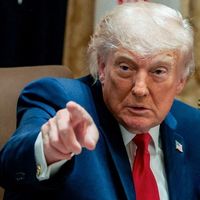
Washington under US President Donald Trump has demanded Tehran quit all uranium enrichment but Iran has balked, saying its pursuit of peaceful nuclear technology is an international right.
In September Supreme Leader Ali Khamenei reportedly sought Qatari mediation to facilitate talks with the West and avert UN sanctions over Tehran’s nuclear program. Those efforts stalled after an Israeli airstrike in Doha shortly after which targeted Hamas leaders based in Qatar.
Iran sought the aid of Qatari leader Emir Tamim bin Hamad to mediate between Tehran and Western powers to avert the reimposition of UN sanctions under the so-called “snapback” mechanism.
Tehran continues to grapple with the aftermath of a punishing 12-day war in June against Israel and the United States and the the reimposition last month of UN sanctions triggered by Britain, France and the United Kingdom.
Weeks after the Israeli airstrike on Qatar, President Trump facilitated Israel's apology to Doha, paving the way for Qatar to help broker the first phase of a US-led Gaza ceasefire between Israel and Hamas on October 8 which currently holds.
Prominent New York-based dissident and journalist Masih Alinejad makes a witness statement next to Polad Omarov and Radar Amirov, who were convicted of involvement in an unsuccessful Iran-backed plot to kill her, as they attend their sentencing at federal court in New York, October 29, 2025 in this courtroom sketch.
A federal judge in Manhattan on Wednesday sentenced two mobsters convicted of plotting to assassinate Iranian American journalist Masih Alinejad at her New York home to 25 years in prison.
The case is one of the most high-profile yet dealing with Iran's so-called transnational repression, or bid to deploy violence to silence its critics abroad.
Prosecutors had argued that Rafat Amirov, 46, of Iran and Polad Omarov, 41, of Georgia were senior figures in a Russian crime group enlisted by members of Iran's Revolutionary Guards to kill Alinejad.
The men were convicted in March after a two-week trial that included testimony from Alinejad and a hired gunman turned witness for the prosecution.
Alinejad, an author and Voice of America contributor, said she would attend the sentencing to deliver an impact statement.
Pleading guilty
The FBI disrupted the assassination attempt after surveillance footage revealed suspicious activity near Alinejad’s residence. She was away at the time, a factor that may have saved her life.
Khalid Mehdiyev, a member of the Thieves in Law gang who was allegedly due to carry out the killing, said he received orders from the two to kill the journalist who uses her platform to expose the Islamic Republic’s repression.
He pleaded guilty to attempted murder and gun charges.
Alinejad, who has long criticized Iran’s compulsory hijab laws and its treatment of women, said she will speak at the sentencing not just for herself, but "for every woman who refuses to be afraid.”
Prominent New York-based dissident and journalist Masih Alinejad holds a sunflower during the sentencing of Polad Omarov and Radar Amirov, who were convicted of involvement in an unsuccessful Iran-backed plot to kill her, at federal court in New York, October 29, 2025 in this courtroom sketch.
The FBI’s Counterintelligence Division and its Iran Threat Task Force led the investigation with support from the NYPD and Czech authorities.
The Justice Department said Alinejad has previously been the target of IRGC-backed plots to kidnap or kill her for her activism, which includes highlighting Iran’s human rights record and advocating against compulsory hijab laws.