Trump's 'peace through strength' seeks Iran's surrender, spy chief says
Iran's intelligence minister, Esmaeil Khatib
Iranian intelligence minister said on Wednesday that the US President Donald Trump's so-called peace through strength policy seeks to pressure Iran into submission, marking another defiant comment leveled at Tehran's perceived nemesis in recent days.
“Enemies have replaced ‘peace through strength’ with ‘surrender through crime,’ creating conditions through spectacle and propaganda to manipulate public opinion against us,” Esmaeil Khatib told officials at a gathering in the town of Shahrekord.
Trump’s peace through strength is a foreign policy doctrine emphasizing military buildup, deterrence and sanctions to avoid wars in a revival of an approach the Reagan administration deployed with the Soviet Union in its latter days.
“The phrase ‘peace through strength’ reflects the very crimes they committed in Gaza, in Syria and Lebanon, and in our own country, where they martyred more than a thousand people,” Khatib said, according to state media.
On June 22, the United States carried out airstrikes on Iran’s key nuclear sites at Fordow, Natanz and Isfahan. The attacks capped a surprise 12-day Israeli military campaign on Iran which badly weakened its Mideast foe.
After the attacks, Iran suspended cooperation with the International Atomic Energy Agency (IAEA), prompting three European countries - Germany, France and the UK - to trigger the resumption of UN sanctions on Tehran last month.
The new measures will pile pressure on Iran's already teetering economy, but officials insist Iran will not alter their stance opposed to the Israel and the United States.
Trump said on Monday that Iran could not withstand the sanctions but would likely return to negotiations, in his latest conciliatory remarks amid signs of diplomatic progress on Gaza.
Iran's Supreme Leader Ali Khamenei appeared to reject Trump's peace overture and said US offers of diplomacy demanded Iran relinquish defense capabilities in an approach the 86-year-old theocrat decried as "bullying."
Iran’s Foreign Ministry on Tuesday criticized US President Donald Trump’s call for dialogue with Tehran, saying his remarks about peace were inconsistent with Washington’s record of sanctions, military strikes and support for Israel.
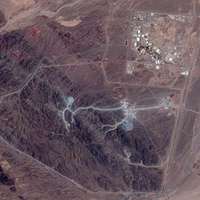
Satellite image shows a close up view of destroyed buildings at Isfahan Nuclear Technology Center, after it was hit by U.S. airstrikes, in Isfahan, Iran, June 22, 2025. Maxar Technologies/Handout via Reuters.
Iran holds enough uranium to build ten nuclear weapons if it chose to enrich further, the UN atomic watchdog chief warned on Wednesday, but stressed that there was no sign Tehran seeks atomic arms.
In an interview with Swiss daily Le Temps, Rafael Grossi said Iran’s stockpile includes roughly 400 kilograms of uranium enriched to 60 percent, just short of weapons-grade.
“If it went further, Iran would have enough material for roughly ten nuclear bombs,” he added. “But we have no evidence that Tehran intends to build one.”
US President Donald Trump and Israeli Prime Minister Benjamin Netanyahu asserted that Tehran had resolved to race toward building nuclear weapons after they launched attacks on nuclear sites in a 12-day war in June.
The characterization appeared to contradict prior public US intelligence assessments. Iran denies seeking nuclear weapons.
Asked how badly the Israeli and American strikes damaged Iran’s nuclear program in June, Grossi said the damage to key sites in Isfahan, Natanz and Fordow was "severe."
Fear of renewed conflict
Tehran and the IAEA have yet to agree on how to resume the UN body's inspection of nuclear sites bombed by the United States and Israel.
“For now, Tehran is only allowing inspectors in dribs and drabs. It’s imposing limits out of security concerns – which I understand. But if diplomacy fails, I fear a renewed resort to force,” International Atomic Energy Agency (IAEA) director general, Rafael Grossi said.
The conflict paused their activities and while an agreement was reached in September on a framework for restored cooperation, little progress has been made since.
Iran denies seeking nuclear weapons and has accused Western countries of instrumentalizing a technical dispute with the IAEA to deploy onerous sanctions.
Grossi, a veteran UN technocrat, is widely seen as interested in becoming the global body's next secretary-general.
He added that while US President Donald Trump speaks of “obliteration,” Iran’s technical know-how has not vanished.
Urging diplomacy
Grossi said inspections must resume to be certain, adding that the agency believes most of the highly enriched uranium remains at Isfahan, Natanz, and Fordow.
He said he is confident in the agency’s assessment because inspectors visited those facilities shortly before the Israeli strikes and have since monitored them through satellite imagery.
“Countries tracking Iran’s program have reached the same conclusions as we have,” he said.
Grossi added that despite the escalation of regional tensions, Iran’s decision to remain within the international framework shows it still seeks a diplomatic route.
“After the twelve-day war, Iran could have cut ties with the international community, withdrawn from the Non-Proliferation Treaty, and become a pariah state like North Korea. It didn’t,” he said.
He commended that decision and said he continues to maintain diplomatic contact with foreign minister Abbas Araghchi.
“I’m maintaining diplomatic space by keeping regular contact with foreign minister Abbas Araghchi,” Grossi said.
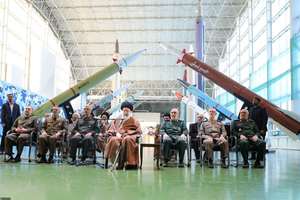
Iran's Supreme Leader Ali Khamenei during his visit to the IRGC Aerospace Force achievements exhibition in Tehran, November 19, 2023
Iran must rely on both its missile capabilities and diplomacy to safeguard national interests, the country’s foreign ministry spokesman said on Wednesday, emphasizing that resistance and engagement are complementary pillars of its foreign policy.
Iran faces stark economic and geopolitical challenges as a lingering impasse over its nuclear program led to the resumption of European-triggered international sanctions last month.
Western countries have called for Tehran to engage in renewed diplomacy with Washington and restored access to international nuclear inspectors.
Speaking at a seminar on “resistance diplomacy” at Ferdowsi University in Mashhad, Esmail Baghaei said: “We must use all tools to protect the country’s rights -- whether through missiles or diplomacy and negotiation.”
“The concept of resistance has now evolved and taken the form of resilience,” he said, adding that that Iran’s approach combines self-reliance with international engagement.
His comments appeared to strike a relatively moderate tone, two days after Iran's ultimate decision-maker Supreme Leader Ali Khamenei appeared to reject a peace overture by President Trump and deployed sharp language at his nemesis.
The 86-year-old veteran ruler called Trump's repeated assertions that US attacks on June 22 had obliterated Iran's nuclear program "nonsense" and in a rare direct address to a US President told him to "keep dreaming."
Khamenei appeared to rule out renewed talks, calling reported US demands for curbs to Iranian missile ranges and Tehran's support for regional armed groups bullying and a
Baghaei said Iran faces powerful adversaries but remains capable of shaping developments within the international system.
“Our opponents invoke international law to justify their actions, so we must also rely on the same law to prove our rights,” he said. “Resistance diplomacy must be seen as an active instrument to secure national interests.”
He defended Tehran’s stance in the wake of the UN sanctions snapback mechanism, saying that Western powers had expected immediate compliance but were surprised by global resistance to reimposing restrictions.
Addressing Iran’s backing of allied groups in the region, Baghaei rejected the notion that Tehran created “proxy” groups.
“We did not create them,” he said. “The issues of Palestine and Lebanon did not begin in 1979 (when the Islamic Republic was established). These movements existed long before, and we have supported them based on our constitutional and strategic principles.”
Baghaei added that Iran’s support is “based on a defined framework” and that “to prevent harm, we must build allies within the international system.”
He said the resilience of such movements is enduring despite repeated attempts to weaken them.
“After two years, those who claimed resistance was finished end up sitting at the same table with them,” he said. “The foundations of resistance are deeply rooted and cannot be easily destroyed.”
Baghaei also defended Iran’s record on diplomacy, citing past cooperation with global institutions and negotiations with Washington.
He recalled that after the US withdrawal from the 2015 nuclear deal, Iran “remained committed for months” before gradually reducing compliance.
He also noted that indirect talks with the United States had taken place under both Trump and Biden but collapsed due to continued sanctions and regional tensions.
“When one side plans an attack and then invites you to a meeting, how can you attend such a session?” he said, referring to recent incidents.
Iran's foreign minister said on Wednesday it will not return to negotiations with the United States unless Washington abandons what it described as unreasonable and excessive demands.
Abbas Araghchi told reporters in the northeastern city of Mashhad that Iran remained committed to diplomacy but would not compromise on its national rights.
He said five rounds of indirect talks with Washington had taken place before the 12-day conflict in June that saw US and Israeli strikes on Iranian nuclear facilities and that subsequent discussions on the sidelines of the UN General Assembly also failed due to US demands.
“This year, after five rounds of negotiations, the United States joined Israel’s military attack against Iran. Later, in New York, there was also an opportunity for a reasonable, mutually beneficial agreement -- but once again, the talks failed because of America’s excessive demands,” he said.
He added, “As long as the Americans persist in their policy of overreach and continue to make unreasonable demands, we will not return to the negotiating table.”
“Iran has always shown that it believes in peace and diplomacy,” Araghchi emphasized. “Wherever the country’s interests can be secured through dialogue, we will not hesitate to act. But the other side has repeatedly proven it does not adhere to diplomacy.”
The comments came as Araghchi arrived in Mashhad to attend a two-day regional diplomacy conference alongside senior Iranian officials, business leaders, and ambassadors to neighboring and Asian countries.
Earlier in the day, the foreign ministry spokesperson said Iran must rely on both its missile capabilities and diplomacy to safeguard national interests.
Speaking earlier in the day in the same city, Esmail Baghaei said: “We must use all tools to protect the country’s rights -- whether through missiles or diplomacy and negotiation.”
The collapse of the talks followed months of rising tension over Iran’s nuclear and missile programs, compounded by the reimposition of UN sanctions under the 2015 nuclear deal’s snapback mechanism.
Members of Hezbollah march with party's flags during a rally in Beirut.
Hezbollah is relying more on its overseas financial networks as Iran faces economic strain, US experts told a Senate hearing on Tuesday, warning that the group could deepen its activities in Venezuela and across Latin America.
“Hezbollah has a long history of turning to its diaspora networks when it’s facing financial stress,” analyst Matthew Levitt said.
He told senators that while Iran continues to support the group, “it is having a much harder time getting that money to Hezbollah in a timely manner.”
Lawmakers described Venezuela as a growing hub for Hezbollah’s drug and finance operations.
Senator Sheldon Whitehouse, the top Democrat on the Senate International Narcotics Control Caucus, said the group “is one of Iran’s tools to destabilize and terrorize,” adding that “if we target Hezbollah’s financing, we can deny them the opportunity to rebuild.”
Levitt said Hezbollah has operated in Latin America for nearly five decades, cultivating ties with traffickers and using illicit trade networks to move money.
“If you need big money real fast, you turn to illicit activities and especially to narcotics trafficking,” he said.
Several senators urged a tougher US response to Venezuela’s cooperation with Iran.
Senator Bernie Moreno said the Maduro government’s actions “meet the legal standard” to be labeled a state sponsor of terrorism and warned that “Maduro should know his days are numbered.”
Witnesses also called on Latin American governments to follow the lead of Argentina, Colombia, and Paraguay in designating Hezbollah as a terrorist organization, saying it would help disrupt its financial activity and weaken Tehran’s influence in the region.
Iraqi Shi'ite Muslim men from the Iranian-backed militia Kataib Hezbollah hold the party's flags as they walk along a street painted in the colours of the Israeli flag during a parade marking the annual Quds Day, or Jerusalem Day, on the last Friday of the Muslim holy month of Ramadan, in Baghdad in this July 25, 2014
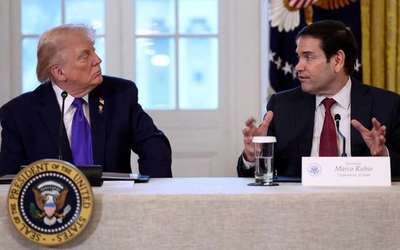
US Secretary of State Marco Rubio urged Baghdad to swiftly disarm Iran-backed militias in a phone call with Iraq's prime minister on Tuesday, accusing the Shi'ite groups of diverting the Arab nation’s resources to Tehran’s benefit.
In his phone call Mohammed Shia al-Sudani, Rubio "highlighted the urgency in disarming Iran-backed militias that undermine Iraq’s sovereignty, threaten the lives and businesses of Americans and Iraqis, and pilfer Iraqi resources for Iran," according to a state department press release.
"The Secretary reiterated the US commitment to working closely with Iraqi partners to advance our shared interests: safeguarding Iraqi sovereignty, bolstering regional stability, and strengthening our economic ties," the state department added.
American officials have issued several private warnings to the Iraqi government since January over the Tehran-backed armed militants, telling Baghdad it could target the groups with airstrikes unless it acted to disband the militias operating on its soil.
The militia commanders, from groups including Kata'ib Hezbollah and Nujaba, were quoted by Reuters in April as saying their main ally, Iran's Revolutionary Guards (IRGC), had given them its blessing to avoid a conflict with the US and Israel.
"Trump is ready to take the war with us to worse levels, we know that, and we want to avoid such a bad scenario," Reuters reported at the time citing a commander of Kata'ib Hezbollah, the most powerful Shi'ite militia.
However, Iraqi politician Muthal al-Alusi denied the report, calling the claims a nominal effort to protect involved politicians. He told Iran International on April 7 that "in practice, the real militias have received advanced weapons, and their participation on the battlefield may be completely evident."
The militias form part of the Islamic Resistance in Iraq, an umbrella group claiming responsibility for numerous attacks on Israel and US forces during the Gaza war.
The developments come as Iraq seeks to strike a balance in its relations with neighbor Iran and superpower the United States, with the militias having grown significantly since the 2003 US invasion.
Washington had warned Baghdad against revenge attacks by these groups after recent strikes on the Iran-backed Houthi movement in Yemen.