Lecturer in International Relations, University of Exeter
China's President Xi Jinping meets Iranian counterpart Masoud Pezeshkian
The return of UN sanctions has deepened Tehran’s isolation and tested Beijing’s pragmatic balancing act in a region shaken by Donald Trump’s new peace plan and the 12-day war between Iran and Israel.
The current state of China–Iran relations is unusually difficult to assess. Both governments continue to affirm their “strategic partnership,” but beyond the rhetoric the reality is less clear.
On paper, the two countries are bound by a 25-year cooperation agreement signed in 2021, covering trade, infrastructure, energy and security.
Yet China has remained notably cautious during Iran’s recent crises. Despite being Tehran’s largest oil customer and a key diplomatic partner, Beijing largely stayed on the sidelines as Israeli strikes hit Iranian territory.
In practice, the partnership operates within strict limits. While Sino-Iranian economic relations have been stagnating, China’s ties with Saudi Arabia and other Gulf monarchies have expanded dramatically.
Expectations meet caution
During the 12-day confrontation with Israel, some Chinese analysts urged a more proactive role—mediation, public condemnation of Israeli strikes or closer military cooperation.
But Beijing did little, triggering accusations in Tehran that it failed to grasp the Islamic Republic’s strategic value in its rivalry with the United States.
China should have done more, many asserted, rarely elaborating on what that more could look like.
Direct military or political backing, however, would have risked confrontation with Washington and jeopardized China’s broader regional network.
Oil and gas tanks are seen at an oil warehouse at a port in Zhuhai, China October 22, 2018.
Oil as quiet support
Where China’s support has been most tangible is in energy trade. The world's top importer of oil is Iran's main, almost sole, customer.
Despite sanctions, imports of Iranian crude have continued to grow in 2025, with tankers often re-flagged or disguised to evade detection. This provides Tehran with a crucial lifeline.
For Beijing, the motive is less political than practical: discounted Iranian oil fits its strategy of stockpiling reserves and securing cheap energy while global prices remain low.
Dependence by default
With UN sanctions back in force, Iran faces renewed isolation from global finance, trade, and technology. That leaves Tehran even more dependent on a handful of partners—above all, China.
A recent review of Iranian media published by the ChinaMed Project confirms this.Iran’s leaders—or at least parts of the elite—prize strategic autonomy and resent reliance on any single power, yet options are scarce.
Russia, itself sanctioned and weakened, offers little beyond rhetoric. China, by contrast, provides trade, energy purchases, and a degree of diplomatic cover, making it Iran’s indispensable partner whether Tehran likes it or not.
The trajectory of Iran-Saudi relations will be decisive. If détente holds, Tehran may find limited room to maneuver; if it collapses, dependence on Beijing will only deepen.
Looking ahead
The return of UN sanctions on Iran coincides with Donald Trump’s unveiling of a new peace plan.
Beijing’s official line is that it “welcomes all efforts” toward peace based on a two-state solution. Chinese experts, however, are skeptical, arguing that peace will be impossible without recognizing Palestinian statehood—a position long enshrined in Chinese diplomacy.
Many Chinese commentators also see Trump’s plan as a US bid to reassert dominance, protect Israel’s interests, and strengthen Arab-Israeli ties.
Beijing opposes none of these in principle, but grows wary when they appear designed to isolate Tehran further, potentially undermining China’s own mediation between Iran and Saudi Arabia.
Beijing’s challenge is to sustain its balancing act: maintaining economic ties with Tehran, preserving partnerships with Iran’s Arab neighbors, and avoiding direct confrontation with Washington.
For Tehran, choices are narrowing. The more isolated it becomes, the more it must rely on China, even if that means accepting a subordinate position in the relationship.
China’s support for Iran remains significant but measured, rooted more in calculation than ideology. As sanctions bite and isolation deepens, Beijing’s role may grow—but within limits that protect China’s own interests above all.
US Vice-President JD Vance said on Tuesday that the United States is committed to diplomacy for the foreseeable future as its strategy to deprive Iran of nuclear weapons.
"(US President Donald Trump) actually wants Iran to be prosperous. He wants to have good relations with the Iranians, but they cannot have a nuclear weapon," Vance told reporters while visiting Jerusalem in a bid to shore up a Gaza ceasefire.
"So we're going to keep on using and exhausting every diplomatic means possible to try to ensure that Iran does not have a nuclear weapon. That's our focus, and that will remain our focus for the indefinite future," he added.
Trump has repeatedly said June 22 US attacks on Iranian nuclear sites "obliterated" the program and the Iran is more focused on survival than rebuilding its capabilities.
Tehran denies seeking nuclear weapons and called the attacks illegal.
Raising some eyebrows, the US President told the Israeli Knesset last week that it would be ideal if Tehran could be folded into a broader Middle East peace deal. Still, he has often mooted bombing Iran again if it seeks to rebuild its nuclear program.
Iranian Supreme Leader Ali Khamenei appeared to rule out any renewed talks with Tehran in a rare speech earlier on Monday, calling Trump's assertions on crippling its nuclear sites "nonsense" and telling Trump to "keep dreaming."
“(Trump) claims to be a man of deals, but if a deal is accompanied by coercion and its outcome is predetermined, it is not a deal but an imposition and bullying. The Iranian nation will not bow to such impositions,” Khamenei said.
The Middle East has been beset by two years of conflict since Iran-backed Hamas militants attacked Israel on Oct. 7 2023, sparking a devastating Israeli incursion into Gaza which triggered interventions by Iran's armed allies in the region.
The fighting, capped by the US-Israeli onslaught on Iran for 12 days in June, left Tehran and its affiliates seriously weakened, though a final resolution on the nuclear issues and Iran's posture toward Israel and the United States has remained elusive.
Tehran’s behavior after the June war with Israel reflects a state of suspended decision-making—a fragile equilibrium that may nevertheless endure, sustained by continuing control and the absence of any obvious alternatives.
The 12-day conflict ended without a written agreement, leaving Iran trapped between war and peace.
Instead of rebuilding through reform or reconciliation, the Islamic Republic has doubled down on surveillance, militarization and the distribution of privilege among loyalists.
What has emerged is a system of permanent crisis management: endurance without renewal.
The real decision-makers in Tehran show no appetite for dialogue with the West, and are unwilling to acknowledge recent political and military setbacks or contemplate change.
The priority has become the securitization of every sphere of life—with key decisions even more concentrated in security bodies, and politics almost wholly transferred to backrooms.
A web of military institutions, economic foundations and domestic platforms mediates between state resources and loyal factions. Executions and heavy sentences have surged; and digital rationing and surveillance have expanded.
More ominously, perhaps, official rhetoric is now focused on the threat of foreign enemies and the need for “constant readiness.” Public life is framed as part of a “media war,” while selective enforcement of hijab laws seeks to contain public anger.
Securitized economy
The boundary between political and security institutions has effectively vanished, with routine governance filtered through bodies such as the Supreme National Security Council.
This securitization coincides with an economic shift.
The government’s developmental role has withered, replaced by a mechanism that distributes limited resources among the faithful.
Economic access—to loans, licenses, or capital—now depends more than ever on political trust, reinforcing the role of intermediaries and fueling the rise of new oligarchs.
Together, these dynamics have produced a control-centered order where security agencies, economic foundations, and data platforms operate as a single network.
Decisions are shaped by military priorities and calibrated to maintain balance among loyal factions. Society is governed through access management, creating obedience through the fear of exclusion.
Longevity but no renewal
This post-war order relies on the state’s ability to maintain control and contain crises.
For now, it has prevented wider instability, but its tools are inherently exhaustible. Surveillance must constantly expand to preserve the same level of discipline; redistribution, when not backed by production, steadily drains what remains of the economy.
Decision-making has become reactive and short-term, aimed at averting immediate risks rather than shaping a long-term vision. Institutions function but no longer evolve; ad-hoc councils have replaced political processes
The result is a façade of coordination that in reality narrows the space for reform.
The endurance of this system stems less from institutional strength than from fear—of both domestic unrest and external pressure—and from the absence of political alternatives.
Dissenting forces lack organization; insiders lack capacity for change. The Islamic Republic thus persists through a passive form of survival, feeding on control and limited access to resources.
It may last for years, but this durability is merely a postponement of decisions, one whose eventual cost will fall on both the state and the Iranian people.
Iran would unleash a devastating response to any assault on its territory, the commander of Iran's Islamic Revolutionary Guard Corps (IRGC), Major General Mohammad Pakpour, said on Tuesday.
“If any aggression is committed against Iran, our response will be stronger than the 12-day war and we will turn the region into hell for the enemy,” Pakpour said, quoted by state broadcaster IRIB.
He added that Iran’s missile systems had performed with “power and precision” during the June war with Israel.
Pakpour made the remarks during a meeting in Tehran with Iraq’s National Security Adviser Qasim al-Araji.
According to Iranian state media, Al-Araji emphasized Iraq’s commitment to security cooperation with Iran and saying his country would not allow its territory to be used for hostile acts against Tehran.
Iraq’s National Security Adviser Qasim al-Araji (L) and Revolutionary Guard commander Mohammad Pakpour (R)
Iran’s top military officials have repeatedly warned they are monitoring regional adversaries and will respond forcefully if provoked.
Armed Forces Chief of Staff Abdolrahim Mousavi said on Monday that Tehran was not seeking war but would deliver a completely different response if attacked.
An Iranian lawmaker also warned on Tuesday that Iran would destroy enemy bases in the region if attacked.
“If the enemy is not attacking now, it is because it cannot,” Esmaeil Siavoshi said on Tuesday, according to state media. “It knows that if it attacks, we will destroy all its bases in the Persian Gulf.”
Pakpour said cooperation between Iran and Iraq was essential to prevent foreign interference and to ensure border security, adding that both countries had agreed to strengthen coordination through a joint field committee.
Iranian national Mahdieh Esfandiari has been put forward in a prisoner exchange arrangement with France, Deputy Foreign Minister Vahid Jalalzadeh said on Tuesday.
“The foreign minister announced that Ms. Esfandiari was placed in the exchange framework, and we have prepared a political and consular package that both countries must carry out,” Jalalzadeh said.
“We hope this will happen soon and that we will see Ms. Esfandiari back in our beloved country.”
Jalalzadeh said Iran had pursued legal and consular measures in Esfandiari’s case, including appointing a lawyer and holding ten consular meetings since her detention.
He accused France of holding her over “support for the Palestinian people,” saying her case was politically motivated.
Esfandiari, a student in Lyon, was arrested earlier this year over social media posts that prosecutors said violated counterterrorism laws.
Foreign Ministry spokesman Esmaeil Baghaei also said on Monday that Iran was seriously pursuing the issue of detainees with France and that “both sides have the necessary will to resolve it,” according to state media.
Similar remarks were made in September, when Foreign Minister Abbas Araghchi told state television that talks on a prisoner swap with France were “in their final stages.”
The comments came amid continuing diplomatic friction between Tehran and Paris over detained nationals in both countries.
France last week condemned lengthy prison sentences handed to citizens Cécile Kohler and Jacques Paris, who were convicted in Iran of espionage. French officials called the charges baseless and their detention arbitrary.
Foreign Minister Jean-Noël Barrot said there were “strong prospects” for bringing the two home following a meeting last month between President Emmanuel Macron and Iranian President Masoud Pezeshkian in New York.
Iranian officials have suggested that Esfandiari’s case could be part of a broader dialogue with France on consular matters, but no timetable has been announced.
Despite years of official rhetoric about a “strategic partnership,” new data show that Russia has slipped from Iran’s list of main trading partners.
Iran’s customs chief Faroud Asgari confirmed the shift without specifying trade volume for the first half of the current Iranian fiscal year (March 21–September 22).
Figures from Iran’s Chamber of Commerce show, however, that bilateral trade totaled less than $1.1 billion in the first five months—just 4.5% of Iran’s total non-oil foreign trade.
This comes despite a 2023 agreement between Tehran and Moscow to boost annual trade to $40 billion after Russia’s invasion of Ukraine and the onset of Western sanctions.
Last year, Iran–Russia trade stood at $2.5 billion.
Exaggerations
Following reports that Russia had fallen off Iran’s main trading list, Deputy Trade Minister Mohammad Ali Dehgan said Iranian exports to Russia had grown by 30% in the first five months of this year, “approaching one billion dollars.”
But data from the Chamber of Commerce show the real figure was less than half that amount.
Tehran has long tried to frame its ties with Moscow as a deep strategic alliance, though critics say Russia sees Iran merely as a tool in its standoff with the West.
Former foreign minister Mohammad Javad Zarif recently said Russia “sabotaged” talks between Tehran and Western powers, calling any improvement in Iran–West relations a “red line” for the Kremlin.
Despite signing more than 100 memoranda of understanding and contracts in the oil and gas sector, Moscow has failed to implement any of them or deliver promised investments in Iran’s logistics infrastructure.
Even so, Russia moved two weeks ago to activate its “Comprehensive Strategic Agreement” with Tehran—a pact focused on military and security cooperation rather than trade or investment.
In 2018, Moscow pledged $40 billion in investments after US President Donald Trump tore up the 2015 nuclear deal and reinstated sanctions on Iran. That promise never materialized either.
Such agreements appear aimed more at encouraging Tehran to resist Western pressure than advancing real economic cooperation. Iranian officials, in turn, use them to project strength and deny isolation at home and abroad.
Broader trade decline
According to customs data, Iran’s non-oil exports reached about $26 billion in the first half of the fiscal year, nearly unchanged from last year, while imports fell 15% to $28.3 billion.
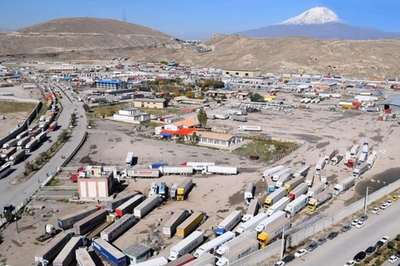
Iraq remains Iran’s second-largest non-oil export market after China, but exports to Iraq dropped 12% year-on-year to $4.5 billion, mostly food products.
In late September, Iraq banned the import of 44 types of agricultural and livestock goods to protect domestic producers, further cutting Iranian exports.
Three-quarters of Iran’s total exports now go to just five countries—China, Iraq, the United Arab Emirates, Turkey, and Afghanistan—underscoring the growing concentration and isolation of its trade.
The same pattern holds for imports. For the first time, 80% of Iran’s imports this year have come from only five countries: the UAE, China, Turkey, India, and Germany.
The trend is not promising for Tehran as UN sanctions return: if trade with Russia fails to recover, nearly all of Iran’s economic eggs will be in the Chinese basket.