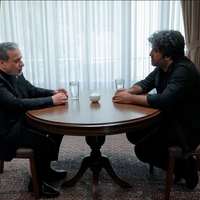
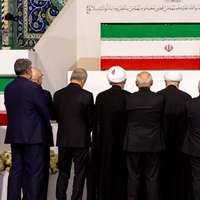
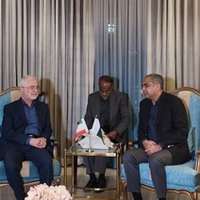
IAEA chief Rafael Grossi and Iranian Foreign Minister Abbas Araghchi sign an agreement to advance resumed nuclear inspections in a ceremony in Cairo, Egypt on September 9, 2025.
Iranian ultra-hardliners are criticizing Tehran's recent agreement with the IAEA in Cairo, despite its blessing by a top decision-making body linked to the Supreme Leader, but an outlet linked to the Revolutionary Guards offered support.
The scrambled messaging suggests deep disagreement on Iran's diplomatic path forward as renewed UN sanctions loom by months-end and arch-foe Israel continues to moot military attacks to chasten Tehran.
Negotiated by Foreign Minister Abbas Araghchi, the Cairo deal addressed an impasse between the UN nuclear watchdog and Tehran after the latter refused to let inspectors resume work following surprise US and Israeli attacks on Iranian nuclear sites in June.
While ultra-hardliners warn it risks national security, supporters insist the agreement reflects careful diplomacy rather than a threat to sovereignty.
Iranian lawmakers convened an emergency meeting with Araghchi on Saturday to review the agreement.
The Supreme National Security Council released a statement shortly after the session announcing that the deal aligns with its nuclear committee’s prior approval, emphasizing that submission of reports on facilities targeted by US and Israeli attacks, and any further operational procedures, would require SNSC authorization.
“While the government emphasizes the legal frameworks and the Supreme National Security Council’s approval for the agreement with the IAEA, ultra-hardliners are using media campaigns to try to disrupt the decision-making process,” independent news outlet Rouydad24 wrote.
Supremo stamp sought
“Araghchi claims he has authorization from the Supreme National Security Council to negotiate (with the IAEA) … and (claims) that the council’s decisions are also endorsed by the Supreme Leader,” hardline MP Ahmad Bakhshayesh, a staunch critic of the IAEA deal and the 2015 nuclear agreement, told Rouydad24.
Mojtaba Zarei, a member of parliament’s National Security and Foreign Policy Committee, posted on X that Araghchi “has acted fully within the country’s legal and strategic framework, and never unilaterally.”
His negotiations, Zarei added, have followed the Supreme Leader’s policies, the Supreme National Security Council’s guidance and recent parliamentary laws, without exceeding his authority or granting IAEA inspectors unrestricted access.
NPT in the crosshairs
Ultra-hardliner lawmakers, having recently passed a high-priority bill that could lead to Iran’s withdrawal from the Nuclear Non-Proliferation Treaty (NPT) and halting cooperation with the IAEA, continue to challenge the agreement.
Hamid Rasaei, an ultra-hardliner lawmaker, insisted in a video posted on X that contrary to what Araghchi told lawmakers, the deal could not block the reimposition of UN sanctions under the snapback mechanism.
“If this agreement bypasses the law, involves violations, or represents a deviation, we will uphold and defend the law,” another ultra-hardliner lawmaker, Eshareh Azizi, threatened.
Ultra-hardliners also say the agreement risks exposing sensitive nuclear sites.
“Technical agreements with the IAEA could be used as a cover for intelligence gathering, preparing the ground for a new attack on Iran, and creating a legal-political framework to increase sanctions pressure,” Kayhan newspaper funded by the Supreme Leader’s office alleged in an editorial on Monday titled “Europe Will Not Lift Sanctions, Don’t Be Deceived by the IAEA”.
The editorial suggested that leaving the NPT “remains one of the (most) viable options to change the game in Iran’s favor.”
IRGC outlet defends the deal
But a commentary by Basirat, an outlet affiliated with the IRGC’s political bureau, described the Cairo agreement as “a vital achievement in managing the nuclear file at its most sensitive juncture” and “a success.”
“The agreement prevented a new resolution against Iran and created breathing space for continued negotiations,” the commentary titled “Cairo Deal: Redefining Iran's Relations with IAEA” asserted.
Noting that the agreement distinguishes targeted nuclear facilities from others, allowing Iran to manage oversight and safeguard security concerns, it concluded that the deal can be seen as “a valuable opportunity to reduce tensions and return to the path of dialogue.”
On the eve of the anniversary of Mahsa Amini’s death in police custody, families and victims of Iranians killed, tortured or injured by authorities have issued an open letter to world leaders calling for urgent international action to confront Tehran.
The signatories warn that current policies only embolden Tehran, which they describe as a menace to foreign powers and its people alike which survives solely through violence.
“The people of Iran have shed blood and stood firm. Now it is time for the international community to act for its own security. The struggle of the Iranian nation will be remembered in history as a sacrifice not only for freedom but also for the security of the world,” the letter states.
Her death sparked widespread outrage and ignited the Women, Life, Freedom protest movement which was quashed with deadly force.
In their letter, the families and victims demanded governments formally designate the Islamic Revolutionary Guard Corps (IRGC) as a terrorist organization, cut diplomatic and economic ties with Tehran, and impose sanctions on the IRGC’s financial, military and cyber networks.
"The people of Iran have shed blood and stood firm. Now it is time for the international community to act for its own security. The struggle of the Iranian nation will be remembered in history as a sacrifice not only for freedom but also for the security of the world," it read.
The families portray the Islamic Republic as weakened at home and increasingly isolated abroad. They point to the twelve-day war in June, during which the United States and Israel jointly struck nuclear sites and targeted senior IRGC officials, as a punishing blow.
Meanwhile, Iran’s economy continues to collapse. The rial has lost more than 90 percent of its value since US President Donald Trump imposed “maximum pressure” sanctions in 2018.
Coupled with widespread drought, empty taps and persistent electricity shortages, the instability is fueling fears of mass migration that could destabilize neighboring countries already struggling with refugee challenges.
The letter is signed by more than 100 victims and families of those killed or injured during nationwide uprisings in 2017, 2019, and 2022.
Among the public signatories are the families of people killed during the 2022 protests including Majid Kazemi, Mino Majidi, Pouya Bakhtiari and Aida Rostami, along with dozens of survivors who suffered severe injuries.
An image of Mahsa (Zhina) Amini, an Iranian Kurdish woman, is displayed on a pole during a protest following her death, in Los Angeles, California, US, September 22, 2022
The United States marked the third anniversary of Mahsa "Jina" Amini’s death in Iran's police custody on Monday with a statement condemning the Islamic Republic leadership and pledging continued pressure on Tehran.
“On the third anniversary of her savage murder, we honor the memory of Mahsa Zhina Amini, whose young life was cut short by the Islamic Republic of Iran,” Thomas “Tommy” Pigott, principal deputy spokesperson at US State Department said in a statement on Monday.
“Her murder, along with so many others, is a damning indictment of the Islamic Republic’s crimes against humanity. The United States will continue to work with allies and partners around the world to ensure that the regime’s atrocities are met with accountability, justice, and resolve,” Pigott added.
Amini, 22, died on September 16, 2022, after being detained by Iran’s morality police for allegedly violating mandatory hijab rules. Her death sparked months of protests dubbed Woman Life Freedom uprising during which at least 551 protesters, including 68 children, were killed, according to rights groups, and thousands detained.
Iran has executed 12 detainees linked to the 2022 protests, with eight others sentenced to death and awaiting execution, according to the US-based Human Rights Activists News Agency (HRANA).
Pigott accused Iran of ruling “through torture and execution,” neglecting its own people while funding regional militias.
“The United States stands with the people of Iran in their calls for dignity and a better life. We will continue to apply maximum pressure on the Islamic Republic, ensuring it is held accountable for actions against its people and against its neighbors,” Pigott said.
International Atomic Energy Agency (IAEA) Director-General Rafael Grossi addresses a news conference during an IAEA Board of Governors meeting in Vienna, Austria, September 12, 2022
International Atomic Energy Agency (IAEA) chief Rafael Grossi on Monday urged Iran to immediately implement the agreement it signed with the UN watchdog last week to resume inspections at the country’s bombed nuclear sites.
"It is now time to implement the agreement ... A return of IAEA inspectors and the resumption of safeguards implementation in Iran would serve as a good sign that agreements and understandings are possible," Grossi said at the IAEA General Conference in Vienna on Monday.
Grossi's remarks come a week after Iran and the IAEA signed a new agreement in Cairo on the practical modalities to resume inspection activities in Iran. He described the new arrangement as a framework to resume technical work and rebuild trust.
“Now it’s up to us together, Iran and the agency to implement it, restore confidence, and move forward,” he said.
The deal appeared to break an impasse between the UN nuclear watchdog and Tehran after the latter refused to let inspectors resume their work following surprise US and Israeli attacks on Iranian nuclear sites in June.
But Iranian Foreign Minister Abbas Araghchi appeared to swiftly add a note of caution following its inking, saying details and restored relations must yet be explored.
Peace in peril
Grossi said that when the agency can fully carry out its mandate and answer all outstanding questions, “there will be no doubt and peace is guaranteed.”
“When that ability is compromised or limited, or when we cannot do what we are supposed to do, then international peace and security are indeed at risk,” Grossi added.
Grossi warned that history had shown the dangers of restricting the agency’s work, saying, “We have seen this throughout history, particularly though not only in the Middle East, and dramatically last June in Iran."
Israel launched a surprise military campaign on June 13 targeting Iranian nuclear and military sites, including senior commanders and nuclear officials in a conflict that lasted 12 days.
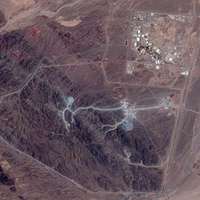
On June 22, the United States joined the campaign, striking nuclear facilities in Fordow, Natanz and Isfahan. Washington brokered a ceasefire on June 24.
In response, Iran’s parliament passed legislation suspending all cooperation with the IAEA, but international pressure has grown for Tehran to restore ties with the agency.
Last month, France, Germany and the United Kingdom triggered the UN snapback sanctions mechanism, leaving a 30-day window for diplomacy before sanctions are due to take effect on October 18.
One of the demands of the three European countries is the immediate resumption of full work between Iran and IAEA.
Security chief Ali Larijani poses beside the Iranian flag in this file photo
Ali Larijani, Iran’s newly appointed security chief, courted controversy on Monday by suggesting Americans could be driven to suicide when hearing Prime Minister Benjamin Netanyahu describe Israel as a bulwark of American civilization.
"When a rootless child-killing criminal like @Netanyahu calls himself 'the frontline of American civilization', you can’t blame Americans if they feel like suicide," Ali Larijani wrote on X.
Larijani is a relative moderate and veteran insider who was elevated to lead Iran's Supreme National Security Council following a 12-day war in which Israel and the United States pounded Iranian nuclear and military sites, leaving hundreds dead.
It was unclear what Larijani meant by the assertions. "Rootless cosmopolitan" was a slur deployed in the Soviet Union directed at intellectual figures and particularly Jews, and the descriptor has been consistently deployed by anti-Semitic polemicists.
Critics of Israel have frequently scorned the relatively recent arrival of its leaders or their families from other countries in the twentieth century.
The Israeli premier's father, who was born in Poland as Benzion Mileikowsky, later adopted the Biblical surname Netanyahu and became a preeminent scholar or early modern Spain.
Larijani's assertion on the United States was less direct and could have been a reference to a fraught moment in American politics as political polarization deepens in the wake of the assassination of prominent political commentator Charlie Kirk.
Holding a PhD in philosophy and the rank of brigadier general in Iran's Islamic Revolutionary Guard Corps, Larijani has long plied a deft course around public debates which have divided Iran's ruling factions.
Larijani also serves as Supreme Leader Ali Khamenei's personal representative to the key decision-making SNSC, an apparent key endorsement by Tehran's top authority.
His new mandate is widely seen as righting Iran's security tack after lapses allowing Israeli attacks to kill nuclear scientists along with hundreds of military personnel and civilians.
In the sensitive new role, Larijani has stepped up the frequency and edge of his social media criticism of Israel and the United States, especially following the 12-day war in June.
Iran's President Masoud Pezeshkian (left) meets Qatar's emir in Doha on September 15, 2025
Iranian President Masoud Pezeshkian said Israel’s September 9 strike on Hamas leaders in Doha amounted to terrorism and warned that no Arab or Muslim capital is safe from future attacks.
"There should be no doubt that last week’s attacks on Doha were pure terrorism; proof that the Tel Aviv regime has cast aside every moral and legal restraint," Pezeshkian told an emergency summit of Arab and Islamic leaders in Doha on Monday.
The Iranian president said the strike was a pre-planned attempt to destroy diplomatic efforts to end the war in Gaza.
“This aggression against diplomacy is more than a crime; it is an open and shameless declaration that now military power, and not law, is decisive,” he added.
Israeli warplanes bombed a Hamas office in Doha on Tuesday, in what Israel described as ac targeted attack against the group’s senior leadership.
They missed their intended targets, killing a Qatari security official and five lower-ranking Hamas personnel.
Qatar denounced the attack as “criminal and cowardly,” while Iran called it an “extremely dangerous” violation of sovereignty and international law.
Pezeshkian accused the United States and Western powers of giving Israel decades of impunity through vetoes, trade and diplomatic protection.
“When a rogue regime receives weapons, financing and diplomatic support under any circumstances, it learns that there are no limits. History will remember the guilt of those who supported this aggression,” he said.
“The Zionist regime has declared war against our sovereignty, dignity and future. We will not be intimidated, we will not be divided, and we will not remain silent. From the ashes of Gaza, justice will rise. From the rubble of destroyed buildings in Doha, Beirut, Tehran, Damascus and Sanaa, a new order will emerge,” Pezeshkian said.
Israeli Prime Minister Benjamin Netanyahu, meanwhile, said on Monday he would not rule out further strikes on Hamas leaders “wherever they are.”
The September 9 strike in Doha marked a sharp escalation of Israel’s campaign, in a region already convulsed by conflict since the Hamas-led October 7, 2023 attacks that ignited an ongoing war in Gaza.
It appeared to push a negotiated solution to the Gaza conflict further away and left in doubt the next chapter of a regional confrontation pitting Iran against Israel and the United States.