US wants Iran to negotiate over its missiles in nuclear talks - Reuters
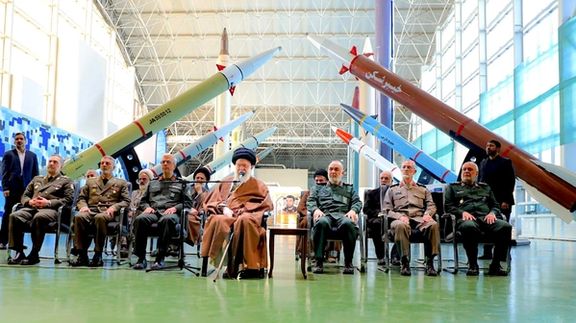
The ongoing negotiations between the United States and Iran are not limited to Tehran’s disputed nuclear program but also include its missile program, Reuters reported on Friday, citing an Iranian official with knowledge of the talks.
Following a second round of talks in Rome on April 19, Iranian negotiators were "persuaded that the US had accepted Tehran's position that it would not entirely end its enrichment program or surrender all the uranium it has enriched already."
However, the official was quoted as saying that Iran's missile program remained a big sticking point.
"The only remaining point of disagreement in the general discussions and mutual understanding is the missile issue," the report said citing the Iranian official.
The Islamic Republic insists that its missile program is a non-negotiable element of its defense strategy. The Trump administration has also refrained from mentioning Iran's missile program, emphasizing that the focus of its ongoing talks with Tehran is solely to prevent the country from acquiring a nuclear weapon.
Iran's chief negotiator Abbas Araghchi has arrived in Muscat and his American counterpart Steve Witkoff has also departed Russia for Oman to attend the third round of talks with Tehran slated for Saturday.
The United States urged Syria’s interim authorities to prevent Iran and its allied groups from exploiting the country’s territory, while Iran accused Washington of worsening Syrians' suffering through sanctions, during a UN Security Council meeting on Friday.
"We will hold Syrian interim authorities accountable for the following steps to fully renounce and suppress terrorism, adopt a policy of non-aggression to neighboring states, exclude foreign terrorist fighters from any official roles, prevent Iran and its proxies from exploiting Syrian territory," said Dorothy Shea, the Deputy US representative to the United Nations in New York.
Iran’s representative Amir Saeid Iravani, in turn, said US sanctions were worsening the suffering of Syrians and hampering reconstruction.
Iran supports free elections and the formation of an inclusive government in Syria, Iravani added, calling for the immediate withdrawal of all foreign forces from Syria.
The Iranian envoy also warned that the presence of foreign forces undermines the country’s sovereignty and delays peace efforts.
To signal and justify possible nuclear concessions in ongoing US talks, Iran's Supreme Leader has once again alluded to a historic concession by a Shi'ite Muslim leader to buy time against a stronger foe.
The reference was the same deployed by the wily 86-year-old theocrat to justify Iran's agreement to a landmark 2015 nuclear deal.
Speaking Thursday at a modest religious gathering in his office on Thursday, Supreme Leader Ali Khamenei recalled how the second Shia Imam, Hasan ibn Ali—seen by Shia Muslims as a paragon of just leadership—signed a controversial peace treaty with hated foe Mu'awiya in 661 CE.
The treaty, Khamenei said, was a calculated move to safeguard the long-term interests of Islam.
Although he made no direct mention of the ongoing nuclear negotiations with the United States, the allusion is almost certainly a subtle endorsement of diplomacy.
“Some people would come forth with complaints and objections when Imam Hasan made peace with Mu’awiya … it is temporary. The Imam has been recorded as saying that this incident, this domination of heresy and hypocrisy, is not meant to be permanent,” Khamenei said.
Khamenei’s tone marks a shift from early February, when he dismissed engagement with US President Donald Trump as “unwise, undignified, and dishonorable" after Washington reimposed so-called maximum pressure sanctions.
While expressing wariness of the West, his stance has since shifted to cautious pragmatism. “We are neither overly optimistic nor overly pessimistic about these talks,” he said after the first round of talks earlier this month, before adding a sharp caveat: “I am very pessimistic about the other side.”
Khamenei used the same historical reference in 2013, branding Imam Hasan’s decision as an act of “heroic flexibility”—a phrase that became a byword for Iran’s nuclear diplomacy which helped seal the 2015 Joint Comprehensive Plan of Action (JCPOA).
“Khamenei resorts to tactical retreat whenever he finds himself in a difficult position,” US-based commentator Ali Afshari told Iran International TV.
“He is trying to warn and to provide a rationale (for his decisions) to his radical supporters. He is telling them they should not raise objections because acceptance of a deal is a tactical move rather than a strategic position.”
Hardline objections
The reference to Imam Hasan’s treaty follows a broader softening of rhetoric among clerics, politicians and media outlets after the first round of indirect US-Iran talks in Oman on April 12.
But Khamenei’s approval of diplomacy with the United States has exposed rifts among Iran’s hardliners. While some factions are rallying behind his position, some others—particularly ultra-hardliners who refer to themselves as the real revolutionaries—have expressed frustration.
In further comments on Thursday, the Supreme Leader appeared to confront those naysayers.
"Our neglect, at times our loose lips, our failure to help, our needless protests, lack of patience, (and) at times the flawed analyses that we make about the situation, can sometimes have an impact," he said. "One must be very careful."
With Khamenei’s authority remaining unchallengeable, dissent remains subdued and blame is often cast on others rather than Khamenei.
“The biggest reason (for Imam Hasan’s peace deal) was the lack of a loyal army," Sasan Daneshpajouh, an ultra-hardliner social media influencer with over 33 thousand followers posted on X.
"The Imam made a deal to save the Shi'ites from death and destruction, so that in the future they could form an army and ultimately win,” he added, implying Khamenei would not have been pushed into concessions had he possessed more loyal followers.
Israel’s Minister of Strategic Affairs Ron Dermer, in a recent meeting in Washington DC, told senior US officials that Iran’s underground nuclear sites could be destroyed if the US Air Force used its 30,000-pound bunker buster bombs, the Washington Post reported on Friday, citing former Israeli and US intelligence officials familiar with the meeting.
A team of approximately 12 working-level experts from various US government agencies will discuss more granular details about a path to a new nuclear agreement, CNN reported Friday, citing a source familiar with the matter.
The talks in Oman on Saturday will cover elements including the scope of sanctions relief on Tehran and limitations on Iran’s nuclear program, the report added.
On Thursday, State Department spokesperson Tammy Bruce said Michael Anton, the department’s head of policy planning, will lead the US technical team in the upcoming talks.
Earlier, The Washington Post reported that a team of around a dozen representatives from various departments — including State, Treasury, and the intelligence community — convened at the State Department for the first time this week to discuss the still-undetermined parameters of the administration’s demands on Iran, which are awaiting a final decision from President Donald Trump.
A top Iranian cleric has described ongoing talks with the administration of US President Donald Trump led by his special envoy and fellow property magnate Steve Witkoff as akin to a real estate negotiation in which Iran will prevail.
Mostafa Pourmohammadi, secretary of the Combatant Clergy Association and a former interior and justice minister, said Iran would get a fair deal after initial posturing and an expected back and forth.
“You want to buy a house. The seller says one million. You walk away. He tells you to wait and brings in a broker. Then suddenly the asking price drops. In your mind, you're thinking 500 or 600 is reasonable. The broker says 750, and the deal is done,” the veteran insider and conservative said in comments carried by state media.
“Neither the seller really intended to sell for 750, nor were you ready to buy at that price. But in the end, it gets resolved. That’s negotiation.”
Pourmohammadi broadly defended Supreme Leader Ali Khamenei’s approval of negotiations with the United States, in remarks that appeared aimed at easing concerns in conservative quarters.
Khamenei’s evolving stance, he said, reflected “wise leadership” in a rapidly changing world. “You cannot say the Leader’s words at one time apply to all times and all cases,” Pourmohammadi said in remarks carried by local media.
“The world is turning moment by moment. We must have the power to make wise and timely decisions. This is the logic.”
Khamenei had in February called negotiations with Washington “unwise, undignified, and dishonorable.” His recent support for talks mediated by Oman and taking place during Donald Trump’s return to the presidency marks a notable shift, particularly given longstanding hardline distrust of US intentions.
Pourmohammadi said President Trump’s public threats were part of a broader political strategy. Referring to a letter Trump sent to Khamenei in March, he said: “If Trump had written in his letter what he said in public, he would never have received a reply. But his formal letters had a different tone, revealing his real politics.”
The cleric framed the current moment as part of a broader strategic contest. “It’s not as if there’s only one moment, one issue,” he said. “This is a psychological war, and the Leader is managing it with wisdom.”
Pourmohammadi has held several senior roles across administrations but is widely known for his involvement in the mass execution of political prisoners in 1988 while serving on a state-appointed committee at Evin Prison.
Human rights organizations and exiled dissidents have linked him to the killings, which Amnesty International described as crimes against humanity. Pourmohammadi has defended the executions in past interviews, saying they were in line with the Islamic Republic's wartime policy.