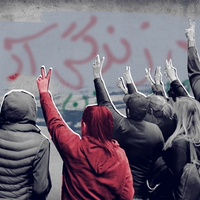
Vida Movahed protesting against compulsory hijab in Tehran in December 2017
The anti-hijab protests of Vida Movahed seven years ago have become a legacy that haunts the Islamic Republic today as a nationwide movement against the Islamic headscarf continues to blight Tehran's leadership.
Videos and photos of Movahed’s unprecedented act of defiance went viral on social media very quickly, becoming known only as “The Enghelab Avenue Girl” after, having climbed a utility box on Enghelab (Revolution) Ave in Tehran on December 27, 2017, removed her white headscarf, tied it on a stick, and waved it in protest.
The young mother of 32 was arrested within minutes.
Movahed was freed from prison a month later after her first arrest, but her bravery inspired several other young women who came to be known as the 'Enghelab Avenue Girls', protesting on the same spot.
Authorities were eventually forced to build a gable on top of the utility box to stop more girls from climbing it to protest.
Nearly a year later, the young mother climbed a turquoise dome in the center of the very busy Enghelab Square in downtown Tehran with a bunch of red, white, and turquoise balloons and a red and black headscarf in her hand to protest again. She was arrested and was this time sentenced to one year in prison for “inciting people to corruption and immorality” by unveiling.
Movahed served eight months at the notorious Qarchak Prison in the south of Tehran. She has not been seen in public since being freed in 2019 but her name and memory are honored by many every year on social media.
And today, her legacy lives large, thousands of women now appearing unveiled in public arenas, forcing authorities to retreat from implementing a harsh new hijab law drawn up by ultra-hardliners.
The movement was given a rebirth in the wake of the death of 22-year-old Mahsa Amini in the custody of the morality police. It sparked the Woman, Life, Freedom protests across the country in September 2022, protests which lasted for months and saw a tide turn against the compulsory Islamic dress.
During and after the Woman, Life, Freedom protests, scores of celebrities including artists and athletes posted unveiled photos on social media or attended public events with no headscarves. Most of the artists who expressed solidarity with the anti-compulsory hijab movement , suffering other penalties such as bank account freezes and travel bans.
Ansar al-Furqan, a Sunni jihadist and ethnic Baluch militant group deemed a terrorist organization by Tehran, claimed responsibility for a suicide bombing that killed a local military intelligence chief in southern Iran.
Local rights group Haalvsh, citing a statement by Ansar al-Furqan, reported on Sunday that the group claimed responsibility for the attack.
The attack took place outside a police headquarters in Bandar Lengeh, a town on the Persian Gulf coast.
While Iranian state media say Captain Mojtaba Shahidi Takhti, the head of Bandar Lengeh police intelligence was the only victim of the attack, a statement by Ansar al-Furqan claims Sohrab Hassan Zadeh, a senior IRGC intelligence member in Hormozgan province, and Bakhtiar Soleimanpour, a delegate from Tehran's central police intelligence unit were also killed in the incident.
Iran International cannot independently verify the militant group's claim.
Captain Javad Chatr-Sahar, the deputy head of Bandar Lengeh police intelligence, was injured in the attack, the IRGC-affiliated Tasnim News confirmed on Saturday citing the local governor.
The identity of the suicide bomber has not yet been precisely identified, the deputy security chief of Hormozgan province said on Sunday, but evidence suggests they were affiliated with what he called terrorist groups.
Authorities in Hormozgan province have arrested one individual in connection with the attack, Iran's judiciary's news agency Mizan reported Sunday citing the provincial judiciary chief.
The bomber was positioned on the two police officers' exit route and triggered the explosion with a remote control, the report by Tasnim news agency said.
Security forces promptly arrived at the scene after the incident and confirmed the attacker was also killed, Tasnim added, citing the local governor Foad Moradzadeh.
The attack came days before the anniversary of twin suicide bombings in January this year claimed by Islamic State which killed nearly 100 people at a southeastern Iran memorial for late top IRGC general Qassem Soleimani.
Jalal Sherafat, a senior Iranian police commander, was killed in a car crash, Iranian media reported on Saturday.
"A vehicle belonging to the Intelligence Organization of Iran's Law Enforcement Command overturned for unknown reasons while on duty on the Ardestan to Na'ein road, near the Noor Complex," Iranian news agency Rokna reported.
"In this incident, General Jalal Sharafat was martyred due to the severity of his injuries and Major Seyyed Mohsen Mirghasemi was injured," the report added.
Sherafat previously served as the head of the Iranian Anti-Narcotics Police's Cyberspace Center at least until 2019, but it is not clear what his position was at the time of his death.
Washington on Sunday urged Iran to release an Italian journalist detained in Tehran in a case likely related to Italy's arrest of an Iranian businessman on terrorism charges at the behest of the United States.
The US State Department called for the immediate and unconditional release of Cecilia Sala, 29, and others detained without just cause.
"Unfortunately, the Iranian regime continues to unjustly detain citizens of many countries, often to use them as political leverage," a State Department spokesperson told La Repubblica.
Sala, a newspaper journalist and podcaster, was arrested on December 19 despite working there with government-issued press credentials.
"There is no justification, and they should be released immediately," the spokesperson said, adding that journalists perform critical work to inform the public and must be protected.
Sala’s detention in Tehran may be linked to the arrest of a Swiss-Iranian businessman at Malpensa Airport three days earlier on a US warrant for allegedly violating sanctions on electronic exports, La Repubblica further added citing his lawyer.
Mohammad Abedini Najafabadi, 38, faces terror-related charges for a deadly drone strike on a US military base in Jordan linked to Iran which killed three US soldiers.
He is currently held at Milan’s Opera Prison and faces potential extradition to the US.
On Sunday, a sit-in in Turin urged the Italian government to "do the impossible" to secure Sala's release and return her to Italy. Around fifty people, including city councilors and representatives from political and activist organizations, participated in the rally.
Italian Foreign Minister Antonio Tajani said on Saturday that Sala is in good health and is being held alone in a cell in Evin Prison. Tajani called for media discretion over the case and confirmed that Sala has spoken to her parents twice by phone. Italian Ambassador to Tehran Paola Amadei has also visited her in prison.
"We know that the Italian government has asked us not to demonstrate, but we disobey, we demonstrate," said Italian politician Igor Boni, a member of the organization Europa Radicale, during the Turin rally on Sunday.
"For a week, a journalist from a democratic country has been arrested without charge in a dictatorial country like Iran. The last thing to do is remain silent."
The Italian government has pledged to work discreetly to secure Sala's release as international pressure grows on Iran over what some rights groups describe as a practice of detaining foreign nationals as political bargaining chips.
Iran's government has warned the country's ultra-hardliners and their vigilante groups of serious consequences if they continue to sow “discord” with their apparently growing protests against the President's new, more progressive policies.
Ali Zeynivand, the political deputy of Iran's Interior Ministry, told the Iranian Labour News Agency (ILNA) on Saturday that individuals behind recent protests against issues such as the easing of internet restrictions, have been summoned and cautioned.
“There have been discussions within the Ministry of Interior regarding the recent rallies,” Zeinivand said. Provincial governors have been instructed to take firm action against protests that could jeopardize national unity and solidarity. All rallies must have official permits in Iran, he added.
Zeynivand’s warning follows growing criticism from political figures and media outlets, who have pointed out that while political parties and groups are routinely denied permits for rallies, ultra-hardliner vigilantes continue to stage protests with impunity against the government whenever and wherever they wish.
It remains unclear whether the Interior Ministry’s move to curb the activities of vigilantes is driven by the President's admiinstration, a higher authority such as the Supreme National Security Council (SNSC), or is a direct directive from Supreme Leader Ali Khamenei whose policies guide Iran's key security ministries of interior, intelligence, and defense.
Ultra-hardliners have accused President Masoud Pezeshkian of colluding with Iran's enemies by advocating negotiations with the West to lift crippling sanctions that have devastated Iran's economy.
They also criticize him for what they say is undermining Islamic values by resisting demands to implement a new hijab law and for taking steps to ease internet restrictions.
The group of hardliners also hold Pezeshkian responsible for the lack of a military response to Israeli airstrikes on Iran in October, accusing him of delaying the so-called “True Promise 3” retaliation.
As they look to attribute blame, the president has also become the fall guy for the depreciation of the national currency and the ongoing power outages, which the government attributes to the previous administration’s failure to stockpile fuel for power plants adequately.
Vigilantes have a long record of attacking political meetings and universities, threatening and slandering top officials including presidents and government officials in street rallies and in their media over the years but their recent focus on Pezeshkian’s government has become particularly relentless now, the reformist Arman-e Melli newspaper wrote in an editorial Saturday.
The newspaper’s editorial referred to these actions as ultra-hardliners' “street maneuvers” to pressure the government.
Vigilantes, often linked to the Revolutionary Guards' Basij militia, were behind the high-profile attacks on the British embassy in November 2011 and the Saudi embassy in January 2016, both of which led to significant diplomatic crises for Iran.
Although the perpetrators were well-known to authorities, they were never held accountable for the extensive damage inflicted on Iran's international reputation and relations.
Ultra-hardliner protesters climbing over the gate of the UK Embassy in Tehran in November 2011
Earlier this week, ultra-hardliners linked to the Paydari (Steadfastness) Party and another group with close ties to the former nuclear negotiator Saeed Jalili announced plans to protest after Friday prayers on motorbikes against the government’s decision to unblock WhatsApp and Google Play. However, reports indicated that turnout for the protest was minimal, with only about a dozen participants.
“The question is, who has allowed them to have such power to be able to cause disruptions in the city, make baseless allegations against authorities, and to insult and threaten them,” the article asked while contending that Pezeshkian’s government will not be able to deal with ultra-hardliners and stop them from harming the system under the name of the revolution by talks and invitation to unity.
Iran's government is grappling with multiple crises, both domestic and international. Abroad, its military stand-off with Israel and the collapse of Bashar al-Assad's rule in Syria have thrown foreign policy into chaos. Direct attacks from Israel have seriously damaged Iran's defense systems while losing its stronghold in Syria has weakened its influence across the region.
Meanwhile, at home, economic challenges such as high inflation and the unprecedented depreciation of the national currency, serious energy shortages, and widespread popular discontent over issues like hijab enforcement and internet filtering still risk sparking further unrest.
A suicide bomber attacked the front of a police headquarters in Bandar Lengeh in southern Iran on Saturday night, killing the head of the port city's military intelligence, the IRGC-affiliated Tasnim News reported.
Captain Mojtaba Shahidi Takhti succumbed to his injuries in the hospital, and one accompanying officer identified as Captain Javad Chatr-Sahar was also injured, the report said citing the local governor.
The bomber was positioned on the two police officers' exit route and triggered the explosion with a remote control, the report by Tasnim said.
Security forces promptly arrived at the scene after the incident and confirmed the attacker was also killed, governor Foad Moradzadeh said.
It was not immediately clear who was behind the attack.
Jaish Al-Adl militants who seek to break away from Iran operate more in Iran’s southeast rather than its central coast.
Radical Sunni Islamic State militants have also launched repeated deadly suicide attacks against state and military targets in the Shi’ite theocracy.
Shahidi Takhti and the other officer injured in the attack "were immediately transported to the hospital," governor Moradzadeh added. However, the former succumbed to the injuries despite the efforts of the medical team.
The condition of injured officer Chatr-Sahar is currently reported as stable, a local judiciary official was quoted as saying.
The public pressure has grown so much in the past year that even Supreme Leader Ali Khamenei appears to have agreed to the shelving of a new and more radical law to enforce hijab, for the fear of inciting unrest if brought into effect.
In a speech in April 2023, Khamenei said that flouting hijab was “religiously and politically haram (forbidden)”, accused foreign intelligence services of encouraging Iranian women to disobey the mandatory head-dress, and urged the authorities to do whatever it took to enforce it.
In his latest speech to a group of women on 17 December, very uncharacteristically, he did not refer whatsoever to the hijab issue and the controversies surrounding it.
Public acts in defiance of the hijab have grown to new heights in recent months despite authorities' threats of severe legal crackdowns, occasional violence against women on the streets, and measures such as impounding vehicles if unveiled women are spotted in them.
There have been a string of now iconic protesters since. In early November, another young woman, Ahu Daryaei, shed her clothes at a university campus in Tehran, reportedly after being harassed by hijab enforcers. She was arrested and sent to a mental health facility but was freed later without charges being brought against her after the story went worldwide.
A few weeks later, Parastoo Ahmadi, a songstress, performed in a historic caravansary in a black evening dress that showed her bare shoulders and streamed her concert live on YouTube. Ahmadi and her band were arrested too but were later released on heavy bail.
Before Movahed’s public act, women’s defiance of hijab had only been done in safe spaces. A campaign was launched by women’s rights activist Masih Alinejad in 2014 on Facebook, My Stealthy Freedom.
Women contributed photos of themselves taken in the car on quiet roads with their hair flowing on their shoulders or in other places where they could “stealthily” remove their headscarves.
But nothing could have predicted the country's biggest rebellion against the mandatory hair covering which has swept the nation, posing the biggest challenge to the government since the Islamic Republic was founded as women from all over Iran continue to rise up.