Iran's vice-president announced that the administration is drafting a bill to amend the highly controversial hijab law, which the Parliament Speaker had promised would take effect on December 13.
“We will send an amendment bill to the Parliament to halt [the controversies over its implementation] now to conduct further investigations,” Deputy President in Parliamentary Affairs, Shahram Dabiri, announced Saturday.
Reformist media and politicians have extensively criticized the new hijab law, spearheaded by lawmakers of the Paydari (Steadfastness) Party and their allies in the parliament, notably the Jebhe-ye Sobh-e Iran (MASAF) that was established less than a year ago. Ultra-hardliners of the Parliament have the backing of the Constitutional Guardian Council whose approval is required for all legislation.
Both groups have close ties to the ultra-hardliner former nuclear negotiator Saeed Jalili who lost the recent presidential elections to Pezeshkian and a shadowy cleric, Ayatollah Mohammad-Mehdi Mirbagheri with an extremely radical interpretation of the Sharia.
More reformist clerics have criticized the law. “This law’s implementation is fraught with political and economic problems and [will result in] stirring up hate and aversion to religion … making it official means neglecting the country’s [serious] political, social, and cultural problems,” Ayatollah Mohammad-Ali Ayazi, a member of the reformist association of Qom Seminary clerics told the moderate conservative Khabar Online Saturday.
Ayazi also argued that ultra-hardliners’ insistence on immediate enforcement of tough hijab enforcement measures is meant to sabotage the Pezeshkian government’s efforts to remedy the more urgent problems it is grappling with. Ayatollah Ali-Akbar Masoudi Khomeini, another member of the same association, has expressed a similar view.
Despite agreeing with the hijab as a religious principle, several top-ranking clerics, including Ayatollah Abdollah Javadi Amoli, have criticized ultra-hardliners’ insistence on implementing the new law in loosely veiled terms.
“This law suggests that they [the government] want to lead people to paradise by force,” conservative cleric Mohsen Gharavian who has been an outspoken critic of the new hijab law told Khabar Online. “Maybe we don’t want to go to paradise. What should we do [if we don’t]?” he added.
On Saturday, the relatively independent Rouydad24 news website wrote: “It appears that [the delay resulted from] the administration’s negotiations [with higher entities] to postpone the implementation of the Act and make some amendments to it have been successful."
Rouydad24 added that authorities at the highest level may have agreed that the controversial legislation formulated by ultra-hardliners cannot be enforced in the current circumstances.
A powerful former security chief inserted himself anew into Iran's fraught domestic power milieu and increasingly exposed position abroad by saying he is a key decision-maker on Iran's global role and nuclear diplomacy.
"I have been entrusted with the project of determining Iran's position in the global order," Ali Shamkhani, secretary of Iran's supreme national security council from 2013 to 2023, said in an interview with Nour News.
The Iranian outlet cited him as adding that he is the official ultimately responsible for the country's nuclear diplomacy dossier and sanctions.
The assertions appeared aimed at reviving the relevance of a figure whose hardline stance on engagement with outside powers has been criticized by relative moderates as Iran's geopolitical influence wanes and economy suffers.
Shamkhani defended legislation he is widely believed to have crafted in December 2020 to boost Iranian uranium enrichment up to 20% which was blamed for harming chances for reviving a lapsed nuclear deal just as relative dove Joe Biden took office.
"The Strategic Action Plan is not a bad law; it was proposed in response to Trump's pressures, and our nuclear achievements are owed to this law," Shamkhani said.
His remarks come as Iran faces a dilemma over whether to double down on a muscular military policy in the region which has taken a severe pounding from Israel or to re-engage the West its disputed nuclear as Donald Trump's return looms.
The influential former military figure has been under intense scrutiny lately over his family's sprawling business interests.
Shamkhani's interview seems to have backfired as critics linked to the Reform camp and the government of former President Hassan Rouhani have again criticized him as a cause of Iran's woes who has been enriched by dodging sanctions which plague the livelihoods of ordinary Iranians.
His comments appear to be a deliberate doubling down on hawkish policies despite mounting domestic and international woes.
“Hardline and aggressive agents chosen by #Trump, if they learned from the past, will have no choice but to opt for rationality and respect in the face of Iranians' strong will to continue #Resistance,” Shamkhani said in a post on X last month.
Shamkhani, formerly a rear admiral in the IRGC, has in recent years become widely known for his and his sons' roles as emerging oil tycoons. They have been implicated in circumventing US sanctions and selling the Islamic Republic's oil through the use of ghost fleets. The allegation of oil dealings became a widely publicized affair in international media in 2024.
Shamkhani’s reputation as a corrupt insider extends beyond his alleged involvement in dubious oil dealings. After the collapse of a high-rise building in Abadan in 2022, which resulted in the loss of dozens of lives, accusations emerged linking Shamkhani and his associates to financial corruption and the exploitation of his influence as a rear admiral. While Shamkhani denied the corruption allegations, Iranian media remained skeptical, citing substantial evidence that cast doubt on his claims of innocence.
(From left) Former Foreign Minister Mohammad Javad Zarif, Ali Shamkhani, and former president Ebrahim Raisi
In the interview, Shamkhani criticized former presidents and claimed he had never voted for Mahmoud Ahmadinejad, Hassan Rouhani, or Ebrahim Raisi. However, critics accused him of complicity in nearly every major decision made in Iran over the past 45 years, including significant financial scandals, while attempting to shift blame onto others.
Mohammad Heydari, managing editor of the Rouydad 24 News website in Tehran, noted that Shamkhani was an integral part of the administrations led by the very presidents he claims not to have voted for. As such, he bears responsibility for their actions and decisions.
Former Reformist MP Mahmoud Sadeghi in a video posted on X accused Shamkhani of being responsible for opening fire at protesters in major demonstrations since 2018. "We never forget and never forgive that."
In another post on X, Iranian political analyst Rouhollah Rahimpour argued that since Shamkhani claims to oversee Iran's nuclear dossier, he should be held accountable for the failures of past nuclear negotiations and possibly those in the future.
Bahram Parsaei, a member of the parliament from Shiraz wrote that Shamkhani has played a major part in the failure of the Rouhani administration and in the inclusion of Iran in the FATF blacklist, which significantly restricts Iran’s international banking and trade.
Although Shamkhani may have chosen to take part in that interview was to overshadow the controversy about his oil empire linked to his family, the decision could signal renewed political ambitions.
Shamkhani has made it clear more than once that he wishes to rise to the post of the security chief again, although Khamenei has so far demurred. Former President Hassan Rouhani has said that Khamenei was against Shamkhani's appointment as security chief in his government.
The Islamic Republic has officially postponed the implementation of the controversial hijab law that imposes severe penalties on women and girls who defy veiling requirements, following huge backlash from the public and the international community.
Iran's Supreme National Security Council, in a letter to the parliament on Saturday, requested that the process of implementing the Hijab and Chastity law be halted so that an amended bill can be submitted to the parliament by the government, said a member of the Parliament's presiding board.
The 'Law on Protecting the Family through the Promotion of the Culture of Chastity and Hijab,' comprising 74 articles, was set to take effect yesterday. It imposes severe penalties on women and girls who defy veiling requirements, including exorbitant fines, prison terms, flogging, and even death penalty.
On Tuesday, Amnesty International condemned the new law, saying it intensifies the oppression of women and girls while exposing activists opposing the rules to charges carrying the death penalty.
“Iranian authorities have adopted a new draconian law that further erases the human rights of women and girls, imposing the death penalty, flogging, prison terms and other severe penalties to crush ongoing resistance to compulsory veiling,” Amnesty International said in a press release.
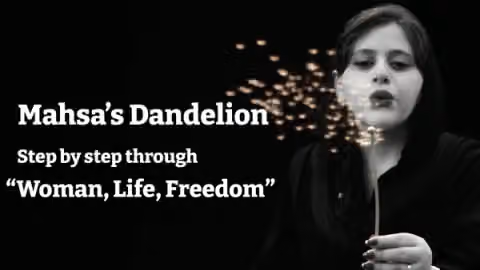
Drafted in May 2023, less than a year after the Woman Life Freedom uprising sparked by the death in custody of Mahsa Amini in September 2022, the law was introduced in response to widespread defiance of compulsory veiling by women and girls, Amnesty said.
Amnesty detailed sections of the new law and how it, warning it criminalizes acts such as “nudity, indecency, unveiling and bad dressing.”
Article 50 of the law defines “unveiling” as failing to cover the head with a hijab, chador, or headscarf. “Bad dressing” is defined in Article 48 as exposing body parts below the neck, other than the hands and feet, or wearing clothing deemed to “contribute to or incite sin by others”.
However, the rights group warned terms such as “nudity” and “indecency” remain undefined in the new law, allowing for subjective interpretation and enforcement.
Amnesty highlighted that activism against the hijab law may even be deemed “corruption on earth,” a charge punishable by death under Iran's penal code—a concern recently raised by Iranian women’s rights activists.
“This shameful law intensifies the persecution of women and girls for daring to stand up for their rights following the ‘Woman Life Freedom’ uprising,” said Diana Eltahawy, Amnesty International’s deputy regional director for the Middle East and North Africa.
Iranian-American journalist Reza Valizadeh, who previously worked for a US government-funded broadcaster, has been sentenced to 10 years in prison by a Tehran Revolutionary Court.
Valizadeh has also been banned from residing in Tehran and neighboring provinces, prohibited from leaving the country, and barred from political party membership for two years, defense attorney Mohammad Hossein Aghasi tweeted on Friday.
Valizadeh worked for Radio Free Europe/Radio Liberty's Persian Service, known as Radio Farda, for 10 years before leaving the organization in November 2022. In March, after 14 years abroad, he returned to Iran to visit his family, according to a tweet he posted. Despite receiving assurances from security officials over the phone that he would not face any problems, authorities arrested him in September.
His two court sessions, held in November, proceeded without a prosecution representative, with the judge taking on that role, according to Radio Farda.
People close to the journalist say he walked into a "security trap" after receiving informal assurances from Iranian security officials that he would not face legal issues upon returning to Iran.
According to HRANA, Valizadeh remains in Ward 209 of Evin Prison, a section run by the Ministry of Intelligence, where he lacks access to basic amenities and visitation rights.
Valizadeh’s sentence was communicated to him and his lawyer only after a delay. HRANA rights group also reported that he has not been moved to the prison’s public ward, even though investigations have concluded.
International organizations, including Reporters Without Borders and the Committee to Protect Journalists, have criticized Valizadeh’s detention. The US State Department called his arrest unjust and described it as a violation of international law.
"Iran routinely imprisons U.S. citizens and other countries' citizens unjustly for political purposes. This practice is cruel and contrary to international law," a State Department spokesperson said last month.
Before his emigration, Valizadeh was briefly detained in 2007 in Iran. His professional history includes working with outlets such as Radio France, Voice of America, Radio Farda, and Iran’s state broadcaster IRIB.
Iranian security forces arrested and released female singer Parastoo Ahmadi during the weekend, after she livestreamed aconcert without mandatory hijab in defiance of the Islamic Republic's law.
Ahmadi was arrested in Mazandaran, northern Iran, three days after she published on YouTube her unveiled performance in a caravanserai, her lawyer Milad Panahipour told Emtedad news website.
"We have no information about the charges against Parastoo Ahmadi, the arresting authority, or her place of detention," Panahipour said.
Two members of her band, Ehsan Beiraghdar and Soheil Faghih-Nassiri, were also arrested on Saturday, according to the lawyer. All three were released by Sunday morning.
On December 12, the Judiciary of the Islamic Republic issued a statement saying that the concert was held "without legal authorization and adherence to Sharia principles" and that "appropriate action" will be taken against the singer and production team.
The Caravanserai Concert, held on Wednesday night, quickly became one of the most discussed topics on Iranian social media.
Despite YouTube being restricted in Iran, the performance has attracted over 1.5 million views over the past three days, with clips widely shared online.
Ahmadi, in her introduction, described the concert as hypothetical, saying, “I am Parastoo; a girl who wants to sing for the people she loves... this is a right I could not forsake.”
Ahmadi was born in 1997 in Nowshahr in northern Iran. She is a graduate in directing from Sooreh University and spent years playing the piano and doing song covers which she shared on her Instagram page.
Iranian law prohibits women from singing solo or appearing in public without a hijab. Ahmadi’s performance, in which she bared her shoulders, challenged these long-standing restrictions.
Her earlier acts of defiance, including a rendition of Az Khoon-e Javanan-e Vatan (“From the Blood of the Youth of the Nation”) during 2022 nationwide anti-veil protests, had already brought her into conflict with authorities. Following that performance, she was summoned by security officials and her home was searched.
Artistic defiance has become a hallmark of Iran’s protest movements, with musicians such as Shervin Hajipour, Mehdi Yarrahi, Saman Yasin, and Toomaj Salehi facing arrest for their roles in mobilizing dissent. Ahmadi’s concert continues this tradition, positioning her as both an artist and an activist in a country where such roles carry significant risks.
The judiciary’s swift action shows the government’s determination to curb what it sees as cultural transgressions, even as social media amplifies these acts of resistance to global audiences.
Authorities have transferred political prisoner Mohammad-Amin Mahdavi Shayesteh to solitary confinement ahead of his execution for "insulting Islamic sanctities" and "collaboration with the enemy," according to Iran Human Rights (IHR).
IHR noted that the charge of collaborating with Israel against 26-year-old Shayesteh, who was arrested last year, was based on confessions obtained under torture and used to expedite his death sentence. The human rights group emphasized the lack of evidence in the case, pointing out that "an empty handgun magazine" and "a pepper spray" were presented as proof of "possession of illegal weapons" to support the charge of "collaboration with the enemy."
"The Islamic Republic is experiencing its greatest crises in its history and, to prevent public protests and cover up its regional failures, resorts to intimidation through the execution of defenseless prisoners," Mahmood Amiry-Moghaddam, Director of IHR, tweeted on Friday.
In recent months, Iranian authorities have escalated their use of the death penalty, with human rights groups reporting that over 42 political prisoners currently face the risk of execution.
According to a November 21 report by HRANA, at least 133 executions were documented in the past month alone, averaging more than four per day. This follows data from the Iran Human Rights Organization, which recorded at least 166 executions in October.
HRANA’s reports reveal an annual average of 811 executions between October 2023 and October 2024, encompassing both political detainees and ordinary prisoners.
This surge in executions coincides with rising tensions between Iran and Israel, with some suggesting that the government is leveraging geopolitical crises to distract from its domestic repression.