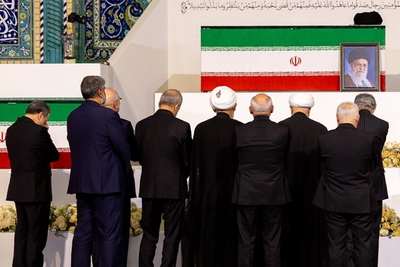
Supreme Leader Ali Khamenei and state officials praying for Seyed Hassan Nasrallah
Devotees of Iran’s Supreme Leader Ali Khamenei took to social media following his Friday sermon, praising his "valor" and leadership as he reaffirmed his support for Arab groups bent on eradicating Israel.
Khamenei, flanked by senior state and military officials at Tehran’s Mosalla, delivered two sermons—one in Persian and one in Arabic—before leading the Friday prayers.
The speech came amid expectations of an Israeli attack for Iran's large missile strike on Israel Tuesday.
Pro-establishment netizens many of whom used the hashtag#جمعه_نصر (Victory Friday) lauded the Leader for his ‘valor’ to appear in public amid Israeli danger to his life instead of hiding and “dignity”. The hashtag has also been used by Khamenei’s X account.
They also said that the “million-strong” congregation, which some of them claimed was the largest Shia Friday prayer congregation to date, would instill fear in Israel.
Based on its surface area, the venue is estimated to have a maximum capacity of 150,000 people.
“Our Leader humiliated Israel in every step today. He arrived half an hour before the sermons, delivered fiery sermons, gave messages to the people of Lebanon and Gaza, stood to prayer, and stayed after the prayer to do the afternoon prayer, too,” one of them tweeted.
“The biggest achievement of today’s Friday prayer was neutralization of the enemy’s extensive psychological warfare in various areas, both in Iran and outside it,” another pro-establishment netizen posted on X.
Establishment-aligned netizens, whose tweets far outnumbered those of the opposition, also referred to the large congregation’s attendance as a "bey’at" (pledge of allegiance) to the Leader.
Many opposition supporters, however, saw “extreme fear” in Khamenei’s face and described his voice as quivering in their posts. Many complained about his Arabic sermon which, they said, few among the congregation could understand and showed that the Arab people of Gaza and Lebanon were more important to him than Iranians.
This was not the first time Khamenei delivered the second sermon of his Friday prayers in Arabic but this time his Arabic sermon was markedly longer than his Persian sermon.
“Reassuring? You must tell this to families seeking justice [for loved ones killed in anti-government protests, the people on the street, the people whose backs are bent under the pressure of high costs of living, those who sell their kidneys to pay their rent …,” a resentful netizen retortedto reformist politician and former vice president Mohammad-Ali Abtahi who described Khamenei’s sermon as “reassuring” in a tweet.
Some claimed that it was a Khamenei double who delivered the sermons based on certain perceived linguistic irregularities in his speech. Others pointed out that the congregation had been mobilized from many other cities and claimed it included big numbers of Afghan immigrants.
“This Khamenei sermon was totally from a position of weakness. I am relieved that this system will be gone, sooner than you think,” a pro-monarchy dissident tweeted.
“He spoke the usual nonsense, [like] there will neither be war nor negotiation. Maybe he is saying Iran will not act hastily if Israel strikes, to lower the expectations of his mercenaries and the Shia youth,” another anti-Islamic Republic netizen contended in his tweet.
“The destructions in Lebanon shouldn’t concern Iran. Iranian people are themselves suffering from poverty, inflation, and high costs of living. Damn Gaza, Lebanon, Palestine, and others … I wish Israel had struck today and destroyed these [people] at the Friday prayers,” an anti-Islamic Republic netizen tweeted.
Another Iranian complained about Khamenei’s promise to help reconstruct Lebanon and Palestine although many in Iran's deprived areas such as Sistan -Baluchestan suffer from poverty. “This promise means taking [the food] from the mouths of the Iranian nation and putting it in the mouths of those in Gaza and Lebanon,” he postedon X.
“Khamenei, in fact, announced the end of the Axis of Resistance and told the people of the region to take care of the Israeli-Palestinian conflict. He has reached the end of his political era and will from now on be a leader who sits in a corner waiting for the angel of death who will make his account for his deeds,” another anti-Islamic Republic netizen posted on X.
People walk in Grand Bazaar, in Tehran, Iran, September 8, 2024.
The Tehran Prosecutor's Office has filed criminal charges against individuals accused of "creating fear to harm the psychological security of society" and "spreading lies" on social media, state media reported on Friday.
Iranian citizens lack the freedom of speech enjoyed in democratic countries. Without independent courts, the government and its judiciary can interpret laws or issue regulations with minimal accountability, particularly on political or religious matters.
According to the Iranian judiciary’s Mizan News Agency, in recent days, certain social media accounts on platforms like X (formerly Twitter), Telegram, and other online activists have been involved in spreading such content. However, no concrete examples or clear definitions of "false news" or "creating fear" have been provided. Some individuals have faced legal action, while others have been warned following monitoring of online activities, Mizan reported.
The latest announcement came in the wake of Iran's missile attack on Israel on Tuesday night, after which the Revolutionary Guards warned that social media posts interpreted as "support for Israel" would be treated as a crime.
This is not unprecedented. The Islamic Republic's judiciary has previously pursued legal cases against citizens, journalists, and media outlets for commenting on events such as the death of Hassan Nasrallah, Hezbollah’s chief, Ismail Haniyeh, the death of Iranian President Ebrahim Raisi, and the ongoing conflict between Iran and Israel.
Although Khamenei declared a five-day period of national mourning for Nasrallah, videos obtained by Iran International revealed a contrasting public reaction. Some Iranians were seen celebrating his death, distributing pastries in the streets and raising toasts. Similar defiance appeared on social media, where users openly challenged the state’s narrative, underscoring a sharp divide between public sentiment and the official line.
Also, in the aftermath of Raisi's death, dozens were arrested for "insulting" officials and "disturbing public opinion" as many celebrated the helicopter crash that killed him and his companions. The government and state media portrayed Raisi and his companions as "martyrs," while trying to suppress any criticism after the crash amid a leadership crisis.
A notable example of narrative control and pressure on free expression occurred in August when blogger Hossein Shanbehzadeh was sentenced to 12 years in prison for posting a single dot in response to a tweet by Supreme Leader Ali Khamenei. His post, which received more likes than Khamenei’s tweet, resulted in his arrest weeks later.
Iran’s Supreme Audit Court reports that despite a surge in oil exports, the projected revenues from these exports in recent months have not been met in the national budget.
The report states that in the first five months of the current Iranian fiscal year (starting March 21), 26% of the projected oil export revenues remain unachieved. By comparison, during the same period last year, half of the budgeted oil export revenues had not been met. However, the Supreme Audit Court did not provide figures in US dollars, and it is not clear what the monetary figure of the shortfall is.
Iran's customs data indicates that in the first five months of the current fiscal year, the country exported $20 billion worth of oil and petroleum products, 45% of which should be allocated to the government budget.
The 26% shortfall in the share of oil revenues allocated to the government budget during the first five months of the current fiscal year persists despite both the volume of oil exports and global prices exceeding the projections in the national budget.
The budget bill for this year anticipated daily exports of 1.35 million barrels of oil and condensates. Furthermore, Iran also exports 240,000 barrels of fuel oil daily, bringing the total daily oil exports to 1.6 million barrels.
The budget also set the price of oil at €65 ($70) per barrel.
Tanker-tracking data reveals that Iran exported at least 1.85 million barrels per day of crude oil, condensates, and petroleum products (including fuel oil) during this period. Additionally, OPEC reports show that the average price of Iranian oil exceeded $80 per barrel. Given these figures, Iran should not only have avoided a shortfall in oil revenues allocated to the budget but should have exceeded its projected revenues by one-third.
The reason for this deficit is attributed to Iran's substantial expenses in bypassing US sanctions, including offering discounts to Chinese buyers.
Additionally, part of Iran’s fuel oil exports is bartered for gasoline, as Iran has faced a gasoline shortage for the past two years.
Data from Kpler, a commodity data company, also shows that during the first five months of the current fiscal year, 50,000 barrels per day of Iranian oil were sent to Syria, a country that has been receiving free oil from Iran for the past decade.
Previously, the government's budget share of oil export revenues was 45.5%. However, with the new government led by Masoud Pezeshkian and a request for help from the supreme leader Ali Khamenei to cover the budget deficit, it was decided recently that the National Development Fund's share of oil export revenues would be halved to 20%, while the government’s share would increase to 65.5%.
Additionally, 14.5% of oil revenues are allocated to the National Iranian Oil Company (NIOC).
Iran’s Oil Exports
According to the annual report of the Organization of the Petroleum Exporting Countries (OPEC), Iran’s oil export revenues reached about $72 billion after the 2015 nuclear deal (JCPOA). However, following the US withdrawal from the agreement, this figure fell below $8 billion in 2020.
With the election of Joe Biden as US president, Iran’s oil export revenues have increased annually, surpassing $41 billion in 2023, without considering oil discounts and the costs of circumventing sanctions.
However, Iran's customs statistics reported oil export revenues of $35.87 billion for the previous Iranian year, revealing that over $5 billion was lost in the process of bypassing sanctions. Additionally, Iranian customs reported that oil export revenues for the first half of the current fiscal year totaled just over $23 billion. Yet, given the export of 1.85 million barrels per day and an average price of $80 per barrel, revenues should have exceeded $27.5 billion during that period.
OPEC statistics show that the total volume of Iran's crude oil, condensates, and petroleum products exports last year averaged about 1.73 million barrels per day, which is two and a half times higher than when Joe Biden took office.
This figure, before US sanctions imposed in 2018, was around 2.5 million barrels per day.
The Iranian police's plan to gain unrestricted access to business CCTV footage has raised serious concerns about potential further restrictions on individual and social freedoms.
The plan, as announced earlier this weekby the spokesman of Iran’s union of trade organizations (Chamber of Traders), obliges a large array of businesses to use only police-approved CCTV cameras from now and to register their cameras on a specially created portal called Saptam.
The information released so far reveals that these “police-approved” cameras must be installed under authorities’ supervision and linked to a cloud-based database.
Many in Iran are worried that the police intend to use the footage from security cameras for tighter control of businesses that serve women who refuse to abide by hijab laws in the name of ensuring the security of large and small businesses.
Security cameras, they say, will be used in the same way that traffic cameras have been to levy cash fines on owners of vehicles who allow passengers not to wear the hijab and women who drive “bare-headed”.
Some also suspect that police access to the footage can help security forces to suppress dissent at times of anti-government protests and unrest much more effectively.
The police began implementing the plan a few months ago by requiring businesses such as money exchange bureaus, goldsmiths, and jewelry shops to install approved security cameras to prevent theft and robberies. Some other businesses now required to use the police-approved cameras include retail shops, cafes and restaurants, hotels, and wedding venues.
Considering that authorities cannot monitor hundreds of thousands of small businesses in real-time, the argument that these cameras are meant to prevent theft seems more like an excuse than a feasible solution.
“It won’t be long before they make the installation of such security systems, or rather tools of state control, in all companies, for the sake of hijab enforcement,” Alireza, the director of a small company in Tehran told Iran International.
“My female staff don't have to wear the hijab in our offices, but this will have to change if we provide the police access to our cameras or they can shut us down,” he added.
The plan is to be implemented by Polis-e Amaken, a dedicated branch of the Police authorized to ensure all business venues comply with Islamic regulations and “values” such as hijab. They also ensure that men and women do not mingle beyond the ‘accepted norms’ and that alcohol is not sold or served in restaurants and event halls.
Wedding halls, for instance, must provide separate sections for men and women if they want to remove their hijab, sing, or dance. Bribing the police to close their eyes to what happens at such a venue has been quite common practice for decades.
According to the Saptam portal, businesses with “low-security requirements” such as dry cleaners must store the footage from their cameras on cloud for at least one month for police reference. Some other businesses such as cafes and restaurants must store their security footage for six months or longer. Whether live police access to the cameras is included or planned is not clear yet.
Experts say creating such a massive database for security cameras on the cloud requires extensive telecommunication infrastructures, huge investments, and vast security measures to prevent hackers from accessing the footage and private data of the users.
Some netizens took to social media after the announcement to voice their concerns over the new plan.
Mandatory registration of security cameras is not the final goal, Saeed Souzangar, an internet access activist, contended in a tweet Thursday. “The next step will be installing cameras in our houses. Businesses must resist such abominable plans instead of surrendering to it,” he wrote.
“This is like the Chinese model [of controlling citizens]. They will deprive people from all their social rights,” another netizen tweeted.
Israel's retaliation options after Iran's largest missile barrage may include "regime symbols" like Supreme Leader Ali Khamenei's residence and targeting officials, which, while risky, are not off the table, according to a former IDF spokesperson.
Retired Lt. Colonel Jonathan Conricus, a senior fellow at Foundation for Defense of Democracies (FDD), on this week's episode of Eye for Iran , said Israel will likely retaliate in a strong way but there are a lot of factors to consider.
"Israel will retaliate strongly in a way that will be painful for the regime," he said.
In order to understand what Israel's next move will be, Conricus said first one must determine what Israel's end game and strategy are, and what it hopes to achieve.
He believes Israel will start by stripping away the defensive capabilities of the Islamic Republic like its air defenses and some of its offensive capabilities like its missile bases.
Iran possesses various missile systems, among them are ballistic missiles, which reportedly have a range of up to 2,000 kilometers. That includes the Ghadr-110, a ballistic missile with a range of 1,800 kilometers, and the Emad, which Iranian officials said is capable of precision strikes.
The key, the former IDF spokesperson believes, is to cut Iran off from its access to external funds to prevent it from funding proxies in the region like Hezbollah, Hamas and the Houthis.
Conricus foresees multiple strikes across Iran that are both economic-related and also represent the core of the Islamic government.
When asked what he meant by "regime-related symbols," he responded anything that symbolizes the Islamic Republic, including Basij headquarters or the Supreme Leader's official residence in Tehran.
"There's a lot of targets in Tehran itself, but also all around the country that are symbols of Iran's military establishment, of the IRGC and of the regime. I don't think that Israel will strike any religious targets, but I think that they will strike targets that are of significant symbolic value."
When it comes to the big question over striking Iran's nuclear capabilities, Conricus remains unsure and weary of the consequences.
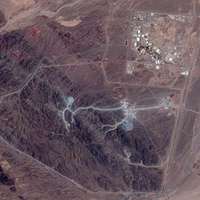
On one hand, he said, Israel's time is now in terms of opportunity but Iran has allegedly 15 nuclear sites, and striking them, may actually push the Iranian government towards a quicker breakout and enrichment. Conricus believes anything nuclear related must be strategic and well planned out. He suggested the possibility of targeting the top 5 locations where weaponization and high-level enrichment are conducted.
US President Joe Biden said on Wednesday he would not support any Israeli strike on Iran's nuclear sites in response to its ballistic missile attack and urged Israel to act "proportionally."
After opposing a strike on nuclear facilities, Biden suggested on Friday during a press briefing in Washington DC that Israel not hit Iran's oil fields either.
Just how much support the US will provide Israel, will also factor into their decision-making on how to retaliate against Iran, he said.
Conricus admits there are many Israelis who believe striking Iran should be done in a way to give the Iranian people a message.
"The Iranians, obviously, undoubtedly are very brave. They've taken to the streets and confronted a ruthless and cruel and oppressive regime, trying to shake free from this oppression. But sadly, they never got any external help. in terms of funding, not in terms of weapons, not in terms of political structure. And eventually, sadly, the regime was able to kill, jail, or otherwise torture and silence people," he added.
He found the timing and messaging of Israeli Prime Minister Benjamin Netanyahu's video to the address to the Iranian people in the midst of fighting a telling and revealing moment.
On Monday the Israeli Prime Minister directly addressed the Iranian people to predict the nigh downfall of their rulers.
Stopping short of pledging any direct action by the Jewish state itself, Netanyahu said the Iranian theocratic system that his country was confronting would soon end.
Conricus told Iran International that these days are "historic" and that he hopes "Israel will change 20 years of failed policy towards the Islamic Republic of Iran."
US President Joe Biden on Friday said Israel ought not to strike Iran's oil infrastructure in response to an Iranian ballistic missile attack, a day after his suggestion that it was a potential target sent crude prices surging.
"The Israelis have not concluded what they're going to do in terms of a strike - that's under discussion. If I were in their shoes, I'd be thinking about other alternatives than striking oil fields," Biden told reporters in the White House Briefing Room.
Biden added that the United States was in constant communication with Israeli counterparts and that Israel had yet to decide on a response, which he said was unlikely to be immediate due to the Jewish New Year holiday.
"I'm assuming, when they make their determination about how they're going to respond, we will then have a discussion ... our teams are in contact 12 hours a day".
Iran launched around 180 missiles at Israel on Tuesday, the Israeli military said. The attack was largely repulsed with US and Western help but several missiles made landfall, including on an Israeli air base and near the Mossad intelligence headquarters.
Supreme Leader Ali Khamenei on Friday praised the missile salvo and said the Islamic Republic was prepared to repeat the assault should it be deemed necessary.
"The brilliant work of our forces just a few nights ago was also completely within their rights," Khamenei said in a hawkish sermon in Tehran with a rifle at his side.
"Any blow by any individual or group against this regime [Israel] is a service not only to the region but to all of humanity", he added.
The 85-year-old leader’s rare appearance at the Friday Prayers came amid a recent wave of assassinations of his key allies by Israel, including Hezbollah leader Hassan Nasrallah, who was killed in an air strike last week.
Israel last week invaded South Lebanon in what it said was a limited incursion aimed at rooting out the sources of rocket fire on its northern communities.
Several weeks of Israeli air strikes have killed over a 1,000 Lebanese - more than in the entire 34-day war Israel and Hezbollah last fought in 2006.
Hezbollah has vowed to keep fighting Israel in solidarity with Hamas and Palestinians in Gaza in what it describes as a divinely-ordained fight against Israeli and American oppressors.
Biden said the US was coordinating with world leaders to tamp down the escalation but cited Iran's armed allies in the region as an obstacle.
"When you have proxies as irrational as Hezbollah and the Houthis, it's a hard thing", he said, referring to the Iran-aligned Houthi group in Yemen.