Israel says it assassinated Hezbollah rocket commander in Beirut air strike
Israel's Iron Dome anti-missile system operates for interceptions as rockets are launched from Lebanon towards Israel, amid cross-border hostilities between Hezbollah and Israel, as seen from Haifa, Israel, September 24, 2024.
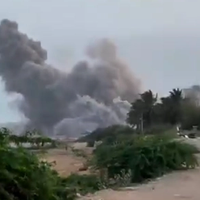
A Hezbollah rocket commander was assassinated in an air attack on the Iran-backed group's stronghold in south Beirut on Tuesday, the Israeli military said, in another apparent heavy blow to its senior leadership.
The Israeli military statement identified Ibrahim Qubaisi, head of Hezbollah's rocket and missile division, as having been killed in the attack on the densely populated suburb.
"Over the years and during the war, he was responsible for launching missiles toward the Israeli civilians," it said. "(Qubaisi) was a significant source of knowledge in the field of missiles and had close ties to senior military leaders in Hezbollah."
At least six people were killed and 11 wounded in the strike on Tuesday afternoon on the Ghobeiry area in southern Beirut, the Lebanese health ministry said.
Hezbollah media channels did not specify any names for the dead.
In March, Israel killed Ali Abdulhassan Na'im, the unit's deputy head.
A Lebanese security source told Middle East Eye that the Israeli strike had targeted two floors in a residential building in the neighbourhood.
The group has fired over 8,000 projectiles to Israel in allegiance with Iran-backed Hamas after their October 7 attacks on Israel.
Meanwhile Tuesday, Hezbollah continued to barrage northern Israel with dozens of projectiles amid a relentless retaliation from Israel, announcing they were targeting military positions.
On Tuesday, Israel's military announced it had carried out strikes on approximately 1,500 terrorist infrastructure targets in Lebanon with 2,000 munitions over the last 24 hours.
In recent days, the death toll in Lebanon has been the highest since the last Lebanon war as the Israeli government has vowed to return the residents of the north home.
Lebanon's health ministry says 558 people have been killed in strikes since Monday, including 50 children. Lebanese Health Minister Firas Abiad told Al-Hadath that the country is planning to increase the capacity of hospitals but with Lebanon in the midst of a dire economic crisis, the healthcare system is already on the brink of collapse.
Lebanon's Al Hadath reported that 150 schools had been allocated to house the displaced from the country's south where at least 100,000 have already been displaced, and hundreds of thousands more expected to follow.
The crisis saw an emergency UN Security Council meeting called in a bid to stop the spiralling violence.
On Friday, commander Ibrahim Aqil was killed along with 14 other senior figures as operations took an uptick last week in a bid to regain security in Israel's north.
It followed the targeting of scores of Hezbollah operatives in a two-day operation which saw pagers and walkie-talkies explode. Israel did not admit or deny the attack which resulted in the deaths of dozens and thousands injured, including women and children.
The turnaround in the aggression from Israel after 11 months of being under almost daily bombardment from Hezbollah has led to a rise in popularity for Prime Minister Benjamin Netanyahu.
While 63,000 Israelis in the country's north remain displaced amid the fighting, it has led to allegations of the government forgetting the country's northern residents under fire since October 8.
Speaking to the Financial Times, Dahlia Scheindlin, a pollster and political analyst said: “Netanyahu has definitely recovered from the postwar crash."
After resisting taking on a second front amid the Gaza war, she added: “It looks like Israel is taking the initiative. It’s true everybody gets terrified about the consequences. But each time they have ultimately been far less than the Armageddon many worried about. And a lot of people come out of it thinking Netanyahu has . . . regained Israel’s footing.”
Brigadier General Esmail Qaani, the head of the Revolutionary Guards' Quds Force
Iran's Quds Force commander told Iraqi political leaders last week to ease criticism of the prime minister who has been embroiled in a row over spying allegations, sources said, seeking to steady a regional ally as conflict in the Middle East flares.
Esmail Qaani made the request during a visit to Baghdad, according to seven Iraqi sources, including people in political parties whose leaders the Iranian commander met. A regional diplomat confirmed the account. All the sources asked not to be named because the meetings were held in private.
The move to avert any weakening of Prime Minister Mohammed Shia al-Sudani reflects concerns in Iran about instability on its doorstep in Iraq, where Tehran has long wielded influence via a range of Iran-backed armed groups and Shiite Muslim parties.
Tehran is keen to avoid further pressure on its regional alliances after the almost year-long Gaza war, which has hammered Hamas, and amid an escalating conflict in Lebanon that has put huge pressure on Tehran's key regional ally, Hezbollah.
The Quds Force is the overseas branch of the Iranian Revolutionary Guards Corps (IRGC). The IRGC and Iran's Foreign Ministry did not immediately respond to requests for comment.
Qaani told Iraqi leaders in the Coordination Framework, a grouping of Shiite Muslim parties that picked Sudani for the job, not to undermine the prime minister amid allegations his office spied on top Iraqi officials and politicians. Qaani said stability in Iraq was vital amid the regional violence.
The spying allegations, which have been denied by advisers to Sudani and for which no evidence has been publicly presented, were aired by lawmakers and major media organisations last month and have caused a stir in Iraq.
Parliamentary elections next year
Loyalists and independent observers say prime minister Sudani's political opponents stoked the allegations to try to weaken him before parliamentary elections next year. Parties critical of him say the allegations are serious.
Iraq's judiciary has opened a probe into the matter overseen by Faiq Zaidan, the head of the Supreme Judicial Council, and some Iraqi officials said the results of the probe could determine whether the prime minister continues in his job.
For Sudani, the dispute comes at a delicate moment. He is seeking to rebuild the economy after decades of conflict ahead of elections and to balance the influence of well-armed, Iran-backed factions while negotiating a drawdown of US-led forces in Iraq, where Washington has maintained a contingent for years.
Renad Mansour at the London-based Chatham House think tank said Iran wanted to prevent tensions in Iraq, where rivalries have often turned violent, before parliamentary polls in 2025.
"At a crucial moment for Iran when it's trying to respond to Israeli aggression, the Iraqi groups are infighting in a way that's destabilising. The last thing Iran wants now is a political mess in Iraq," Mansour said.
It's not the first time Qaani has intervened in Iraq in a moment of crisis.
In February, he asked armed factions that Iran backs in Iraq to cease attacks on U.S. forces after a strike by one group on a US base in Jordan, on Iraq's western border, killed three US troops, Reuters reported at the time.
Iranian President Masoud Pezeshkian during a meeting with American media representatives in New York, September 23, 2024
An audio file obtained by Iran International reveals that Masoud Pezeshkian, president of the Islamic Republic, told American media representatives in New York on Monday that Iran is ready to disarm if Israel does the same.
Pezeshkian said, "We are prepared to give up all our weapons, provided Israel also disarms, and an international organization steps in to ensure security in the region. We don't even need them—we know how to secure our own safety."
Pezeshkian who spoke at length about Israel being the main culprit in the region, attacking others and seeking war, also briefly mentioned the war in Ukraine. He denied recent accusations that Iran has supplied ballistic missiles to Russia and called for a peaceful resolution to the conflict. However, he did not mention Iran’s delivery of around 8,000 Shahed suicide drones to Russia since mid-2022.
Just before his trip to New York to attend the UN General Assembly, Pezeshkian had said that one his goals during the visit was to improve the image of the Islamic Republic in the world.
Iranian President Masoud Pezeshkian (center) and Foreign Minister Abbas Araghchi (left) and Mohammad Javad Zarif, an advisor to the president, during a meeting with a group of representatives of US media outlets in New York, September 23, 2024
In the meeting with reporters the Iranian president stated, "A terrorist is a terrorist, whether Arab, non-Arab, or Persian, whether it's Israel, the US, or Iran. If they commit terrorism, they are a terrorist. But it’s not acceptable to call one side’s actions self-defense while labeling the other a terrorist for the same actions." During the hour-long event, Pezeshkian focused on portraying Israel as engaged in one-sided aggression. “We want to live in peace, we don’t want war. It’s Israel that is seeking to provoke a full-scale conflict."
Addressing the media representatives present at the meeting, Pezeshkian said, "This is the essence of our message, and you can publish it however you wish. Help us find a way not to go to war. Let’s resolve what can be solved through dialogue, not with missiles and weapons."
He added, "Help bring peace and security to the world. We are ready. We don’t want war. We have no desire for any country’s land, nor are we seeking to cause disruption anywhere."
Pezeshkian clarified, "This doesn’t mean there aren’t some Iranians who may be involved in certain actions in some places. It’s possible, just as it’s possible for people in our own country to rise up and do certain things. But to say that ‘we’ are behind these actions—this isn’t true. There are individuals who don’t adhere to the framework and act independently. Don’t attribute their actions to us."
However, throughout four decades of its existence the Islamic Republic leaders have often threatened regional countries for not siding with Tehran in its campaign against Israel and the United States, while calling for destruction of the Jewish state,
Pezeshkian also declared, "We speak truthfully. I’m not skilled in politics and deception. That’s why I want people to speak honestly and tell the truth, so we don’t feel deceived later. We don’t deceive anyone." He added, "By God, we are human too, and we are not warmongers."
Iranian Foreign Minister Abbas Araghchi speaking during a meeting with American media representatives in New York, September 23, 2024
However, hours after Pezeshkian’s remarks were published, Iran’s Foreign Minister Abbas Araghchi, issued a statement saying, "I reject the reports by some media outlets claiming that Masoud Pezeshkian said the Islamic Republic is ready to de-escalate with Israel. Mr. Pezeshkian never made such remarks."
Araghchi also told Tasnim News, affiliated with the IRGC, "Contrary to what has been reported, Dr. Pezeshkian strongly condemned the crimes of the Zionist regime in Gaza and its aggression against Lebanon during a meeting this morning in New York with some American media executives. He stressed that these crimes are in violation of all human and international standards and must be stopped."
He added, "He clearly stated that these crimes, including the assassination of martyr Haniyeh in Tehran, will not go unanswered, and the response will be delivered in due time."
Pezeshkian also condemned Israel’s operations in Gaza and Lebanon on Monday, accusing Israel of setting a trap to drag the Islamic Republic into a full-scale war. He reiterated that Iran does not seek war but wants peace and security in the region.
On Monday, in separate meetings and statements, Pezeshkian accused Israel of trying to provoke the Islamic Republic into war, while also affirming Iran’s resolve to avenge the killing of Ismail Haniyeh in Tehran.
Pezeshkian, addressing the delay in what the Islamic Republic calls its "harsh response" to avenge the killing of Ismail Haniyeh, the former head of Hamas' political bureau, pointed to Iran's consultations with Western countries. He remarked, "We were told a ceasefire agreement between Israel and Hamas would be reached within a week, but that week never arrived. Instead, Israel has continued to escalate its attacks."
Araghchi further emphasized, "The Islamic Republic will certainly not remain indifferent to the recent Zionist regime's aggression against Lebanon and will fully defend and support Lebanon."
However, Tasnim News highlighted Pezeshkian’s emphasis on the need to end Israel’s military operations and establish peace and security in its reports on his Monday meetings with leaders from several countries.
Disregarding repeated accusations from Western countries that the Islamic Republic supports terrorism and violates international law and treaties, Pezeshkian stated, "We believe global peace and security can only be achieved if all nations respect international treaties and, regardless of power dynamics, stand united against any country committing acts of aggression."
According to Tasnim, in a meeting with Viola Amherd, the President of Switzerland, Masoud Pezeshkian stated, "In our foreign policy, we seek to establish stability, security, and peace in the region, while the Zionist regime is striving to incite war and create instability."
On Monday, Pezeshkian also met with the President of the European Council and the President of Turkey.
According to Iranian media, he is also scheduled to meet with King Abdullah II of Jordan and French President Emmanuel Macron. The Gaza war and the conflict between Hezbollah and Israel are expected to be the main topics of Pezeshkian's discussions in New York.
Masoud Pezeshkian's trip to the United States has sparked significant criticism on social media. Reports indicate that contrary to initial news, he traveled to New York with a 40-member delegation, including his two sons, daughter, and son-in-law.
The group also includes three key figures from the Islamic Republic's 2015 nuclear negotiation team: former Foreign Minister and current deputy to Pezeshkian, Mohammad Javad Zarif; Foreign Minister Abbas Araghchi; and Araghchi's deputy, Majid Takht-Ravanchi.
However, it appears unlikely that any meetings will take place between officials of the Islamic Republic and the US government during this trip.
Media outlets affiliated with the Islamic Republic quoted Abbas Araghchi as stating that he will not meet with US Secretary of State Antony Blinken or any Biden administration officials, as he said such a meeting is "not advisable."
Smoke billows over southern Lebanon following Israeli strikes, amid ongoing cross-border hostilities between Hezbollah and Israeli forces, as seen from Tyre, southern Lebanon, September 23
Israeli air strikes targeting Hezbollah in Lebanon killed 492 people on Monday, the Lebanese health ministry said, in one of the deadliest days in the war weary Mediterranean nation's history.
The dead include 35 children and 58 women, the ministry added, while over 1,645 were wounded.
The air attacks sent residents of south Lebanon fleeing for safety northward as some public schools were turned into shelters.
"Air Force fighter jets have attacked ... about 800 Hezbollah terrorist targets in southern Lebanon and in the Bekaa area deep in Lebanon in several waves of attacks throughout the day," the Israeli air force said in a post on X.
"The IDF attacked buildings where Hezbollah hid rockets, missiles, launchers, unmanned aerial vehicles and other military infrastructure," it said, adding that it aimed to destroy the group's "capabilities and infrastructure".
For its part, Hezbollah claimed responsibility for rocket attacks targeting Israeli military sites and the Israeli military said over a million civilians were forced to seek shelter in the third-largest city Haifa.
Around 165 rockets and other projectiles launched by Hezbollah have crossed into Israel since this morning, the Israeli military added, though no casualties have yet been reported.
Israeli prime minister Benjamin Netanyahu on Monday warned of difficult days ahead, urging unity among Israelis and for Lebanese to heed Israeli evacuation orders.
"For too long, Hezbollah has been using you as human shields", he said in a video message on X directed at the Lebanese people.
"To defend our people against Hezbollah strikes, we must take out these weapons ... The IDF has urged you to get out of harm's way. I urge you - take this warning seriously."
Israel last week updated the aims of its nearly one-year-old war against Hamas in Gaza and Hezbollah in Lebanon to include returning tens of thousands of civilians evacuated from its northern border to their homes.
Starting on Tuesday, two back-to-back days of explosions hit communication devices held by Hezbollah fighters and on Friday an air strike killed senior members from the group while they were meeting in southern Beirut, in attacks which killed scores.
Hundreds of others, including Iran's ambassador to Lebanon, were left maimed and in hospital.
Iran's foreign ministry spokesman Nasser Kanaani condemned the killing of "hundreds of defenseless people", in comments on the ministry's official Telegram channel.
"We strongly condemn the silence and support of the US and some Western states to the Zionist regime and warn against the continuation of the regime's crimes against Palestinians and its attempt to expand war to the entire region," Kanaani said. "There will be dangerous consequences for the Zionists' new adventure."
Major General Hossein Salami, the commander of Iran's Islamic Revolutionary Guard Corps, said last week that the so-called Axis of Resistance grouping of Islamist militias Tehran leads in the region would punish Israel for the attacks.
But an Israeli military official, speaking on condition of anonymity to the Associated Press, said the Jewish state had no immediate plans for a ground incursion and that the aerial bombardments were aimed at curbing Hezbollah's ability to fire rockets.
The United Nations has urged against a further escalation of hostilities as its special coordinator for Lebanon, Jeanine Hennis-Plasschaert touched down in Israel on Monday.
"There is no military solution that will make either side safer. With the wellbeing of civilians on both sides of the Blue Line and the stability of the region at stake, space must be given for diplomatic efforts to succeed," she said in a statement, referring to the Israel-Lebanon border.
Smoke billows over southern Lebanon, amid ongoing cross-border hostilities between Hezbollah and Israeli forces, as pictured from Marjayoun, Lebanon, near the border with Israel, September 22, 2024.
Israel's Prime Minister Benjamin Netanyahu said that Iran-backed Hezbollah had been "hit in ways it could not imagine" after retaliatory attacks for an overnight bombardment struck deep in the heart of the group's infrastructure.
His address came after Hezbollah struck deeper into Israel reaching the northernmost city of Haifa in overnight strikes which saw schools in the north closed and residents advised to stay near shelters.
The Israeli military said it struck around 290 targets on Saturday, including thousands of rocket launchers, one of the biggest offensives since the conflict began 11 months ago.
"No country can accept the wanton rocketing of its cities. We can't accept it either. We will take whatever action is necessary to restore security and to bring our people safe back to their homes," he said, as 63,000 Israelis remain displaced amid the conflict sparked by the war in Gaza.
In southern Lebanon, the almost daily exchanges of fire have also seen around 100,000 civilians displaced.
"On October 7th, the Hamas terrorist monsters burst into Israel, murdered our people, raped and beheaded our women, burnt babies alive, and took 255 innocent people hostages, including many Americans," Netanyahu said of the day nearly 1,200 mostly civilians were murdered by Iran-backed Hamas.
"A day later, on October 8th, another Iranian terrorist proxy, Hezbollah, attacked Israel completely unprovoked. They fired missiles and rockets into our cities. They made 60,000 Israelis leave their homes along the Lebanon border, becoming refugees in their own land. In the subsequent months, they haven't stopped for a single day attacking us."
The Israeli military said that over 150 projectiles had been fired overnight from Lebanon, with over 8,000 in total having been fired from Lebanon since October 8 as Hezbollah fights in allegiance with Hamas in Gaza in the country's south.
While most were intercepted, several buildings were struck, including from interception shrapnel, leaving Kiryat Bialik north of Haifa ablaze.
On Sunday, Hezbollah claimed to have hit military and military-industrial sites, but Israel did not comment on the claims.
"We have entered a new phase, the title of which is the open-ended battle of reckoning," Hezbollah deputy chief Naim Qassem told mourners at the funeral of one of the group's commanders killed last week in Beirut.
Israeli Defence Minister Yoav Gallant said strikes would continue until it was safe for the evacuated people in the north to return as the war took a new turn last week.
Last week, hundreds of pagers and walkie-talkies belonging to Hezbollah operatives exploded in a two-day operation which struck deep into Iran's biggest proxy. Israel has not commented on the operation which led to at least 42 deaths and the overwhelming of Lebanon's healthcare system as 3,000 more were injured.
Then on Friday, 37 people including 16 commanders were killed by Israel as it targeted a meeting of the top echelons of the group's leadership. On Sunday, Hezbollah's parliamentary representative Hussein Fadlallah, said the group has already replaced the commanders killed over the weekend.
“There is no vacuum - on the night of the attack in Dahieh, the new commanders were already appointed and began to plan an attack on the enemy. Not a single outpost remains empty of commanders for even a single day,” he said.
On Sunday, the Iran-backed Islamic Resistance in Iraq also claimed to have sent drones targeting an Israeli military base amid the Lebanese onslaught.
The attack from Iraq is believed to be a retaliation for the killing of one of the group’s commanders.
A statement from the group said that on Sunday, the funeral of Abu Haider al-Khafaji, the senior commander of the Iraqi Hezbollah Brigades was taking place at 4pm local time. The group said he was killed in an attack attributed to Israel in Damascus on Friday morning. The funeral is being held in Baghdad.
"Escalation in Lebanon means escalation from Iraq," an official from the group said.
Iran's Jihad missile system was officially unveiled for the first time on September 21, 2024.
Iran showcased a new ballistic missile named Jihad, developed by the Islamic Revolutionary Guard Corps (IRGC) Aerospace Force, during a military parade in Tehran on Saturday.
The Jihad missile system was officially unveiled for the first time on Saturday, introducing a new launch platform for liquid-fueled missiles, according to Iranian government media and IRGC sources.
According to the IRGC-affiliated Tasnim website, it is a ballistic missile with a range of 1,000 kilometers, featuring a dual-missile launcher that distinguishes it from other Iranian liquid-fueled missiles.
Tasnim stated, "A glance at the Jihad missile reveals that it is an optimized version of the Qiam missile, whose range was previously increased from 800 kilometers to 1,000 kilometers, and its warhead became guided."
First generation of Iran's Qiam missile
The Qiam missile, Iran's first liquid-fueled missile without fins, was introduced in 2010 with an initial range of 800 kilometers. Its design modification for fin removal allowed for launch from various missile silos. Subsequent enhancements included the replacement of the standard triple-cone warhead with a detachable, guided variant, improving accuracy to within 50 meters, according to Tasnim.
In October 2018, images from an operation revealed the Qiam missile with newly added small fins to enhance its flight profile. By 2021, the Ministry of Defense reported further advancements in the Qiam missile, achieving a range of 1,000 kilometers and marking the emergence of what the IRGC says is a new generation.
According to Tasnim, the Jihad missile is equipped with a warhead weighing approximately 600 kilograms and travels at speeds exceeding eight times the speed of sound. It employs a different launch platform, enabling the simultaneous launch of two missiles, thus enhancing operational efficiency despite the longer preparation time typically associated with liquid-fueled missiles.
Although the Islamic Republic has made continuous advancements in its ballistic missile program, it is not possible to independently verify claims of developing advanced weapons. Around 350 missiles and drones launched against Israel in April, 99% were intercepted by Israeli air defenses and allied warplanes.
Following the introduction of the Kheibar-Shekan and Martyr Haj Qasem missiles, Tasnim reported that a new generation of Iranian ballistic missile launch platforms has also become operational. This platform, used in the Fattah missile, is equipped with the DRU (Precise Navigation System), providing highly accurate positioning data. "This enables rapid firing immediately after deployment, along with swift closure and exit capabilities," the report added.
Iran's first hypersonic ballistic missile Fattah
Iran's missile program has generated ongoing concerns among Western nations, particularly the United States and its allies, as Iran invests heavily in developing various ballistic and cruise missiles. The advancements in missile technology have raised alarms about potential threats to regional stability, especially regarding Iran's backing of non-state actors and militant groups.
The potential development of intercontinental ballistic missiles (ICBMs) has prompted calls for tighter controls over Iran's missile program.
In response to the tensions, the United States and its allies have imposed sanctions targeting Iran's missile development, aiming to restrict access to materials and technologies that could enhance missile capabilities.