Iran's Exiled Crown Prince Calls for Action Against Iranian Violence in UK
Iranian exiled Prince Reza Pahlavi
Iran's exiled Crown Prince issued a call for British and Western governments to protect their citizens from “violence perpetrated by supporters of the Iranian regime" after the latest attack in London.
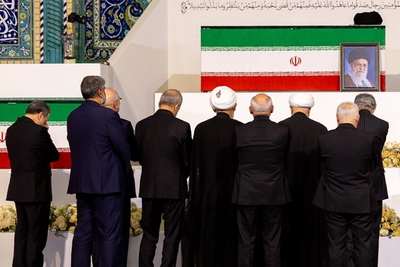
Iranians in the UK, demonstrating against a memorial service for the late president Ebrahim Raisi on Friday were targeted by possible Iranian state agents, resulting in injuries to four people, as reported by the Metropolitan Police who confirmed the arrest of one suspect.
Prince Reza Pahlavi said, "What happened in London on Friday must not happen again," the latest in a string of incidents against dissidents in the UK since 2022.
Journalist and political activist Masih Alinejad who has also been the target of Iranian death threats through government agents in the UK and US, said the British authorities must act against the "thugs of the Islamic Republic."
In a show of defiance, Iranians in the UK rallied the following day in front of Iran's embassy in London to protest the violence. Pahlavi said, "Your coming together at this short notice to defend our compatriots is commendable," Pahlavi stated.
In March, Iran International host Pouria Zeraati, was stabbed by unknown attackers outside his home in London, suspected to be Iranian agents. In November 2022, threats were made against two of the channel's London-based journalists before the offices were forced to close temporarily last year after UK security services, MI5, said it could no longer guarantee the safety of Iran International staff.
Saeed Jalili, Ali Khamenei's representative in the Supreme National Security Council, is set to run in the upcoming presidential election after having run in both 2013 and 2020, as Khamenei lines up his staunchest allies.
Jalili received a delegation of four representatives from Mashhad at his office to invite him to enter the presidential race as Khamenei ensures a line-up of hardliners in the upcoming elections in the wake of the sudden death of President Ebrahim Raisi in a helicopter crash last week.
Jalili, who has held significant diplomatic and security roles within the Iranian government, served as the secretary of the Supreme National Security Council from 2007 to 2013 and is currently a member of the Expediency Discernment Council.
Known for his hardline stance, Jalili was Iran's chief nuclear negotiator and has previously served as the deputy foreign minister for European and American Affairs. Despite his positions, his bids for presidency have yet to secure him the office, with a third-place finish in the 2013 elections and a withdrawal in favor of Ebrahim Raisi in the 2021 elections.
Jalili's return to the presidential race comes amidst whispers of political maneuvering, with some suggesting that recent shifts in leadership, including the rumors of assassination of Raisi by Khamenei’s son Mojtaba, might be clearing the way for new power alignments.
A hardline ballot of clerics and military figures are among the politicians who look set to stand for the June 28 snap elections, with candidates likely to include Parviz Fattah, a former IRGC officer and currently the head of the multi-billion-dollar economic empire controlled by Iran's Supreme Leader.
Also likely is Mehrdad Bazrpash, the current transport minister who was aboard one of the other helicopters flying with Raisi's doomed delegation, and Alireza Zakani, the current mayor of Tehran, who, like Jalil, dropped out of the 2021 presidential race to back favorite, Raisi.
Iranian media are widely speculating about the Guardian Council’s strategy for setting the stage for the election of Raisi’s successor in the upcoming June 28 elections. They suggest that three scenarios are likely to unfold.
This time, the Guardian Council has very little time for the usual machinations it is often accused of, as the law requires that a president be elected within 50 days. Unlike previous elections, there are currently no pieces on the board to arrange for the desired outcome.
The significance of which past approach the Council is likely to adopt regarding diversity of candidates is more important than which particular politicians are likely to run, moderate conservative Asr-e Iran news website wrote Sunday.
Some speculate that the Council may eliminate all candidates capable of mobilizing the electorate, including certain hardliners and ultra-hardliners, to ensure the victory of their most preferred candidate.
Another possible approach, according to media analysts, is allowing various hardliner and ultra-hardliner factions to compete relatively freely, which could result in an unpredictable outcome.
The five-day period of registration is to begin on May 30 after which the Guardian Council has a week to vet candidates. So far, some controversial figures such as former President Mahmoud Ahmadinejad, once Khamenei’s favorite who fell from his favor during his second term, have implied they are ready to run. Ahmadinejad was barred from running in the past two elections.
The dilemma facing the Khamenei-appointed jurists of the Guardian Council is how to orchestrate the election so that the "desired" future president emerges from the ballot boxes while also ensuring "maximum participation" of the electorate, or at least a level of participation that does not call the legitimacy of the next president into question.
According to official figures, only 48 percent of the electorate went to the ballots in the presidential election of 2021 in which the arrangement of candidates, which included one low-profile reformist, Abdolnaser Hemmati, was meant to guarantee Raisi’s win.
Disqualified candidates included moderate former Parliament Speaker Ali Larijani, reformist former Vice President Eshaq Jahangiri, and Masoud Pezeshkian, a reformist lawmaker from East Azarbaijan Province who could potentially bring some reluctant voters to the ballots. Pezeshkian on Sunday again announced his candidacy.
Turnout was 73% in the 2017 election and over 72% in the 2013 election, both of which saw Hassan Rouhani winning with over 50% and 57% of the vote, respectively.
In an unprecedented move, 13 percent of eligible voters cast blank and void votes in 2021. This was higher than votes cast for the second runner up, Mohsen Rezaei, who got 11.8 percent of the vote against Raisi’s 62 percent.
Blank and void ballots were cast by those who did not find any of the four approved candidates to their liking or were coerced into voting. Lawyers, physicians and other health workers, for instance, are intimidated into voting by being threatened with loss of their licenses.
In 2017 and 2013 elections, blank and void ballots respectively made up just 2.9 and 3.39 percent of all votes. In both elections various factions within the political establishment had their own candidates.
Khamenei and the hardliners have not appeared overly concerned about voter turnout in the past three elections since 2020. Despite a consistent decline in turnout, they continue to describe each election as "epic."
Besides behind-the-scenes instructions, Khamenei has the power to overturn the Guardian Council’s decisions with so-called “state edicts”. He reinstated two reformist candidates disqualified by the Council, Mohsen Mehralizadeh and Mostafa Moeen, with such edicts in the controversial presidential elections of 2005 which brought hardliner Mahmoud Ahmadinejad to power. He also reinstated Pezeshkian in the 2024 parliamentary elections.
Iran's oil industry is facing a crisis as oil specialists and workers continue to leave the country, officials warned on Sunday.
Arash Najafi, a member of the Energy Commission at the Chamber of Commerce, told ILNA news agency that "We are easily losing our skilled and specialized workforce, and if serious action is not taken, we may face a problem in the oil human resources area."
"For every skilled worker that leaves, we lose 35 years of life," he remarked, emphasizing the severity of the brain drain. He also highlighted the vast disparity in wages that is exacerbating the situation, pointing out that a top manager in Iran earns about $1,700 a month, whereas the same role would command around $5,000 in even the most average global companies.
The disparity in living costscompared to income, especially when contrasted with places like the Emirates where expenses are similar but incomes are significantly higher, has prompted a range of professionals from nurses to technical specialists to seek better opportunities abroad, particularly in Persian Gulf countries and neighboring states.
The situation is compounded by soaring inflation rates in Iran and a disparity between income and household expenses, leading to widespread unrest.
In response to the economic pressures, energy and oil workers in Iran have organized numerous protests in recent months, demanding better working conditions such as wage increases, timely payment, insurance, transportation, food, hygiene, and accommodation facilities.
Conservative politicians Parviz Fattah, Mehrdad Bazrpash, and Alireza Zakani are preparing their presidential campaigns and will most likely run for the office in the June 28 snap elections, the IRGC-affiliated Tasnim reported, citing sources.
Fattah, a former IRGC officer, is currently the head of the multi-billion-dollar economic empire controlled by Iran's Supreme Leader.
Bazrpash is the current transport minister who was aboard one of the other helicopters flying with Raisi's doomed chopper.
Zakani is also the current mayor of Tehran who dropped out of 2021 presidential race and backed Raisi.
In an open letter, LGBTQ+ activists and organizations voiced their strong disapproval of Western governments that expressed condolence to Iran honoring President Ebrahim Raisi, who died last weekend in a helicopter crash along with other officials.
The activists condemned the action as an "insult to those who rose chanting Woman Life Freedom to overthrow the Islamic Republic."
They emphasize that such gestures of sympathy are a betrayal to the Iranian people, particularly women and the LGBTQ+ community, who have been fighting against the Islamic Republic's brutal policies.
“Raisi's role in the execution and killing of homosexuals and queers who were unjustly killed by the judicial system of the Islamic Republic cannot be hidden,” the letter read.
The activists call on governments to take a firm stand against the Islamic Republic and cease appeasement policies, and designate the IRGC as a terrorist organization.
The letter includes endorsements from organizations such as Azad Queer, which is a network of Iranian queers in the Netherlands, the Organization of Iranian Rainbows, and 6rang, as well as numerous individual activists from around the world.
According to critics, offering condolences to such a regime implicitly legitimizes its actions, such as suppressing dissent, supporting terrorism, and violating human rights in the present.
Ebrahim Raisi served on a "Death Panel" responsible for the execution of at least two thousand Iranian political prisoners during the 1980s.
As president, he was also in office at the time of the 2022 Woman Freedom Movement in Iran that was sparked by the death in custody of Mahsa Amini.
According to a UN fact-finding mission in March, the Iranian regime committed crimes against humanity in its crackdown on the protests, including killings, imprisonment, torture, and sexual assaults.
She asked UN chiefs to call Raisi by the same term that "Iranians call him: Butcher of Tehran."
At the UN Security Council meeting on Monday, a minute of silence was observed for Raisi and his delegation, and the UN flag was flown at half-mast at its New York headquarters.
Gilad Erdan, Israel's ambassador to the UN, condemned the observance and asked the council, "What's next? Will there be a vigil for Hitler? We wouldn’t be surprised.”
On Thursday, Kylie Moore-Gilbert, a former Australian hostage held in Iran for over two years, also criticized Western governments for their condolences over the death of Iran’s president, saying they lack leadership in denouncing “a man widely regarded to be complicit in mass murder.”