Khamenei sent security chief to Moscow to seek S-400 air defenses – report
File photo shows Russian S-400 missile defense system
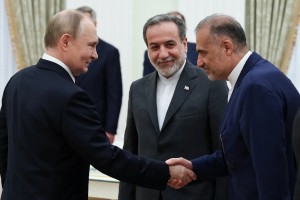
Iran sent security chief Mohsen Rezaei to Moscow to request S-400 air defense systems in a personal letter from Supreme Leader Mojtaba Khamenei to President Vladimir Putin, The Telegraph reported Friday, citing a senior Iranian official.
A senior Iranian official told the newspaper Tehran was “optimistic” that Putin would deliver the systems, which Iran has sought for years.
Rezaei visited Moscow on Thursday, where he met the Russian president. The report did not establish that a deal had been finalized or give a delivery timetable.
The Telegraph also said confidential documents showed a secret parliamentary committee had recommended strengthening military ties with Russia and China before the war began in February. Its proposals called for building “strategic relations, especially military ones” with those powers and bolstering Iran’s “air defense, missiles and drones.”
The visit followed a phone call between Putin and Rezaei on Monday, after which no new military commitments were announced.
Alex Vatanka, a senior fellow at the Middle East Institute, told Iran International that Moscow would help Tehran so long as doing so did not risk direct confrontation with Washington.
Iran’s pursuit of the S-400 reflects the damage inflicted on its air defenses during the war, which exposed nuclear facilities and senior commanders to attack. But Moscow has stopped short of supplying the systems for years, wary of damaging relations with Israel and other regional states, analysts and regional officials told The Telegraph.
Russia’s own needs could also complicate any delivery. Analysts cited by the newspaper said Ukrainian drone and missile attacks had placed Russian air defenses under sustained pressure, limiting the systems Moscow could spare.
The talks add to evidence of expanding military cooperation. The Financial Times reported Thursday that Russia had agreed to supply Iran with 90 helicopter-mounted launchers for precision-guided missiles. A Russian production schedule identified the customer under a code used for Iran.
The partnership has developed in both directions: Iran supplied Russia with Shahed attack drones and helped establish Russian production. But analysts say Moscow continues to balance assistance to Tehran against its own war in Ukraine and relations with Washington and Middle Eastern powers, leaving the extent of its support uncertain.
Vessels at the Strait of Hormuz, as seen from Musandam, Oman, October 12, 2026.
Ships linked to Iran looped, loitered and went dark over undersea internet cables in the Gulf of Oman in the weeks after Tehran threatened the region’s digital infrastructure, the Financial Times reported on Friday. One of them had been boarded by US Marines in May.
At least four vessels tracked by the maritime analytics firm Windward took unusual routes and lingered over cable corridors off Oman in October, the FT said. Three were tankers under US sanctions. The fourth was a small Iranian fishing boat with no known owner.
The ships sailed normally “until they reached a specific cable corridor, and only then slowed, looped, turned back, loitered or went dark,” Windward told the newspaper. That behavior “fits the profile of mapping the cable routes, or placing charges or mines on them while dark,” it said.
86 hours in the dark
The most striking case is Celestial Sea, an Iran-flagged products tanker sanctioned by the United States last year and boarded by US Marines in the Gulf of Oman in May on suspicion of trying to run the American blockade.
On October 14 it drifted in a loop for more than four hours beside the 2Africa cable, which will connect Persian Gulf states to Europe and the east coast of Africa, according to Windward’s October 29 report, on which the FT’s story is based. The next day it switched off its transponder inside the 2Africa and Bay of Bengal Gateway corridors off Sohar. It stayed dark for 86 hours and reappeared nine nautical miles away, made a U-turn over the second cable and anchored. It was empty the whole time.
A second sanctioned tanker, a gas carrier loaded with about half a million barrels of Iranian LPG, left the same anchorage for Malaysia on October 23. Ten hours out, it slowed over 2Africa, turned 180 degrees back toward Oman and went dark. Five days later it had not reappeared. A loaded ship with a buyer waiting has no cargo reason to do that, Windward said.
The third, a crude tanker operated by Iran’s state tanker company, loitered at under one knot for about ten days in Iranian waters between Jask and Chabahar, within a few miles of four cable routes, switching off its tracking repeatedly, once for 33 hours.
The fishing boat
The fourth vessel is the odd one. A 34-meter Iranian fishing-support boat whose beneficial owner has been unknown since last year drifted at under half a knot along the Europe India Gateway and Transworld cables between October 21 and 26, in waters it had never entered in two years of tracking. Then it sailed north into Iranian waters and went dark.
Fishing in Iranian waters requires a state license, Windward noted, and the Revolutionary Guards’ navy has organized fishermen and their boats into a naval Basij that its commander has called a shadow navy. Iran has used civilian hulls as intelligence platforms before: the cargo ships Saviz and Behshad fed targeting data to the Houthis off Yemen, and on October 6 US forces destroyed an Iranian-linked dhow in the Gulf of Oman that CENTCOM said was watching American warships.
The threats that came first
The ships’ movements tracked a run of Iranian warnings. On October 12 Mohsen Rezaei, secretary of the Supreme National Security Council, said “data centers and artificial intelligence facilities will be destroyed” if the war resumes. On October 19 the Guards’ spokesman, Hossein Mohebbi, said seven cables ran under the Strait of Hormuz and that “new targets and new weapons shall be unveiled.” On October 21 the Guards’ political deputy, Yadollah Javani, said the cables would be hit in retaliation for attacks on Iranian infrastructure.
Two days later, two senior Iranian security officials told Iran International that Tehran had detailed plans to target the cables if the United States and Israel attacked again, and would try to prevent repairs to prolong any outage. That was the day the gas carrier turned around.
Who would feel it
Iraq, Kuwait, Bahrain and Qatar depend entirely on cables under the strait for their international connectivity, the FT reported, citing TeleGeography. The cables’ owners include Meta, Vodafone, Orange, AT&T, Verizon, BT and China Mobile.
Masha Kotkin of the Center for Strategic and International Studies told the FT that damage would slow financial transactions and disrupt cloud computing in Persian Gulf states that are betting on digital business to diversify from oil. Threats alone had already halted construction on several cable projects, she said.
Iran International reported last month that the strait carries less than one percent of the world’s international bandwidth and that the main Europe-Asia routes run through the Red Sea, so an attack would hurt Iran’s neighbors far more than the global internet.
The experts the FT consulted held back from conclusions. Sidharth Kaushal of the Royal United Services Institute said the maneuvers could be coincidence but that “Iran might be trying to demonstrate its capacity to damage undersea infrastructure if there is a war.” Jon Pentreath, a retired Royal Navy rear admiral, said almost any vessel could be fitted to lay mines. Celestial Sea’s owner did not respond to the FT.
Three of the four ships were still dark when Windward published. Where they reappear, it said, will show whether the cables were the destination or a stop on the way.
A man walks past a display of Iran's Kheibar Shekan ballistic missile in Tehran.
Russia agreed to supply Iran with 90 helicopter-mounted launchers for precision-guided missiles widely used by Russian forces in Ukraine, the Financial Times reported on Thursday, revealing another dimension of Moscow's military cooperation with Tehran.
The previously unreported order adds to evidence of Russian assistance to Iran's military, including a secret program to help Tehran develop supersonic cruise missiles that could potentially threaten US Navy vessels in the Persian Gulf.
A Russian defense industry production schedule covering 2024 and 2025, obtained by the FT, identified an export order for 90 APU-L launchers from a buyer designated "K-10," a code used by Russia's state arms exporter to refer to Iran.
The documents did not establish whether the launchers were ultimately delivered.
Precision-guided weapons used in Ukraine
The launchers are designed to carry Russia's light multipurpose guided missile, known as LMUR or Izdeliye 305, a precision weapon capable of striking moving targets.
The missile entered Russian military service in 2022 and has since been widely used in Ukraine. An operator can guide it during flight, allowing adjustments to its target.
According to the US Army's Worldwide Equipment Guide, APU-L launchers are designed for Russia's Mi-28 attack helicopters and can carry two missiles each.
Iran has already acquired Russian Mi-28 helicopters. In November 2023, Iranian officials announced that arrangements for their delivery had been finalized. Images appearing online in January 2026 subsequently showed an Mi-28 at an aviation facility in Tehran, according to the FT.
The production documents were provided to the newspaper by Dallas Analytics, a Ukrainian private intelligence organization.
A May 2024 letter from Russian missile manufacturer Vympel warned another defense bureau that delays in supplying launcher components could jeopardize several contracts.
Russia also helped Iran develop supersonic cruise missiles
The latest report follows a September FT investigation revealing that Russia had secretly assisted Iran in developing supersonic cruise missile technology through a program codenamed C430L.
According to leaked Russian correspondence, travel records and military patents reviewed by the newspaper, the program began in 2023 and continued during this year's war involving Iran, the United States and Israel.
The project focused on developing a ramjet propulsion system capable of sustaining missile flight at several times the speed of sound, potentially reducing the time available for US and allied air defenses to respond.
"For the Iranians, this would give them a qualitatively new strategic weapon system that could threaten US Navy vessels," Jim Lamson, a former CIA military analyst specializing in Iran, told the FT.
Iran had built and flight-tested the propulsion system, but the newspaper found no evidence that a Russian-assisted supersonic cruise missile had entered operational service.
Russian engineers reportedly traveled repeatedly to Iran and later analyzed Iranian flight-test data, advising on fuel systems, combustion stability, air intake and engine design.
"This is the transfer of a highly strategically sensitive military technology from Russia that the Iranians have wanted to acquire for decades," Fabian Hinz, a senior analyst at Conflict Armament Research, told the FT in September.
Military cooperation deepens during Iran war
The launcher agreement and missile development program illustrate different aspects of Russian assistance to Tehran, ranging from supplying military equipment to transferring specialized technical knowledge.
The FT has also reported that Russia agreed to supply Iran with Verba shoulder-fired air defense systems.
The relationship has developed in both directions. Iran previously supplied Russia with Shahed attack drones used in Ukraine and helped Moscow establish domestic production.
Western intelligence officials told the FT that Moscow and Tehran had strengthened their military partnership further during this year's conflict in the Middle East, despite US President Donald Trump's assertion that Russia was doing "very little, if anything" to assist Iran.
"It is indicative of Russia's willingness to continue supplying Iran despite its own wartime demands and with far less concern about western objections than in the past," Nicole Grajewski, a scholar at the Carnegie Endowment for International Peace, told the newspaper.
Limits to Moscow's involvement
Despite growing cooperation, analysts cautioned against overstating Russia's role in the ongoing conflict.
Hanna Notte, Eurasia program director at the James Martin Center for Nonproliferation Studies, said Moscow was balancing its support for Iran against its relationships with Washington and other countries in the Middle East.
"Russia still has certain red lines when it comes to its involvement in this war," Notte told the FT.
"Which is why the support it has provided to Iran is operationally helpful but is not the game changer in this war."
US President Donald Trump and Vice President JD Vance take part in ceremonies in commemoration of the Memorial Day holiday, at Arlington National Cemetery in Arlington, Virginia, US.
US Vice President JD Vance blamed the war with Iran for Republicans' sweeping midterm election defeats, including the loss of both chambers of Congress, as President Donald Trump weighed renewed military strikes against Tehran or a negotiated settlement to end the conflict.
"The reason we lost is the war," Vance wrote on X.
"If you'd like to argue it was worth it, that losing the Senate for the next 6 years was worth it, then do so," Vance wrote on Wednesday. "But everyone knows why we lost. And any honest conversation about where we go from here must start there."
Trump acknowledged that the war had contributed to the election setbacks but defended his decision to attack Iran, saying he would make the same choice again.
Trump defends Iran war
Speaking to reporters on Wednesday, Trump said Vance's assessment was "largely true," pointing to the rise in gasoline prices following the conflict.
"We had no choice. You can't let Iran have a nuclear weapon," Trump said.
Asked when he would end the war, Trump replied: "Whenever I wanted to. But it's got to be done right, because they can't have a nuclear weapon."
In comments to The Wall Street Journal, Trump said "Iran was a piece of it," referring to the Republican losses, but reiterated that the military campaign was necessary.
Vance, who has been involved in negotiations with Tehran, also praised advice to seek a diplomatic resolution to the conflict.
The Wall Street Journal reported that Vance had opposed the war from the outset, despite publicly defending the administration's military actions.
US officials debate renewed strikes on Iran
Senior US officials are debating whether to escalate military operations against Iran or continue applying economic pressure while pursuing negotiations, according to reports by The Wall Street Journal and Axios.
The Journal reported on Wednesday that some officials were advocating an escalation of strikes, while the administration had spent weeks discussing the war's impact on the elections and whether to publicly acknowledge continuing military operations against Iran.
Axios reported that the US military was completing preparations for a possible resumption of major combat operations, including deploying additional military assets to the region.
Other senior officials favor maintaining the naval blockade of Iranian ports and economic sanctions while assessing whether Tehran is prepared to reach an agreement.
CIA Director John Ratcliffe and Treasury Secretary Scott Bessent are among those advocating continued economic and military pressure rather than an immediate return to large-scale strikes, according to Axios.
Trump has not announced a decision on whether to expand the military campaign.
Qatar seeks agreement to avert renewed fighting
The discussions in Washington come as Qatar continues efforts to secure US and Iranian approval for a proposal aimed at preventing another major escalation and potentially restarting direct negotiations.
According to Axios, Qatari mediators are working to obtain support from both sides for a draft agreement, with the possibility of direct talks in the coming days.
Vance has been among the senior officials advising Trump to pursue an agreement with Iran, warning privately about the consequences of prolonging the war, the report said.
The mediation effort has yet to produce a breakthrough. Iranian and US officials remain divided over key issues, including Tehran's nuclear program, sanctions and arrangements involving the Strait of Hormuz.
Trump's administration is also considering maintaining its current approach of a naval blockade and economic pressure without immediately resuming large-scale military operations.
Trump backs defense secretary amid scrutiny of Iran campaign
Trump also defended Defense Secretary Pete Hegseth on Wednesday as questions emerged over whether the administration might change its military leadership following the election.
Asked whether he was considering replacing Hegseth, Trump said: "No, I think he's doing a very good job."
Reuters reported that some Trump advisers had discussed the possibility of replacing Hegseth, who has been a prominent supporter of the war against Iran.
Democratic lawmakers, who won control of both chambers of Congress, have indicated that they intend to investigate the Pentagon's handling of the Iran conflict.
The Defense Department said Hegseth remained committed to serving through the end of Trump's term and defended the legality of its operations.
With no agreement yet reached between Washington and Tehran, the administration continues to weigh renewed strikes, sustained economic pressure and diplomatic efforts to end the conflict.
The US Capitol looms in the distance as US President Donald Trump departs following his remarks ahead of the midterm elections at the National Mall in Washington, DC, US, November 2, 2026.
Democrats' victory in both chambers of Congress could strengthen oversight of Donald Trump's war with Iran, but some analysts say the electoral setback may encourage the US president to intensify military operations before the new Congress takes office in January.
The Democratic takeover gives opponents of the war greater influence over military spending, congressional investigations and legislation restricting presidential authority. Yet it also creates a nearly two-month period in which Trump can pursue military objectives before lawmakers assume their new positions on January 3.
The possibility that electoral defeat could encourage further military action emerged in assessments by foreign policy specialists and analysts interviewed by Iran International on Tuesday.
"We can expect Trump to carry out a major military operation, perhaps even more intense than what he would have undertaken had he retained control of Congress," international relations analyst Fereshteh Pezeshk told Iran International.
Pezeshk argued that Trump could seek to demonstrate his authority and influence the media narrative following Republican losses. She said the incoming Congress might delay military funding or create other obstacles, but would have limited power to restrain the president, who would remain commander-in-chief after January 3.
Trump acknowledged the economic impact of the Iran war after the Republican defeat but rejected the suggestion that voters opposed the military campaign itself.
"I don't think it's the war. I think it's a gasoline price. People agree with what I'm doing on Iran, but they really probably weren't willing to do the short-term consequence of paying more for gasoline," Trump told Fox News.
The president nevertheless defended his Iran policy.
"I am totally convinced that my decision on Iran for the long term good of our country and even the world was absolutely the correct one and it continues to be," Trump told Politico.
Could defeat encourage a bigger offensive?
The administration was preparing a major new offensive against Iran before the midterms, and the election result could strengthen Trump's incentive to proceed during the transition period, Barbara Slavin, a distinguished fellow at the Stimson Center, wrote on November 2.
Slavin identified reopening the Strait of Hormuz and securing Iran's stockpile of highly enriched uranium as possible objectives.
But she said that renewed attacks could expose American allies in the Persian Gulf to further Iranian retaliation, increase energy costs and cause extensive destruction without achieving Washington's goals.
A military escalation could also offer Trump a way to seek a decisive outcome before Democrats acquire greater oversight powers.
Trump's calculations differ from those of conventional presidents because he places considerable weight on his personal political achievements, journalist and political analyst Omid Memarian told Iran International.
A person walks near the US Capitol building during the US midterm elections, in Washington, DC, US, November 3, 2026.
"Trump is an unconventional president whose calculations of costs and benefits are very different from those of other politicians and former presidents," Memarian said.
He argued that the president could use the period before January to launch a concentrated military operation, weaken Iran's military or nuclear capabilities, declare victory and then seek negotiations or reduce American involvement.
"I think it may even have increased the likelihood of an attack," Memarian said.
A Democratic Congress would make managing the war more difficult through investigations, committee hearings and scrutiny of military decisions, Memarian said. That could increase Trump's incentive to seek a faster conclusion rather than simply abandon military options.
The possibility has a historical parallel. After Republicans lost the 2006 midterm elections, President George W. Bush increased US troop deployments to Iraq the following year despite mounting public opposition to the conflict.
That precedent does not establish what Trump will do, but it illustrates why an electoral defeat need not produce an immediate reduction in military operations.
How much power will Democrats have?
Control of Congress gives Democrats substantial legislative and budgetary authority, but the president remains commander-in-chief.
Congress can investigate the administration, restrict appropriations and pass legislation addressing military operations. Trump, however, can veto restrictive legislation, requiring two-thirds majorities in both chambers to override him.
"Even if Democrats hold a majority in both houses, their influence will be limited to the legislative and political tools of Congress," former national security adviser John Bolton told Deutsche Welle.
Democrats have already sought to use Congress's financial authority against the war.
Senator Tim Kaine, who has repeatedly challenged Trump's military operations without congressional authorization, pledged in August to continue efforts to cut off funding.
"I'm going to keep doing all that I can to cut off funding for what will go down in history as one of America's most foolish foreign policy catastrophes of all time," Kaine said in an official statement.
Other Democrats, including Senator Chris Coons, have distinguished between replenishing American military stockpiles and financing operations that would effectively extend the conflict.
Yet restricting funding may become politically harder if Trump orders a major offensive before January.
Democrats could inherit responsibility for decisions about supplying American troops already engaged in combat, political analyst Morad Veisi said. Opposing the war would not necessarily make lawmakers willing to withhold resources from deployed forces.
Could Trump pursue the Islamic Republic's downfall?
The possible objectives of further military action remain a major point of disagreement among analysts interviewed by Iran International.
Trump could regard the remainder of his presidency as an opportunity to secure a historic legacy, potentially including military action contributing to the Islamic Republic's downfall, Veisi said.
"I think Trump could leave behind a political legacy by helping bring about the downfall of the Islamic Republic. I'm not saying he will definitely do it, but it would be consistent with his character, and he has 60 days," Veisi said.
Veisi linked that possibility to what he described as Israel's increasingly explicit pursuit of the Islamic Republic's removal. He argued that Trump might support a broader campaign if he believed it could deliver a defining political achievement.
The analyst also suggested that an expanded conflict launched before January could leave incoming Democrats confronting military commitments they would find difficult to reverse.
Pezeshk offered a different assessment, distinguishing between forcing the Islamic Republic to submit to American demands and deliberately seeking its overthrow.
"We still do not see evidence that Trump is taking steps that would lead us to conclude he intends to overthrow the Islamic Republic rather than force it to submit," Pezeshk told Iran International.
She argued that Trump appeared more attracted to a Venezuela-style approach than an Iraq-style intervention involving prolonged American responsibility for political reconstruction.
She also questioned whether Washington had a clear plan for replacing Iran's governing institutions.
Could Tehran misread the election?
Iranian parliament speaker Mohammad Bagher Ghalibaf portrayed the election result as a rejection of the war and warned Washington against disregarding what he described as the will of American voters.
"Conscience or the cost of living, Americans said NO TO WAR, and we endorse this message," Ghalibaf wrote on X.
"If the US govt betrays their public will to serve international paymasters and blackmailers, it will learn our NO comes with a Nightmare," he added.
Ghalibaf's message combined his interpretation of the election with a warning of consequences if Washington continued its military campaign.
But the shift in congressional control does not necessarily signal a corresponding change in Washington's strategic objectives.
Iranian leaders should not mistake political divisions in Washington for a weakening of American power, Washington-based national security specialist Amir Hamidi told Iran International.
"President Trump may lose his congressional majority, but he has not lost his presidential authority. An electoral defeat for one party is not a defeat of America's national power," Hamidi said.
Hamidi added that the Islamic Republic could pay a heavy price for misreading the election result, arguing that the US president remains commander-in-chief and retains significant authority over diplomacy and crisis management.
Congressional oversight of military operations and war spending could increase under Democratic control, but that would not necessarily diminish US deterrence or its longstanding security commitments, Hamidi said.
A narrowing window before January
The Democratic victory may have changed the political timetable for the Iran war without changing who controls its immediate course.
Until the new Congress takes office on January 3, Trump retains the authority to make military decisions that could shape the conflict well beyond the transition period. A major offensive during those weeks could leave incoming lawmakers confronting decisions already made and military commitments difficult to reverse.
The election result also presents a question for the Islamic Republic: whether Washington's domestic political divisions will translate into restraint or whether an approaching deadline could encourage further military action.
The coming weeks may therefore matter more than the new balance of power in Congress. A vote intended to change the direction of American politics could precede a decisive turn in a war that the incoming lawmakers have yet to gain the power to influence.
Missiles are displayed beside a large portrait of Iran's Supreme Leader Mojtaba Khamenei and images of military figures on a street in Tehran, Iran.
Iranian military officials and hardline lawmakers have warned that a new confrontation with the United States could extend beyond the Middle East, while conservative media have begun identifying American military facilities in Europe as potential targets.
The warnings follow a statement attributed to Supreme Leader Mojtaba Khamenei on Saturday, ordering Iran's armed forces to prepare for retaliation without geographic restrictions and expand their list of potential US and Israeli targets.
The hardline daily Kayhan went further, arguing that American and NATO facilities "in the heart of Europe" could be targeted if US and Israeli attacks on Iran resume.
The newspaper named military facilities in Cyprus, Greece, Romania, Albania, Italy and Britain, as well as the joint US-British base on Diego Garcia in the Indian Ocean.
Military commanders signal broader reach
Iran's Army spokesman, Mohammad Akraminia, said renewed fighting could spread beyond the countries and territories involved in previous rounds of the war.
"In the recent war, the conflict extended from the occupied territories to US bases in regional countries, but if another attack takes place, the geography of the war could expand beyond West Asia," he said.
He added that Iran was updating its list of potential US and Israeli targets.
A senior Basij commander, Ghassem Ghorayshi, also said Iran's armed forces would no longer be bound by previous limits on missile range, target selection or the scale of operations.
"In the past, target selection and missile ranges were restricted," he said, attributing those limits to decisions made under former Supreme Leader Ali Khamenei.
"From now on, the armed forces will have no restrictions on striking targets, determining missile range or the scale of missile operations," he added.
The remarks do not by themselves establish that Iran has developed new long-range missiles or formally changed its military doctrine.
Iranian newspapers identify European bases
A separate report in the newspaper Hamshahri also raised the possibility of targeting American military infrastructure in Europe, including air bases, logistics centers and support facilities.
The newspaper cited speculation that Iranian missiles could reach targets 4,000 to 5,000 kilometers away, significantly beyond the roughly 2,000-kilometer range Iran previously described as a self-imposed limit.
However, those longer-range estimates remain disputed, and the ability to extend a missile's theoretical range does not necessarily establish its accuracy, payload or operational effectiveness.
The reports reflect a broader shift in Iranian rhetoric toward threatening American military infrastructure outside the Middle East.
Western defense experts have offered more cautious assessments of Iran's long-range strike capabilities. The Washington-based Center for Strategic and International Studies lists Iran's principal ballistic missiles with ranges generally around 2,000 kilometers, with some variants potentially reaching 3,000 kilometers.
Britain’s Royal United Services Institute has said strikes as far as the UK may be theoretically possible, but would involve smaller, less accurate warheads traveling through defended airspace.
Hassan Ghashghavi, spokesperson for parliament's National Security and Foreign Policy Committee, warned that renewed fighting could spread far beyond the countries already affected by the war.
"I don't want to use the term World War III, but the geography of the war would be almost on the scale of World War III," he told Iranian media.
He said another conflict would be considerably wider than the previous 12-day and 40-day rounds of fighting.
Ghashghavi also suggested that Iranian retaliation could affect civilian infrastructure and everyday life in countries involved in attacks on Iran.
"If they leave your people in darkness, you should leave their people in darkness too," he said.
In another warning, Tehran lawmaker Kamran Ghazanfari said Iran could retaliate against US assets in Europe and potentially on American territory if Washington used military bases in Arab states to attack Iran.
Ghazanfari also speculated that Iran might already possess nuclear weapons, without providing evidence. Tehran has not officially announced that it possesses a nuclear weapon.
Tehran links warnings to negotiating demands
The military warnings have come alongside renewed Iranian demands in negotiations aimed at ending the war.
Parliament Speaker Mohammad Bagher Ghalibaf said Tehran had delivered a "firm and rational response" to Washington and that "the ball is now in America's court" to prevent renewed fighting.
Iran's armed forces chief, Ali Abdollahi, separately outlined five conditions for lasting regional security: an end to fighting on all fronts, particularly in Lebanon and Gaza; the lifting of sanctions and release of frozen assets; war reparations; recognition of Iranian authority over the Strait of Hormuz; and guarantees against renewed attacks under a new regional security framework.
The demands come amid diplomatic efforts involving Qatar and other mediators, although a senior Iranian official told Reuters on Tuesday that Tehran and Washington remained far from an agreement.