Heavy fighting spreads in southeastern Iran, with security force casualties reported
A screengrab from videos of clashes in Saravan, Sistan-Baluchestan province, September 12, 2026
Heavy fighting between Iranian security forces and unidentified gunmen spread across parts of Saravan in southeastern Iran on Saturday, with reports of attacks on military vehicles and dozens of security personnel killed or wounded, the rights group Haalvsh reported.
The clashes began around a residential property in the Bakhshan area before dawn and were still continuing nearly eight hours later, extending to the vicinity of the Madani Grand Mosque and parts of Jahadabad, according to the group’s updates.
Local sources cited by Haalvsh said gunmen attacked at least three vehicles carrying military and security personnel, as well as two locations where forces had gathered. The reported casualty figures have not been independently confirmed.
Sources described sustained gunfire, repeated explosions and the use of heavy weapons, with fighting resuming after brief pauses. Haalvsh said it had not independently established the precise locations of all the exchanges.
Several ambulances were reportedly stationed nearby. Local sources said wounded personnel and bodies had been removed by other security forces, with some transported by ambulance to medical facilities. The identities and exact number of those killed or wounded remained unknown.
Roads blocked around residential area
Security forces blocked streets and access routes around the Madani Grand Mosque, roughly 200 meters from the house targeted in the initial operation, local sources said. A substantial deployment remained in the area, restricting movement around the fighting.
Gunmen inside the house exchanged fire with security personnel, some of whom were wearing traditional Baluch clothing, according to the sources. The property was described as belonging to a local resident, but the reports did not establish his connection, if any, to the gunmen.
Haalvsh reported civilians close to some of the clashes. Their situation remained unclear as fighting continued and roads were blocked, with no confirmed information on civilian casualties.
The gunmen’s identities and affiliations, the reason for the initial operation and any casualties among the armed group were also unknown. Military and security authorities had not issued an official account by the time of its latest update.
Saravan is in Sistan and Baluchestan, a southeastern province bordering Pakistan and Afghanistan and home to Iran’s mainly Sunni Muslim Baluch minority. The province has a long history of armed insurgency, although the reports provided no established link between Saturday’s gunmen and any known group.
Israel's Ambassador to the United States, Yechiel Leiter, sits for an interview with Iran International's Marzia Hussaini
Israel will settle for nothing short of the collapse of the Islamic Republic, its ambassador to the United States Yechiel Leiter told Iran International.
“The regime has to fall,” Leiter said. “I think they are on the road to collapse … It may take a little longer than we thought.”
Leiter’s remarks offer an explicit description of Israel’s desired endgame in Iran, going beyond the destruction of Tehran’s nuclear and missile capabilities or the weakening of its regional allies.
When asked whether victory required the government’s collapse, Leiter was unequivocal.
“Absolutely,” he said. “Because if this regime does not fall, if it does not collapse, it will find a way to rebuild itself.”
‘Who outlasts whom?’
Leiter portrayed the next stage of the confrontation primarily as a contest of economic pressure and endurance, crediting US President Donald Trump’s sanctions strategy with putting growing pressure on Iran’s leadership.
“The big question now is: Who outlasts whom? The West or the ayatollahs?” he said, adding that the key was “patience, will, perseverance, resilience and the ability to keep going.”
“We will defeat them. They will fall.”
Leiter’s assessment that the Islamic Republic is heading toward collapse is a prediction rather than an established outcome.
Despite months of war and economic pressure, the Islamic Republic remains in power and capable of inflicting significant military damage.
Iran has continued launching large missile salvos and attacking shipping around the Strait of Hormuz, while strikes this week damaged several US military aircraft at a base in Jordan. The Iran-backed Houthis have meanwhile made new territorial gains around the Bab el-Mandeb Strait.
He acknowledged that the timing of any collapse was inherently uncertain, comparing Iran’s situation to the final years of the Soviet Union, whose demise few specialists accurately predicted.
Helping US with intelligence
Leiter also disclosed that Israel is providing Washington with intelligence and other information to support the US economic campaign against Tehran.
“We’re helping right now,” he said. “We’re helping with intelligence and all kinds of supporting information that the United States needs.”
That includes information for “sanctioning the regime, sanctioning countries associated with the regime and companies that do business with the regime,” he said.
He said Israel had taken the leading military role during the 12-day war but that the balance had since shifted, with Washington assuming leadership and the two allies operating “shoulder to shoulder.”
Trump has consistently framed his central demand as preventing Iran from obtaining a nuclear weapon, while continuing to leave open the possibility of a negotiated settlement with Tehran.
Leiter described Washington as the dominant power in the partnership and Israel as its “junior partner.”
“The United States is a superpower,” he said. “We’re a small regional power. We’re powerful, very powerful, but we’re a small regional power.”
Ready for a ‘final blow’
Leiter also raised the possibility that Trump could eventually conclude that economic pressure had brought the Islamic Republic close enough to collapse for another military operation to tip the balance.
“There may come a point where the president decides and says, ‘This is the tipping point. We’ve brought them to the verge of collapse. Now we need another operation to completely throw them off balance,’” he said.
Leiter described a hypothetical request from Trump for Israeli Prime Minister Benjamin Netanyahu to participate in what he called a “final blow” against the Iranian government.
“And we’ll be there,” he said. “We want to see this regime fall. We want to see it collapse. We want to see the Iranian people free.”
Leiter did not say such an operation had been ordered or was imminent, presenting it instead as a possible future scenario.
He acknowledged that Israel and the United States could not determine Iran’s political future alone, saying a “third pillar” would ultimately have to come from the Iranian population itself.
Any such uprising would confront a state that has repeatedly demonstrated its willingness to use overwhelming force to survive.
Iranian security forces killed thousands during the January protests and arrested thousands more, while the authorities have continued using executions against people accused of involvement in the unrest.
Asked how largely unarmed civilians could overthrow a government that had survived military pressure from both countries, Leiter said he did not have an “exact formula,” while describing the fragmentation of Iran’s opposition as a major obstacle.
People participate in a parade after attending a Houthi military training as part of a mobilization campaign, in Sanaa, Yemen December 18, 2024
Russia could help sustain Yemen’s Houthis if Iran’s ability to support the group is weakened, providing a lifeline as the group expands its reach around a second crucial Middle Eastern shipping route, according to Anna Borshchevskaya, a senior fellow at the Washington Institute.
Borshchevskaya said Moscow has already provided intelligence and other assistance to the Iran-backed group, making the Houthis the clearest example of how Russia could help sustain parts of Tehran’s regional network if Iranian resources come under greater strain.
“With the Houthis in particular, there were reports in previous years that Russia also provided them with intelligence… details aside, it’s clear that Russia has been supporting the Houthis,” she told Iran International.
The Houthis reached the strategic island of Perim on Friday after Yemeni government forces withdrew, while the group also took the nearby mainland town of Dhubab, tightening its grip on a vital shipping route as disruption continues in the Strait of Hormuz.
Since late 2023, the group has repeatedly attacked shipping in the Red Sea, while previous reporting has indicated that Russia provided targeting data and satellite intelligence used in attacks on Western vessels.
Iran has also brokered secret talks between Russia and the Houthis over the possible transfer of advanced anti-ship missiles, while Russian actors have reportedly explored weapons sales to the group.
Asked whether Iran could effectively delegate some of the burden of sustaining its regional network to Russia if its own resources were depleted, Borshchevskaya said: “Yes, and that’s not just in Syria; that’s in other parts of the Middle East.”
She argued that Moscow could provide a lifeline without crossing what remains an important Russian red line: direct military confrontation with the United States.
“Russia would do a lot to support this regime. I don’t think they would go far enough to risk a direct military clash with the United States… But they’re not going to sit idly by either.”
A weakened network
Iran’s regional network faces some of its most severe pressure in years. The fall of Bashar al-Assad in December 2024 deprived Tehran of a key regional ally and ended its overt military presence in Syria.
Hezbollah has also suffered heavy losses in its conflict with Israel, which said on Thursday it had destroyed a major underground Hezbollah complex in southern Lebanon.
Iran itself is meanwhile under mounting military and economic pressure from the United States, raising questions about how much support it can continue to provide allied armed groups across the region.
The Houthis stand out in that landscape. Their latest offensive has brought them to the Bab el-Mandeb, on the opposite side of the Arabian Peninsula from Hormuz, potentially giving Iran and its allies leverage over another of the world’s most important maritime chokepoints.
For Borshchevskaya, Russia’s previous assistance to the group provides a model for how Moscow could help keep an Iranian ally operational even if Tehran’s own resources diminish.
“I think we can count on Russia to continue to provide this type of support to Iran—that is, support that stops short of putting Russia in a direct military confrontation with the United States.”
A broader Russia-Iran partnership
The relationship with the Houthis sits within a broader pattern of military and technical cooperation between Moscow and Tehran.
Since Russia’s invasion of Ukraine in 2022, Iran has supplied Shahed drones and production know-how to Moscow, while Russia has provided Iran with military technology and equipment.
More recently, Russia has secretly helped Iran develop supersonic cruise missile technology that could give Tehran another means of threatening US naval vessels in the Middle East.
Borshchevskaya said the partnership is driven by a broader convergence of interests, particularly their shared desire to reduce US influence.
For Moscow, she argued, the worst outcome would be an Iran that moved decisively toward the West, depriving Russia of an important partner in its wider confrontation with Washington.
That does not mean Russia would assume responsibility for Iran’s regional strategy wholesale. But it gives Moscow a strong incentive to prevent Tehran and its allies from being weakened beyond recovery.
Syria shows limits—and opportunities
Syria illustrates both the limits of Iranian influence and Russia’s ability to preserve its own position after a major regional upheaval.
Iran lost its overt military presence after Assad’s fall, while Moscow has maintained relations with the government of President Ahmed al-Sharaa and negotiated to preserve a reduced Russian footprint.
“There are no Iranian bases. There are no open talks with the Iranian government the way there are with Russia,” Borshchevskaya said, while cautioning that Iran’s exclusion should not necessarily be assumed to be permanent.
Whether Moscow might eventually use its remaining position in Syria to assist Iranian-linked groups is, she said, “an open question.”
For now, the Houthis provide a more concrete test. Their advance around the Bab el-Mandeb comes as Iran is struggling to maintain pressure around Hormuz and its other regional allies face growing military pressure.
There is little evidence so far that Moscow is assuming the financial burden of Iran’s regional network wholesale. But Borshchevskaya argues that the support already provided to the Houthis offers a model for how Russia could help keep parts of that network operational if Tehran’s resources diminish.
Any such support could complicate Washington’s efforts to weaken Iran by squeezing its ability to finance and supply its regional allies.
A woman undergoes an ultrasound examination at a medical clinic.
Routine screenings and consultations for Iranian women can now cost more than two months of average pay, as healthcare prices rise much faster than wages and force some women to postpone preventive care.
An analysis published by Tejarat News on Wednesday estimated that a package of common women’s screenings and consultations could cost as much as 518 million rials in 2026, up from 138 million rials two years earlier.
For workers earning the average monthly pay of 250 million rials, the upper-end estimate represents more than two months of income.
“People can’t afford bread to eat. Staying healthy has become a luxury, like studying and going to university,” one social media user wrote in response to the figures.
The maximum listed price of a mammogram rose from 10 million rials in the Iranian year beginning March 2024 to 30 million rials in the year beginning March 2026, according to Tejarat News.
That represents a threefold increase in two years for an imaging procedure commonly used to screen for and detect breast cancer.
Ultrasound examinations have also become considerably more expensive. The maximum cost of a transvaginal ultrasound increased by about 80 percent in two years, while an ultrasound of the uterus and ovaries rose from 18 million to 44 million rials, an increase of more than 140 percent.
Pap smears showed an even steeper increase at the upper end of the reported range, with the maximum listed price rising from 9 million rials in 2024 to more than 130 million rials in 2026.
Tejarat News cautioned that the highest figure should not be treated as a typical nationwide price, with testing methods, accompanying services and providers producing substantial differences in the final cost.
Official tariffs for visits to gynecologists have also risen. A specialist consultation increased from just under 2 million to 5 million rials between 2024 and 2026.
The figures are based on tariffs approved by Iran’s Health Ministry, though Tejarat News said many specialists charge more than the official rates.
A woman undergoes a mammogram at a medical imaging center.
Healthcare prices outpace wages
The increases come as Iranian households contend with rapidly rising living costs and a sharp decline in the value of the rial.
The currency has lost around three-quarters of its value against the dollar since March 2024, while annual pay increases for many salaried workers have been around 20 percent. As a result, wages have failed to keep pace with the rising cost of many goods and services.
The burden has particular implications for women, according to journalist Roghayeh Rezaei, who pointed to a contradiction between rising healthcare costs and government policies encouraging women to have more children while restricting access to contraception.
“The issue is no longer simply a woman’s body and her own personal choices. It is a political body that the Islamic Republic uses ideologically,” Rezaei told Iran International.
She said women were expected to serve the state’s population policies while being left to bear much of the financial burden of examinations and treatment.
The problem is particularly acute for women who must choose between preventive healthcare and other household necessities, she said.
“There are women in Iran who see that if they get a Pap smear or a mammogram, they have to take money away from feeding their children,” Rezaei said. “They postpone these tests.”
Healthcare workers wearing protective equipment operate an ultrasound machine at a hospital in Iran.
‘Just don’t live at all’
Rezaei said doctors had described patients, particularly from poorer and more marginalized groups, delaying medical care until their conditions became more serious because they could not afford treatment.
The Tejarat News estimate also excludes medicines, additional laboratory tests, transportation, sanitary products and other medical expenses.
The healthcare figures also prompted broader expressions of frustration over living costs on social media.
One user listed expenses people are increasingly expected to cut, including fuel, restaurants, meat, chicken, shoes and other purchases.
“Just don’t live at all, only so the clerics can rule for two more days,” the user wrote.
Anthropic’s Claude AI is shown in an illustration.
Anthropic said Thursday that Iranian state-aligned and Iran-linked accounts used Claude in separate operations involving propaganda, targeting US naval forces, domestic surveillance and profiling people in Israel and the Jewish diaspora.
The report covers malicious activity Anthropic said it disrupted between December 2025 and August 2026 across several areas, including cyber operations, influence campaigns and surveillance.
In one set of influence operations, Anthropic said it identified and removed three Iran state-aligned accounts linked to government propaganda institutions. The accounts used Claude to develop campaigns intended to shape opinion inside and outside Iran while disguising state-backed narratives as independent content.
The company linked the accounts to the Islamic Culture and Communications Organization under Iran’s Ministry of Culture and Islamic Guidance, the Islamic Propaganda Office of Khorasan Razavi and the Islamic Propaganda Organization’s Bina Cultural Observatory.
Anthropic reported that the accounts used Claude to produce campaign plans, doctrine manuals, persona systems and target databases and to turn official government intelligence bulletins into tailored material in Farsi, Arabic, Urdu, Malay, Spanish and English, with a broader plan covering 20 languages. The material was distributed through platforms including X, Instagram, Telegram, TikTok, YouTube, Eitaa, Bale and Rubika.
Some of the content was disseminated through channels sympathetic to IRGC narratives, with Anthropic saying it observed material appearing on IRGC-aligned channels on Iran’s Eitaa platform and elsewhere. The company assessed the operation as Category Three on its Breakout Scale, reflecting distribution across multiple platforms.
Anthropic also reported that an account linked to the Bina Cultural Observatory generated messaging in the official voice of an IRGC spokesperson. During the 2026 US-Israel-Iran war, the network attributed false claims to Western research institutions including CSIS, Brookings and RAND to make state-backed messaging appear more credible.
The report also detailed a separate Iran-linked account that Anthropic said used Claude to collect and analyze publicly available information to develop targeting recommendations against US naval forces in the region. The account used Claude to compile targeting handbooks and identify and track naval positions through open-source information.
According to Anthropic, the material included names of US personnel collected from captions on public military photographs, ship and aircraft transponder identifiers, commercial satellite-imagery query scripts and lists of public websites exposing US naval movements. The account also used Claude to research vulnerabilities in shipboard systems, including maritime satellite terminals, Cisco communications equipment and industrial control products.
Anthropic said the same account separately used Claude to develop components for an Iranian state domestic surveillance platform combining automatic license-plate recognition with interception of mobile-device identifiers. It also analyzed a same-day export from a private Telegram group with 244 members, including mapping social connections among its members.
In another case, Anthropic identified an Iran-linked account that used Claude to build an automated open-source intelligence tool for profiling hundreds of people in Israel and the Jewish diaspora. The account sought to produce intelligence on Israeli and US individuals. Separately, it used Claude to modify malware and build an obfuscation pipeline intended to make the malware harder to identify and analyze.
Anthropic also identified a separate Iranian operation that used free Claude accounts to develop malware, phishing infrastructure and delivery pages targeting people inside Iran. The pages were designed to deliver malicious material only to users connecting from Iranian IP addresses and included sites posing as censorship-circumvention tools and a fabricated Farsi news outlet.
The company said it banned accounts associated with the operations and, in the US naval reconnaissance case, shared threat intelligence with government authorities. It also said it shared indicators from the Iran state-aligned influence operations with industry and research partners.
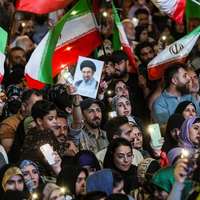
Crowds gather at a state-sponsored event in central Tehran under a large billboard promoting resistance, August 31, 2026
Hardliners in Tehran are pressing for further military and nuclear escalation despite mounting economic pressure and a widening confrontation with the United States. Is it a reckless gamble, or a realistic response to Iran’s dwindling options?
Calls for a tougher response have grown louder as fighting expands beyond the Strait of Hormuz and US pressure on Iranian oil exports intensifies.
In parliament, ultraconservative lawmaker Mohammad Taghi Naghdali has called for a stronger response to prevent further weakening of Lebanese Hezbollah, while Hassan Ghashghavi, spokesman for parliament’s National Security and Foreign Policy Committee, has argued for measures aimed at strengthening Iran’s deterrence.
Other hardline figures have gone further, renewing calls for Iran to withdraw from the Nuclear Non-Proliferation Treaty, end remaining international monitoring and adopt a more confrontational nuclear posture.
The Revolutionary Guards said Thursday its navy had targeted two US vessels, eight oil tankers and 10 other ships in the Persian Gulf and Strait of Hormuz in response to US attacks on five Iranian tankers.
The escalation is taking place against severe economic pressure at home. Food inflation reached 127.5 percent year-on-year in the month to late August, while the rial has fallen to record lows against the dollar.
For advocates of escalation, the calculation is that greater military pressure can produce strategic leverage before the economic and military costs become harder to sustain.
The International Atomic Energy Agency’s Board of Governors this week reported Iran to the UN Security Council over breaches of its nuclear non-proliferation obligations, the first such referral in 20 years.
Tehran rejected the decision, accusing Western governments of using disruption caused by US and Israeli attacks on its nuclear facilities as a pretext for further pressure.
Calls to leave the NPT or further restrict international monitoring could give Tehran another means of raising the stakes. They could also deepen its isolation and increase the risk of further military action at a time when diplomatic options are already limited.
But what are Iran’s alternatives?
Yet judging the hardliners’ strategy solely against Iran’s vulnerabilities misses the other side of the calculation.
President Donald Trump said this week that negotiations with Iran “could happen,” but added that talks were “not something we’re looking at” for now. US forces, meanwhile, have continued attacks on Iranian oil tankers and enforcement of Washington’s maritime blockade.
Trump also said he wants any eventual agreement to go beyond the nuclear issue, potentially making a negotiated settlement more difficult to reach.
Senior advisers have privately warned Trump that Iran could continue resisting US pressure and that the conflict could last through the remainder of his presidency, according to a Wall Street Journal report.
Iran’s latest attack on the US base in Jordan required American forces to fire roughly 30 Patriot interceptors, according to a US official, adding to concerns about the rate at which the war is consuming sophisticated air-defense missiles.
Precise stockpile figures are classified, but independent estimates and recent reporting have pointed to significant pressure on US inventories of Patriot and other high-end interceptors, which can take years to replenish.
The disparity in overall military and economic power remains considerable, while Iran is already contending with high inflation, disruption to its oil trade and the costs of sustained military operations.
But the calculation in Tehran appears to be that Iran can impose sufficient costs on the United States and its regional partners before its own vulnerabilities become overwhelming.
It is a strategy with considerable risks. But with no clear diplomatic off-ramp, the harder question is whether Tehran’s hardliners are ignoring the options available to Iran—or responding to how few remain.