Ghalibaf, who also serves as parliament speaker, has in recent months been identified as the head of Iran’s negotiating delegation. However, following the delivery of Vance’s letter to the secretary of Iran’s Supreme National Security Council, ultra-hardline media outlets said that Rezaei had replaced him in negotiations with Washington.
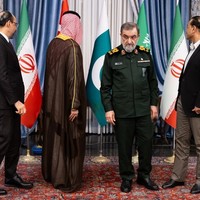
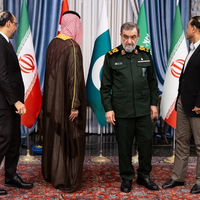
The speculation intensified after Ghalibaf was absent from an unprecedented meeting last week involving the Pakistani army chief, Saudi Arabia’s defense minister and the head of Turkey’s intelligence service (MIT), representing three members of the Mecca Pact. Rezaei and Foreign Minister Abbas Araghchi attended.
Ghalibaf’s supporters have argued that the so-called Tehran Summit was unrelated to negotiations with the United States and instead concerned Iran’s possible accession to the Mecca Pact.
Similar rumors that Ghalibaf was being removed from Iran’s negotiating team emerged in May before being officially dismissed.
Officials insist Ghalibaf remains in charge
Iranian officials have maintained that Ghalibaf continues to lead the country’s negotiating team.
Araghchi told Al Jazeera on Saturday, October 31, that Tehran still regarded Ghalibaf as its chief negotiator and that Rezaei fully supported this arrangement.
Describing the American initiative to establish contact, the foreign minister said: “The American side’s attempt to open the door to dialogue and understanding more broadly is a positive step.”
However, he warned: “If Washington’s goal in sending this letter is to stir up discord, it would be yet another mistake to add to its previous ones.”
Foreign Ministry spokesman Esmail Baghaei said Monday that Ghalibaf remained Iran’s chief negotiator and that the country's diplomatic process was managed through the Supreme National Security Council.
Manouchehr Mottaki, a member of parliament’s National Security Commission who is aligned with conservative hardliners, also dismissed reports that Ghalibaf had been excluded from decision-making.
Speaking to the reformist Ensaf News website on Monday, he said: “Ghalibaf’s significant role in decision-making after Rezaei’s appointment demonstrates that he continues to play an effective part in this process.”
Hardliners welcome Rezaei’s growing role
Despite official assurances, Vance’s letter has prompted some hardline outlets and supporters of the Paydari Front to welcome Rezaei’s growing role and the prospect of diminished influence for Ghalibaf.
Raja News, a website close to the Paydari Party, wrote on October 29 that recent developments demonstrated that “the center of gravity of foreign policy during wartime has shifted from the negotiating team to the secretariat of the Supreme National Security Council”.
The website also drew a distinction between two recent meetings with Iran’s Supreme Leader, Mojtaba Khamenei. It said that during his meeting with Ghalibaf, Khamenei had emphasized resolving people’s livelihood problems through parliament and the government, as well as advancing relations with strategic partners. By contrast, it said, discussions with Rezaei had focused on “fulfilling Iran’s seven new conditions” in negotiations with Washington.
Nobonyad, another news website associated with radical conservatives, reported on October 30 that the media committee for the Islamabad negotiations, which consisted of associates and advisers of the parliament speaker, had been dissolved on the orders of a “senior security official”.
Raja News subsequently published an article titled “Why Does Support for Rezaei Anger Ghalibaf’s Supporters?”, accusing Ghalibaf’s supporters of portraying backing for Rezaei as a political maneuver motivated by satisfaction among his rivals over Ghalibaf’s diminishing role in wartime diplomacy.
The website also leveled a series of accusations against the parliament speaker. It alleged that he had accepted a ceasefire without the Supreme Leader’s authorization, falsely claimed in a Supreme National Security Council statement that the United States had fully accepted Iran’s conditions, entered nuclear negotiations in Islamabad contrary to the Supreme Leader’s instructions, and used the issue of Lebanon’s rescue as a pretext for traveling to Switzerland and continuing direct negotiations with representatives of US President Donald Trump.
Raja News wrote that Ghalibaf and his political allies could have enjoyed the same support from revolutionary forces as Rezaei, particularly under wartime conditions. However, it said they had chosen to place their personal views above the Supreme Leader’s principles and consequently became the target of what it described as “one of the harshest reprimands in the history of the Islamic Republic,” referring to Mojtaba Khamenei’s June 18 message in which he said he had held a different view on the agreement with the United States but authorized it after the president, on behalf of himself and other members of the Supreme National Security Council, gave assurances and accepted responsibility for it.
The website also criticized Araghchi’s recent statement that Tehran was still giving diplomacy an opportunity to succeed.
It described the foreign minister’s remarks as a “special gift to Trump on the eve of his electoral defeat” and a “direct signal of military weakness to the Pentagon and Tel Aviv operations rooms”.
“It is regrettable that Seyed Abbas Araghchi’s behavior at this critical juncture is exactly like that of someone who enters the scene whenever the enemy is on the verge of collapse and facing danger, in order to protect its interests,” it wrote.
Moderates reject claims of a power struggle
Ghalibaf and his close associates have not directly commented on the issue. However, the moderate conservative website Khabar Online described Raja News’s support for Rezaei as “superficial”, arguing that the website was using its support for Rezaei’s positions as a means of undermining and weakening Ghalibaf.
In a commentary published on Monday under the headline “The Duality That Never Materialized: Ghalibaf and Rezaei on the Same Side”, the moderate Asr-e Iran website argued that if the American letter had been intended to create divisions within Iran’s decision-making structure, that objective had effectively failed.
It added that even if Washington had no such intention, some domestic political factions had attempted to exploit the development to manufacture a rivalry between the two officials, despite their public rejection of such a division.
According to Asr-e Iran, Rezaei’s message in a television interview on Saturday was clear: an expanded role for the Supreme National Security Council, or the decision to address its secretary directly, did not mean that he was competing with the head of the negotiating team.
The website argued that although foreign governments could choose whom to address in their correspondence, they could not dictate Iran’s internal decision-making structure.
“The Vance letter could have become an issue for polarization. Some domestic factions also tried to create this duality. But the coordinated positions of Rezaei, Araghchi and Baghaei demonstrated that attempts to manufacture divisions among officials, at least in this case, face a serious obstacle: a division of responsibilities is possible, and differences in language are natural, but Iran’s final decision is one,” Asr-e Iran wrote.