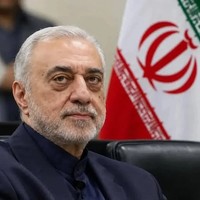
Masoud Pezeshkian was at the Shanghai Cooperation Organization summit in Bishkek when the news came in.
Two supertankers, each carrying 2 million barrels of Saudi crude loaded at the Juaymah terminal, were struck within minutes of each other as they sailed out of the strait off Khasab, Oman, according to the shipping intelligence firms Marisks and Kpler.
The timing was, at minimum, unhelpful to Pezeshkian, and it fits a pattern in which his intermittent push for de-escalation is contradicted within hours by events in the strait. Whether by design or coincidence, escalation in Hormuz has repeatedly arrived at the moments his diplomatic track needed quiet.
It did not stay at tankers. By Tuesday night the most significant exchange of fire in weeks was under way. US Central Command said it had struck Revolutionary Guards air defenses, radar, maritime assets, mine-laying capabilities and communications sites, with Iranian media reporting hits near the strait.
Iran said it struck American assets in Bahrain, Jordan, Kuwait and Iraq; Jordan reported intercepting 10 of 13 ballistic missiles, and a drone set a residential block alight in Kuwait City. The Guards claimed heavy American casualties in Jordan and Erbil. Two US officials told Reuters initial assessments found none.
The civilian toll was not in dispute. Five people were killed and dozens wounded near Sirik on the Hormuz coast, according to the Iranian Red Crescent, with the Mehr news agency reporting a four-year-old among the dead. Seven more were killed in strikes on Khuzestan province.
Pezeshkian, it should be said, was not offering peace. He paired his appeal for a mutual return to the Islamabad framework with a declaration that Iran remains prepared to fight, which is the standard formula and the reason his diplomacy has never been the alternative to the war camp that outsiders sometimes take it for.
Inside Iran the coverage and the anxiety pointed in different directions. Newspapers led on the fight over Hormuz and the arguments over the war and the nuclear file; the public was watching the exchange rate.
And when Pezeshkian's de-escalation push was defended at all, it was defended by his own side: outlets close to the administration were the only ones to amplify his son Yousuf and Vice President Jafar Ghaempanah, who spoke up for him.
Both sides want the same thing
What makes the collapse of the past week strange is that the two governments are asking for the same outcome.
At the G20 finance ministers' meeting in Asheville, North Carolina, US Treasury Secretary Scott Bessent set out a dual-track strategy of financial pressure and calibrated military action, emphasizing economic isolation under Operation Economic Outcast over any broad expansion of the war.
Secondary sanctions and banking blockades, he said, are meant to force Tehran back to negotiations without committing ground forces.
That is, in substance, what Pezeshkian was asking for in Bishkek. Both capitals want a route back to talks. Neither can stop shooting long enough to find one.
A controlled cycle, for now
The shape of the conflict supports that reading. What is visible is a tit-for-tat pattern: targeted American strikes on Iran's mine-laying and air defense assets, localized Iranian missile and drone retaliation, both sides using maximum leverage without opening a sustained strategic bombing campaign.
Constraint is part of the explanation. Iran's war-damaged economy and degraded conventional forces have left it stretched, while the US Army has burned through much of its global stockpile of precision long-range missiles, as Reuters reported last month. Trump's own position is complicated by fuel prices rising ahead of November's congressional elections, and this week's strikes pushed oil to a five-week high and sent Asian stocks down.
The rhetoric has not adjusted. "I like our position now much better, with almost total control of the Hormuz Strait, and their economy totally collapsing," Trump said, asking when Iranians would "rise up and fight." Iran's joint military command warned that any country aiding American action in the region would face "heavier, more widespread, and devastating responses."
Washington's attempt to assemble an economic coalition is meeting resistance from partners wary of further disruption to energy and trade, particularly amid tariff disputes. Major importers in Europe and Asia want maritime stability restored rather than prolonged hostilities.
In Bishkek, Xi urged all parties to end the conflict at Hormuz, warning that continued instability threatens energy routes for everyone, which is Iran's largest customer asking it, in public, to stop.
Qatar, which mediated the June ceasefire that swiftly unraveled, went further, holding Iran "fully legally responsible" for this week's attacks and their consequences.
Both sides are pursuing leverage rather than victory. The trouble with leverage is that it only works if the other side can concede, and nobody in Tehran has shown any sign of conceding on the strait.