• العربية
  • فارسی
Brand
  • Iran Insight
  • Politics
  • Economy
  • Analysis
  • Special Report
  • Opinion
  • Podcast
  • Iran Insight
  • Politics
  • Economy
  • Analysis
  • Special Report
  • Opinion
  • Podcast
  • Theme
  • Language
    • العربية
    • فارسی
  • Iran Insight
  • Politics
  • Economy
  • Analysis
  • Special Report
  • Opinion
  • Podcast
All rights reserved for Volant Media UK Limited
volant media logo

Iranian forces used cultural sites, medical clinics in Alborz crackdown

Farzad Fattahi
Farzad Fattahi

Iran International

Aug 13, 2026, 19:50 GMT+1
Crowds gather in front of Fardis Cinema during protests in Alborz province on Jan uary 9, 2026. A fire burns nearby as smoke rises over the area.

Security forces used cultural venues and medical clinics as firing positions, ammunition stores and sites for holding bodies during Iran's January 2026 protest crackdown in Alborz province, according to material reviewed by Iran International.

The accounts and materials focus on January 8 and 9, when anti-government protests were taking place across Iran and large crowds took to the streets in several cities in Alborz, a province bordering the capital. Security forces responded with live fire in several areas, according to witnesses.

Verified footage, eyewitness testimony and information gathered from several cities across the province describe security operations inside medical facilities, bodies left in streets and the removal of corpses in municipal garbage trucks.

Iran International could not independently corroborate every account or casualty figure because of communications restrictions and the lack of unrestricted access. The details in this report are therefore based on testimony and information from local sources.

Cultural sites turned into firing posts

In Fardis, a city west of the capital, a public library was converted into an ammunition store and staging point, while schools and mosques were used as gathering places for armed personnel, residents said.

Security forces were deployed at a traffic police building adjacent to the city's main cinema, using tear gas, stun grenades and live ammunition against protesters, according to testimonies.

On the evening of January 9, shooters took positions on the cinema roof and surrounding buildings and opened fire on crowds below, multiple sources said.

Forces began firing in bursts around 10 p.m. without appearing to select individual targets, one resident said, describing elderly men in the streets who had been struck by live ammunition or pellets.

Bodies were kept inside the cinema for two days before being removed, several others said. Security personnel also forced residents to delete footage they had recorded.

Gunfire from government buildings

Similar patterns emerged elsewhere in Alborz, where security forces fired from or near government and police buildings.

In Hashtgerd, a city about 70 kilometers west of the capital, forces used Kalashnikov and G3 rifles as well as DShK heavy machine guns. Some of the shooting came from an area containing the local governor's office and police headquarters, local sources said.

Twelve-year-old Sana Tosangi was killed by direct gunfire on January 9 after two bullets struck her in the back and head near government buildings, people familiar with her death said. Shooters were also positioned on the governor's office and a nearby shopping center.

In Meshkin Dasht, special police units used loudspeakers to tell residents that conditions were calm before opening fire after people emerged from their homes.

In Eshtehard, gunfire was reported near a police station and governor's office. A truck carrying bodies was later taken to a largely abandoned cemetery as the number of dead increased, local sources said.

In another part of Alborz, cranes were used to destroy access points to alleys, making it harder to move between the main road, residential streets and medical facilities.

Clinics raided, bodies found bound

Medical facilities in Fardis also came under security control.

The morgue at one clinic quickly reached capacity, while security forces entered another medical facility and detained staff members and wounded protesters. Witnesses said security forces shot some wounded protesters inside the clinic.

Security personnel also took jewelry and personal belongings from wounded or dead women, several people who described events at the facilities said.

“The basement of the clinic was full of bodies,” one resident told Iran International.

Another clinic refused to admit some wounded people, information gathered by Iran International showed.

Iran International's verification team used visual and audio analysis and matched architectural features across submitted footage to identify the dental section of another clinic as the location where some of the images were recorded.

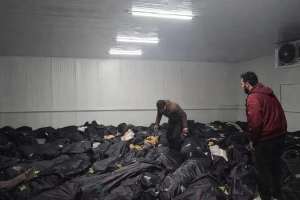
The footage shows bodies inside the medical facility, including several people whose hands and feet were bound. Three people identified by sources as members of the same family were among the dead visible in the footage.

Bodies removed in garbage trucks

Bodies were also left in streets after the shooting, according to testimony from the area.

Plainclothes personnel traveling in vehicles without license plates left bodies in pairs at alley entrances and forced passing drivers at gunpoint to transport corpses, several residents said.

One said that when people contacted the municipality about bodies in the streets, an employee responded by comparing the corpses to garbage.

The testimony and verified footage reviewed by Iran International describe the use of civilian and government infrastructure across Alborz during the January crackdown, from cultural venues and administrative buildings to medical facilities, while restrictions on independent access continue to hinder a full accounting of the deaths.

Most Viewed

US ship strike tests Tehran’s narrative of victory in Hormuz
1
INSIGHT

US ship strike tests Tehran’s narrative of victory in Hormuz

2
ANALYSIS

Iran loses ground in oil market as neighbors rebound

3
INSIGHT

Iran hardliners tout offensive posture as Khamenei reshapes military command

4

US strikes Iran-bound ship as mediators signal Hormuz breakthrough

5
ANALYSIS

From Hormuz to Bab el-Mandeb, conflict converges on vital shipping lanes

Banner
Banner

Spotlight

  • Iranian forces used cultural sites, medical clinics in Alborz crackdown

    Iranian forces used cultural sites, medical clinics in Alborz crackdown

  • Iran seals dozens of businesses in renewed hijab crackdown

    Iran seals dozens of businesses in renewed hijab crackdown

  • Iran hardliners see shift on US talks in Rezaei appointment
    INSIGHT

    Iran hardliners see shift on US talks in Rezaei appointment

  • Security by design: why Tehran is tearing up cobblestones
    ANALYSIS

    Security by design: why Tehran is tearing up cobblestones

  • Iran loses ground in oil market as neighbors rebound
    ANALYSIS

    Iran loses ground in oil market as neighbors rebound

  • When the language of home is no longer the language of life
    ANALYSIS

    When the language of home is no longer the language of life

Banner
  • Iran tightens grip on Karaj hospitals after deadly clashes, witnesses say

    Iran tightens grip on Karaj hospitals after deadly clashes, witnesses say

  • Over 36,500 killed in Iran's deadliest massacre, documents reveal

    Over 36,500 killed in Iran's deadliest massacre, documents reveal

•
•
•

More Stories

Iran seals dozens of businesses in renewed hijab crackdown

Aug 13, 2026, 11:16 GMT+1
•
Reza Akvanian
100%
Image shows a cozy book-cafe scene in Tehran.

Iranian authorities have sealed at least 42 cafés, restaurants, shops, sports clubs and other businesses across the country in the past three weeks, over compulsory hijab rules and what officials describe as violations of Islamic norms.

The figure is based on individual closure cases reported separately by state media and rights groups.

The closures were reported in at least 17 cities, including Tehran, Mashhad, Yazd, Kerman, Ardabil and Birjand, and affected cafés and restaurants, women's gyms, shops and a cultural center.

In just three weeks, the number of closures has already reached about 22% of the 191 cases HRANA documented over the entire previous Iranian calendar year.

Cafés, shops and gyms targeted

Among the latest cases, an optician in Qaen was sealed on Wednesday after authorities said customers and employees had failed to comply with compulsory hijab rules.

The Yin Yang café in Khomein was sealed over what authorities described as "improper hijab" and Instagram content, while a women's clothing store called Shabnam Maison in Kerman was also shut.

A café-restaurant in Tehran's Velenjak district was sealed a day earlier. Authorities in Ardabil also closed three coffee shops and arrested 16 people in connection with the businesses.

Hossein Salari, Ardabil's deputy prosecutor, said inspections of cafés would increase and authorities would act against shops selling clothing that he described as contrary to Islamic law or harmful to "public chastity."

Three cafés in Mashhad, Bojnourd and Birjand were sealed on August 10. Authorities also shut the Zhovan café in Minudasht on August 9 and the Arghavan café-bookstore in Mashhad on August 5.

The enforcement has extended beyond cafés. Two sports clubs in Borujerd were sealed by judicial order on August 4, while authorities shut a Shahr-e Ketab bookstore in Babol the same day.

Four women's sports clubs were also sealed in Yazd, while authorities in Abadeh shut five businesses and arrested a café operator.

In Dezful, the local prosecutor announced the closure of 15 cafés and hookah lounges on July 23.

Enforcement rises sharply in Mashhad

Authorities have used terms including failure to observe compulsory hijab, "violations of norms," failure to observe "Islamic standards," and promotion of indecency to explain the closures.

Some businesses have also faced other accusations. Authorities in Ardabil cited alleged gambling and promotion of corruption among the reasons for closing three cafés.

One café in Mashhad was cited for issues including failing to list matcha on its price list and selling cakes and desserts without required health certification. Police described the alleged violations at four women's gyms in Yazd only as "disciplinary offenses."

Official figures from Mashhad point to a sharp rise in closures.

Mohsen Sayadi, the city's head of trade inspection and supervision, said authorities sealed 104 businesses during the first four months of the current Iranian year, which began on March 21, compared with five during the same period a year earlier - an increase of about twentyfold.

100%
Friends gathered at a cafe in Tehran to watch a match together.

Pressure extends to social media

The enforcement has also extended online.

HRANA said that between July 11 and August 1, authorities sealed at least 23 businesses, blocked or seized at least 72 social media pages and accounts, and required the operators of 21 pages to publish statements pledging compliance.

Those affected included bloggers, content creators, athletes, artists, fashion and beauty workers, online businesses, travel agencies and cafés.

HRANA also reported that authorities had identified and removed 56 Instagram pages in Qazvin and deleted 3,258 pieces of content from social media pages belonging to 32 businesses in Rasht.

Businesses face wider pressure

The closures come as businesses are also struggling with falling purchasing power and broader economic pressure.

Iranian authorities have previously sealed businesses that joined strikes, supported anti-government protests or did not enforce compulsory hijab, including during the 2022 Woman, Life, Freedom protests and demonstrations earlier this year.

Many Iranian women have increasingly appeared in public without the mandatory headscarf since 2022, while authorities have continued to use business closures and action against social media accounts to enforce compulsory hijab rules.

Iran International's Negar Mojtahedi wins top Canadian journalism honor

Aug 13, 2026, 10:24 GMT+1
100%
Iran International's reporter Negar Mojtahedi during an interview

Iran International's Negar Mojtahedi has won Canada's 2026 Bill Good Award, part of the Jack Webster honors regarded as western Canada's preeminent journalism awards, cited for reporting that bridged the gulf between the West and Iran, often at risk to her own safety.

"Reporting on war, state violence and human rights violations, often at great risk to her personal safety, Negar has helped bridge the gulf between the West and Iran and increased cultural understanding," the Jack Webster Foundation said in announcing the award.

The foundation also praised Mojtahedi, a first-generation immigrant, for challenging negative stereotypes and serving as a role model for journalists seeking more equitable representation of their communities.

The Bill Good Award was created to mark the retirement of its namesake, one of Canada's most trusted broadcast voices, after a 50-year career spanning CTV, CKNW and CBC. Unlike the foundation's juried categories, its recipient is chosen directly by the board, and past honorees have been drawn from the country's most established newsrooms, from CBC to the Vancouver Sun.

"No other award in Western Canadian journalism instills a sense of pride greater than a Webster," the foundation says of its honors.

Mojtahedi is an investigative reporter, documentary filmmaker and host of Eye for Iran, Iran International's weekly English-language podcast, based in British Columbia.

  • Iran International wins four WAN-IFRA Middle East digital media awards

    Iran International wins four WAN-IFRA Middle East digital media awards

  • Negar Mojtahedi, Iran International awarded 2025 TLN media freedom award

    Negar Mojtahedi, Iran International awarded 2025 TLN media freedom award

The award caps a run of international recognition for the network and its journalists stretching back less than two years.

Last year, the Transatlantic Leadership Network in Washington presented Mojtahedi its Freedom of the Media Award for excellence in international reporting, an honor whose past recipients include the Iranian dissident journalist Masih Alinejad; Iran International was recognized at the same ceremony.

In May, the network took four top prizes at the 2026 WAN-IFRA Digital Media Awards Middle East, run by the World Association of News Publishers, including two for a secure Telegram bot that lets Iranians submit verified footage and reports from inside the country, alongside awards for its interactive map of the 12-day war and its Woman, Life, Freedom coverage. The bot advanced to the global stage of the competition, where the network placed among the Middle East's top-performing organizations.

The same month, Art of Resistance, a short documentary produced by the network's parent company Volant Media and directed by Iran International correspondent Mehran Abbassian, won Best Short Documentary at the Swedish Cinema House Film Festival, with Abbassian named Best Director.

The Webster foundation also named Surrey Now-Leader journalist Tom Zytaruk the recipient of the Bruce Hutchison Lifetime Achievement Award and CBC producer Anne Penman the recipient of the Shelley Fralic Award.

The honors will be presented at the Webster Awards gala in Vancouver on November 2.

Security by design: why Tehran is tearing up cobblestones

Aug 13, 2026, 00:04 GMT+1
•
Mehdi Sepahvand
100%
Piles of historic cobblestones torn from central Tehran’s streets sit stacked beside traffic.

Tehran's municipality is tearing up the cobblestones of the capital's historic pedestrian zones and laying asphalt, a change officials call traffic management and that architects and urban sociologists read as something older: the redesign of a city to make protest harder.

The work, underway in District 12, Baharestan Square and 30 Tir Street, is presented by municipal officials as a routine measure to ease congestion, carried out at the request of the traffic police.

Critics in architecture and urban sociology argue it cannot be read as a merely technical decision, and belongs instead to a long historical tradition: the use of urban design as an instrument of control.

When the city takes away the barricade

The link between redrawing a city's body and engineering its security is not new. Its most famous case is the great reconstruction of nineteenth-century Paris, carried out by Baron Haussmann on the orders of Napoleon III.

Until the 1850s, Paris was a city of narrow, winding, organic streets that let protesting citizens pry up the paving stones, throw up barricades and take control of their own neighborhoods, the world Victor Hugo drew so vividly in Les Misérables.

By demolishing the old fabric and driving broad, straight, uniform boulevards through it, Haussmann pursued two entwined goals: to strip the public of the ability to barricade the streets, and to ease the rapid movement of troops and heavy artillery for the suppression of unrest.

Later theorists built the insight into the foundations of urban thought. Walter Benjamin in The Arcades Project and David Harvey in his work on the "right to the city" traced how space itself becomes a tool for reproducing ruling power and erasing the protester's presence from it.

Physical disarmament of public space

The replacement of segmented paving blocks with continuous asphalt functions, in effect, as the physical disarmament of the urban environment. Unlike uniform asphalt, cobblestones can be pried loose in a street confrontation, handing demonstrators ready material for barricades or for holding back advancing security forces.

  • Over 36,500 killed in Iran's deadliest massacre, documents reveal

    Over 36,500 killed in Iran's deadliest massacre, documents reveal

Beyond removing potential projectiles, the smooth surface answers the operational needs of motorized units. Pedestrian infrastructure, with its uneven paving, varying widths, benches and street furniture, slows vehicles down. Coating these zones in asphalt creates uninterrupted corridors for special forces, water cannons and high-speed motorcycle patrols.

100%
Pedestrians stroll along a cobblestone walkway in central Tehran.

Eradicating gathering points

The repaving projects coincide with heightened enforcement against public gathering spaces in central districts, including the sealing of outdoor cafes and the removal of street furniture.

Pedestrian-friendly designs naturally create pause points where citizens congregate, engage in conversation, and form initial nodes of public assembly.

Converting pedestrian hubs into vehicular thoroughfares prioritizes rapid transit over civic presence, reshaping central public areas into channels designed for continuous traffic flow.

The removal of seating and outdoor dining areas reinforces this operational shift by eliminating physical spaces that encourage citizens to linger.

Reclaiming the street

Public thoroughfares have consistently served as primary arenas for civil expression during periods of political tension in Iran.

Highlighting the symbolic and practical weight of public space, prominent Iranian actress Hedieh Tehrani addressed security forces in a public message during the 2022 nationwide protests, writing, "My only way of communicating with the people is the street."

  • Iran crossed a political threshold

    Iran crossed a political threshold

Similarly, exiled Prince Reza Pahlavi emphasized the importance of public thoroughfares during his calls for widespread demonstrations in January 2026, framing the reclamation of street spaces as a central objective for people.

Replacing historical pedestrian infrastructure with asphalt prioritizes security deterrence and vehicular velocity over civic life and urban heritage. By converting public gathering hubs back into high-speed transit corridors, municipal authorities reduce public space from a venue for civic engagement into an infrastructure designed to prevent assembly.

Iran could prolong war to outlast Trump, IRGC adviser says

Aug 12, 2026, 19:08 GMT+1
100%
Senior Iranian commander Mohammad Reza Naghdi speaks to PBS

A senior adviser to the commander of Iran's Revolutionary Guards said Tehran could deliberately prolong the war until US President Donald Trump leaves office to wear down its adversaries and deter future attacks.

"One way is to prolong this war until we get to the next term of the presidency and cause attrition, so that if anyone else wants to attack Iran, they will know there is a cost," Mohammad Reza Naghdi told PBS NewsHour on Tuesday.

Naghdi made the comment after being asked directly whether Iran's objective was to drag out the war and wait until Trump was out of office.

He said Iran needed to establish enough deterrence to prevent future attacks.

"We have to attain deterrence so that the enemy never dares to attack us, so we can live with security," he said.

Civilian ships in Strait of Hormuz

Naghdi also defended attacks by Iranian forces on non-military vessels attempting to cross the Strait of Hormuz.

Asked why Iran had attacked civilian ships on at least two occasions this week, Naghdi said Tehran needed to control shipping routes during wartime.

"When we are at war, vessels need to pass through a region we can control," he said. "When they leave an area that we control, it could be that they're transporting supplies for the enemy."

Asked whether attacking civilian vessels violated international law, Naghdi said Iran had the right to control routes it viewed as a threat during a war.

"When you're in a state of war, any thoroughfare deemed to be a threat, we can control it," he said.

His comments came as shipping through the Strait of Hormuz has fallen sharply amid the conflict and attacks on commercial vessels.

Khamenei absence due to security, Naghdi says

Naghdi was also asked why Supreme Leader Mojtaba Khamenei had not appeared publicly during the war.

"Naturally, it is due to security," Naghdi said when asked whether his absence was for security reasons. "Certainly, there is no other reason."

Asked whether he had personally seen Khamenei, Naghdi declined to answer.

"Let's leave this matter alone," he said.

PBS said it asked the White House for a response to Naghdi's remarks.

"It would be wise for Iran to agree to a deal," the White House said in a statement cited by PBS, adding: "Otherwise they know what will happen."

When the language of home is no longer the language of life

Aug 12, 2026, 13:02 GMT+1
•
Tahmineh Rostami
100%
The photo shows Persian-language textbooks used in Iranian elementary schools.

The child understands every word her grandmother says in Persian. She answers in English. She can ask what's for dinner in her parents' language, but not describe her anxiety, her love or her future in it. She calls herself Iranian. Persian is no longer the language of her life.

In the study of migration and bilingualism, Persian is, for many children of Iranian immigrants, a heritage language: a language passed down through family and cultural background while another language dominates their schooling and social world.

The term is not the same as mother tongue. A mother tongue is usually the first language learned in childhood; a heritage language may lose its dominant place very early, sometimes before the child can read a word of it.

For Iranians, this is not merely a question of language teaching. More than four decades of political, social and economic emigration have built a multigenerational society outside Iran, one now entering its third generation.

The question is no longer how many Persian words the children know. It is how much of the language, the family memory and the direct connection to Iran will reach the generations after them.

  • One in 15 Iranians lives abroad after 45 years of Islamic Republic rule

    One in 15 Iranians lives abroad after 45 years of Islamic Republic rule

One generation weakens a language; the next can lose it

Starting school is one of the deepest turning points in a child's linguistic life. The host country's language is not just the language of lessons; it becomes the language of friendship, play, jokes, music, the internet and most of the child's social world. Even in a family where the parents speak Persian at home, the real share of Persian in the child's day shrinks, steadily and without anyone deciding it should.

Studies of Iranian families abroad find the same gap from the parents' side. In interviews conducted by sociolinguist Khadij Gharibi and her colleagues with Iranian households in the United Kingdom and New Zealand, and in similar research in the Netherlands, parents express a deep commitment to passing Persian on; one parent in the UK study put it simply: "You are Iranian even if you were born on the moon." Yet the same studies document a persistent distance between what parents believe and what daily practice at home actually delivers.

The shift rarely happens suddenly. First the child understands Persian and answers in Persian. Then she still understands her parents but replies in the dominant language. Later, Persian narrows to family matters and daily routine, while feelings, schoolwork and personal disputes migrate to the other language.

Nor are understanding, speaking, reading and writing a single skill. A person may understand Persian almost completely yet grope for words when speaking, or speak fluently yet be unable to read a simple text. At that point, direct access to Persian literature, media, history and much of the written world of the language closes too.

The experience of other immigrant communities shows how deep the shift can run within two or three generations, a pattern sociolinguists have described since Joshua Fishman's classic model of three-generation language loss.

In the United States, 89 percent of first-generation Latino youth and 79 percent of the second generation report speaking Spanish well; in the third generation the figure falls to 38 percent, and only 26 percent report strong reading and writing.

Canadian data show the shift happening inside the family itself: in households where both immigrant parents shared the same non-official mother tongue, 24.4 percent of children used only English or French at home, against 2.5 percent of their parents.

These numbers are not about Iranians and cannot be transferred to them directly. But the pattern they draw is unambiguous: a language's strength in the first generation is no guarantee it will reach the third.

When the shared language shrinks, the hard conversations shrink with it

The consequences are not only cultural. One of the most consequential facts of immigrant family life is the gap that can open between the linguistic reach of parents and children.

A child usually learns the host country's language faster and deeper than her parents do. A father or mother may handle the new language perfectly well for work and errands, yet still feel a memory, an emotion or a complicated thought most precisely in Persian. The child may lack sufficient Persian in exactly those places.

In childhood the gap barely shows. School, food and tomorrow's plans need only a narrow band of language. Adolescence demands other conversations: anxiety, love, identity, discrimination, gender, politics, the future, the family's own disputes.

A shrinking common language does not by itself produce a family crisis, and the difficulties of immigrant families cannot be reduced to language. Economics, the migration experience itself, generational difference and social pressures all play their part. But the more complicated the conversation, the more the linguistic ceiling makes itself felt.

In Iranian families, the bond with the older generation carries its own weight. A child with limited Persian can manage daily talk with her grandparents. Hearing the story of a life, the memory of an emigration, an argument about history, is harder.

For a community whose modern experience is knotted together with revolution, war, repression, protest and wave after wave of departure, this is not only about preserving literature and culture. Language is one of the principal carriers of family and historical memory. The narrower it becomes, the more the next generation's access to its own family's lived experience will depend on summaries, and on translation.

The third generation: who will teach Persian, and with which Iran?

About the coming generations there is still no comprehensive data. Nobody knows how many Iranian children abroad understand Persian, how many speak it, how many can read and write it. Even the size of the diaspora resists precise measurement, because countries classify people differently, by birthplace, citizenship, ancestry, ethnicity or language.

Yet the third generation's challenge is already visible in outline. The first generation typically carried complete Persian out of Iran. The second may hold a reduced version: strong comprehension, weaker speech, little literacy. When that generation becomes parents, its narrower Persian is no longer a private matter; it directly constrains what can be passed to the next child.

For Iranians, teaching the language carries a political complication too. Many immigrant families are caught between the need to preserve Persian and their distrust of institutions that are official, or tied to the Islamic Republic. Not everyone has access to a Persian school, and some parents refuse to let their child's language lessons come bundled with religious instruction, ideological content or the state's official narrative of Iran's history and identity.

So the question is not only how Persian should be taught. It is who teaches it, with what content, and with which image of Iran.

A few hours of weekend class will not carry a language on their own. A language survives when a child has reasons to use it: books and media made for her age, friendships with other Persian speakers, and the ability to talk in Persian not only about home and food, but about her own world.

For part of the second generation, Persian is still the language of home but no longer the language of life. For the third, the question is more fundamental: will Persian remain the language of home at all?

That question is not only about the survival of a language. Its answer will decide how directly generations who may never live in Iran can reach their family's memory, their people's modern history and the Iranian experience itself; whether Iran, for them, will be a land whose language they know, or a story that always arrives in translation.