Dozens of Iran protest detainees held without hearings - rights group
Dozens of people detained over Iran's January protests remain in a security ward in the country's northwest, with more than half still awaiting hearings or serving prison sentences of up to five years, the US-based Human Rights Activists News Agency (HRANA) reported on Friday.
HRANA said 54 detainees were being held in Ardabil prison, near Iran's border with Azerbaijan. Of those, 25 have been sentenced to between six months and five years and three months in prison, while 29 remain in custody without having had a hearing in their cases.
Among those convicted, Ahmad Seifi received the longest sentence of five years and three months, while Milad Ashkani was sentenced to four years. Three others received sentences of three years and six months, according to HRANA.
Prosecutors seek harsher sentences
An informed source told HRANA that Ardabil prosecutor Jalal Afaghi considered the sentences handed to 10 of those convicted too lenient and had asked Iran's Supreme Court to increase their punishments.
HRANA said full details of the charges, proceedings and courts responsible for the sentences had not been made public.
Some of the detainees have also been denied telephone calls and family visits, while relatives have faced restrictions in seeking information about their cases or requesting temporary release, the rights group said.
Hundreds detained in northwestern province
Around 800 people were arrested in Ardabil province during the January protests, according to HRANA. The group said about 500 were released during the first 10 days and roughly another 250 were later freed after posting bail or other forms of security.
The cases form part of a much broader judicial crackdown following the protests. Rights groups have estimated that more than 60,000 people were detained across Iran, while some independent sources have put the number summoned, detained or interrogated at more than 100,000.
Iranian judiciary spokesman Asghar Jahangir said in February that authorities had issued more than 10,000 orders sending cases for prosecution and around 9,000 indictments against people detained during the unrest.
The report comes amid mounting international concern over prosecutions and executions connected to the protests.
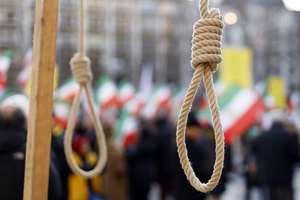
UN human rights chief Volker Türk said this week that Iran had executed at least 56 people on national security-related charges since March 19, including 27 in protest-related cases. He urged Iranian authorities to halt executions and move towards abolishing the death penalty.
Iran has opened a second case against Ahmad Seyyed-Abdollahi, who is serving a prison term after posting a video urging Donald Trump to protect demonstrators during January’s nationwide protests, sources familiar with the case told Iran International.
The second case was opened in June on the charge of “propaganda against the establishment” and remains at the preliminary investigation stage, the sources said.
Seyyed-Abdollahi, 32, posted the English-language video on January 4, two days after Trump warned that the United States would come to the aid of peaceful protesters if Iranian authorities opened fire on them.
In the video, Seyyed-Abdollahi urged Trump to act quickly, saying many young Iranians had trusted his words and that help would come too late for those killed.
He added that Iranians would remember those who helped them and would seek to repay their friends in the future.
Seyyed-Abdollahi was first arrested on January 14, ten days after posting the video. He was held for about two months in solitary confinement at Borujen Prison and an intelligence detention facility operated by the Islamic Revolutionary Guard Corps in Isfahan.
He was released on bail on March 10.
Branch One of the Borujen Revolutionary Court later convicted him of “engaging in media activities against national security,” sentenced him to seven months in prison and barred him from government and public services for five years.
He was detained again on July 7 to begin serving the sentence and transferred to Borujen Prison in southwestern Iran’s Chaharmahal and Bakhtiari province, where he remains incarcerated.
Seyyed-Abdollahi was denied access to a lawyer of his choosing during his detention and was at times prevented from contacting his family, according to the sources.
He was among several Iranians who appealed directly to Trump for help during the nationwide protests.
Videos sent to Iran International showed one woman holding a sign reading, “Trump, a symbol of peace. Don’t let them kill us,” while another protester urged him to “do something” as security forces opened fire in Yazdanshahr in Isfahan province.
A protester in the northeastern city of Mashhad also addressed Trump directly and appealed for help during the crackdown.
Trump repeated his warning on January 9, telling Iranian authorities: “You better not start shooting because we’ll start shooting too.”
On January 13, he urged Iranians to continue protesting and wrote that “help is on its way.”
Iranian authorities crushed the protests with lethal force and carried out mass arrests.
The US-based rights group HRANA has reported that more than 50,000 people were arrested during just over six weeks of protests and the ensuing crackdown.
Authorities have since intensified their use of the death penalty against protesters. UN human rights chief Volker Türk said Wednesday that Iran had executed at least 56 people on national security-related charges since March 19, including 27 in cases linked to the January protests.
Amnesty International says at least 60 protest-related defendants, including three who were arrested as children, remain at risk of execution.
From top left: Ali Zaghi, Mehdi Zarif and Mohammad Zanganeh; from bottom left: Najmeh Amini and Vahid Khedrikhah.
Five people detained over Iran’s nationwide January protests have been sentenced to death or are at risk of receiving death sentences in the northeastern city of Mashhad and nearby Shandiz, sources familiar with their cases told Iran International.
Mohammad Zanganeh, Mehdi Zarif and Ali Zaghi have been sentenced to death, while Najmeh Amini and Vahid Khedrikhah face charges that could carry capital punishment, sources told Iran International.
The five cases come amid a sharp escalation in Iran’s use of capital punishment against people detained during the January unrest. The UN human rights chief says at least 56 people have been executed on national security-related charges since March 19, including 27 in protest-linked cases.
Najmeh Amini: Facing capital charges over Instagram stories
Amini, a 23-year-old accounting student, was arrested in Mashhad on February 2 over several protest-related Instagram stories.
Sources said she was beaten and arrested while shopping at a market in the city.
She was held in police custody for two days and forced to confess, according to the sources.
Hengaw reported that Amini faces charges including moharebeh, or “waging war against God,” and collaboration with Israel, accusations that could carry the death penalty.
Amini has been denied access to a lawyer throughout her detention and is being held in Mashhad’s Vakilabad Prison.
Mohammad Zanganeh: Prison sentence followed by death ruling
Zanganeh, a 24-year-old protester, is at risk of execution after the Mashhad Revolutionary Court issued a new notice sentencing him to death.
He has gone on hunger strike in Vakilabad Prison in protest against the ruling.
Sources told Iran International that the court, presided over by Judge Hadi Mansouri, recently notified Zanganeh that he had been sentenced to death.
The same court had previously sentenced him in June to three years, six months and one day in prison on charges including acting against internal and external security, chanting slogans against the Islamic Republic, insulting religious sanctities, calling for protests and unrest, damaging public property and setting fire to a banner of former supreme leader Ali Khamenei.
Sources said his condition in prison is “extremely concerning.”
Before recently being allowed to communicate outside the prison, Zanganeh had been held incommunicado for five months, during which his family had received no information about him.
He was denied access to a lawyer and other basic rights as a prisoner throughout that period, sources told Iran International.
Mehdi Zarif: Death sentence imposed under espionage law
Zarif, a 21-year-old dental technician from Shandiz, is at risk of execution after Iran’s Supreme Court upheld his death sentence, a source familiar with his case told Iran International.
He was arrested at his home on February 14 and, after a period in solitary confinement, suffered a heart-related medical complication during questioning, which the source attributed to pressure exerted by interrogators.
Zarif is currently being held in Mashhad’s Vakilabad Prison.
The source said Branch Five of the Mashhad Revolutionary Court, presided over by Judge Yazdankhah, sentenced him to death under legislation introducing harsher penalties for espionage, cooperation with Israel and collaboration with states deemed hostile to Iran’s national security.
The Supreme Court upheld the ruling, and Zarif’s lawyer was denied access to the full judgment and the case documents, according to the source.
Ali Zaghi and Vahid Khedrikhah
Zaghi has been sentenced to death in connection with the January protests, sources told Iran International.
He was arrested on January 12 in Shandiz, a city near Mashhad. No further details about his case were available.
Khedrikhah, a 32-year-old from Mashhad who is being held in Vakilabad Prison, is at risk of being sentenced to death, informed sources told Iran International.
Khedrikhah, who lost both parents at the age of 12, was taken to a friend’s home for treatment after being wounded in the side on January 9.
Security forces went to the house on January 19 and arrested him, the sources said.
According to the sources, he faces charges of “leading the protests” and moharebeh, or “waging war against God,” the latter of which can carry the death penalty.
Use of death penalty against protest detainees
UN human rights chief Volker Türk said on Thursday that executions and death sentences had risen sharply since March, with more than 100 other people facing national security-related charges that could carry the death penalty.
Mai Sato, the UN special rapporteur on human rights in Iran, echoed Türk’s alarm, pointing to a persistent pattern of executing people, including protest participants, on security-related charges.
“The purpose of these executions is to control society by instilling fear through lethal force,” she said.
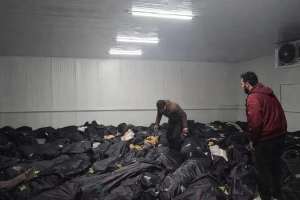
Bodies wrapped in black body bags lie at Kahrizak morgue following the deadly crackdown on anti-government protests in Iran in January 2026.
President Masoud Pezeshkian drew angry reactions from Iranians after rejecting higher estimates of those killed in Iran's January protests and calling those who cite such figures "traitors" in an interview published on Wednesday.
Pezeshkian described the protests as a "riot" and accused people abroad of falsely inflating the death toll.
"Those sitting abroad who present themselves as intellectuals and scholars, yet say 30,000 or 40,000 people were killed, are dishonorable and traitors," he said in the video interview.
His remarks prompted a wave of criticism from citizens who sent messages to Iran International, with many accusing the president himself of bearing responsibility for the killings.
"Mr. Pezeshkian, this is disgraceful. Stop lying and have some shame," one said. "Your hands are stained with the blood of tens of thousands of Iranian protesters. Curse all of you killers and the remaining figures of the Islamic Republic."
Others argued that even the official death toll acknowledged by his administration warranted accountability.
Crowds take part in anti-government protests in Tehran in January 2026.
"Sitting there and saying 3,000 people were killed – first of all, this is not about the number," one citizen from Arak said. "Even if it were those 3,000 people you admit were killed, you should answer for every single one of them."
Another viewer wrote that if Iran had "a normal government," Pezeshkian should face punishment simply for acknowledging that thousands had been killed.
"So if, by your own account, 3,000 people were killed, that's acceptable?" another message read.
Government figures disputed
In mid-February, Pezeshkian's office published a list containing the names of 2,986 people it said were killed during the January protests, saying it had been compiled using data from the Legal Medicine Organization and cross-checked with the National Organization for Civil Registration.
The figure is far below Iran International's editorial board estimate of at least 36,500 people killed during the crackdown. Several international media outlets have also cited similar estimates.
Pezeshkian has repeatedly accused protesters of carrying out armed attacks and sabotage.
In his latest interview, he again described protesters as having been armed by US President Donald Trump, referred to the crackdown as an "incident" and said demonstrations had turned into a "riot" in which "difficult events" occurred.
One person responded by invoking a Quranic verse.
"If your memory serves you, the Quran you probably believe in says killing one innocent person is like killing all humanity," the message read. "Yet you speak about 3,000 deaths as though nothing important happened."
Another accused the president of contradicting earlier official accounts.
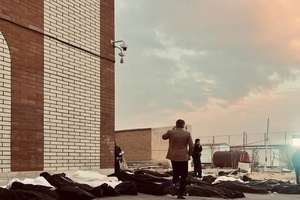
Bodies wrapped in blankets lie outside Alghadir Hospital in eastern Tehran following anti-government protests in January 2026.
"It is interesting that you say terrorists killed the victims, yet you become angry at those who say the real figure is 40,000 and call them traitors," he wrote. "That amounts to admitting that the terrorists you blamed were actually yourselves."
Activists challenge official narrative
Human rights activist and former political prisoner Mehdi Mahmoudian also criticized Pezeshkian's remarks.
"Please explain who killed the several thousand people whose deaths you yourself do not deny, and what those responsible for this crime should be called," Mahmoudian wrote.
Separately, critics resurfaced comments by Mojtaba Lotfi, a cleric and former aide to the late Grand Ayatollah Hossein Ali Montazeri, who argued that the government's casualty list had been censored.
Referring to his hometown of Najafabad, Lotfi wrote that local records indicated at least 30 victims from the city had been omitted from the official list, suggesting the government's figures were incomplete.
A shopper looks over dairy products in an Iranian supermarket. Retail workers say thefts of basic food items have become more common as economic pressures intensify.
Petty thefts of basic food items are becoming a symbol of Iran's economic hardship, according to a newspaper investigation published on Wednesday that linked supermarket shoplifting to inflation and shrinking purchasing power.
Unlike the corruption scandals that have long dominated headlines in Iran, the report by Jahan-e Sanat focuses on thefts measured not in billions of rials but in loaves of bread, packages of cheese and cuts of meat.
It argues that cases involving everyday groceries are increasingly reflecting economic distress rather than simple criminality.
"There are no billions of tomans, no gold, no luxury villas," the newspaper wrote. "Sometimes it is only a can of cheese, a loaf of bread or a few simple food items."
Days before Jahan-e Sanat published its report, CCTV footage from outside a minimarket at night in the northern city of Babolsar spread widely across Persian-language social media.
The footage appears to show a woman wearing a black chador approaching a display of boxed goods outside the shop. After pausing beside the display and glancing around, she appears to pick up one of the boxes before walking away.
Exactly what prompted the woman's actions remains unknown. But for many Iranians, the clip became less about one apparent shoplifting than about the growing struggle to afford everyday necessities.
"May God never let anyone feel ashamed in front of their family," one user wrote.
"This is what happens when prices keep rising. We live in a country rich in oil and gold, yet the government cannot provide for 87 million people," another commented.
"People simply cannot afford to buy things anymore because prices have become so expensive," another wrote.
Others pleaded with whoever shared the footage not to expose the woman's identity.
"Who would steal a few groceries unless driven by poverty and hunger? God help them," one commenter wrote.
AI-generated image shows a security camera monitoring supermarket shelves in Iran, where reports of petty thefts involving everyday groceries have sparked debate over poverty and the country's worsening cost-of-living crisis.
"Maybe she had no money to buy food for her children. The shopkeeper should have protected her dignity instead of exposing her," another said.
Some comments contrasted the apparent theft with what they described as large-scale corruption, arguing authorities should focus on powerful figures accused of enriching themselves rather than people taking everyday necessities.
The sympathy expressed online echoed account gathered by Jahan-e Sanat from a supermarket employee who described an apparent increase in customers taking inexpensive food items.
Behind the supermarket shelves
Amirhossein, an employee at a large supermarket chain, told the newspaper he had witnessed several such incidents during the past 10 months.
He recalled seeing a woman place two tubs of cheese into her handbag during a busy period before leaving without paying. In another case, he said, security camera footage later showed a man leaving with butter, cakes and pastries concealed beneath his coat.
Staff also stopped a customer who had eaten packaged cakes inside the store and hidden the empty wrappers before trying to leave, according to the employee.
Perhaps most surprising, Amirhossein said, was a regular customer who was caught taking a package of meat.
"I think poverty is the main reason," he told Jahan-e Sanat. "You cannot judge everyone the same way, but when someone steals a simple item, they are probably under enormous pressure. Sometimes, if what was taken has little financial value, we don't pursue it because we think the person's circumstances may have brought them to this point."
'A crisis of livelihoods'
Sociologist Mostafa Abroshan said reports of thefts involving bread, dairy products and other essentials should be viewed in the context of Iran's prolonged economic difficulties.
"Thefts of basic goods, especially food and other necessities, reflect disruptions in economic structures and the declining ability of households to meet their basic needs," he told the newspaper.
"This does not justify theft, but it shows that people's behavior must be understood within its social context."
Abroshan said inflation, declining purchasing power and job insecurity had left many households struggling to afford essential goods.
"A society in which stealing bread, milk or rice becomes more common is facing a crisis of livelihoods and social justice more than a security crisis," he said.
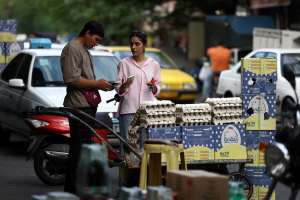
A shopper carries groceries in Iran. Rising prices and declining purchasing power have pushed basic food items to the center of the country's widening cost-of-living crisis.
Prolonged economic hardship, he warned, could also erode social trust, leaving retailers more suspicious of customers, increasing security costs and weakening confidence in public institutions.
While enforcing the law remains necessary, Abroshan said that reducing poverty, controlling inflation, creating jobs and strengthening social support would do more to curb petty theft than harsher punishment alone.
Without addressing the economic pressures facing low-income households, he said, the theft of everyday groceries risks becoming an increasingly visible measure of Iran's widening cost-of-living crisis.
Iran has intensified its repression of ethnic minorities, particularly Kurdish and Baluch communities, through arbitrary arrests, enforced disappearances and executions, a group of UN human rights experts said on Thursday.
The experts said at least 24 members of the Baluch minority and 22 members of the Kurdish minority had been executed in 2026, with many more at imminent risk of execution.
“Iran’s ethnic minorities must be able to live in safety and dignity, free from discrimination,” the experts said in a statement.
Kurds are concentrated mainly in western and northwestern Iran, while many of Iran's Baluch population live in the southeastern province of Sistan-Baluchistan. Both predominantly Sunni communities have long faced political, economic and security pressure from the Shiite-led authorities, according to rights groups.
“Reports point to a significant increase in arbitrary arrests, and what appears to be politically motivated sentences,” the experts said, adding that members of ethnic minorities were often detained under broadly defined national security charges.
The experts said a 2025 law expanding the definition of espionage, along with offenses including moharebeh, or “enmity against God,” efsad-fil-arz, or “spreading corruption on earth,” and baghi, or armed rebellion against the Islamic Republic, had been used particularly against Kurds.
They described the laws as “a tool to repress dissent.”
Thursday’s warning comes a day after UN human rights chief Volker Türk said Iran had executed at least 56 people on national security-related charges since March 19, including 27 in cases linked to protests earlier this year.
Türk said executions and death sentences had risen since March and that more than 100 other people faced similar charges and the death penalty.
The figures follow a series of executions in recent weeks involving young people detained over the January protests.
Iranian authorities executed 20-year-old Arvin Kheirkhah at Shahroud prison on Saturday after he was sentenced to death over his involvement in the protests, according to information obtained by Iran International.
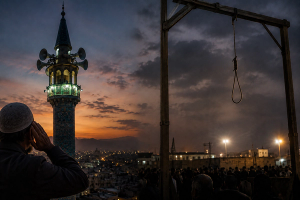
Days earlier, authorities hanged Amirhossein Safari and Abolfazl Sepahi in Isfahan’s Alikhani Square. They were among 12 young men sentenced to death in a case stemming from protests there in January.
A group of UN human rights experts led by Mai Sato, the UN Special Rapporteur on the situation of human rights in Iran, had urged Tehran to halt executions in the Isfahan case, citing concerns about closed proceedings, alleged ill-treatment and the use of confessions broadcast on state television.
Türk urged Iranian authorities to halt all executions and move towards abolishing the death penalty.