Where steak is a dream

Kambiz Tavana
Iran International

A social media exchange about steak struck a chord among Iranian users this week, turning one young user's dream into a broader conversation about economic hardship and political frustration.
Iran International
A social media exchange about steak struck a chord among Iranian users this week, turning one young user's dream into a broader conversation about economic hardship and political frustration.
Replying to a couple who shared photos of a home-cooked steak after losing weight together, the 20-year-old user wrote: "Please don't laugh at me, but one of my dreams is to eat steak once in my life."
The exchange quickly spread across Persian-language social media, drawing more than 750,000 views and over 11,000 likes.
When the couple later revealed their meal had cost around 1.5 million tomans, the user replied: "Sister, I live for three weeks on 1.5 million... what are you talking about?"
Others responded with a mixture of empathy and anger.
"We're not laughing," one user wrote. "We're cursing the ones responsible for making steak one of our dreams."
Another observed that with meat costing around two million tomans per kilogram, "it's clear most of society has never eaten steak."
The exchange reflected a broader reality: for many Iranians, red meat has shifted from an ordinary part of the diet to an occasional luxury—or, for some, an aspiration.
In June 2025, Masoud Rasouli, secretary of the Meat Production and Packaging Association, said annual meat consumption had fallen had fallen to as little as seven kilograms per person from a previous average of 18 kilograms.
While some people still managed to consume around 20 kilograms a year, he said, others no longer ate red meat at all.
The decline has continued amid persistent inflation, repeated currency depreciation, the removal of preferential exchange rates for many essential imports, and the economic effects of conflict and sanctions.
Although the minimum wage rose by around 60 percent in March 2026, analysts say it has failed to keep pace with the cost of a basic nutritional basket, while many households already spend between 50 and 70 percent of their income on housing.
One reply captured the gradual narrowing of everyday diets:
"The most luxurious thing I've eaten in about seven months was an Italian pizza. Honestly, these days I can't even afford grilled chicken."
The shift is visible across many households. Families that once regularly bought red meat have increasingly turned to chicken, then eggs, and in some cases to cheaper staples as rising prices steadily narrowed their choices.
The viral exchange did not reveal an unknown hardship. It simply gave it a sentence, offering many users another way to express both economic despair and political frustration.
One comment perhaps best captured the connection many Iranians drew between everyday hardship and the country's political order:
"Iran will be free soon, and then I'll treat you to a proper steak, God willing."

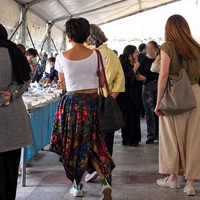


Just days earlier, authorities had affixed heavy metal seals to the doors of several cafes that had become popular gathering places for young people - 1401, Theory, Jo Cafe, Dobareh, Sam Cafe, Maan, and Nook. Now, even the physical footprint of these gathering spots was being erased.
The scene along Sanaei is not an isolated urban redevelopment project; it is the visible edge of an expanding domestic front. As the Islamic Republic navigates profound geopolitical vulnerability, military standoff, and international isolation, its security apparatus has turned inward with renewed vigor. The target is the physical fabric of daily life—the informal, everyday spaces where citizens meet, breathe, and quietly subvert official ideology.
The erasure of the 'Patogh'
In Iranian urban culture, the patogh - a hangout spot, whether a neighborhood coffee shop, a shaded bench, or a specific street corner- holds a special resonance. Central Tehran, with its historical universities, cultural venues, and tree-lined avenues, has long served as a sanctuary for students and young professionals seeking conversation away from state surveillance.
Cafes in this district do not merely sell coffee; they operate as vital breathing rooms in a pressure-cooker society. They are spaces where women routinely drop their headscarves, where independent acoustic music plays quietly, and where social networks form organically.
To the security state, these hubs represent something far more dangerous than simple rule-breaking: they are unmonitored incubator spaces for civil defiance.
By dismantling the planters and outdoor ledges where young people once congregated, the state is conducting a campaign of physical depatterning. The objective is simple: raise the friction of gathering, eliminate opportunities for unscripted human interaction, and force citizens back into the isolation of private homes.
From central cafes to northern bazaars
The systematic clearing of social life is not confined to central Tehran's bohemian quarters. In the northern district of Tajrish—a bustling commercial hub anchored by its traditional bazaar, the Imamzadeh Saleh shrine, and the thoroughfares leading toward the Saadabad Palace—a parallel push is underway.
Here, the crackdown targets street musicians, artisans, and informal vendors whose presence gives the district its distinctive kinetic energy.
"Plainclothes men carrying two-way radios came up to me last week while I was playing," a young handpan musician who performed near Tajrish Square told Iran International. "They told me bluntly: 'The time for these antics is over. There will be none of this in the streets anymore.'"
For many, performing or vending in Tajrish was not a lifestyle choice, but a last resort. Following the internet blackouts imposed during recent nationwide unrest, thousands of small online businesses, home-craft pages, and digital storefronts collapsed overnight. Young artisans, women-headed households, and unemployed graduates migrated to the pavements of Tajrish to sell handmade goods or play music for passing crowds.
Now, even that economic and social retreat is being shut down. Vendors near the shrine report periodic sweeps by security personnel and vigilantes ordering them to pack up their "sinful stalls" under threat of physical violence.
The asymmetry of public space
What makes this campaign so striking to Tehran residents is its stark selectivity.
While young people face sledgehammers and security sweeps for sitting on a sidewalk ledger or strumming a guitar, state-aligned groups enjoy unrestricted access to the city’s major arteries. For months, heavily subsidized groups have set up nightly ideological gatherings, loud ceremonial processions, and roadside stands with full logistical backing from the state.
This spatial double standard reveals the regime's broader urban philosophy: public space in Iran is not a shared civic commodity, but a state monopoly. The streets are permitted to be loud, crowded, and disruptive—provided that noise serves the government's narrative. The moment a street corner becomes a site for quiet civilian autonomy, it is treated as a security threat.
The historical pattern: Internal repression as external defense
This tightening grip on everyday life follows a familiar pattern in post-revolutionary Iran. Historically, whenever the Islamic Republic faces severe external threats or internal crises, its immediate response is to signal total domestic control.
The destruction of cafe seating and the silencing of street performers occur alongside a sharp escalation in judicial violence, including a surge in executions and political detentions. The message directed at society is unified across every medium: the state retains absolute authority over who walks the street, who speaks, and who lives.
Yet, despite the shattered concrete on Sanaei Street and the quieted plazas of Tajrish, Tehran's urban ecosystem remains stubbornly resilient. The urge to assemble, connect, and reclaim small fragments of normal life has repeatedly outlasted physical destruction—proving that while a government can tear up a sidewalk, controlling the social life that flows over it is a far more difficult task.
Iranians are increasingly borrowing money, delaying treatment and bargaining over medical bills as healthcare costs outpace household incomes, according to a new report by Eghtesad Online, while authorities say medicines and medical supplies are fully secured for Arbaeen, the annual pilgrimage commemorating the 40th day after the death of third Shiite imam.
The report describes a healthcare system where treatment increasingly begins not with a doctor's diagnosis but with offers to activate credit, pay in installments or use discount codes. From dental care and physiotherapy to psychotherapy, prescription drugs and online consultations, households are increasingly financing healthcare with future income.
"The issue is not just the growth of a few startups or advertisements by a few clinics; the issue is the shrinking liquidity of households, where a patient is forced to borrow from next month's income to pay for today's pain," the report said.
When treatment depends on payday
Conversations in doctors' offices, the report said, increasingly focus on affordability rather than treatment. Patients ask whether insurance will cover consultation fees or whether doctors can charge less, while physicians report seeing people who postpone laboratory tests, imaging scans and prescriptions after paying for the initial visit.
"Is this charged at the private rate? Doesn't insurance cover it? Can't you charge a little less?" are now common questions at reception desks, according to the report, which said patients bargain "not out of habit, but out of necessity."
Long-term treatment is particularly vulnerable. Patients stop physiotherapy midway, discontinue psychotherapy after only a few sessions or ration medication so it lasts longer, turning what the report called "a shortage of cash into a shortage of treatment."
Official figures for the current Iranian year have not yet been released, but the latest available data showed healthcare accounted for 8.7% of urban household spending and 9.8% of rural household spending in 2024.
Mental health becomes a luxury
Financial pressures are especially visible in mental healthcare, where patients increasingly align appointments with payday.
"Can I pay for this session at the end of the month?" is among the requests therapists now hear regularly, according to the report. Others ask, "My salary is deposited on the 10th. Can I pay for two sessions together?" or explain, "I can't come every week for now. I'll come twice a month."
The report said psychotherapy is intended to help people cope with anxiety, exhaustion and the pressures of daily life, yet "the cost of the session itself has become one of those anxieties." Social media users quoted in the report described calculating rent, loan payments, medicine and food costs before deciding whether they could afford therapy.
Dental care has become another symbol of the trend. Clinics increasingly advertise installment plans for implants, orthodontics and root canals, while online pharmacies and health platforms now offer credit for medicines and health-related products.
"Toothache does not wait for next month's paycheck," the report said, describing installment payments as both an opportunity to obtain treatment and a warning that essential healthcare costs are increasingly becoming future debt.
Officials warn of shortages
The financial pressures coincide with warnings from lawmakers about Iran's pharmaceutical sector.
Salman Es’haqi, spokesperson for parliament's Health and Treatment Committee, described medicine shortages as a "serious and critical" issue, citing sanctions, the recent war and disruptions to imports of pharmaceutical raw materials. He warned that unstable access to medicines could cost lives.
Other lawmakers have linked shortages to delays in foreign currency allocations and cash shortages affecting imports, while pharmacists have said weak oversight has allowed some medicines to be diverted from official distribution channels into the unofficial market.
Medical support for Arbaeen
Despite those concerns, officials have repeatedly emphasized that healthcare resources for Arbaeen will be fully available.
Jafar Miadfar, head of Iran's Emergency Organization, said authorities had no concerns about supplying medicines and intravenous fluids for pilgrims. He said around 300,000 units of intravenous fluids had been allocated and medicine stocks positioned at six border crossings ahead of the pilgrimage.
Earlier, Iranian Red Crescent chief Pirhossein Kolivand said medicines and medical equipment had been dispatched for Arbaeen and that five hospitals in Iraq along the Najaf-Karbala route would provide care for Iranian pilgrims.