• العربية
  • فارسی
BrandBrand
  • Iran Insight
  • Politics
  • Economy
  • Analysis
  • Special Report
  • Opinion
  • Podcast
  • Live TV
  • Iran Insight
  • Politics
  • Economy
  • Analysis
  • Special Report
  • Opinion
  • Podcast
  • Live TV
  • Theme
  • Language
    • العربية
    • فارسی
  • Iran Insight
  • Politics
  • Economy
  • Analysis
  • Special Report
  • Opinion
  • Podcast
  • Live TV
All rights reserved for Volant Media UK Limited
volant media logo
ANALYSIS

Iran looks to China and Russia for leverage in US talks

Behrouz Turani
Behrouz Turani

Iran International

Nov 4, 2026, 04:08 GMT+0
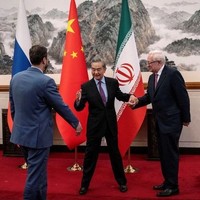
Chinese Foreign Minister Wang Yi welcomes Russian Deputy Foreign Minister Sergey Ryabkov and Iranian Deputy Foreign Minister Kazem Gharibabadi, before a meeting regarding the Iranian nuclear issue at Diaoyutai State Guest House on March 14, 2025, in Beijing, China. Pool via REUTERS

Iran has turned to Beijing and Moscow for backing in talks with Washington over the Strait of Hormuz. Mediators are weighing whether China could help guarantee that Washington delivers on sanctions relief in return for Iranian nuclear concessions.

Al Hadath reported on October 30 that mediators were considering a plan to match each Iranian nuclear concession with a US step to ease sanctions. The draft raised the possibility of China serving as a guarantor. Beijing’s account of its talks with an Iranian envoy on Monday gave no indication it had accepted that role.

The question has practical consequences for Tehran. In 2018, President Donald Trump withdrew the United States from the 2015 nuclear agreement and reimposed sanctions. Matching concessions step by step could limit how much Iran gives up before it sees an economic return. What China would do if Washington later restored sanctions remains unclear.

Beijing also has a stake in reopening Hormuz

Ali Bagheri Kani, deputy secretary of Iran’s Supreme National Security Council, told Chinese Foreign Minister Wang Yi in Beijing on Monday that Tehran wanted China to play a greater role in regional diplomacy. According to China’s foreign ministry, Wang backed Iran’s sovereignty and urged all sides to make concessions to avoid renewed fighting.

Wang’s separate meeting that day with Saudi national security adviser Musaed al-Aiban helps explain the limits of that backing. Wang stressed the need to protect energy supplies and shipping routes. China relies on oil shipped through Hormuz, giving it an interest in reopening the waterway even if Tehran would prefer to keep it closed until Washington meets its demands.

Beijing also announced plans to send its Middle East envoy, Zhai Jun, to Iran, Oman and Saudi Arabia. Oman’s Sultan Haitham bin Tariq welcomed a larger Chinese role during his own visit to Beijing. Qatar, meanwhile, continues to mediate between Tehran and Washington.

Where Moscow and Tehran agree

Mohsen Rezaei, who heads Iran’s Supreme National Security Council, spoke by phone with Russian President Vladimir Putin on Monday. The council said they discussed regional developments. Its public account gave no details of any agreement on the US naval blockade.

Putin said in October that he wanted shipping through Hormuz to resume and sanctions on Iran eventually lifted. Russia has also offered to take custody of Iran’s enriched uranium, giving Moscow a potential role if Tehran and Washington can agree on what happens to the stockpile.

For Tehran, the order of concessions matters. Rezaei said Tuesday that Washington must act on Iran’s seven conditions before the strait reopens. A senior Iranian official told Reuters the demands include oil sanctions waivers, an end to the naval blockade and the release of frozen funds. Moscow supports sanctions relief, but Putin has stopped short of endorsing Tehran’s demand that Washington move first.

Most Viewed

Arab states warn Iran of individual, collective retaliation over attacks - WSJ
1

Arab states warn Iran of individual, collective retaliation over attacks - WSJ

2

Israel denies pressing Trump for Iran strikes amid diplomatic push

3

Iran’s war threats now reach Europe, from Cyprus to Britain

4

Three Iran protesters face imminent execution after final family visits

5

Tehran denies Ghalibaf sidelined as Rezaei's role grows

Banner
Banner

Editors' Pick

  • Iran says US tone shifts but demands still block talks

    Iran says US tone shifts but demands still block talks

  • Halloween gathering in Tehran ends in arrests and police crackdown

    Halloween gathering in Tehran ends in arrests and police crackdown

  • Netanyahu or Eisenkot? Tehran sees little difference on war
    INSIGHT

    Netanyahu or Eisenkot? Tehran sees little difference on war

Banner
Banner
Banner
Banner

Spotlight

  • Iran looks to China and Russia for leverage in US talks
    ANALYSIS

    Iran looks to China and Russia for leverage in US talks

  • US can't end Iran war with symbolic Pickaxe strike, state TV commentators say

    US can't end Iran war with symbolic Pickaxe strike, state TV commentators say

  • Tehran’s factions weigh Doha talks as hardliners prepare the public for war

    Tehran’s factions weigh Doha talks as hardliners prepare the public for war

  • How far would Russia and China go to save the Islamic Republic?
    ANALYSIS

    How far would Russia and China go to save the Islamic Republic?

  • Qatar turns to US LNG to cushion Iran war losses

    Qatar turns to US LNG to cushion Iran war losses

  • Mohsen Rezaei’s negotiating calculus: someone else always pays the price
    ANALYSIS

    Mohsen Rezaei’s negotiating calculus: someone else always pays the price

  • Residents describe struggle to afford basic needs as Iran inflation hits 88.7%
    VOICES FROM IRAN

    Residents describe struggle to afford basic needs as Iran inflation hits 88.7%

•
•
•

More Stories

US can't end Iran war with symbolic Pickaxe strike, state TV commentators say

Nov 3, 2026, 22:13 GMT+0
•
Maryam Sinaiee
100%
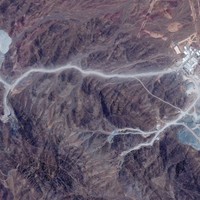
A satellite view shows tunnel entrances at Pickaxe Mountain, of the Natanz nuclear facility, near Natanz, Iran, June 30, 2026. Vantor Handout via REUTERS

Iranian commentators are questioning whether Donald Trump can end the conflict with a short military operation, arguing that the unresolved confrontation over Hormuz and the threat of economic retaliation could frustrate an attempt to strike Iran and declare victory.

Vahid Khazab, a regular commentator on the state television program Be Vaght-e Iran (Iran Time), argued Monday night that the circumstances that allowed the 12-day war to end no longer applied.

He recalled that Trump declared that conflict over after the United States struck Iran’s Fordow nuclear facility and Tehran retaliated against the Al Udeid air base in Qatar. This time, he said, a strike would leave the question of shipping through the Strait of Hormuz unresolved.

“Suppose he attacks Kuh-e Kolang (Pickaxe Mountain) and then says, ‘That’s it, it’s over.’ Well, what happens to the Strait of Hormuz?” Khazab asked.

“This means the war has not ended. That is why a symbolic move like the one during the 12-day war is not possible,” he added.

Khazab argued that Trump needed to end the conflict either through military action or an agreement, while portraying Iran as unwilling to make concessions in negotiations.

He urged Tehran to convey a warning that renewed attacks would provoke retaliation carrying lasting economic and political costs for Washington.

“Trump must understand this. It is very important that this message be conveyed to him — publicly, officially, secretly, in any way — that if you attack again, Iran will respond in a way that will seriously jeopardize the next two years of your future and America’s future, particularly by causing economic problems, including a recession,” he said.

“This would make him refrain from taking risks, including launching even a short war, regardless of the electoral outcome, in order to protect his legacy.”

Nima Akbarkhani, another regular panelist introduced on the program as a military expert, discussed the possibility of Trump staging a “major, spectacular Hollywood-style operation” to declare victory and end the war.

He argued that even such an operation would leave Trump in a difficult political position if Democrats won the midterm congressional elections.

Mehdi Abbasi, a guest introduced as a US affairs expert, speculated that a Democratic victory could prompt Trump to attack Iran during the roughly two months before the new Congress takes office in January.

Limited strikes and plans for further attacks

The discussion came amid limited US military action and reports of preparations for a potentially broader confrontation.

The United States struck Iran’s Qeshm Island on Monday as part of a series of limited attacks in recent weeks, The Wall Street Journal reported, citing US officials.

Trump said Tuesday that US forces had destroyed an Iranian anti-aircraft installation that he said had taken about two months to build.

The New York Times separately reported Tuesday, citing US officials, that US Central Command had a plan to begin strikes against Iran as early as Wednesday, after the midterm elections. The reported plan did not establish that Trump had ordered an attack.

Responding to the Qeshm strike, Deputy Foreign Minister Kazem Gharibabadi said Tuesday that Iran remained in a state of war and retained the right to defend itself until military aggression against it had ended completely and permanently.

Russian Foreign Ministry spokeswoman Maria Zakharova said Monday that reports of plans for further military action against Iran were deeply concerning and urged renewed diplomatic efforts.

Tehran holds to its demands

Tehran and Washington continue to exchange messages through intermediaries, including Qatar. Trump and Vice President JD Vance have expressed optimism about diplomacy, while Iranian officials insist Washington must meet Tehran’s conditions.

Mohsen Rezaei, secretary of Iran’s Supreme National Security Council, said Tuesday that Washington’s response to Tehran’s demands was unconvincing. He said the Strait of Hormuz would reopen only after the United States explicitly addressed and implemented Iran’s seven conditions.

Vance sent Rezaei a letter through Qatar several days earlier. Rezaei did not specify whether his Tuesday remarks referred to that letter or another message conveyed through intermediaries.

Parliament Speaker and chief negotiator Mohammad-Bagher Ghalibaf also warned Tuesday that Tehran’s response to a possible US attack would be unpredictable.

President Masoud Pezeshkian, meanwhile, reiterated that Supreme Leader Mojtaba Khamenei had granted his government additional powers to pursue negotiations.

Pezeshkian said his administration would seek to resolve the conflict through diplomacy but did not specify the scope of that authority.

His emphasis on negotiations drew criticism from hardline commentator and university professor Foad Izadi, who argued that such statements could help Washington choose the timing of another attack.

In a post responding to Pezeshkian, Izadi cited Trump’s remarks that oil prices were falling because people believed there would be no war with Iran and that Tehran wanted an agreement quickly.

Izadi accused Pezeshkian of helping Trump lower public expectations of war and manage oil prices by repeatedly emphasizing negotiations. He warned that Washington could attack again in the middle of diplomatic exchanges, at a time of its own choosing.

Speculation over nuclear weapons

Some Iranian commentary has also raised the possibility of nuclear weapons being used in a renewed confrontation, although Gharibabadi said Tuesday that Washington had not announced an official position on using such weapons against Iran.

Hossein Ajorlou, an international relations academic, told Fararu that a broad but short operation using powerful conventional weapons remained the most likely scenario.

He nevertheless speculated that Washington could consider tactical nuclear weapons if it failed to secure a quick result and reached a military stalemate.

Ajorlou emphasized that he considered conventional weapons, including bunker-busting bombs and precision-guided munitions, the likelier option.

Limits of a change in Congress

Several Iranian commentators have cautioned that a shift toward Democrats in Congress would not necessarily prevent another military confrontation.

Ali Hassan Heydari, an international affairs analyst writing for the hardline Siraj24 website, argued that victory for either party should not be interpreted as a fundamental change in Washington’s strategic approach.

A Democratic victory could nevertheless raise the political and financial costs of continuing the war and restrict Trump’s freedom of action, he wrote.

“This matters for Iran’s calculations, but it should not lead to a strategic miscalculation, because the outcome of the war and the question of the Strait of Hormuz will not be determined solely by the composition of Congress,” Heydari wrote.

“The elections may change the rules of Trump’s game, but resolving the confrontation with Iran requires decisions and agreements that go beyond the US ballot box.”

Amirali Abolfath, a US affairs expert, similarly cautioned against expecting a change in congressional control to end the conflict.

“We should not place too much hope in the idea that a change in the composition of Congress alone will bring the war to a halt, although these changes are not without effect and should not be viewed in absolute, black-and-white terms,” he told ISNA.

Tehran’s factions weigh Doha talks as hardliners prepare the public for war

Nov 3, 2026, 13:45 GMT+0
•
Behrouz Turani
100%
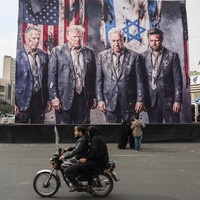
A mural in Tehran showing US President Donald Trump, Israeli Prime Minister Benjamin Netanyahu, US Vice President JD Vance and US envoy Steve Witkoff.

Tehran’s newspapers agree across factions that negotiating with the United States is legitimate, but are deeply divided over whether diplomacy can still prevent war, as Qatar said on Tuesday that both sides were reviewing its proposals.

While reformist and moderate newspapers, including Etemad, Shargh and Arman Melli, explore ways to reach an agreement, hardline outlets such as Hamshahri and Kayhan appear to be preparing the public for conflict.

Iranian negotiators left Doha on Sunday after three days of talks with Qatari mediators, and a Qatari team traveled to Tehran on Monday night before returning to Doha.

“Both parties are reviewing suggestions we as mediators proposed,” Qatar’s Foreign Ministry spokesperson said on Tuesday, adding that differences remained but talks were continuing. A senior Iranian official told Reuters the same day that Tehran and Washington were still far from a deal, and that Iran would not accept what he called Washington’s “excessive demands.”

Tehran says negotiations should be based on its seven-step September plan to reopen the Strait of Hormuz and end the US naval blockade, on a faster timetable proposed by Qatar. Foreign Minister Abbas Araghchi has suggested reopening the strait within two days of an agreement, leaving nuclear issues for a second phase.

President Donald Trump has said there will be no further strikes before Tuesday’s midterm elections, but has not ruled out military action afterward. Secretary of State Marco Rubio says no decision has been made. US allies in the Persian Gulf have reportedly been told to prepare for possible strikes after November 4. Supreme Leader Mojtaba Khamenei has ordered Iran’s armed forces to prepare for war across an extended front.

  • Tehran denies Ghalibaf sidelined as Rezaei's role grows

    Tehran denies Ghalibaf sidelined as Rezaei's role grows

The immediate focus in Tehran is a letter from US Vice President JD Vance to Mohsen Rezaei, secretary of the Supreme National Security Council. After a week of confusion over who was leading negotiations, Foreign Ministry spokesman Esmail Baghaei said on Monday that Parliament Speaker Mohammad Bagher Ghalibaf remained in charge, but that Rezaei would answer Vance because the letter had been sent to him. Ghalibaf has not spoken publicly about a nuclear agreement for weeks.

Agreement on talks, not on terms

In a report headlined “We Must Negotiate,” the reformist daily Etemad set out three positions. Hossein Nourani-Nejad, deputy head of the reformist Ettehad-e Mellat party, described Iran’s choices as surrender, warmongering or de-escalation. He backed President Masoud Pezeshkian’s “smart management of hostility” and criticized hardliners and the state broadcaster for raising the idea of withdrawing from the Nuclear Non-Proliferation Treaty.

Asadollah Badamchian, a conservative politician of the Motalefeh party, argued that negotiation was a tool, not a principle, and was acceptable if it served national interests. He read Vance’s letter as evidence that Washington’s pressure strategy had failed, but warned against “naive optimism.” The final decision, he said, rested with the Supreme National Security Council and the Supreme Leader.

Ali Sufi, a reformist politician, was more hopeful. He identified five elements in Vance’s letter, including direct talks, lifting the blockade and reopening Hormuz, and argued that Iran was approaching a turning point, with both the Supreme Leader and Rezaei calling for an end to “neither war nor peace.” Including the nuclear issue could complicate negotiations, he cautioned, but would probably be unavoidable.

Hardline newspapers largely ignored the letter. Kayhan read his latest orders to military commanders as ending America’s ability to launch limited strikes and then withdraw. It dismissed US threats as psychological warfare, insisting Iran did not seek war but did not fear it.

Javan, a daily close to the Revolutionary Guards, called the threats a “psychological bombardment of the negotiating table” and said Tehran had rejected Qatar’s five-day confidence-building proposal.

The reformist outlet Eslahat News quoted lawmaker Fada-Hossein Maleki, who called the decision to send the letter to Rezaei a US conspiracy to divide Iranian officials.

‘War is certain’

Heshmatollah Falahatpisheh, a former chairman of parliament’s National Security and Foreign Policy Committee, offered a darker assessment in Shargh. Intensive Qatari mediation, he argued, reflected alarm rather than progress: the mediators had, he said, glimpsed both sides’ plans for a new war.

He described Vance’s approach as Trump’s attempt to secure a diplomatic success before the election, but said Washington’s proposed concessions were too limited to overcome mistrust. Pointing to military deployments, he declared war “certain.”

The only way out, Falahatpisheh said, was a regional agreement involving the United States and guaranteed by China. Russia, he argued, sees the region through the prism of the Ukraine war and is a spoiler rather than a credible guarantor.

  • How far would Russia and China go to save the Islamic Republic?

    How far would Russia and China go to save the Islamic Republic?

China has around $480 billion in economic ties with the region, imports six to eight million barrels of Persian Gulf oil a day and has major investments in Qatar’s side of the gas field it shares with Iran. Falahatpisheh argued that rivalry with Washington gave Beijing both the interest and the influence to guarantee an agreement, despite suggestions that China might prefer to keep America occupied in the Middle East rather than focused on Taiwan.

Iranian observers have often argued that China puts its own interests ahead of Iran’s. Javan reported that a Chinese special envoy would visit Iran and the region soon, and cited a joint call by China and Oman for a return to the Islamabad memorandum.

The economic cost

In Arman Melli, the economist Mahmoud Jamsaz warned that Tehran was misreading Washington. Officials who assume America’s economic problems leave Trump no choice but to accept Iran’s conditions, he said, risk wasting the mediators’ last opportunity. Trump might instead decide that war is preferable to the status quo.

During the closure of Hormuz, Jamsaz noted, China drew on its strategic reserves and cut imports, countering forecasts of oil at $200 to $300 a barrel and weakening Iran’s leverage.

A prolonged confrontation, he warned, would bring foreign-currency shortages, a falling rial, runaway inflation and the destruction of the middle class, weakening society’s ability to withstand the crisis. Iran’s distorted state capitalism, he argued, fails the test of a “resistance economy”; budget deficits and the misery index show little economic resilience.

Neither war, a prolonged frozen conflict nor a Korean-style armistice serves Iran’s national interests, Jamsaz concluded. Only negotiations aimed at ending the confrontation offer a way forward.

How far would Russia and China go to save the Islamic Republic?

Nov 3, 2026, 10:15 GMT+0
•
Negar Mojtahedi
100%
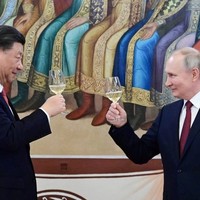
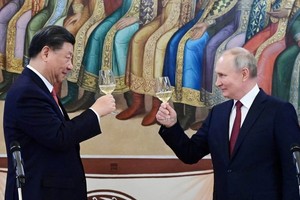
Russian President Vladimir Putin and Chinese President Xi Jinping attend a reception at the Kremlin in Moscow, Russia March 21, 2023.

Putin’s rare call to Iran’s security chief and a state TV commentator’s account of Chinese preparations for the Islamic Republic’s possible collapse raise a question about Tehran’s most powerful partners: how far would Moscow and Beijing go to ensure its survival?

Iranian state media said Putin’s conversation with Mohsen Rezaei, secretary of the Supreme National Security Council, covered regional developments and continued strategic cooperation. No new military commitments were announced.

The call came days after the Wall Street Journal reported that US Vice President JD Vance had reached out to Rezaei to revive negotiations, which may explain why Putin wanted to speak to him directly.

Two days earlier, on Saturday, Rouhollah Amin Saeedi, a political analyst, told viewers of Iran’s state broadcaster that Chinese officials had believed the Islamic Republic was close to collapse during the January protests, and that diplomats at China’s embassy in Tehran had prepared for that possibility. Neither China nor Russia wants Iran to have nuclear weapons, he added.

China buys most of the oil Iran sells abroad and signed a 25-year cooperation agreement with Tehran in 2021. Moscow’s ties run through security, and through Rezaei.

Why Putin called Rezaei

The protocol was unusual. Putin normally speaks to presidents, not security chiefs. Alex Vatanka, a senior fellow at the Middle East Institute, said the call could reflect Rezaei’s growing weight in Iran’s leadership, including his rivalry with Parliament Speaker Mohammad Bagher Ghalibaf over who handles talks with Washington.

  • Tehran denies Ghalibaf sidelined as Rezaei's role grows

    Tehran denies Ghalibaf sidelined as Rezaei's role grows

Tanya Lukyanova, an associate producer at CBS’s 60 Minutes who covers Russia, suggested that Putin may see Rezaei, with his reported line to the Trump administration, as useful in his own negotiations over ending the war in Ukraine on Moscow’s terms.

The two countries have traded heavily in war. Iran supplied Russia with drones and the technology to build them for use in Ukraine; Moscow has been reported to give Tehran intelligence and military help in its war with the United States.

But Vatanka cautioned against reading the call as a promise of more. Moscow will help Tehran, he said, as long as it does not risk a direct confrontation with the United States.

A nuclear Iran or no Islamic Republic

The conventional wisdom is that Russia and China do not want Iran to have a bomb. Vatanka said that may no longer hold.

“That’s the conventional wisdom that they don’t want Iran to become a nuclear weapon state,” he told Iran International. Moscow’s confrontation with Washington has changed the calculation.

“If they had to choose between an Islamic Republic that’s nuclear armed versus an Islamic Republic gone and replaced with a pro-US, pro-Western entity, they’d rather have this regime with a nuclear weapon,” he said.

Ilan Berman, senior vice president of the American Foreign Policy Council, said the Kremlin benefits from leaving the nuclear question unresolved. An Islamic Republic that keeps challenging Washington and the region pulls American attention and weapons away from Ukraine, which serves Moscow without Iran having to cross the threshold.

Russia’s growing role

The call followed Russian Foreign Minister Sergei Lavrov’s visit to Tehran this month and President Masoud Pezeshkian’s meeting with Putin in Moscow.

In an analysis published on Monday by Chatham House, Aniseh Bassiri Tabrizi argued that the war has changed how Tehran sees Russia. Once regarded by some Iranian officials as an unreliable partner, Moscow is now seen as essential to Iran’s military survival, its reconstruction and its future deterrence.

Russia has been reported to supply satellite imagery, targeting intelligence and military components, and its expertise could help Iran rebuild its air defenses and missile sites.

Berman also pointed to reports that Russian intelligence has helped the Houthis in their attacks on Saudi targets, as a sign that Moscow is willing to support Tehran’s allies too.

That help comes at a price. In an analysis published on Sunday in Lawfare, Carol R. Saivetz of MIT and Kimberly Marten of Barnard College argued that Moscow has gained from higher oil prices and from American air defenses being diverted from Ukraine, but that backing Tehran puts its relations with Saudi Arabia and other Persian Gulf states at risk. They described the partnership as one built on wartime advantage, not lasting trust or binding commitments.

Support without guarantees

None of this means Moscow would rescue Tehran if it faced collapse.

Saivetz and Marten identified several developments that could lead Putin to cut his support: a deal that reopens the Strait of Hormuz, an Iranian military or economic collapse, or a ceasefire in Ukraine on terms he likes. Bassiri Tabrizi argued, by contrast, that Russian military cooperation could become a lasting part of Iran’s security as it rebuilds.

On Monday Moscow again stressed diplomacy, with Foreign Ministry spokeswoman Maria Zakharova calling for greater efforts to end the conflict.

The picture is lopsided. The Islamic Republic increasingly depends on Russia for its security; Russia keeps the freedom to decide how much support serves its own interests. And by the account of a commentator on Iran’s own state television, China was already planning for the day it would no longer be there.

Putin may prefer the Islamic Republic to survive, and may profit from its confrontation with Washington. Preserving it at any cost is a different calculation.

Iran’s war threats now reach Europe, from Cyprus to Britain

Nov 3, 2026, 09:56 GMT+0
100%
Missiles are displayed beside a large portrait of Iran's Supreme Leader Mojtaba Khamenei and images of military figures on a street in Tehran, Iran.

Iranian military officials and hardline lawmakers have warned that a new confrontation with the United States could extend beyond the Middle East, while conservative media have begun identifying American military facilities in Europe as potential targets.

The warnings follow a statement attributed to Supreme Leader Mojtaba Khamenei on Saturday, ordering Iran's armed forces to prepare for retaliation without geographic restrictions and expand their list of potential US and Israeli targets.

The hardline daily Kayhan went further, arguing that American and NATO facilities "in the heart of Europe" could be targeted if US and Israeli attacks on Iran resume.

The newspaper named military facilities in Cyprus, Greece, Romania, Albania, Italy and Britain, as well as the joint US-British base on Diego Garcia in the Indian Ocean.

Military commanders signal broader reach

Iran's Army spokesman, Mohammad Akraminia, said renewed fighting could spread beyond the countries and territories involved in previous rounds of the war.

"In the recent war, the conflict extended from the occupied territories to US bases in regional countries, but if another attack takes place, the geography of the war could expand beyond West Asia," he said.

  • Netanyahu pressing Trump to strike Iran immediately after midterms - Axios

    Netanyahu pressing Trump to strike Iran immediately after midterms - Axios

  • Iran sends conflicting signals on US deal as Trump raises prospect of strikes

    Iran sends conflicting signals on US deal as Trump raises prospect of strikes

  • Netanyahu or not, the next move on Iran may be Trump's

    Netanyahu or not, the next move on Iran may be Trump's

He added that Iran was updating its list of potential US and Israeli targets.

A senior Basij commander, Ghassem Ghorayshi, also said Iran's armed forces would no longer be bound by previous limits on missile range, target selection or the scale of operations.

"In the past, target selection and missile ranges were restricted," he said, attributing those limits to decisions made under former Supreme Leader Ali Khamenei.

"From now on, the armed forces will have no restrictions on striking targets, determining missile range or the scale of missile operations," he added.

The remarks do not by themselves establish that Iran has developed new long-range missiles or formally changed its military doctrine.

Iranian newspapers identify European bases

A separate report in the newspaper Hamshahri also raised the possibility of targeting American military infrastructure in Europe, including air bases, logistics centers and support facilities.

The newspaper cited speculation that Iranian missiles could reach targets 4,000 to 5,000 kilometers away, significantly beyond the roughly 2,000-kilometer range Iran previously described as a self-imposed limit.

However, those longer-range estimates remain disputed, and the ability to extend a missile's theoretical range does not necessarily establish its accuracy, payload or operational effectiveness.

The reports reflect a broader shift in Iranian rhetoric toward threatening American military infrastructure outside the Middle East.

Western defense experts have offered more cautious assessments of Iran's long-range strike capabilities. The Washington-based Center for Strategic and International Studies lists Iran's principal ballistic missiles with ranges generally around 2,000 kilometers, with some variants potentially reaching 3,000 kilometers.

Britain’s Royal United Services Institute has said strikes as far as the UK may be theoretically possible, but would involve smaller, less accurate warheads traveling through defended airspace.

  • Arab states warn Iran of individual, collective retaliation over attacks - WSJ

    Arab states warn Iran of individual, collective retaliation over attacks - WSJ

  • Iran’s nuclear bomb debate gains ground on official platforms

    Iran’s nuclear bomb debate gains ground on official platforms

  • Iran rejects nuclear talks despite ongoing mediation with US

    Iran rejects nuclear talks despite ongoing mediation with US

Lawmakers warn of wider conflict

Hassan Ghashghavi, spokesperson for parliament's National Security and Foreign Policy Committee, warned that renewed fighting could spread far beyond the countries already affected by the war.

"I don't want to use the term World War III, but the geography of the war would be almost on the scale of World War III," he told Iranian media.

He said another conflict would be considerably wider than the previous 12-day and 40-day rounds of fighting.

Ghashghavi also suggested that Iranian retaliation could affect civilian infrastructure and everyday life in countries involved in attacks on Iran.

"If they leave your people in darkness, you should leave their people in darkness too," he said.

In another warning, Tehran lawmaker Kamran Ghazanfari said Iran could retaliate against US assets in Europe and potentially on American territory if Washington used military bases in Arab states to attack Iran.

Ghazanfari also speculated that Iran might already possess nuclear weapons, without providing evidence. Tehran has not officially announced that it possesses a nuclear weapon.

Tehran links warnings to negotiating demands

The military warnings have come alongside renewed Iranian demands in negotiations aimed at ending the war.

Parliament Speaker Mohammad Bagher Ghalibaf said Tehran had delivered a "firm and rational response" to Washington and that "the ball is now in America's court" to prevent renewed fighting.

Iran's armed forces chief, Ali Abdollahi, separately outlined five conditions for lasting regional security: an end to fighting on all fronts, particularly in Lebanon and Gaza; the lifting of sanctions and release of frozen assets; war reparations; recognition of Iranian authority over the Strait of Hormuz; and guarantees against renewed attacks under a new regional security framework.

The demands come amid diplomatic efforts involving Qatar and other mediators, although a senior Iranian official told Reuters on Tuesday that Tehran and Washington remained far from an agreement.

Arab states warn Iran of individual, collective retaliation over attacks - WSJ

Nov 3, 2026, 00:21 GMT+0
100%
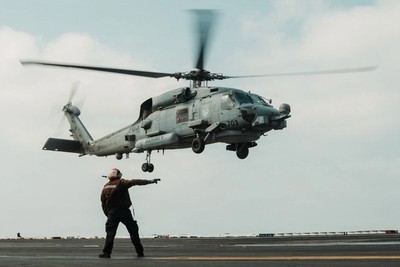
A US Navy MH-60R Sea Hawk takes off from the flight deck of the USS George Washington as the aircraft carrier supports enforcement of the US blockade against Iran, October 31, 2026. (CENTCOM/X)

Some Arab states have warned Iran that they could retaliate individually or collectively if Tehran targets their infrastructure, as Persian Gulf countries prepare for the possibility of renewed US strikes and Iranian retaliation, the Wall Street Journal reported Monday.

Qatar and the United Arab Emirates have been conducting security drills, including at airports, while some attendees at a major energy conference in Abu Dhabi were cutting short their stays on government advice. Schools in Riyadh were also set to remain online this week as Saudi Arabia faces attacks by the Iran-backed Houthis. UAE presidential adviser Anwar Gargash said his country hoped diplomatic efforts would succeed but was “braced for the worst.”

The warnings come against a backdrop of continuing attacks around the Strait of Hormuz. A tanker was struck by two unidentified projectiles near a Saudi port late Sunday, while another vessel was hit by an unidentified projectile off Oman early Monday. Iranian state media also reported Monday that an oil tanker caught fire after striking a mine in the eastern part of the strait.

The heightened preparations coincide with diplomatic efforts to prevent renewed fighting. Iranian negotiators left Doha on Sunday, with a draft proposal still circulating for feedback and a follow-up meeting possible. An Iranian source cited by the IRGC-affiliated Fars news agency said Monday that indirect communications with Washington had produced no diplomatic breakthrough and that Tehran continued to insist on its seven conditions. A third Qatari delegation in a week was heading to Tehran on Monday as Doha sought to bring Tehran and Washington closer to an agreement to end the war, Al-Araby Al-Jadeed reported, citing an informed Iranian source.

Axios reported that Qatari mediators had drafted an agreement outlining a three-day sequence of confidence-building measures aimed at resuming direct US-Iran negotiations. Trump told Axios he was “in no rush” to decide whether to resume fighting with Iran, saying: “One way or the other, we will do something, but there is no rush.”
The diplomatic push has also exposed differing views within the Trump administration over how to proceed. CIA Director John Ratcliffe, Treasury Secretary Scott Bessent and Secretary of State Marco Rubio favor maintaining economic pressure without either a new war or a deal, while Vice President JD Vance and White House envoy Steve Witkoff are urging Trump to move toward an agreement, Axios reported.

Vance said Monday that Washington had made “some progress” toward a negotiated settlement. “The President and I both feel pretty good about the prospects for potentially coming to a negotiated settlement,” Vance said, adding: “We've certainly made some progress. We'll see if we can make some more.”

Despite those signs of progress, the possibility of renewed US military action remains. The Journal reported that Trump has been leaning toward a large attack on Iran after the US midterm election but has not decided whether to proceed. Trump told Israeli Prime Minister Benjamin Netanyahu in a call Saturday that he wanted to first give continuing diplomatic efforts a chance to succeed, according to people familiar with the call.